
Local SEO for Home Services: The Complete Playbook
Master local SEO for home services with this proven playbook. Get actionable steps for Google Business Profile, reviews, service-area pages, and AI visibility.

Proximity drives roughly half of local ranking influence for home services, so city-specific relevance and precise service areas matter more than generic on-page tweaks. Google's local ranking model centers on relevance, distance, and prominence, and distance can account for about 48% of Google Business Profile ranking influence overall. Google's local results guidance and the available local ranking analysis point to the same practical conclusion: a business must be visible where its crews work, not merely somewhere in the wider metro area.
That changes how a cleaning, tile installation, or post-construction cleanup company should approach search. The objective isn't to rank everywhere. It's to become the obvious, trustworthy option in the towns and neighborhoods where customers need service and the business can respond quickly.
Table of Contents
- Why one Massachusetts strategy won't fit every town
- Start with service routes, then build search coverage
- Set the identity before adding details
- Turn services into clear entries
- Use evidence, not stock imagery
- Build pages around real combinations
- Use proof that belongs to the location
- Handle surrounding towns without creating thin pages
- Prioritize useful local references
- Use schema to clarify, not decorate
- Reinforce every city-service page
- Write answer blocks that stand alone
- Connect urgent intent to a booking path
- Measure visibility beyond clicks
Why Local Visibility Matters More Than Ever for Home Services
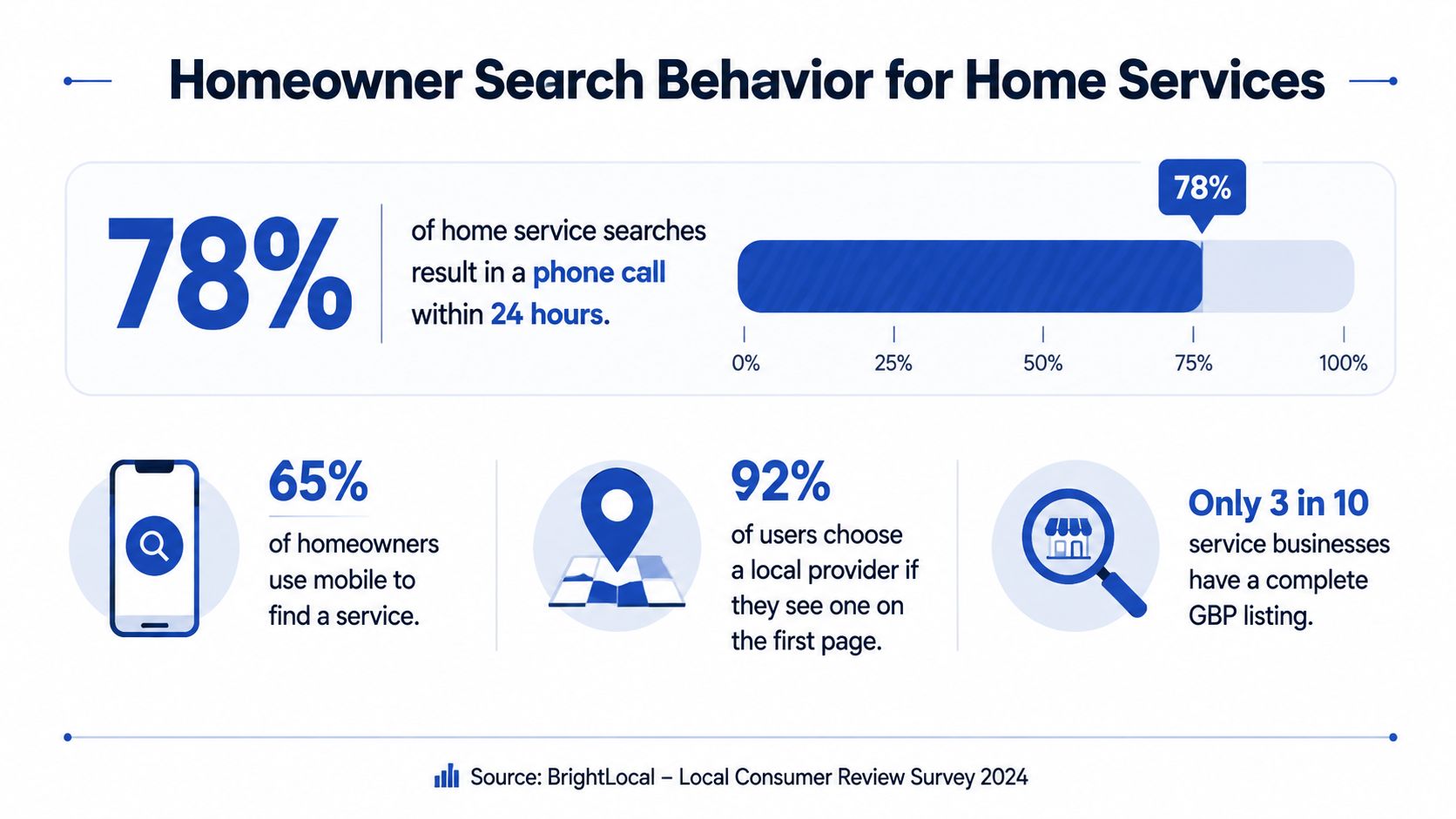
For nearby service businesses, local search is often the shortest path between a problem and a phone call. Google found that 4 in 5 consumers use search engines to find local information, and 50% of smartphone users who conduct a local search visit a store within a day, compared with 34% of users searching on a computer or tablet. Google's local search behavior research supports a simple operational rule: mobile visibility and fast response matter because homeowners frequently search when they're already close to making a decision.
The same research found stronger purchase intent for local queries. 18% of local smartphone searches led to a purchase within a day, compared with 7% for non-local searches. That pattern fits home services particularly well. Someone searching for a cleaner before a move, a tile installer during a remodel, or post-construction cleanup after contractors leave usually isn't browsing for general education. They're trying to identify a qualified provider.
Practical rule: Optimize for the town where the next job should come from, not an abstract metro-wide ranking.
Why one Massachusetts strategy won't fit every town
A company serving Wayland, Newton, Needham, Wellesley, and Weston shouldn't expect one generic service page or one broad map position to perform evenly across all five towns. Proximity changes what people see, and local relevance changes which business Google considers a close match. A cleaning page with evidence from Wayland may be useful there but provide little local proof for a tile installation search in Newton.
Google says local results are mainly based on relevance, distance, and prominence. Relevance reflects how well the profile matches the search, distance reflects the searcher's relationship to the business or service area, and prominence reflects how established and trusted the business appears across the web. Google's explanation of local ranking makes clear why broad national SEO tactics rarely solve a suburban home-services problem.
Start with service routes, then build search coverage
List the towns where the company has real operational capacity. Group them by priority, service type, and travel practicality. Then create local assets that support those routes:
- Cleaning demand: Deep cleaning, recurring housekeeping, move-in and move-out cleaning, and post-construction cleanup should have clear service language.
- Installation demand: Tile pages should distinguish porcelain, ceramic, marble, granite, backsplashes, bathrooms, kitchens, and full-room remodels.
- Urgent demand: Fast response, scheduling clarity, and booking access should appear where the customer is likely to act immediately.
A useful supporting resource is this guide to deep cleaning services near me, which reflects the kind of service-specific, local-intent content homeowners use when they're ready to compare providers.
Building a Google Business Profile That Actually Ranks
A Google Business Profile is the first local asset to fix because it controls how a business appears in Maps, local results, calls, directions, photos, services, and reviews. It can't overcome every proximity limitation, but an incomplete or confused profile makes relevance harder for Google to determine.
Set the identity before adding details
Start with the primary category. Choose the category that best represents the company's principal revenue-driving service, not every service it happens to offer. A mixed-service business can use relevant secondary categories, but category stacking creates a muddled identity when the profile tries to present cleaning and tile installation as equal answers to every query.
Then complete the core business information:
- Business name: Use the name customers know, without adding cities or keyword phrases.
- Address or service-area setup: A service-area business should represent its operating model accurately. Don't publish a customer-facing address merely to appear closer to a town.
- Service areas: Add only communities the team serves and can support consistently.
- Hours: Keep regular hours, holiday hours, and appointment expectations current.
- Phone and website: Use the number customers answer and a landing page that confirms the profile's services.
Google's local model rewards relevance, distance, and prominence, so these fields work together rather than independently. A profile that says “cleaning company,” a website that emphasizes tile installation, and reviews that mention only general maintenance send weaker signals than a consistent service narrative.
Turn services into clear entries
Add each meaningful service as a discrete GBP service entry. For cleaning, that could include recurring house cleaning, deep cleaning, move-in and move-out cleaning, and post-construction cleanup. For tile, separate installation from backsplashes, bathroom tile, kitchen tile, and material-specific work where those distinctions reflect the actual offering.
Each entry should explain the customer problem, the work performed, and any useful price indicator if the business chooses to publish one. Avoid turning descriptions into keyword lists. Google needs clarity, while homeowners need enough detail to decide whether to call.
Use evidence, not stock imagery
Upload authentic project photos regularly. Before-and-after cleaning photos, grout and tile details, finished backsplashes, protective preparation, and completed rooms help customers evaluate workmanship before contacting the business. Name files descriptively before upload, write accurate captions where available, and avoid claiming a town unless the project occurred there.
Use the Q&A area proactively. Add useful questions customers commonly ask, then answer them in plain language. Examples include whether the company handles post-construction dust, what materials it installs, whether estimates are available, and how scheduling works. The answers should reduce friction, not repeat sales slogans.
Creating Service-Area and City Pages That Win by Town
A single “service areas” page rarely gives Google enough detail to match every service with every town. A better structure separates what the business does from where it does it, then connects the two through useful internal links and local proof.
Create a dedicated page for each priority town, beginning with the communities that align with actual routes and profitable demand. For each town, explain the relevant services, the types of homes or projects commonly served, scheduling considerations, and the evidence that makes the coverage believable. Don't swap city names into a fixed template. That produces pages that look interchangeable to customers and search engines.
Build pages around real combinations
A city page can introduce the full local offering, but service-specific pages should handle distinct search intent. For example:
- Wayland cleaning page: Focus on recurring housekeeping, deep cleaning, move-related service, and the practical needs of busy households.
- Newton tile page: Emphasize kitchen backsplashes, bathroom surfaces, remodel coordination, and material selection.
- Wellesley post-construction page: Address fine dust, construction residue, final-detail cleaning, and handoff readiness.
A page about house cleaning in Newton should not compete with a Newton tile page. Each page needs a distinct purpose, title, heading structure, service vocabulary, calls to action, and supporting links.
Use proof that belongs to the location
Local relevance needs more than a town name. Add authentic project photos, customer reviews that naturally identify the service and town, nearby neighborhood references, and practical service details. Don't fabricate local experience or imply a project occurred in a community where it didn't.
The following matrix helps decide what belongs on each page:
| Town | Priority Services | Proof Elements | Internal Links |
|---|---|---|---|
| Wayland | Deep cleaning, recurring cleaning, move-in and move-out cleaning | Cleaning project photos, relevant reviews, scheduling details | Deep cleaning, recurring cleaning, quote page |
| Newton | House cleaning, tile installation, backsplashes | Room photos, material examples, service-specific reviews | House cleaning, tile installation, bathroom projects |
| Needham | Residential cleaning, remodeling support | Local project evidence and service explanations | Cleaning services, tile services, contact page |
| Wellesley | Post-construction cleanup, detailed residential cleaning | Before-and-after images, contractor-facing process details | Post-construction cleanup, deep cleaning, estimate page |
| Weston | Premium residential cleaning, tile and flooring installation | Finished-room photography, relevant testimonials, clear workmanship details | Cleaning, tile installation, project gallery |
Handle surrounding towns without creating thin pages
Smaller communities can sit beneath a primary town hub when they share routes and customer intent. Link from the main town page to relevant service pages, then link those service pages back to the strongest local hubs. Only create a separate page when the business can provide unique content and genuine local evidence.
This hub-and-spoke model avoids two common failures. The first is a single page trying to rank for every town and service. The second is a large collection of nearly identical pages that add URLs without adding useful information.
Running a Review Strategy Built for Recency and Relevance
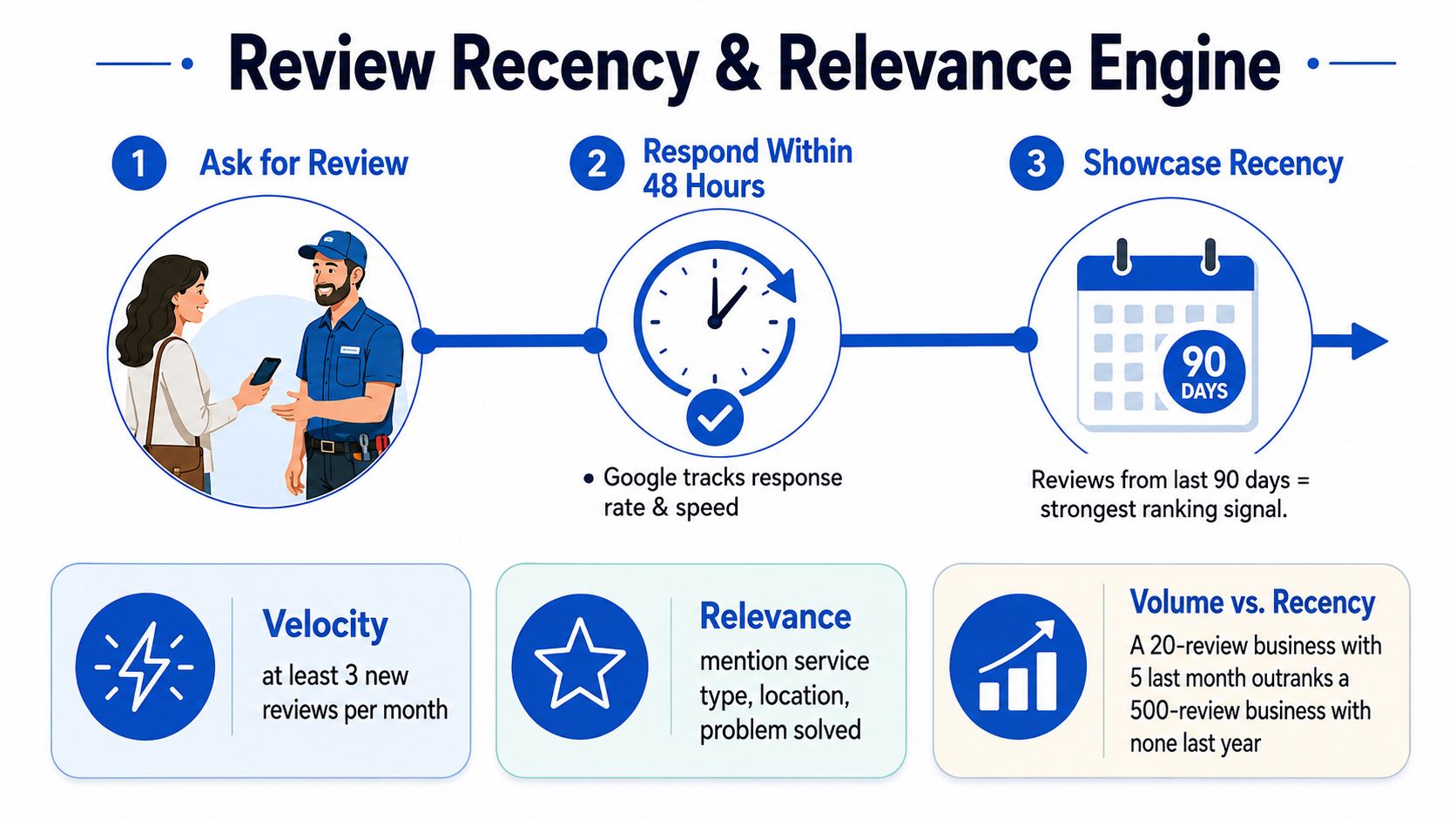
Reviews influence both trust and local relevance. One dataset found that top-three local ranking rates increased from 39.3% for businesses with 1 to 5 reviews to 73.0% for businesses with 201 to 500 reviews, while another analysis attributed about 11% of ranking influence to review keywords and 8% to review count. The local ranking factor analysis shows why review strategy shouldn't focus only on star ratings or a single volume milestone.
The best workflow begins when the job ends, not weeks later. Send a convenient request shortly after completion, make the review link easy to use, and invite the customer to describe the service and location naturally. Don't dictate wording or offer incentives that could compromise authenticity.
Ask at the moment the work is fresh
A practical request can mention the completed service without scripting the customer's response:
- After cleaning: Ask whether the customer would describe the deep cleaning, recurring service, or move-related work.
- After tile installation: Invite feedback about the material selection, installation process, or finished room.
- After post-construction cleanup: Ask whether the final cleanup helped prepare the property for occupancy or handoff.
Track review activity by service line and town, rather than averaging every review together. A profile may have a healthy overall reputation while lacking recent evidence for tile installation in Newton or post-construction cleanup in Wellesley.
Review quality matters twice: Customers read the words for confidence, while Google can use service and location language to better understand relevance.
Respond to every review with a specific, professional reply. Mention the work performed naturally, thank the customer, and address any concern without arguing. A response to a tile review should not sound like a generic cleaning reply. That distinction reinforces the business's mixed-service structure.
Prefer a steady workflow over review bursts
Recent local-search coverage increasingly emphasizes freshness and velocity, but the available guidance doesn't establish a universal review target for every business. The operational answer is consistency. Request feedback after eligible jobs, monitor the flow weekly, and investigate gaps by technician, service type, and town.
One home-services study reported that 54.9% of clicks came from branded searches even though branded queries represented 8.1% of impressions, reinforcing the importance of making the business easy to find and trust when customers search by name. The cited local ranking analysis provides useful context for measuring branded and non-branded visibility separately.
Strengthening Your Foundation With Citations, Schema, and On-Page SEO
Supporting signals help Google match the business across its profile, website, and third-party listings. Citation work earns its place when it fixes contradictions, not when it adds low-value directory entries.
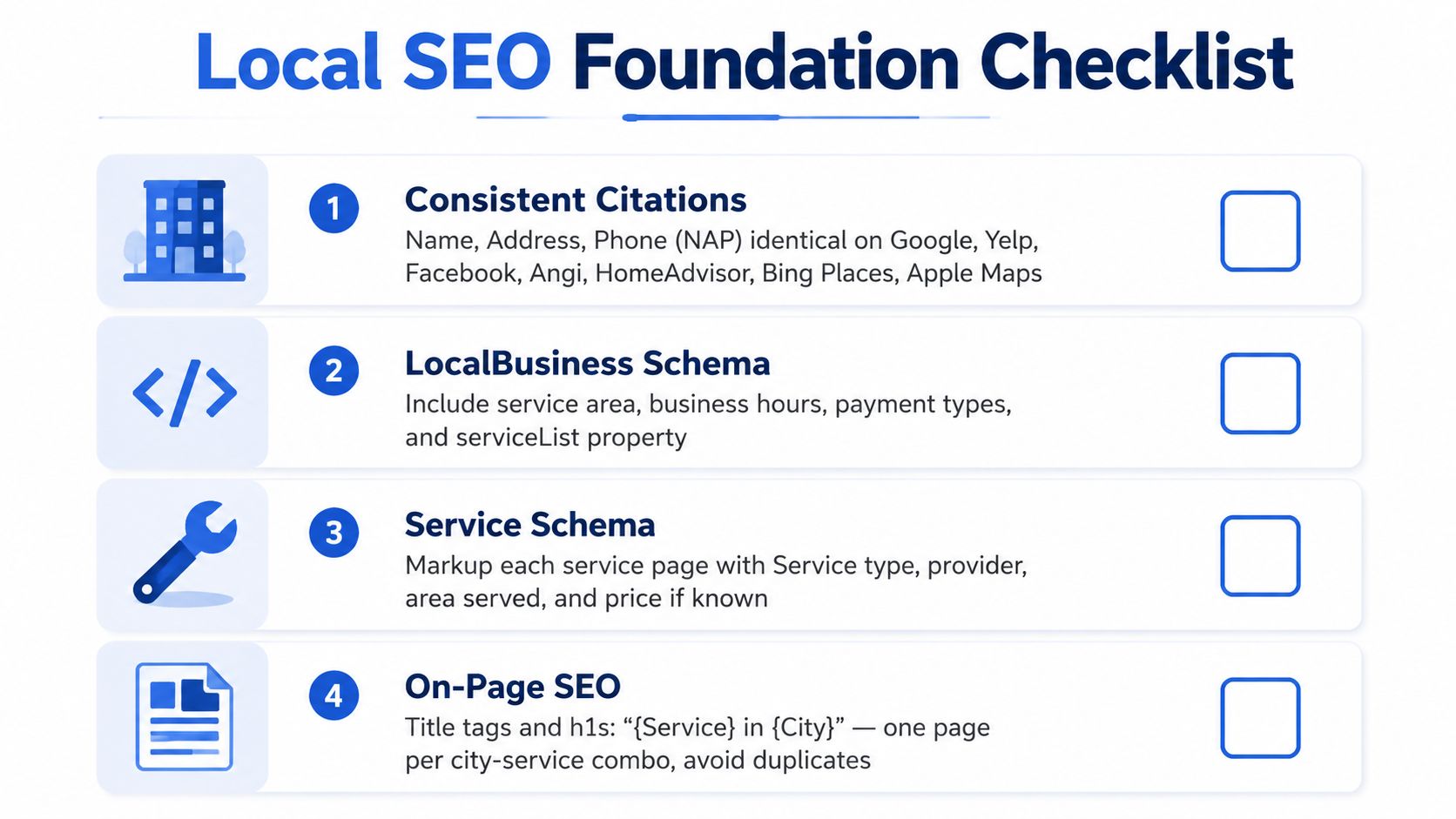
Keep the business name, address, and phone number consistent on major platforms. For a service-area business, show the operating address accurately, then describe towns served through the appropriate profile fields and website content. Categories also need to agree. If the Google Business Profile emphasizes cleaning while the website presents tile installation as the primary service, the combined signal becomes harder to interpret.
Prioritize useful local references
Audit Google, Yelp, Facebook, Angi, HomeAdvisor, Bing Places, and Apple Maps. Remove duplicate profiles, replace outdated phone numbers, and check that core services match across listings. A smaller group of accurate, maintained profiles supports trust better than a long list of neglected citations.
Use schema to clarify, not decorate
Structured data gives search engines a consistent description of the business and its services. Consider:
- LocalBusiness schema: Identify the business, contact details, hours, service area, and relevant organization information.
- Service schema: Describe each major service, its provider, area served, and price information when known.
- Review schema: Use it only when the markup accurately reflects visible, eligible review content.
- FAQPage schema: Apply it to legitimate, visible questions and answers, not hidden keyword blocks.
- AreaServed: Match covered locations to the towns the business serves.
Schema does not guarantee rich results or AI visibility. Its value comes from alignment. The profile, page copy, headings, and structured data should describe the same service and location without conflicting labels. That alignment matters when the site separates cleaning, tile installation, and post-construction work.
Reinforce every city-service page
Use a title tag and H1 that identify the service and town. Write unique introductory copy, add relevant internal links, compress authentic images, and use descriptive alt text. Build city pages around the towns closest to the company first, then expand when the business can support distinct, useful content for additional areas.
A focused cleaning services page should target cleaning intent rather than dilute it with unrelated installation copy. Apply the same discipline to tile, post-construction, and town hub pages. Each page should confirm the matching profile category, service, and location.
Winning AI Overviews and the New Local Discovery Layer
Map visibility remains important, but it isn't the only place a homeowner may encounter a business. AI-generated answers, conversational interfaces, voice queries, and booking-oriented search experiences can compress the path between a question and a service request. Recent home-service SEO guidance treats this as a distinct layer that sits alongside classic Google Business Profile and local-pack optimization. The 2026 home-services SEO discussion outlines why businesses need content that answers questions cleanly and leads directly to action.
The practical mistake is publishing broad informational articles that never help a customer schedule work. AI systems need concise, reliable answers, while homeowners need proof, availability, service boundaries, and a clear next step.
Write answer blocks that stand alone
Use question-based headings for real customer concerns:
- What does post-construction cleanup include?
- Can a tile installer work around an active kitchen remodel?
- How should a homeowner prepare for a deep cleaning?
- Which tile materials work well in a bathroom?
- Does the company serve Weston and nearby towns?
Answer each question directly near the heading, then provide supporting detail. Google describes featured snippets as special result boxes where the descriptive answer appears before the usual result format, and says selection depends on how well and helpfully a page answers the user's question. Google Search Central's featured snippet documentation supports using direct definitions, concise explanations, and useful question sections without treating snippets as a guaranteed outcome.
Connect urgent intent to a booking path
Emergency or time-sensitive service content should reduce decision friction. State what the business handles, which towns it serves, how customers request an estimate, and what information helps the team respond. For rushed tile installation, explain the planning dependencies, material availability questions, and site-readiness considerations without promising a timeline the business can't control.
Every important service page should include a visible phone option, a short estimate form, service-area confirmation, and links to relevant proof. A page that answers questions but makes booking difficult is only half optimized.
Measure visibility beyond clicks
Track impressions and queries in Search Console, then segment findings by:
- Intent: Emergency, service-specific, informational, and branded.
- Location: Wayland, Newton, Needham, Wellesley, Weston, and surrounding communities.
- Action: Calls, form submissions, direction requests, and booking starts.
- Surface: Maps, organic results, featured snippets, and observed AI answers.
AI visibility is harder to measure than a traditional ranking, so document recurring questions and whether the business appears in the answer context. Don't chase every new interface. Improve the source pages first, then monitor how those pages are represented.
Tracking Results and Running Outreach That Compounds
A local SEO program needs a measurement system that distinguishes visibility from business value. Track core searches by town and service instead of relying on one average ranking. Examples include “cleaning near me,” “tile installation Newton,” “post-construction cleanup Wellesley,” and branded searches for the company name.
Google Business Profile Insights and Search Console can reveal how people discover the business, which services attract impressions, and where users take action. Pair that information with call tracking and form records. A ranking that produces no qualified conversations deserves less attention than a modest position that consistently generates estimates.
Audit the local footprint regularly
Review the profile for category accuracy, service entries, hours, photos, Q&A, and service areas. Check citations for name, address, phone, and URL consistency. Compare the website's town pages with actual routes, current services, and recent project evidence.
For outreach, pursue relationships that naturally connect the business to local property activity:
- Real estate agents: Offer dependable move-in, move-out, and listing-preparation support.
- Property managers: Build repeat workflows for turnovers and maintenance coordination.
- Remodelers and contractors: Coordinate post-construction cleaning and tile finishing.
- Community organizations: Seek legitimate sponsorships or project mentions that identify the business locally.
- Local publications and associations: Contribute useful home-maintenance guidance when it serves their audience.
These partnerships can produce relevant mentions and referral relationships, but don't buy irrelevant links or manufacture local associations. Prominence is stronger when the relationship reflects real work.
Common operational questions
How should a service-area business handle town coverage?
Represent the business accurately in its Google Business Profile, then reinforce each priority town with unique pages and genuine proof. Don't claim communities the team can't reliably serve.
Should the business use a tracking number?
Use call tracking only if it preserves the primary business number where consistency matters. Configure reporting so marketing attribution doesn't create conflicting public listings.
How often should GBP posts be refreshed?
Publish when there's a real update, seasonal service, project, or customer-relevant announcement. A steady stream of empty posts won't compensate for weak categories, outdated services, or missing reviews.
Review performance by service and town every quarter, then adjust pages, requests, citations, and outreach based on qualified leads rather than vanity metrics.
If your Massachusetts home-services business needs a clearer local search foundation, Sunny Day Pro Services offers professional house cleaning, deep cleaning, move-in and move-out service, post-construction cleanup, and expert tile and flooring installation across Wayland, Newton, Needham, Wellesley, Weston, and surrounding communities. Visit Sunny Day Pro Services to request a quote, choose the service you need, and schedule dependable help from a local team.

