
Find Your Perfect Home Floor Polishers and Buffers in 2026!
Discover the best home floor polishers and buffers for sparkling clean floors in 2026. Our expert guide helps you choose the perfect machine for your home.
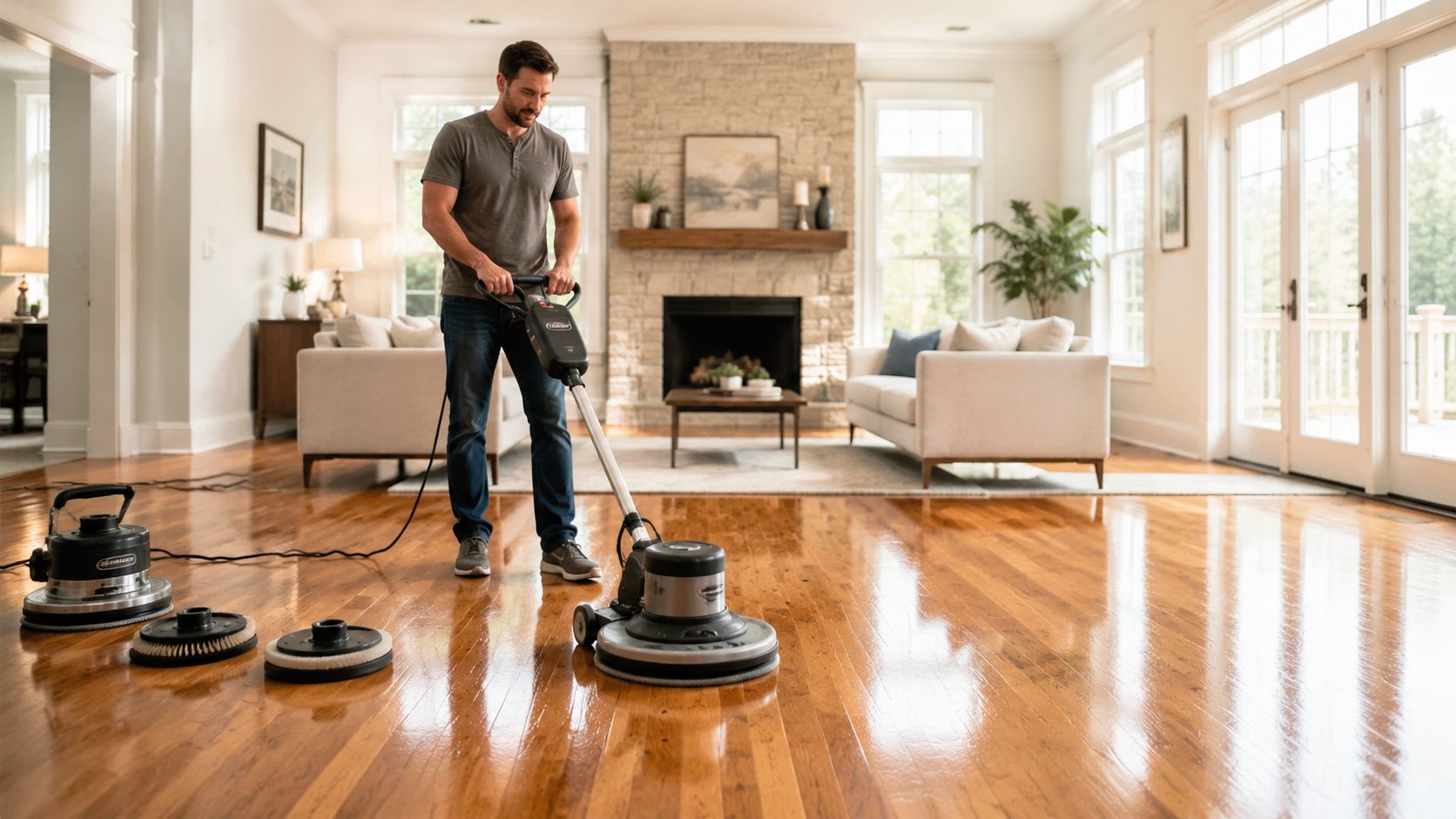
Dull floors usually sneak up on people. One month the tile still looks fine, the hardwood still reflects a little light, and then one day the whole room feels tired. You mop, you change cleaners, you scrub the traffic lanes by hand, and the floor still looks flat.
That's when a lot of homeowners start searching for home floor polishers and buffers. The appeal is obvious. A machine feels like the missing step between basic cleaning and a restored finish. Sometimes it is. Sometimes it's also the fastest way to put swirl marks into a floor that didn't need aggressive treatment in the first place.
Most online advice falls short. Retail pages tell you a machine can clean, strip, polish, and shine. They don't spend much time on whether your specific floor should be buffed at all, how much control the machine takes, or whether buying one makes sense for a job you'll only do occasionally.

Floor buffers aren't a gimmick. They've been around for a long time. Home floor polishers and buffers have been labor-saving household tools for over a century, and the first patent for an electric floor buffer was filed in 1921, after earlier machines from the early 1900s helped move floor care away from fully manual polishing, as described in this history of flooring machines.
Bottom line: A floor buffer is a real tool with real uses. It's not automatically the right tool for every home, every finish, or every homeowner.
Introduction Restoring Your Home's Shine
A floor buffer sits in the middle ground between routine cleaning and full restoration. For the right floor, it can lift embedded soil, improve the appearance of the finish, and bring back a cleaner, brighter look that a mop won't deliver. For the wrong floor, it can dull the surface, leave visible patterns, or wear through a thin top layer.
That's why the first question shouldn't be, “Which machine should I buy?” It should be, “What floor do I have, and what problem am I trying to solve?”
What homeowners are usually trying to fix
Homeowners and renters researching home floor polishers and buffers are typically dealing with one of these situations:
- Dull traffic paths where the center of the room still looks decent but walkways don't
- Ground-in grime on tile or textured surfaces that regular mopping leaves behind
- Light surface scuffs that make a finish look older than it is
- Pre-sale cleanup when a house needs to look sharper for photos or showings
- Post-renovation cleanup where fine residue makes a hard floor look cloudy
Some of those are good DIY buffer jobs. Some aren't.
The honest approach
A machine can help. It won't correct every floor problem. It also won't replace judgment.
If the finish is already compromised, if the floor has material limits, or if you're guessing about the pad and product, the machine usually magnifies the mistake. Good floor care is less about owning equipment and more about matching the method to the surface.
What Exactly Is a Floor Polisher or Buffer
Think of a floor buffer as a weighted motorized pad driver. It uses rotation and pressure to do work that hand cleaning can't do evenly. In practical terms, it's similar to a large finishing tool for floors. The pad moves across the surface, creates controlled friction, and changes the floor's appearance depending on the pad and product you use.
For most homeowners, the words buffer and polisher get used interchangeably. In everyday use, that's fine. What matters more is the job you're asking the machine to do.
Buffing, polishing, and scrubbing are not the same job
These terms get mixed together constantly, and that's one reason DIY results are uneven.
- Buffing means improving the look of an existing finish. You're usually restoring gloss, reducing haze, or evening out light wear on the top surface.
- Polishing usually means using a polish or finishing product to enhance appearance and protection.
- Scrubbing is about deep cleaning. The goal isn't shine first. It's removing soil, residue, and buildup.
A single low-speed machine can often handle all three jobs, but only if the floor is compatible and the pad choice matches the task.
Why speed and power matter
A buffer that spins too aggressively creates more heat and friction than many residential finishes can tolerate. A machine that's too weak may not clean or polish evenly. That's why specs matter more than marketing phrases.
Most consumer units run at 175 to 185 RPM with a 1.5 HP motor, which is the common low-speed range used for buffing, scrubbing, and stripping without the higher heat associated with faster burnishing equipment, as shown on this Clarke dual-speed floor polisher product page.
If you're working on a residential floor, low speed is usually the safer lane. More aggressive isn't automatically better.
What the machine actually does well
A home floor buffer can help when you need:
- More even pad pressure than hand polishing can deliver
- Better agitation for dirty tile or resilient flooring
- Consistent finish work across open areas
- A mechanical assist that saves time and physical effort
What it doesn't do well is make an unsuitable floor safe to buff. It also doesn't fix deep damage, failing coatings, or product buildup caused by the wrong cleaners.
The Different Types of Home Floor Buffers
Not all home floor polishers and buffers behave the same way. The machine style changes how much skill it takes to control, how likely it is to leave visible marks, and what kind of floors it suits.
The biggest divide for homeowners is usually between rotary machines and random-orbit or dual-direction machines.

Rotary buffers
A rotary buffer spins in a single direction. That gives it solid cleaning and polishing power, but it also means the machine has a stronger “pull” while you're operating it. If your technique is uneven, you can leave arcs, swirls, or patchy results.
These machines make sense when the floor is durable, the user has some control, and the job needs stronger pad action.
Random-orbit and dual-direction machines
These are the more forgiving option for many homeowners. Random-orbit floor buffers are designed to reduce gouges, swirls, and sanding marks through simultaneous bidirectional motion, which makes them a safer fit for DIY users and delicate glossy surfaces, as noted on this 17-inch random orbit floor buffer listing.
That motion matters in real homes. On sealed hardwood, polished tile, or mixed-surface spaces, a less directional machine usually gives the homeowner a wider margin for error.
A machine that's slightly less aggressive but easier to control often produces the better finished result.
Floor Buffer Types Compared
| Type | Best For | Pros | Cons |
|---|---|---|---|
| Rotary buffer | Durable hard floors, heavier cleaning, experienced DIY users | Strong pad action, versatile for scrubbing and buffing | Easier to leave swirls, takes more control |
| Random-orbit buffer | Beginners, delicate glossy floors, mixed hard surfaces | More forgiving, lower risk of visible directional marks | May feel slower on stubborn buildup |
| Dual-speed low-speed buffer | Homeowners who want flexibility for different maintenance tasks | Can handle multiple floor care tasks with one machine | Still requires the right pad, product, and surface judgment |
What actually matters more than the label
The type of machine matters, but the result still comes down to a few practical variables:
- The floor material decides whether buffing is safe at all
- The pad choice determines how aggressive the contact will be
- The operator's control affects streaking, swirl risk, and edge detail
- The floor's current condition tells you whether maintenance is enough or restoration is needed
If a homeowner asks me for the safest starting point, I'd steer them toward a more forgiving machine before I'd steer them toward the strongest one.
Which Floors Can You Safely Use a Buffer On
This is the part that matters most. A lot of machines are marketed as if they work on every hard surface. Real floors don't cooperate with that kind of sales language.
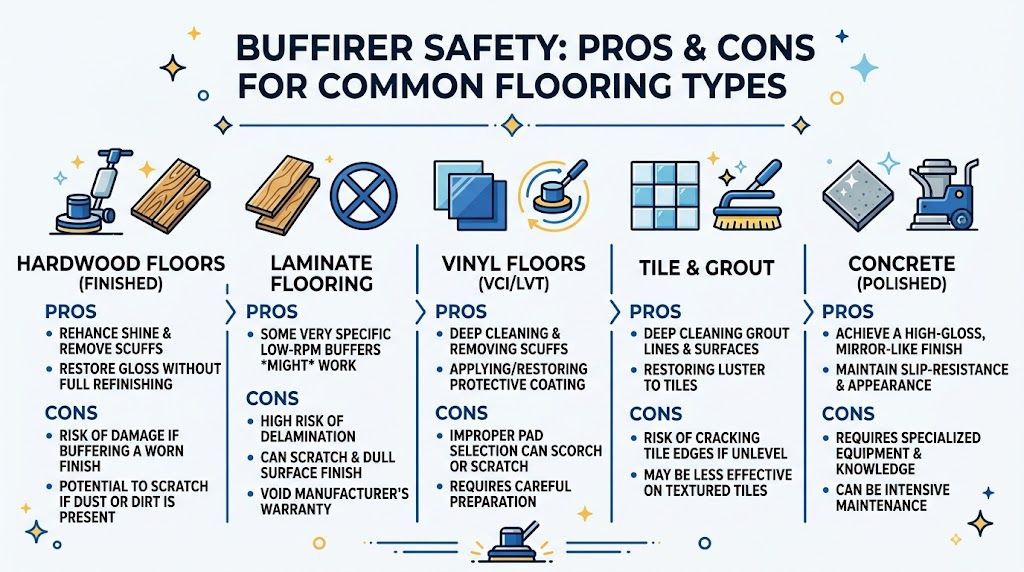
Floor-type compatibility is the issue many homeowner guides gloss over. Buffers sold as suitable for “all floors” can still damage surfaces like laminate or LVP by wearing down a thin protective layer, which is exactly why the retail category language on The Home Depot floor scrubbers and buffers page isn't enough to make a safe decision.
Go ahead on the right surfaces
Some floors are much more buffer-friendly than others.
- Sealed ceramic and porcelain tile usually handle light machine work well, especially when the goal is deep cleaning and appearance improvement.
- Stone with the correct finish and process can sometimes be maintained mechanically, but caution rises fast here.
- Resilient flooring built for maintenance programs can often tolerate low-speed work better than delicate residential finishes.
If your concern is tile appearance, grout soil, or restoring a cleaner look to hard-surface areas, professional tile care and tile service options are often the safer route than experimenting with pad pressure and chemicals at home.
Proceed with caution on wood and specialty finishes
This category trips up a lot of DIY jobs.
Sealed hardwood may tolerate careful buffing under the right conditions, but that doesn't mean every hardwood floor should be machine buffed by a homeowner. The finish type matters. The age of the coating matters. So does the machine motion.
Engineered wood can be even trickier because the wear layer can be limited. If the finish is thin or already stressed, the margin for error gets small quickly.
For these surfaces, proceed only if all of the following are true:
- You know the finish type
- The manufacturer allows machine maintenance
- You're using a gentle pad and compatible product
- You're not trying to correct deep wear, scratches, or peeling finish
Practical rule: If you can't confidently identify the floor and finish, don't put a machine on it.
Stop and do not use a buffer
Some floors should make you put the machine back in the garage.
- Laminate is high on that list. It can't be treated like a refinishable wood surface.
- LVP and similar thin wear-layer products can also be risky if the machine and pad abrade the top layer.
- Unsealed wood is a no-go.
- Cork and other softer specialty materials are poor candidates unless the manufacturer specifically approves the process.
What goes wrong on these floors is predictable. The machine can dull the finish, expose edges, create scuff patterns, or push moisture and residue into seams. Once that happens, the “quick refresh” turns into a repair conversation.
Buy Rent or Hire A Smart Homeowner's Decision
This is the question most shopping guides avoid. They compare machines without asking whether ownership makes sense in the first place.
For many homes, buying a floor buffer is not the smartest first move. If you only expect occasional use, the machine becomes one more bulky tool to store, maintain, learn, and hope you use correctly.

When buying makes sense
Buying can work if you have a larger home, several compatible hard-floor areas, and a real plan to use the machine regularly. It also helps if you don't mind learning technique and dealing with storage.
Ownership usually includes more than the machine itself:
- Pads and brushes for different tasks
- Floor-specific cleaning or polishing products
- Storage space for a heavy, awkward tool
- Upkeep and replacement parts over time
A purchased machine can be useful. It's just not “cheap floor care” once all the practical pieces are added.
When renting is the middle-ground choice
Renting suits homeowners who want to handle one specific job without committing to permanent ownership. It can be a reasonable option for a seasonal refresh, move-out prep, or one-time deep cleaning project.
The downside is uncertainty. Rental machines may be heavier than expected, set up differently than beginner-friendly models, or come with pads and wear patterns you didn't choose. You also have a short time window to get the job done, which pushes people to work too fast.
When hiring is the smarter call
Hiring makes the most sense when the floor is expensive, the material is sensitive, the result matters, or your time is worth more than a trial-and-error weekend. That's often the case for busy homeowners in places like Wellesley, Weston, Needham, and Newton.
Many articles about home floor polishers and buffers miss this point entirely. For infrequent use, the cost of ownership, storage, and learning curve often make professional service the more reliable option, a gap highlighted on FloorBuffers.com.
If you're already deciding between DIY floor work and broader home maintenance help, this guide on how homeowners choose local house cleaning support is useful because it addresses the same basic issue. Time, hassle, and consistency often matter more than equipment ownership.
If the job has to look right on the first try, hiring is usually less stressful than learning on your own floor.
When to Call the Pros at Sunny Day Pro Services
There are clear moments when DIY stops being practical.
Call a pro when the floor material is expensive, the finish is delicate, or you're not sure whether the problem is dirt, dull finish, wear, or actual damage. Marble that has lost its luster, hardwood with uneven sheen, and glossy tile with visible machine marks are all situations where guessing gets costly fast.
It also makes sense to bring in help when timing matters. If you're preparing a Needham home for sale, turning over a property in Wayland, or trying to get a Weston or Wellesley home ready before guests arrive, a weekend spent wrestling with rented equipment usually isn't the best use of your time.
Sunny Day Pro Services provides professional cleaning services for Massachusetts homeowners who want a clean, polished result without handling the machine work themselves.
The smart trigger is simple. If you'd be upset by a bad result, don't make your floor the practice surface.
Frequently Asked Questions About Floor Polishers
How often should a homeowner polish or buff floors
There isn't one schedule that fits every home. Foot traffic, floor type, finish type, pets, and cleaning habits all change the answer. A kitchen used heavily every day won't age the same way as a guest room. Buff only when the floor's condition and finish allow it.
Can a home floor buffer clean carpet
Some low-speed machines can be used for carpet bonneting or shampoo-related tasks when fitted properly. That doesn't make a standard floor buffer a replacement for dedicated carpet cleaning equipment. It's usually a limited-use option, not a universal carpet solution.
What's the difference between a low-speed buffer and a burnisher
A low-speed buffer is meant for buffing, scrubbing, and general floor maintenance. A burnisher runs much faster and is used to produce a higher-gloss look on appropriate surfaces. For typical homeowners, low-speed equipment is the more relevant category.
Will a buffer remove scratches
It may improve the appearance of very light surface scuffs if the floor and finish are suitable. It won't solve deeper scratches, finish failure, water damage, edge swelling, or wear-layer problems.
Is an orbital machine better for beginners
Usually, yes. A random-orbit or dual-direction machine is generally easier to control and less likely to leave obvious directional marks than a single-direction rotary buffer.
If your floors look dull but you're not sure whether they need buffing, polishing, deep cleaning, or professional repair, Sunny Day Pro Services can help you make the right call before you risk the finish. Request a quote and get practical guidance for your home, your flooring, and the result you want.

