Professional House Cleaning Supplies List: Expert 2026 Guide
Master your cleaning with our professional house cleaning supplies list. Get an expert 2026 checklist covering chemicals, tools, and quantities for every job.
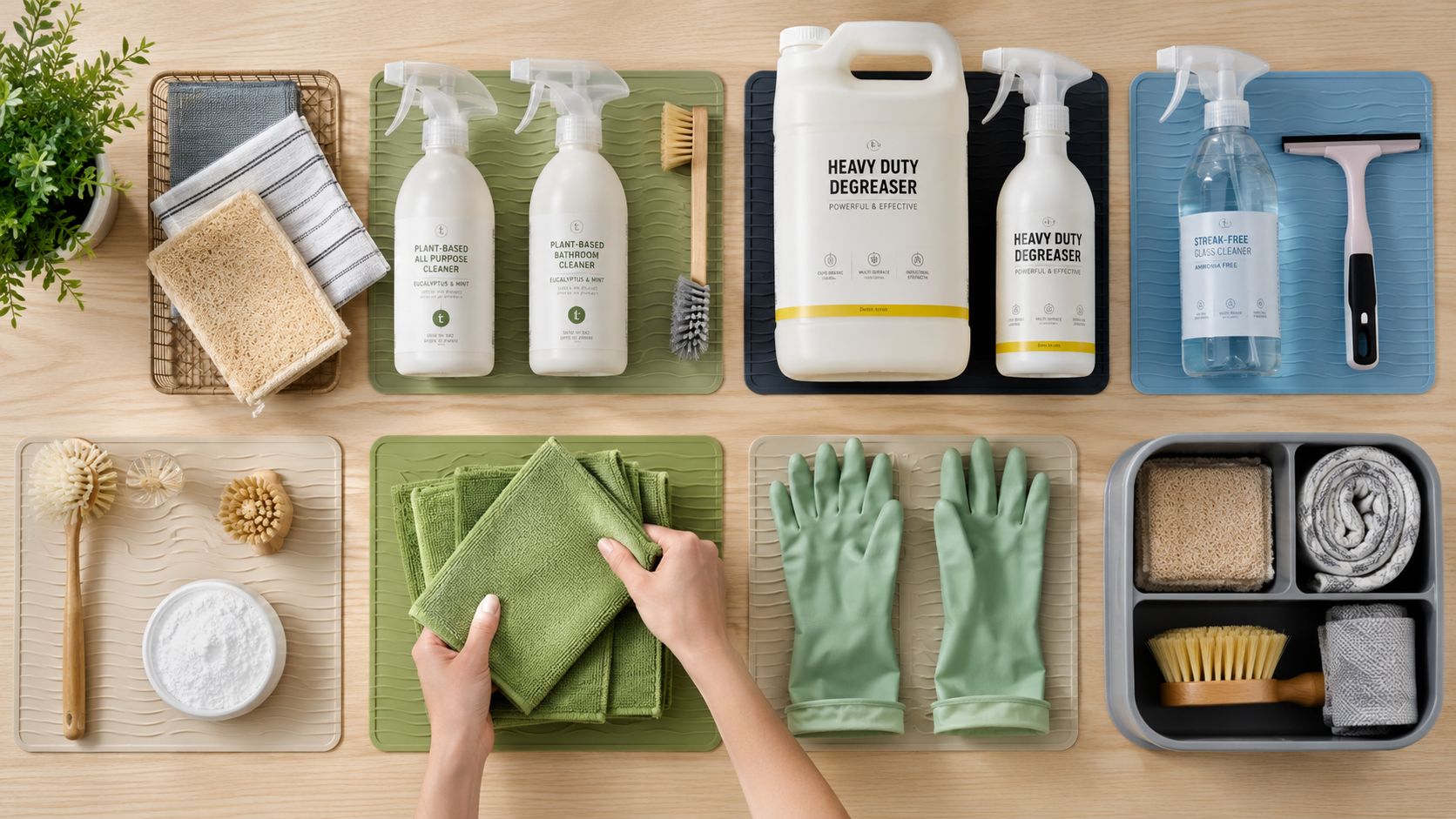
You're probably here because your cleaning cabinet is full, but your kit still feels incomplete. That's common. Most homeowners, solo cleaners, and even new cleaning companies buy supplies one bottle at a time, then realize they're missing the core items that keep jobs moving, like extra microfiber, a second bucket, scraper blades, or the right brush for grout lines.
A professional house cleaning supplies list shouldn't be a random shopping list. It should help you clean faster, protect surfaces, avoid cross-contamination, and keep each job consistent from kitchen to bathroom to floors. That matters whether you're maintaining a home in Newton, turning over a rental in Needham, or prepping a move-out clean in Wellesley.
Professional standards also support a more structured approach than most online checklists suggest. The CDC recommends neutral detergents with a pH of 6 to 8 for most environmental cleaning, and it identifies core equipment such as portable containers, cleaning cloths, mops or squeegees, buckets, and wet-floor caution signs. It also notes that a two-bucket system is best practice for routine mopping, while a three-bucket system is used for disinfection, according to the CDC cleaning supplies and equipment guidance.
The market size tells the same story. Household cleaning products aren't a niche category. The global market was valued at $282.28 billion in 2025 and is projected to reach $413.57 billion by 2034, reflecting a 4.40% CAGR, based on Fortune Business Insights household cleaning products market data.
Table of Contents
1. Molly Maid – Cleaning Supply Checklist

Molly Maid's cleaning supply checklist is one of the better starting points for residential work because it follows how cleaners move through a house. Instead of dumping everything into one giant category, it separates supplies by room and typical task, which makes it easier to build a repeatable grab-and-go kit.
For everyday residential cleaning, that structure helps. Kitchen degreasing, bathroom descaling, living-area dusting, and floor work need different chemistry and different tools, even if the house looks straightforward at first glance.
Why it works for residential teams
The best part is the list feels usable in the field. You can hand it to a new technician, use it to stock a caddy, or turn it into a team checklist without much editing. That's valuable if you want consistency across recurring maintenance jobs.
A few items I'd treat as essential when using this kind of baseline:
- Microfiber by task: Keep separate cloths for glass, bathrooms, and general dusting so you're not moving residue from one room to another.
- An extendable duster: Standard dusters miss vents, fan blades, and upper trim.
- Dedicated bathroom tools: Toilet brush, grout brush, and non-scratch scrub pads should never mix with kitchen tools.
Practical rule: A room-by-room checklist is only useful if you translate it into stocked kits, not loose shelf inventory.
Its weakness is that it leans toward standard residential cleaning. If you're doing post-construction cleanup, heavy move-out work, or homes with delicate natural stone and specialty finishes, you'll need a more surface-specific system than this checklist provides.
2. Housecall Pro – Cleaning Business Supplies & Equipment List
Housecall Pro's cleaning business supplies guide is built for operators, not just people making a shopping list. That's the difference. It treats supplies, equipment, PPE, and transport as one system, which is exactly how a cleaning business should think about them.
That makes it more useful for owners who are trying to standardize vans, caddies, and refill routines. A lot of supply lists ignore what happens between jobs. This one pays attention to storage and movement, which is where good systems either hold up or fall apart.
Best use case
This is a good resource when you're deciding when to upgrade from household-grade tools to pro gear. Spray bottles, vacuums, and pump sprayers seem interchangeable until lids crack, nozzles fail, or chemicals chew through cheap plastics.
The guide is also a strong companion if your services go beyond basic wipe-down work. Floor care, for example, requires a different level of planning once you start maintaining specialty surfaces or using dedicated equipment. If that's part of your service mix, Sunny Day Pro's guide to home floor polishers and buffers is a useful next read.
What I like most is the operational mindset:
- Consumables and equipment together: Easier to budget and restock.
- Transport thinking: Important if teams work from vehicles instead of one fixed site.
- Upgrade cues: Helpful for knowing when “good enough” tools are slowing you down.
The trade-off is that it isn't a simple printable field sheet. It's better for planning and owner-level decisions than for clipping onto a caddy.
3. Jobber Academy – Cleaning Business Supplies List (60+ Essentials)

Jobber Academy's cleaning business supplies list gets more granular than most. That's useful when you're no longer asking “what do I need?” and start asking “which version of this tool belongs in every kit?”
That distinction matters. A standard spray bottle and a chemical-resistant spray bottle look almost identical on a shelf. On the job, they don't perform the same, and the cheaper one often becomes a leak point.
Where it stands out
The list helps with kit standardization across multiple technicians. That's where many cleaning businesses lose consistency. One person carries scraper blades, another doesn't. One has solvent-resistant sprayers, another has discount-store bottles. The result is uneven performance and wasted time.
This resource is especially practical if you're trying to tighten SOPs and improve speed on recurring residential routes. It pairs well with field workflow training, like Sunny Day Pro's advice on how to clean house fast, because speed only works when the kit is stocked correctly from the start.
The best cleaning kits don't have the most items. They have the fewest wrong items.
Another strength is that it addresses client-supplied products. That's a real issue in residential cleaning. Clients sometimes request “please use my cleaner,” but if that product isn't suitable for the surface or doesn't fit your process, the job slows down fast.
Its limitation is that it's more educational than transactional. You won't use it as a one-click reorder page, but you will use it to make smarter purchasing decisions.
4. ZenMaid Magazine – Cleaning Business Supplies (Residential vs. Commercial)

ZenMaid Magazine's cleaning business supplies article earns its place because it separates residential and commercial needs instead of pretending one kit fits every job. That's one of the most common mistakes I see in supply planning.
A residential maintenance clean in Weston doesn't need the same setup as a vacant property reset or a heavier turnover job. When your service types vary, your supply plan should vary too.
What pros will like
ZenMaid is especially helpful for its missed-item reminders. Extension poles, squeegees, and PPE don't always make the first draft of a house cleaning supply list, but they save time and protect techs when the work gets more demanding.
That makes this resource stronger for specialty jobs than some residential-only checklists. If your work includes first-time deep cleans, move-out prep, or high-detail resets, Sunny Day Pro's page on deep cleaning services is a natural companion because it reflects the extra layers those jobs require.
A few practical takeaways from this approach:
- Right-size the kit: Don't load every cleaner with every specialty tool on routine jobs.
- Protect access points: Window tools and poles matter when dust and cobwebs sit above reach.
- Keep PPE visible: If gloves and masks are buried, techs won't swap them as often as they should.
The downside is that it's lighter on specific product recommendations. It helps you think clearly about categories, but you'll still need your own final purchasing standards.
5. The Janitorial Store – Housekeeping Cart Basics

The Janitorial Store's housekeeping cart basics is less about chemistry and more about staging. That's a smart angle. A well-stocked cart or caddy changes how fast a cleaner moves, especially in larger homes, multi-level properties, and vacancy work.
Most supply lists stop at “buy these tools.” This one asks where those tools live during the job. That's a more professional question.
Why cart logic matters
When a technician has to walk back for liners, cloths, scrub pads, or backup trigger sprayers, the house takes longer and quality usually drops. Good staging reduces those breaks in motion.
The article is especially strong if you want to build a rolling setup for larger homes or turnover projects. It also highlights alternate setups like maid caddies and apron pockets, which sounds small but makes a real difference in tight bathrooms and staircase-heavy homes.
A solid cart philosophy usually includes:
- Front-access essentials: Glass cloths, bathroom cloths, scrub pads, and detail brushes should be easiest to grab.
- Lower shelf weight: Keep heavier bottles and buckets low so the cart stays stable.
- Separate waste and clean stock: Don't let used rags drift into clean microfiber inventory.
This resource does lean a bit toward hospitality workflow. Still, the ergonomics and staging principles transfer well to residential cleaning, especially if you manage teams and want every job set up the same way.
6. Rubbermaid Commercial – Stocking the Housekeeping Cart (Flyer)

Rubbermaid Commercial's housekeeping cart stocking flyer is concise, brand-led, and more useful than it looks at first glance. It's not a teaching piece. It's a control sheet.
That's exactly why many owners and supervisors will like it. When you need a procurement standard, short beats inspirational every time.
Strongest fit
This flyer works best as an inventory audit tool. If your technicians' kits slowly drift apart over time, a SKU-oriented reference helps bring them back into alignment. One cart has extra liners, another is missing cloth stock, another has random replacement bottles from a hardware store. That inconsistency is expensive.
Professional cleaning tools and supplies are a major category on their own. The household cleaning tools and supplies market was valued at USD 10.82 billion in 2024 and is expected to reach USD 12.68 billion by 2032 at a 2.00% CAGR, with segmentation that includes mops, brooms, cleaning brushes, wipes, and gloves, according to Data Bridge Market Research on household cleaning tools and supplies.
Owner's note: Vendor lists are best used to control replacement standards, not to decide every product category from scratch.
The hospitality slant is real, and the product focus is obviously Rubbermaid-heavy. But if your goal is to stop kit drift and create reordering discipline, this kind of document does the job well.
7. Mobile Janitorial Supply – Janitorial Supply Checklist (order-ready)

Mobile Janitorial Supply's checklist is one of the most practical options if you already know what you need and want to order quickly. It's organized for purchasing, not just reading, which makes it useful during restock days.
That said, an order-ready checklist can also tempt people into overbuying. Residential cleaning teams usually don't need every category a janitorial supplier carries, especially if your work is mostly maintenance cleaning and occasional deep cleans.
What to watch before ordering
Use this kind of resource with a filtered list in hand. Decide your approved chemicals, cloth colors, brush types, PPE, and bag sizes before opening a supplier page. If you don't, carts get bloated fast.
A more disciplined way to use it is to separate supplies into three internal groups:
- Daily-use stock: Microfiber, gloves, liners, trigger bottles, scrub pads.
- Specialty stock: Descaler, degreaser, grout brushes, scraper tools, spot-treatment products.
- Rare-use stock: Post-renovation residue tools, specialty floor products, heavy-duty dust containment items.
This source is particularly handy for comparing substitutions when your preferred item is out of stock. Just verify shipping timing and don't assume a broad janitorial assortment is automatically the right residential assortment.
The checklist is broad, and that breadth is both its strength and its trap.
8. Merry Maids – Bathroom Kit & Move-In/Out Checklist
Merry Maids' bathroom cleaning kit guide is useful because bathrooms expose weak kits fast. If your supplies aren't dialed in, soap scum, hard water buildup, grout haze, and fixture fingerprints will eat up time.
This resource is strongest when you need targeted bathroom and move-in or move-out logic, not just a generic supply list. That matters because deep-clean bathrooms often need more than an all-purpose cleaner and a rag.
Where it earns a spot
What I like here is the sequencing mindset. Dust first, then remove buildup, then clean glass and fixtures, then finish floors and touch points. Good kits support that order.
It also matches a real gap in most online articles. Many lists name common items but don't give much surface-specific buying guidance. That weakness is called out clearly in Clean Pixel's analysis of professional house cleaning supplies list content, which notes that most articles skip material-safe recommendations and fail to separate everyday cleaning from stone-safe cleaning, bathroom scale removal, and post-renovation residue work.
For bathroom and move-out service, I'd want these categories covered without fail:
- Scale and soap scum removal: Strong enough for buildup, but still matched to the surface.
- Detail tools: Grout brush, crevice brush, and non-scratch pad.
- Finish tools: Glass cloths and dry microfiber for fixtures and mirrors.
The limitation is simple. It isn't one unified master list. You'll still need to merge bathroom-specific and turnover-specific notes into your own standardized kit sheet.
9. QuotePro for Cleaners – Cleaning Business Equipment & Supplies Checklist
QuotePro for Cleaners' equipment and supplies checklist is better for planning than for training. If you're trying to map out starter, pro, and more advanced kit tiers, this kind of list helps you think in levels instead of one giant inventory pile.
That's useful because not every cleaner needs every specialty tool on day one. But every business does need a clear path for when a basic kit becomes too limited.
Useful for planning kit levels
I'd use this type of checklist for fleet planning, expansion, or service-line changes. If you're adding move-out work, post-construction touchups, or more specialty floor care, your supply kit should grow in layers, not in random one-off purchases.
Professional cleaning products are also a large and growing category. The market is projected to grow from USD 58.7 billion in 2025 to USD 97.5 billion by 2035 at a 5.2% CAGR, and surface cleaners and disinfectants account for 41.0% of the 2025 market, according to Future Market Insights on the professional cleaning products market.
That aligns with what operators already know on the ground. Surface-focused chemistry does most of the daily work, while specialty chemicals and tools support edge cases, buildup, and uncommon materials.
Its drawback is trust calibration. On a newer site, I'd verify specific product picks before making bulk purchases, but the tiering concept itself is solid.
10. UpFlip – House Cleaning Business Checklist (printable PDF)

UpFlip's printable house cleaning business checklist PDF is compact and practical. It's not the deepest resource on this list, but it does something a lot of longer guides don't. It's easy to print, hand out, and use on a real workday.
That makes it good for onboarding, ride-alongs, and quick inventory checks before teams leave the shop or garage.
Best for training
If I were training a new technician, I wouldn't start with the most detailed article. I'd start with a short printable list, then layer in the more advanced guidance once the basic workflow is second nature.
This PDF works well in that role because it can sit inside an SOP binder or live in a vehicle folder. It's also useful for QA spot checks when you want to confirm that a kit still contains the basics and hasn't slowly lost core tools.
A printable checklist is most useful when you pair it with your own standards for:
- Approved products: Which chemicals and surfaces they're for.
- Color coding: Which cloths go where.
- Restock trigger: When technicians replace used or low-stock items.
- Damage control: What to do if a bottle leaks, a sprayer fails, or a tool breaks on site.
It won't answer every specialty question. But for field usability, it's one of the easiest resources here to put into action immediately.
Top 10 Professional House Cleaning Supplies Checklists, Comparison
| Resource | Core features | Best for / Target audience | Key value / Unique selling points | Limitations |
|---|---|---|---|---|
| Molly Maid – Cleaning Supply Checklist | Room-by-room supplies, storage & safety tips, downloadable PDF | Homeowners, residential cleaners, training | Recognizable national brand, field-ready printable checklist | Not MA-specific, limited post-construction guidance |
| Housecall Pro – Supplies & Equipment List | Categorized tools, chemicals, PPE, upgrade notes, transport tips | Professional operators scaling field workflows | Recent update, operational focus, useful for quoting & cost planning | Includes software upsells, not a single printable page |
| Jobber Academy – 60+ Essentials | 60+ items, side-by-side comparisons, purchasing notes | Owners standardizing kits, multi-team businesses | Granular quality tiers, guidance for kit standardization | No direct cart, not MA-regulation specific |
| ZenMaid Magazine – Residential vs Commercial | Side-by-side residential/commercial table, PPE emphasis | Businesses serving mixed job types (residential & commercial) | Helps right-size inventory, flags commonly missed items | Limited brand/product recommendations, no PDF |
| The Janitorial Store – Housekeeping Cart Basics | Housekeeping cart stocking list, workflow & ergonomics tips | Cleaning company owners, trainers, large-turnover jobs | Standardizes staging, improves operational ergonomics | Some hospitality-leaning items, no direct purchase links |
| Rubbermaid Commercial – Stocking Flyer | SKU-based vendor recommendations, category checklist | Procurement, inventory/audit managers | Vendor-verified SKUs, prevents kit drift, procurement-ready | Hospitality examples may need residential adaptation, brand-centric |
| Mobile Janitorial Supply – Order-ready Checklist | Category checklist with click-to-buy links, cost comparison | Buyers needing fast replenishment, procurement teams | Actionable e‑commerce links, streamlines ordering & cost checks | CA-based retailer (check MA shipping), broad scope may lead to overbuying |
| Merry Maids – Bathroom Kit & Move‑In/Out Checklist | Targeted bathroom kit, move‑in/out process steps, sequencing | Specialty visits: deep cleans, move-in/move-out jobs | Clear process sequencing, trusted brand recommendations | Not a single master list, contains marketing tie-ins |
| QuotePro for Cleaners – Equipment & Supplies | Starter/pro/commercial kit tiers, year-stamped budget ranges | Owners forecasting budgets & scaling kits | Recent pricing bands, useful for replenishment forecasting | Newer site, verify recommendations, no downloadable PDF |
| UpFlip – House Cleaning Business Checklist (PDF) | Compact printable checklist, business setup + supplies | New technicians, onboarding, SOP binders | Printable field-friendly PDF, good for training & QA spot checks | Less depth than long-form guides, not deep-clean specific |
Final Thoughts
The best professional house cleaning supplies list isn't the longest one. It's the one that helps you show up ready for the actual surfaces, soil levels, and service type in front of you.
That's where many generic checklists fall short. They name the usual suspects, like microfiber cloths, mop buckets, all-purpose cleaner, glass cleaner, gloves, and brushes. Those are important, but the real difference comes from how you organize them, when you upgrade them, and how tightly you match them to kitchens, baths, stone, stainless, floors, and turnover work.
If you're building a serious house cleaning kit, think in layers. Start with core daily-use tools. Add room-specific chemistry and brushes. Then add specialty items for deep cleans, move-outs, and post-renovation work. Keep your microfiber separated by task. Use bucket systems properly. Standardize your bottles, labels, and refills so every cleaner works the same way.
For busy homeowners, this matters too. A pro-level supply setup often means fewer shortcuts, better surface protection, and more consistent results from visit to visit. If you've ever had one cleaner leave streaky glass, another miss hard water buildup, and another use the wrong product on a delicate surface, the issue usually isn't effort. It's system quality.
The strongest resources on this list each solve a different problem. Molly Maid is a strong residential baseline. Housecall Pro and Jobber are stronger for operations and standardization. ZenMaid is useful when service types vary. The Janitorial Store and Rubbermaid help with staging and cart discipline. Mobile Janitorial Supply helps with fast replenishment. Merry Maids gives good specialty guidance for bathrooms and move-outs. QuotePro helps with tiered planning. UpFlip is easy to print and train from.
The smartest move is to combine those strengths into one internal checklist of your own. Typically, this means one master supply sheet, one field-ready printable, one reorder list, and one specialty add-on sheet for deep clean and move-out jobs.
If you're a homeowner in Wayland, Newton, Needham, Wellesley, Weston, or nearby Massachusetts communities, this same logic applies when choosing a cleaning company. Ask whether the team uses surface-appropriate products, separate cloth systems, and standardized kits. A professional answer usually means a professional result.
If you'd rather skip the trial-and-error and hire a team that already has the systems, supplies, and surface-specific know-how dialed in, Sunny Day Pro Services is a strong local option. They provide professional house cleaning, deep cleaning, move-in and move-out service, and post-construction cleanup across Massachusetts communities including Wayland, Newton, Needham, Wellesley, and Weston, with the same detail-focused approach they bring to their expert tile and flooring work.

