
Acid Toilet Bowl Cleaner: Safety, Risks, and Alternatives
Learn the safe use of an acid toilet bowl cleaner, its risks, and better alternatives for a sparkling bathroom.
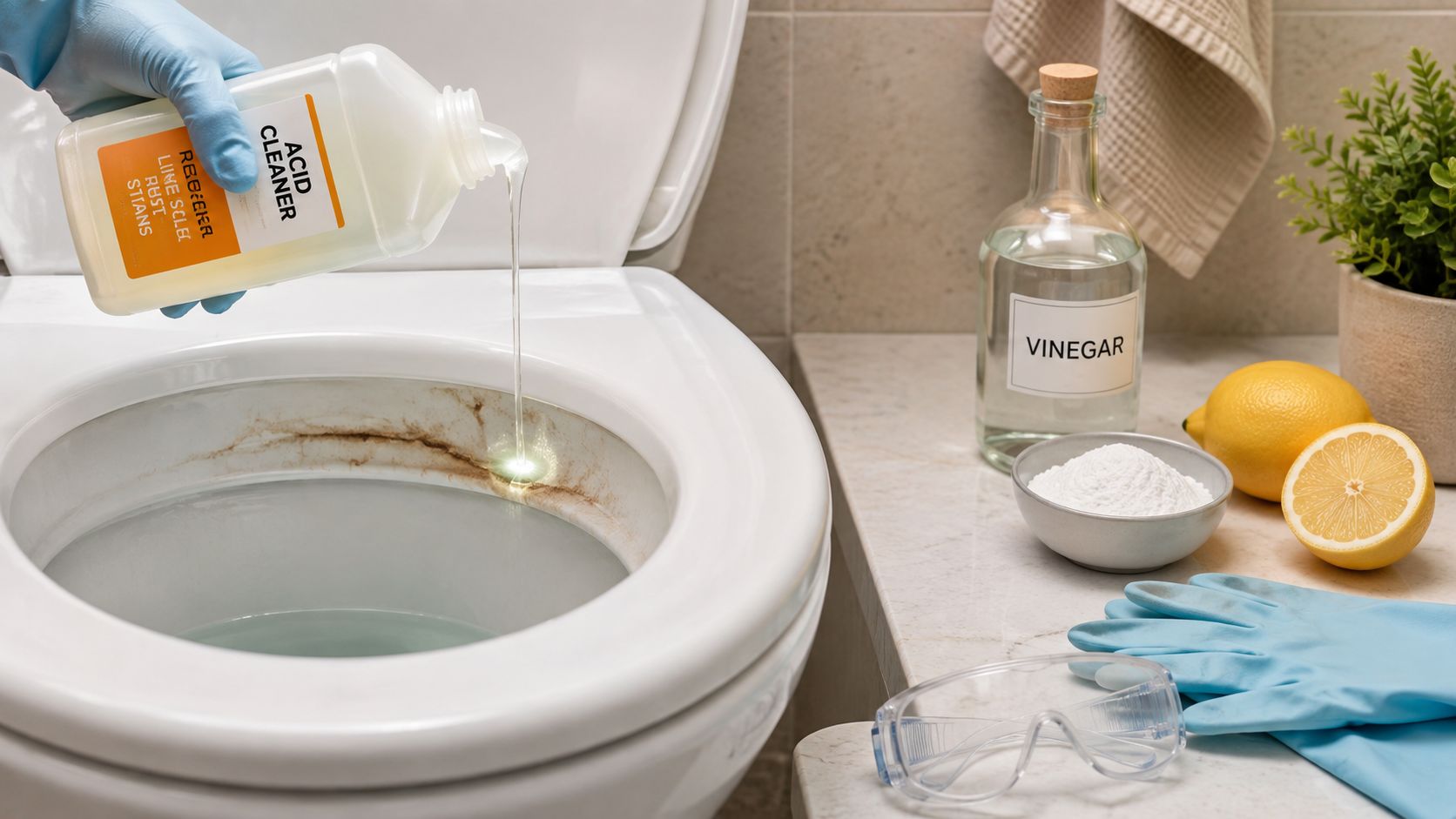
That stubborn toilet ring is sitting right there, and scrubbing it for the third time this week hasn't moved it. In a lot of Massachusetts homes, that's not because the brush failed. It's because the stain isn't ordinary dirt. It's usually mineral scale, rust, or a mix of buildup that needs the right chemistry, the right dwell time, and a little restraint around the rest of the bathroom.
If you reach for acid toilet bowl cleaner without diagnosing the stain first, you can get good results in the bowl and bad results on the fixtures around it. Used well, it's a specialized tool for hard-water deposits and rust. Used blindly, it can etch sensitive surfaces, react badly with other chemicals, and create more cleanup than you started with. The smartest approach is simple, match the stain to the chemistry, then protect everything the cleaner touches.
Table of Contents
When the Toilet Bowl Stain Won't Budge
You've already done the usual thing. Brush, flush, repeat. The ring is still there, maybe brown, maybe gray, maybe a chalky white line that keeps coming back no matter how often you clean. That's the point where you start shopping for a stronger bottle, but the better move is to ask what kind of stain you're looking at.
Hard water leaves mineral residue behind, and that residue behaves differently from soap scum or everyday soil. In areas with mineral-heavy water, the toilet bowl can collect scale right at the water line, and the brush just skates across it. An acid toilet bowl cleaner works because it targets that mineral layer directly, not because it's a universal dirt remover.
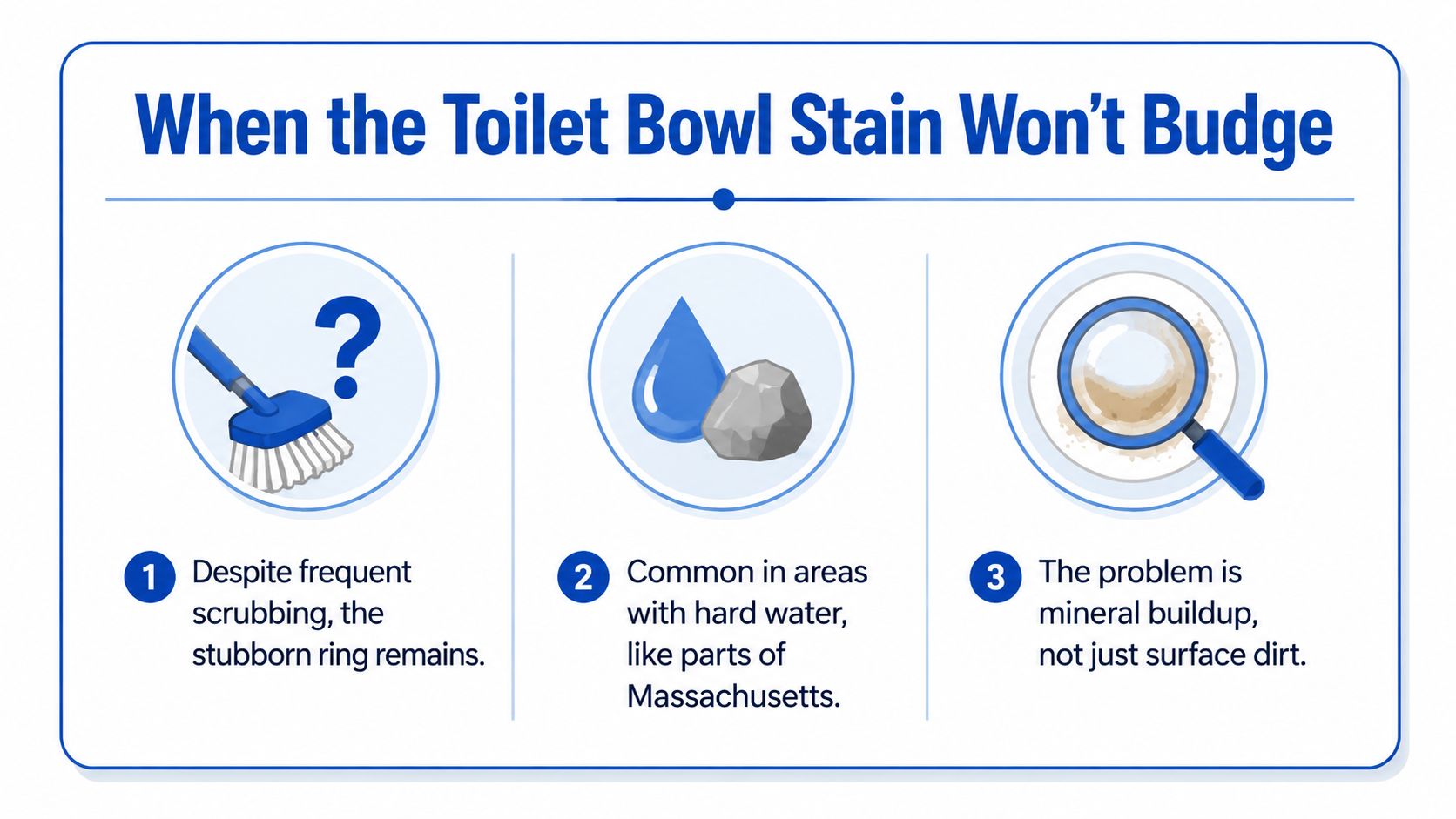
Practical rule: If the stain keeps reappearing in the same waterline band, think mineral buildup first.
A useful first pass is to look at the shape and texture of the stain. Mineral rings often feel crusty or rough. Organic residue tends to smear more easily and may not sit in a perfect line at all.
That distinction matters because the cleaner that wins against scale can be the wrong choice for other messes. If you know the stain type, you can stop over-scrubbing and start matching the chemistry to the job. That's the logic I use in homes where the same bowl has been scrubbed three times and still looks tired. The internal method matters too, and a deeper bathroom reset often starts with a broader cleaning routine like the one described in this deep-cleaning guide.
How Acid Toilet Bowl Cleaner Works
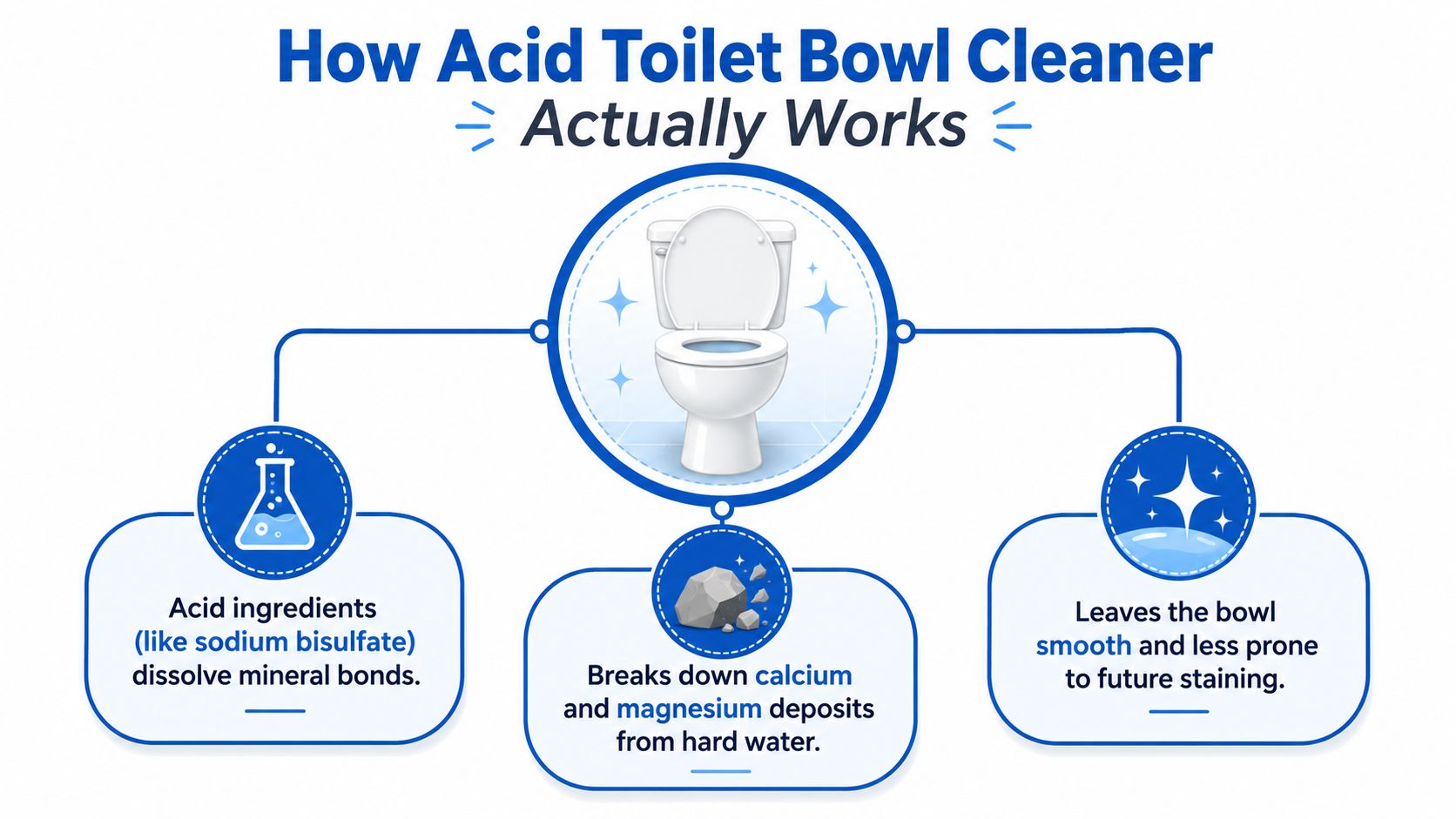
Acid toilet bowl cleaner is reactive chemistry aimed at mineral deposits. If the stain is scale, rust, or the kind of crust that clings to porcelain after hard water dries, acid can break it down where a regular detergent just slides past it. Early commercial examples made that clear. Sani-Flush was introduced in 1911 by the Hygienic Products Company in Chicago, and by 1922 it was being marketed for rust, scale, and sludge in automobile radiators, which shows how early the category was already being used for hard mineral removal. Its main ingredient, sodium bisulfate, creates a highly corrosive acidic solution when mixed with water that dissolves deposits such as iron, magnesium, and calcium (Sani-Flush history).
The chemistry changed, but the basic job did not. Modern products still rely on acids to loosen mineral buildup, and they are chosen for different trade-offs, from speed to surface contact to the amount of fuming a user has to tolerate. A cleaner built around acid is for scale, not for every bathroom problem, and that distinction matters before anyone starts scrubbing.
The working principle is simple. The acid attacks the bond between the deposit and the porcelain, softens the crust, and makes the residue easier to remove with a brush or cloth. That means the cleaner has to touch the stain directly, stay in place long enough to react, and only be used on surfaces that can handle that chemistry.
Common Active Acids in Toilet Bowl Cleaners
| Active Acid | Typical Role | Strength Range | Key Trade-off |
|---|---|---|---|
| Sodium bisulfate | Creates an acidic solution that dissolves mineral deposits | Qualitative, used as an acidic cleaner base | Effective on scale, but still harsh on sensitive materials |
| Hydrochloric acid | Strong scale and rust removal in bowl cleaners | 5.00% to 10.00% in one consumer product SDS | Fast on mineral buildup, higher risk around metals and finishes |
| Phosphoric acid | Removes restroom buildup in ready-to-use formulas | Qualitative, product-specific | Often easier to handle, but still needs careful surface matching |
Performance depends on more than acid strength. Viscosity and cling matter because the cleaner has to stay on the rim and vertical porcelain long enough to work instead of running straight into the water. One commercial datasheet describes a product that clings to surfaces for improved contact time and less splashing, and that kind of behavior is what helps a cleaner stay on a stained band instead of disappearing on first contact with the bowl.
Using Acid Toilet Bowl Cleaner the Right Way
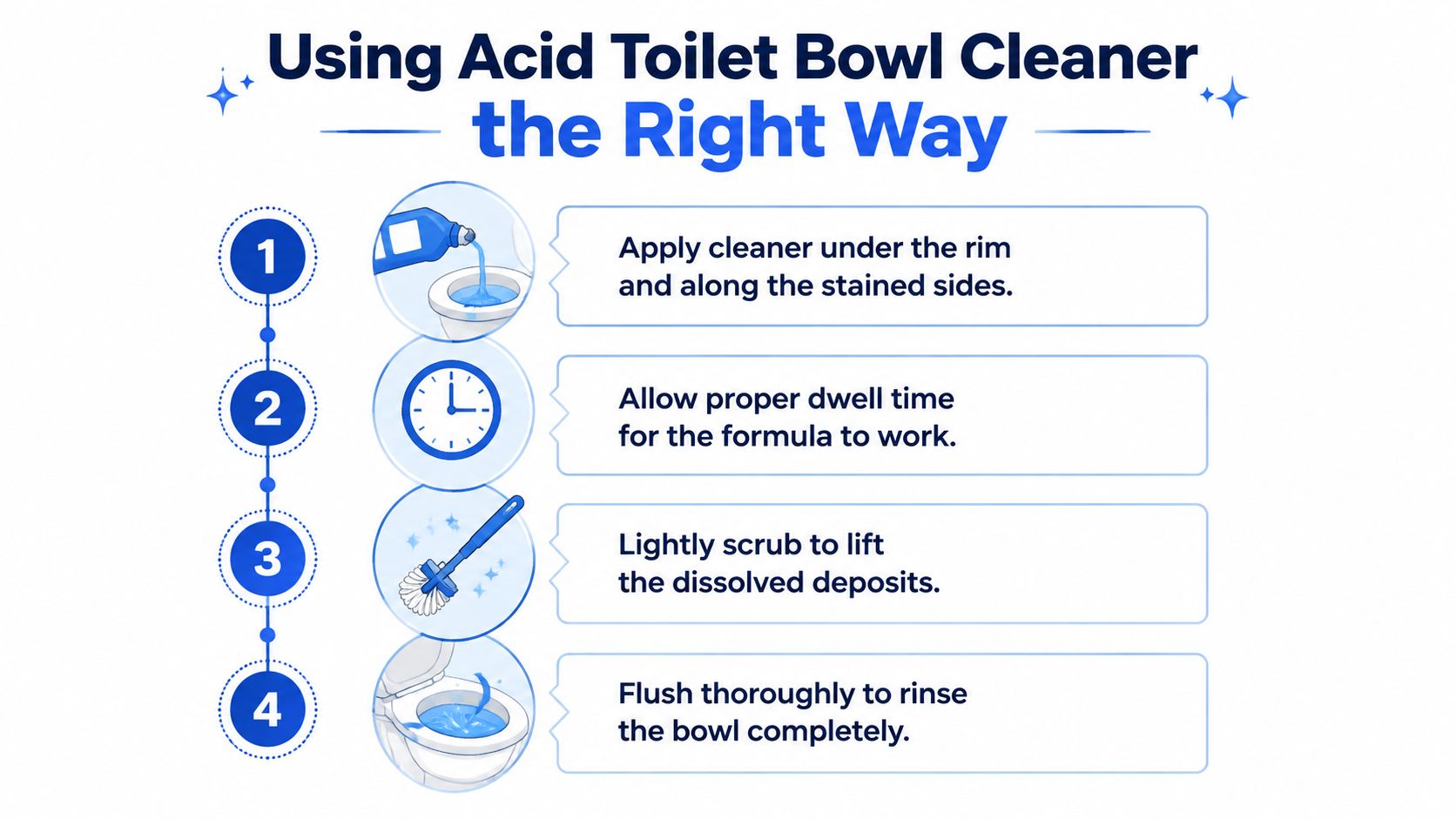
The cleaner works best when it's placed where the stain lives. That usually means under the rim, along the waterline, and on any visible mineral band on the bowl wall. If you pour it in and flush too quickly, you've wasted the chemistry before it had a chance to soften the buildup.
Higher-cling formulas help because they stay put. One commercial formulation reports a viscosity around 2,000 cps and specifically calls out improved contact time and less splashing (Stepan formulation data). That translates into a real-world benefit, especially on vertical porcelain where a thin liquid would just slide straight down.
A practical sequence that actually works
- Apply the cleaner under the rim. Aim for the stained band, not the center of the bowl.
- Let it dwell. The acid needs uninterrupted contact to loosen the deposit.
- Brush lightly after the buildup softens. Aggressive scrubbing first just wastes energy.
- Flush thoroughly. You want the bowl rinsed clean before anyone uses it again.
A thick product is often easier to control than a watery one. It clings better, splashes less, and keeps the active acid where you need it. That said, no product should sit on a surface longer than the label allows, especially if the bowl has any damage or nearby materials that don't like acid.
Acid works best when it's matched to the stain and given enough contact time to do the job.
The mistake I see most often is people scrubbing too soon. Once the mineral bond starts to break, the brush does the finishing work. Before that, all you're doing is moving a stubborn deposit around.
Real Safety Risks Every Household Should Know
A toilet ring can look like a simple cleaning problem, but the safety risk is in the chemistry sitting inside the bottle. Acid toilet bowl cleaner is built to attack mineral buildup, and the same acid that breaks down scale can also burn skin, sting eyes, and irritate breathing if the product is handled carelessly. A safety data sheet lists hydrochloric acid at a pH of 1.0, and another identifies hydrochloric acid at 15% to 40% with corrosive toilet and urinal cleaner hazards, including severe burn and eye-damage risk (Michigan SDS, Swish SDS). In a home bathroom, that means the product needs respect from the moment the cap comes off.
Bleach is where people get into real trouble. An acid bowl cleaner and chlorine bleach can react and release toxic chlorine gas, and there are documented incidents that show how fast that turns into an emergency. One reported event on April 8, 1964 in St. Petersburg, Florida, led to evacuation of a Winn-Dixie food store and hospitalization of 11 people after incompatible products were used together (NASSCO SDS and product sheet). That is why bathroom chemicals have to stay separated, even if the bowl still looks dirty and you are tempted to “finish the job” with whatever is under the sink.
What the label precautions mean in real life
- Wear gloves, clothing, and eye protection. One SDS says protective gloves, protective clothing, and eye/face protection are required (Staples SDS).
- Do not mix with bleach or ammonia products. The risk comes from the reaction itself.
- Ventilate the room. Strong acid fumes build quickly in a small bathroom, especially if the door stays closed.
- If swallowed, rinse the mouth, do not induce vomiting, and call poison control or a doctor immediately. That guidance is explicit on the SDS (Staples SDS).
Acid cleaners also react with metals, which is easy to forget when the bottle is aimed at the bowl and the overspray lands elsewhere. One SDS warns that hydrochloric acid reacts with most metals and can generate explosive hydrogen gas (Michigan SDS). That means the bottle belongs in the porcelain basin, not on the flush handle, supply line, hinge hardware, or decorative trim.
If you want a gentler route for jobs that do not call for acid, chemical-free cleaning products are worth looking at before you reach for the strongest cleaner on the shelf. The right product starts with the stain, then matches the chemistry to what is in the bowl.
Fixture Compatibility and What Acid Can Damage
The bowl itself is usually the safest place for an acid toilet bowl cleaner, but the bathroom around it isn't built the same way. Glazed porcelain can usually handle acid better than nearby metal parts, grout, or natural stone. That's the part many overlook when they're focused on the ring in the bowl.
The concentration difference matters too. Modern acidic cleaners can be relatively mild for the category, like a product listed at 5.00% to 10.00% hydrochloric acid (NASSCO SDS and product sheet), while heavy-duty formulas can reach 23% hydrochloric acid in one 3M bowl cleaner and 24% in another commercial toilet-and-urinal cleaner (3M product sheet, 3M phosphoric-acid restroom cleaner sheet). That's a meaningful jump in risk, especially if the cleaner splashes onto finishes that weren't meant to see it.
What belongs in the bowl and what doesn't
- Glazed porcelain, generally the best fit for acid cleaners when used as directed.
- Natural stone, a poor match because acid can etch or dull it.
- Metal fixtures, a bad target because acid can corrode or discolor them.
- Damaged glaze, risky because weakened surfaces can stain or etch faster.
- Grout and adjacent trim, worth protecting because overspray lands there more often than people think.
Keep the product inside the bowl, and rinse splashes right away.
The practical rule is simple. If the surface isn't glazed ceramic inside the bowl, assume the acid can create a problem over time. If you're cleaning a bathroom with specialty finishes, a stronger product isn't automatically a smarter one.
Bathroom Surface Compatibility With Acid Cleaners
| Surface | Acid Tolerance | Risk With Strong Acid | Safer Alternative |
|---|---|---|---|
| Glazed porcelain bowl | Generally good for directed use | Low if used briefly and rinsed well | Use as directed, then flush thoroughly |
| Natural stone | Poor | Etching, dulling, surface damage | Stone-safe cleaner |
| Metal flush parts | Poor | Corrosion, discoloration | Mild non-acid cleaner on a cloth |
| Grout | Limited | Erosion and weakening with repeated contact | Grout-safe cleaner |
Diagnosing the Stain and Choosing the Right Product
A toilet ring tells you more than it first appears. Some marks are hard-water scale, some are rust, and some are organic residue that happened to land in the bowl. Acid toilet bowl cleaner works best on mineral-based buildup, so it belongs on hard-water deposits and some rust stains, not on every ugly spot you can see.
Hard-water deposits are usually the cleanest match for acid because the chemistry breaks down mineral buildup. Rust can also respond well, since acidic cleaners are made for inorganic deposits that cling to bathroom fixtures. Mold, mildew, and other organic residue call for a different approach, and a bleach-based cleaner or another product is often the better fit.
Citric acid sits in a useful middle ground for some homeowners. It is still acidic, but it is often the choice when you want strong stain removal without jumping straight to the harshest product on the shelf. If you are comparing vinegar, baking soda, and other milder options, this vinegar and baking soda cleaning guide is a better place to start than assuming acid solves everything.
A quick stain check helps before you buy.
- White or chalky ring: Usually mineral scale.
- Orange or brown streaking: Usually rust-related.
- Smudgy or spreading residue: Usually not a mineral problem.
- Persistent buildup after repeated acid use: Often a fixture issue or a water issue, not a cleaning problem.
Repetition is the biggest clue. If the same stain comes back fast, the issue may be hard water, a flush problem, or buildup somewhere else in the system. In that case, stronger bottles only keep treating the symptom.
If the stain type is wrong, the cleaner is wrong, no matter how strong it smells.
The best product choice starts with diagnosis, not force. That saves money, protects fixtures, and keeps you from using acid on a stain it cannot solve.
Storage, Disposal, and Household Safety Checklist
A bottle of acid toilet bowl cleaner should stay in the cleaning cabinet, sealed in its original container, and kept apart from bleach, ammonia, and other products that could react if a cap loosens or a bottle leaks. In a house with kids, guests, or a busy cleaning closet, that separation is part of the job, not an extra precaution.
A spill calls for quick, careful cleanup. Open a window or turn on ventilation, use gloves and eye protection, and keep other cleaners out of the area. If the product gets on skin, rinse it off right away instead of waiting to see whether it starts to burn. Acid can start causing trouble fast.
Keep this checklist handy
- Storage: Put the cleaner in a cool, dry place, inside the original bottle, where children and pets cannot reach it.
- Disposal: Follow local disposal rules, and do not pour large leftovers casually down a drain.
- Safety: Wear gloves and eye protection during use, and never mix acid cleaner with any other product.
That checklist is plain because the risks are plain. The worst problems usually start with small mistakes, like a cap left loose, a bottle stored next to bleach, or someone grabbing the wrong cleaner for the wrong stain. The bottle sitting untouched on a shelf is rarely the issue.
When the job is finished, wash your hands, tighten the cap, and return the bottle to a spot where nobody will mistake it for a general-purpose spray. That habit keeps a toilet cleaner in its lane and out of the rest of the house.
When to Bring in Sunny Day Pro Services
Some toilets need more than another round of acid. If the stain keeps returning, if the bathroom has specialty stone or delicate trim nearby, or if you're dealing with move-in, move-out, or post-construction grime, a professional cleaning team is often the safer call. That's especially true in homes where repeated acid use would put finishes, fixtures, or septic concerns at risk.
A pro can also separate what's mineral scale from what isn't. That matters because the wrong cleaner wastes time and can damage the room while the actual problem stays in place. In older homes and high-use bathrooms, I'd rather see a targeted plan than a homeowner keep escalating to harsher bottles.
The right help saves fixtures as well as time.
Sunny Day Pro Services works with Massachusetts homeowners who want a clean bathroom without the guesswork around chemistry, surfaces, or follow-up maintenance. If you're in Wayland, Newton, Needham, Wellesley, Weston, or a nearby town and you're tired of fighting the same stain, it's worth getting a team involved before the next bottle makes the problem worse.
Sunny Day Pro Services handles deep cleaning, move-in and move-out resets, and post-construction cleanup with trained, background-checked professionals and a satisfaction guarantee. If acid toilet bowl cleaner hasn't solved the ring, or you'd rather protect your bathroom finishes from the start, visit Sunny Day Pro Services and request a fast quote.

