
Inspiring Bathroom Tile Backsplash Ideas: 2026 Trends
Find 8 inspiring bathroom tile backsplash ideas, with pros, cons, installation tips, 2026 trends, and cost. Contact Sunny Day Pro Services.
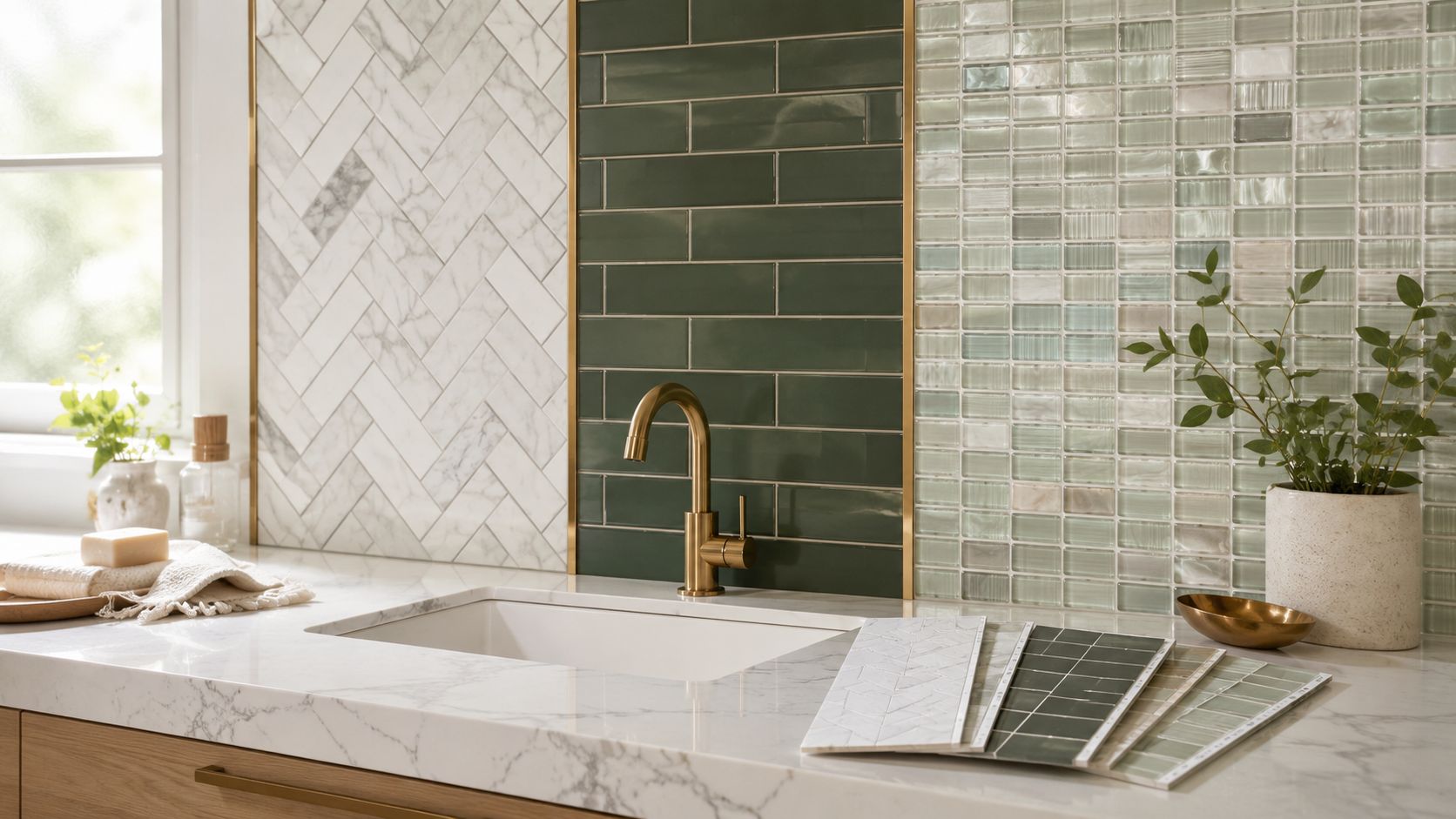
Transform Your Bathroom with Style and Function
Walk into most busy Massachusetts bathrooms and you can spot the same problem fast. The vanity wall takes more abuse than people expect. Toothpaste spray, hand soap splatter, damp hands, curling-iron heat, and the occasional puddle at the faucet base all end up on one small stretch of wall. A good backsplash fixes that, but it should also make the room look finished instead of patched together.
The best bathroom tile backsplash ideas do both jobs at once. They protect the wall, tie the vanity into the rest of the room, and give you a surface that wipes clean. In homes around Wayland, Newton, Needham, Wellesley, and Weston, that often means balancing classic New England taste with newer 2026 design moves like tile drenching, artisanal texture, and larger-format tile.
This roundup gets straight to the point. You'll find 8 bathroom tile backsplash ideas that work in real homes, not just showroom photos. Each one includes where it shines, where it can go wrong, what installation details matter, how much visual scale you're taking on, and what I'd recommend if you want the result to age well. If you're updating a powder room, refreshing a primary bath, or getting a home ready for sale, these are the backsplash styles worth considering.
Table of Contents
- Texture works best when light and maintenance are planned first
- My recommendation for scale and budget
- Best uses for reflective tile in 2026 bathrooms
- What homeowners should know before choosing it
- How to keep the finish polished
1. Classic Subway Tile Backsplash
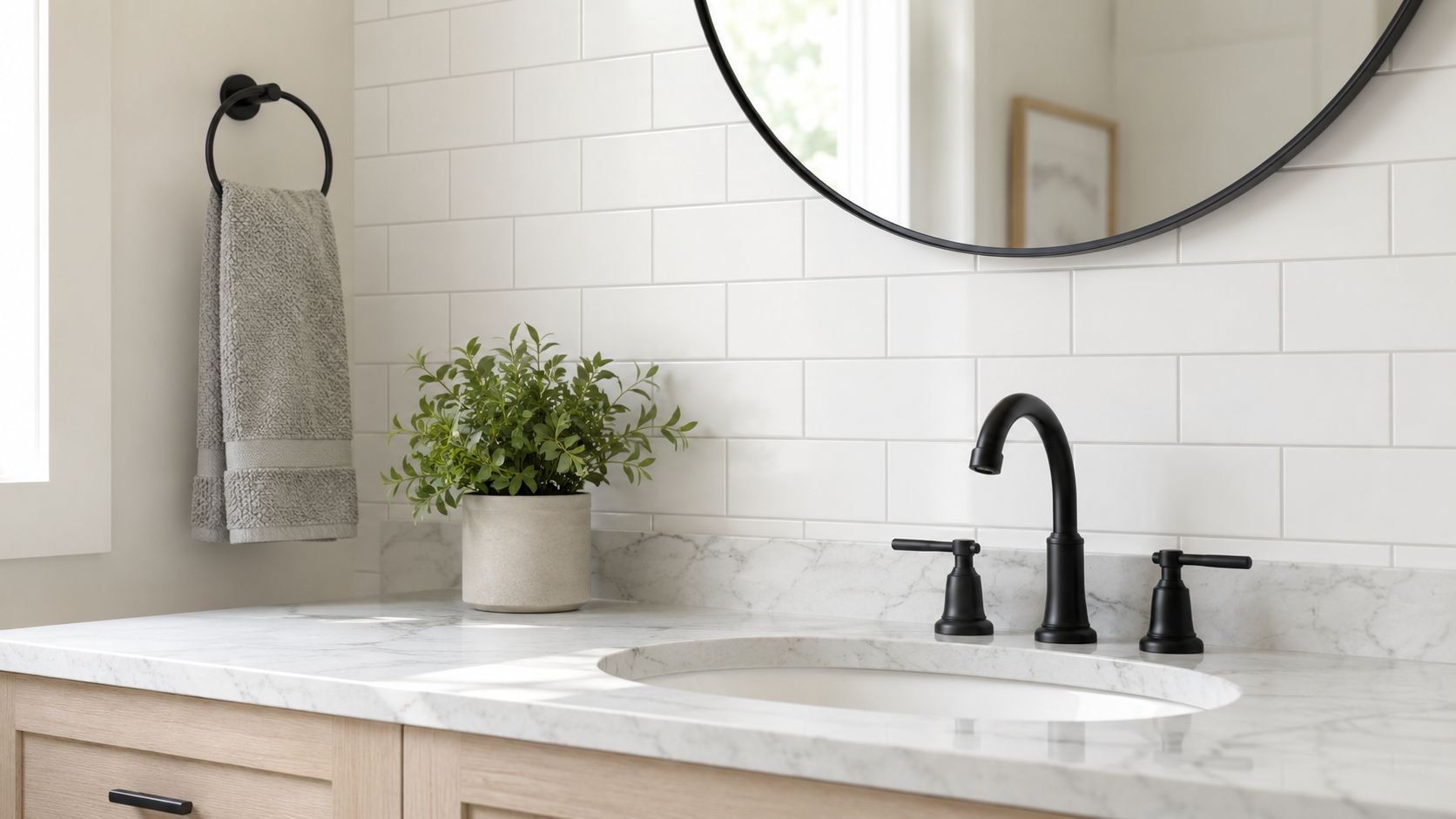
You walk into a Lexington hall bath after a long winter, the mirror is fogged, the kids have splashed the vanity wall again, and you want a backsplash that still looks clean without constant fuss. Classic subway tile keeps getting specified for that exact reason. It is familiar, easy to scale, and hard to make look out of place in Massachusetts homes, from older colonials to newer condo renovations.
Subway tile also has more range now than homeowners expect. The Tile Council of North America notes in its 2024 tile trends report that larger wall tile formats continue gaining attention, and that shift shows up in subway sizes too. In practice, I see more 4x12 and 5x10 than old-school 3x6 on upscale vanity walls because the longer format looks calmer and leaves fewer grout joints to scrub.
Why it still works in Massachusetts homes
This style earns its keep in towns where resale matters and bathrooms need to age well. In Needham, Wellesley, and Newton, white or warm off-white subway tile still fits the broadest range of cabinet colors, countertop patterns, and fixture finishes. It also works with the 2026 tile drenching direction, where the backsplash, side splash, and sometimes the full vanity wall stay in the same tile family for a more wrapped, intentional look.
Orientation changes the effect more than color does. A horizontal brick pattern helps a tight powder room feel wider. A vertical stack feels cleaner and more current, especially on a narrow wall between sconces. If the room already has busy stone or bold wallpaper, keep the tile simple and let the finish quality do the work.
Practical rule: In a humid bath, porcelain subway tile usually gives you better long-term durability than basic ceramic, especially in busy family bathrooms.
Best uses and common mistakes
Classic subway tile fails when the installer treats it like a default instead of a finish surface people will see at eye level. Crooked lines, cheap plastic edge trim, and poorly planned cuts around outlets will cheapen the whole vanity area. Good subway tile looks crisp because the layout was centered, the terminations were deliberate, and the grout color matched the room instead of being chosen at the last minute.
For Massachusetts homeowners watching budget, this is one of the safer backsplash choices to scale up or down. Standard ceramic subway tile is usually the lower-cost entry point. Porcelain, handmade-look surfaces, beveled edges, and longer formats raise material and labor costs. On a small vanity wall, that upgrade can still make sense because the square footage is limited and the backsplash sits right in your line of sight.
If you are planning the work yourself first, review Sunny Day's guide on how to install a kitchen backsplash. The substrate, spacing, and layout discipline apply to bathroom vanity walls too.
- Best for: Family baths, resale-focused remodels, and vanity walls that need a timeless finish
- Works especially well with: Quartz or marble-look tops, painted vanities, polished nickel, chrome, and matte black fixtures
- Watch for: Bright white grout that soils fast, awkward end cuts, and overly beveled tile in small bathrooms where shadows can look busy
For homeowners who want a backsplash that stays relevant, cleans up easily, and fits both classic and current Massachusetts bathrooms, subway tile is still one of the smartest calls. If you want it installed with sharper layout work and cleaner finishing than the average builder-grade job, Sunny Day Pro Services is the team to call.
2. Herringbone Pattern Tile Backsplash
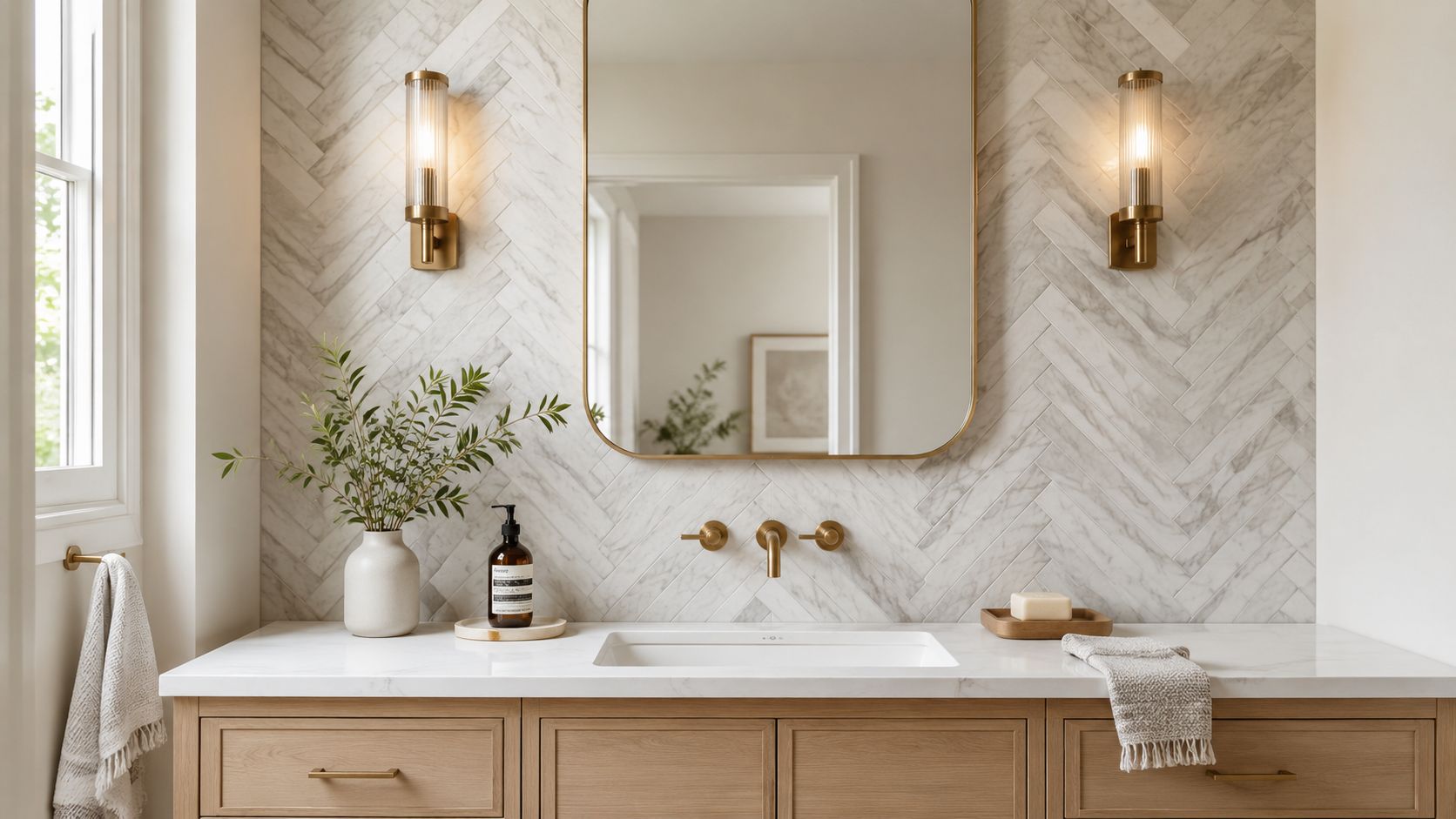
Herringbone is what I recommend when a homeowner wants subway tile energy with more movement. It uses familiar rectangular tile, but the V-shaped layout gives the vanity wall a custom feel. In a Weston primary bath or a refined Needham remodel, that extra pattern can lift the whole room without forcing a loud color choice.
This layout works especially well when the vanity itself is simple. A flat-panel cabinet, slab countertop, and understated mirror leave room for the tile to do more.
When herringbone earns its keep
A herringbone backsplash is strongest on a modest wall area, usually behind a single or double vanity where you want a focal point. Marble-look porcelain works well if you like the upscale look but don't want the stone maintenance. Real marble looks beautiful too, but it demands better care and a more disciplined cleaning routine.
Contrast matters here. Light tile with charcoal grout gives you a crisp geometric read. Tone-on-tone grout softens the pattern and reads more like texture.
Use herringbone when you want the pattern to be the statement. Don't stack it next to a busy wallpaper, ornate sconces, and a heavily veined countertop unless you've already mocked it up.
What to plan before installation
This is not the pattern to hand off to someone who only sets straight rows. Small alignment errors drift fast, and once the pattern starts walking out of square, every cut gets harder. Good installers dry-lay a section first, establish the centerline, and decide in advance where cuts land at the ends.
A few practical trade-offs matter:
- More visual energy: Great in plain bathrooms, risky in already busy ones
- More labor: Every corner, edge, and outlet cut takes more care
- More grout decisions: Grout color changes the whole look more than often realized
If you're in a compact Massachusetts bath and want designer detail without covering every wall, herringbone is one of the smartest bathroom tile backsplash ideas on this list.
3. Mosaic and Mixed Pattern Tile Backsplash
A Massachusetts powder room is often where homeowners loosen up a little. The vanity wall is small, the risk is contained, and a mosaic backsplash can add character that would feel too busy in a full primary bath. In Newton, Wellesley, and older Boston-area homes, I see this style work best when it has one job: give the vanity wall a focal point without pulling the whole room off balance.
Where mosaic looks intentional
Mosaic needs a controlling idea. That can be a tight color story, one repeated shape, or a clear finish choice such as matte porcelain with a small amount of gloss. The bathrooms that miss the mark usually mix too many things at once: different scales, shiny and flat finishes fighting each other, and accent colors that already show up in the countertop, wallpaper, and floor.
For Massachusetts homes, scale matters as much as pattern. A compact vanity in a Lexington colonial can handle a framed mosaic panel or a clean backsplash band. A larger primary bath in Weston has more room for a mixed-pattern installation, but even there I usually recommend keeping it to the sink wall unless the rest of the material palette is very restrained.
Tile drenching is pushing more homeowners toward fuller wall coverage in 2026. Mosaic can still fit that direction, but it works better as a contained statement than as a full-room treatment. Too much pattern on every surface makes the bathroom feel smaller and harder to read.
Cost, layout, and maintenance trade-offs
This is one of the first backsplash styles where labor can overtake material cost. Sheet mosaics sound simple until the wall is out of plumb, the outlet cuts get tight, or the pattern requires hand-setting to keep joints even. If you want a realistic sense of where labor starts climbing, Sunny Day's guide to backsplash installation cost factors lays out the main pricing drivers clearly.
Mixed pattern also means more decisions before the first tile goes up. Grout color, sheet alignment, edge trim, and where the pattern stops all change the result. I always advise homeowners to mock up a few full sheets on a table first, because a mosaic that looks balanced in a sample board can feel scattered once it spreads across a wall.
Color blocking is also shaping current remodel choices. The NKBA's 2024 Kitchen Trends Report points to continued use of contrasting materials and colors to define zones, and that idea carries over well to bathroom backsplashes. Use mosaic to mark the vanity area clearly, especially in open or larger baths, instead of repeating the same mixed pattern on the floor, niche, and shower walls.
- Best move: Keep mosaic to one defined vanity zone, framed panel, or short backsplash run
- Risky move: Repeat multiple bold patterns across the backsplash, shower niche, and floor
- Smart material mix: Use porcelain for the main field, then add glass or metallic pieces sparingly for light and depth
If you want a backsplash that feels custom and local to the home, this is one of the strongest bathroom tile backsplash ideas on the list. For clean execution, the installer matters as much as the tile choice. Sunny Day Pro Services can help Massachusetts homeowners plan the layout, control the pattern, and keep the finished wall from reading cluttered instead of crafted.
4. Large-Format and Slab Tile Backsplash
If subway tile is the familiar classic, large-format tile is the cleaner, quieter modern answer. This is the backsplash style I suggest when homeowners want fewer grout joints, calmer surfaces, and a more architectural look. It fits especially well in newer homes in Weston or updated primary baths in Newton where the goal is less visual interruption.
Large-format doesn't have to mean oversized drama. Even stepping up from small tile to a larger rectangular piece can change how polished the wall feels.
Why larger tiles are gaining ground
The 2026 shift toward 4x12 and 6x12 subway formats reflects a broader preference for fewer grout lines and easier care, as noted earlier. That same principle is one reason full slab and large-format backsplashes feel so strong in bathrooms. They look cleaner because your eye isn't stopping at every joint.
This style also lines up with tile drenching. In 2026 projections, tile drenching has emerged as a dominant bathroom benchmark, and large-format or minimal-grout tile supports that continuous appearance while also addressing maintenance concerns. The same report notes that 78% of homeowners in major markets prefer finishes that minimize maintenance and grout cleaning time, according to My Stone Floor's bathroom tile trend article.
Best fit for modern bathrooms
A slab-look porcelain backsplash paired with a matching vanity top can make a smaller bath feel calmer and more upscale. In Massachusetts homes where winter light can be flat for part of the year, I usually steer people toward soft whites, greige stone looks, and light gray veining rather than harsh bright white.
What doesn't work is poor wall prep. Larger pieces show every hump, dip, and crooked line.
- Best for: Minimalist bathrooms, spa-inspired remodels, and easy-clean priorities
- Watch for: Uneven substrates, awkward seam placement, and glossy finishes that show every spot
- Good pairing: Floating vanity, simple mirror, warm brass or polished nickel hardware
5. Textured and 3D Tile Backsplash
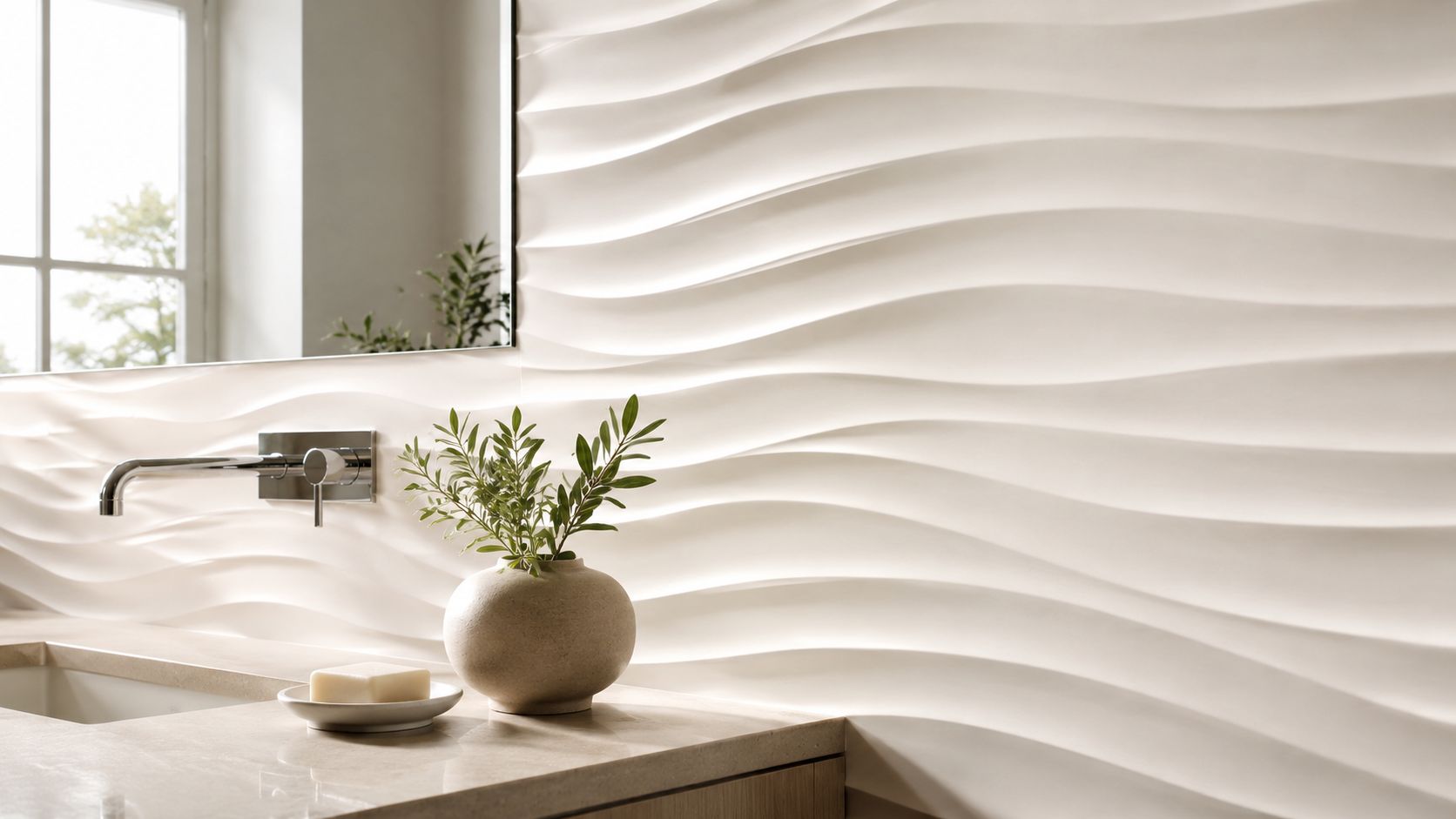
A lot of Massachusetts homeowners reach this point in the selection process after rejecting flat tile that feels too plain and patterned tile that feels too busy. Textured and 3D backsplash tile solves that problem. It gives the vanity wall movement, catches side light, and adds interest without forcing a strong print into a small bathroom.
This style is gaining traction for 2026 because bathrooms are getting warmer, quieter, and more tactile. Designers are calling out tile drenching, color continuity, and handcrafted surfaces as key directions in the National Kitchen and Bath Association 2026 design trend report. That lines up with what works in local homes. In Boston-area condos and older suburban baths, a textured backsplash in clay, putty, muted green, or warm gray can soften the room without dating it fast.
Texture works best when light and maintenance are planned first
I like this look most on a vanity wall with good sconce placement or a mirror light that washes the surface from the side. That is what brings out fluting, soft ridges, hand-formed edges, and uneven glaze. If the lighting is flat, much of the detail disappears.
The other trade-off is cleaning. Subtle texture is manageable. Deep relief is harder to wipe down, especially around toothbrush splash, soap residue, and hair product buildup. For family baths, I usually recommend a low-profile textured porcelain rather than a sharply sculpted ceramic tile.
A few options consistently perform well:
- Best texture profiles: Fluted, ribbed, softly pillowed, hand-molded, or lightly undulated tile
- Best colors for Massachusetts homes: Warm white, mushroom, sage, dusty blue, sand, and greige
- Best use: One vanity wall or a short backsplash run where lighting can highlight the surface
- Avoid if: The wall gets heavy daily splash and nobody wants detailed cleaning
For homeowners considering stone-look textured surfaces nearby, proper care still matters. Our guide on how to clean marble tile without dulling the finish covers the kind of maintenance questions that often come up once texture enters the plan.
My recommendation for scale and budget
For a standard 36 to 60 inch vanity, textured backsplash tile usually works best when the pattern repeat is restrained and the tile size stays moderate. Tiles in the 2x8, 3x12, and 4x10 range tend to give enough shadow line without making the wall feel crowded. In smaller powder rooms, one well-chosen textured field tile often looks better than mixing texture with mosaic or a bold grout color.
Cost is also worth being direct about. Textured and 3D tile usually runs higher than basic flat subway because installation is slower, layout matters more, and uneven faces can expose sloppy grout work. If the goal is a custom look without slab pricing, though, this is one of the better places to spend.
In Wellesley, Newton, and Needham homes, I see this style land best in bathrooms that want a calm, refined finish instead of a sharp modern edge. If you want that result without ending up with a backsplash that is hard to maintain or poorly lit, Sunny Day Pro Services can help you choose the right profile, scale it to your vanity, and install it cleanly the first time.
6. Natural Stone Tile Backsplash (Marble, Granite, Slate)
Natural stone gives a bathroom something manufactured products still struggle to copy completely. Real veining, tonal variation, and surface character make the vanity wall feel grounded and expensive in the right way. In older Massachusetts homes, that authenticity can also connect nicely with original architecture and millwork.
But stone is not the easy button. If you want it, you need to be honest about maintenance.
Stone gives you character, but it asks more from you
Marble is the classic favorite for elegance. Slate brings an earthier, moodier look. Granite tends to be the tougher, more forgiving choice where you still want natural material but less fuss.
For 2026 installations, earthy tonal palettes like sand, sky, and warm greige are appearing in 70% of new bathroom installations, while 65% of bathroom remodels are using textured, handcrafted, or perfectly imperfect tile surfaces, according to Oasis Tile's bathroom trend report. Honed marble, tumbled limestone looks, and slate all sit comfortably in that move toward natural, less polished surfaces.
Where each stone type fits best
Marble works best when the homeowner accepts that patina is part of the charm. It's a strong choice behind a primary bath vanity where the room is well ventilated and cleaning is careful. Granite suits harder-use family bathrooms better. Slate can be striking in powder rooms or moody transitional spaces, though it needs a room design that supports its weight.
For marble care, Sunny Day's guide on how to clean marble tile properly is worth bookmarking before installation, not after the first stain.
- Marble: Elegant, classic, higher maintenance
- Granite: More durable, often better for busy bathrooms
- Slate: Rich texture, strong personality, not for every room
7. Glass and Metallic Tile Backsplash
A common Massachusetts bathroom problem is simple. The vanity wall sits under one fixture, the room gets gray winter light, and everything looks flatter than it did in the showroom. Glass and metallic tile can fix some of that by throwing light back into the room, but only if the material is used with restraint.
I usually recommend this category for powder rooms, smaller hall baths, and vanity walls that need more life without adding a loud pattern. Glass gives a cleaner, brighter read. Metallic tile adds warmth or contrast, depending on the finish. Both show installation mistakes fast, so the appeal is tied closely to workmanship.
Best uses for reflective tile in 2026 bathrooms
Designers continue to call out glossy, light-catching surfaces as part of the 2026 move toward more immersive bathrooms, especially in color-drenched spaces where the backsplash is meant to participate in the wall treatment instead of standing apart, according to Fireclay Tile's 2026 bathroom design trend report. That fits what I see in towns like Newton, Needham, and Arlington. Homeowners still want calm palettes, but they want depth and light inside those palettes.
For a Massachusetts home, the strongest versions are usually controlled and scaled to the room:
- Glass subway tile: Good for tight vanity walls that need brightness and easy wipe-downs
- Iridescent mosaic: Better as an inset or narrow field than a full reflective wall
- Brushed metallic tile: Works best in small amounts, especially with warm brass or polished nickel fixtures
- Blue-gray or smoke-toned glass: Suits coastal and transitional homes without looking cold
Tile drenching matters here. If the wall color, backsplash, and side splash stay in the same tonal family, reflective tile feels intentional. If every surface competes, it starts to look busy fast.
What homeowners should know before choosing it
This material asks for a flatter substrate, cleaner cuts, and tighter setting than many ceramic options. Glass can telegraph trowel lines. Metallic finishes can highlight lippage, crooked outlets, and uneven grout joints. That means labor costs can run higher than a basic ceramic backsplash, even when the tiled area is small.
Budget also shifts by format. A simple glass subway installation is often the most manageable path if you want shine without paying mosaic-level labor. Metallic accents cost less when they are treated as a border, insert, or mirror surround instead of a full field. For homeowners trying to balance cost and visual impact, that is usually the smarter trade.
How to keep the finish polished
A few rules prevent this look from getting harsh:
- Match the sheen to the lighting: Strong cool LEDs can make silver and mirror finishes feel sterile
- Use contrasting texture nearby: Painted wood, quartz, or stone-look counters help ground the reflection
- Keep grout lines consistent: Reflective tile makes sloppy spacing obvious
- Limit full-wall metallic coverage: Accent placement usually looks more custom than an entire shiny field
In practice, I get the best results when glass or metallic tile supports the room instead of dominating it. Used well, it brightens a small vanity wall, sharpens a transitional design, and gives a Massachusetts bathroom a finished look that still feels livable.
8. Patterned and Encaustic Tile Backsplash
Patterned tile is for homeowners who want the vanity wall to carry personality on its own. It can be geometric, floral, Moroccan-inspired, Mediterranean, or monochromatic. The strongest versions don't apologize for being decorative. They just stay disciplined about where the pattern starts and stops.
This is often the right move in a powder room, guest bath, or a vanity area that otherwise feels too plain.
Pattern works best when the rest of the room settles down
Patterned backsplashes work when they have room to breathe. If the floor already has a strong motif and the shower tile is active, I'd usually pull back. If the vanity is simple, the walls are quiet, and the hardware is clean, encaustic or printed pattern can become the room's signature feature.
There's also a useful in-between option that many guides skip. You don't always need to tile everything. Homeowners in high-steam bathrooms often prefer targeted moisture barriers like vinyl-coated or epoxy-sealed panels instead of covering the whole wall, and 40% prefer that approach, according to Home Depot's bathroom backsplash guidance. That's a practical move if you want pattern at the vanity without over-tiling the room.
If you love patterned tile, keep the field small and the cuts clean. Pattern that stops awkwardly at a mirror or outlet always looks cheaper than the tile itself.
How to use bold tile without regretting it
Choose pattern with a long shelf life. Repeating geometrics and old-world motifs usually last better than novelty prints. Monochromatic pattern is also easier to live with than high-contrast multi-color work.
One more overlooked trick is grout contrast. Trend coverage notes that movement-filled materials and contrasting grout are rising while some older framed-inlay looks decline, and many mainstream articles still miss how much dimension grout alone can add, according to this YouTube trend analysis on backsplash design direction. If full patterned tile feels like too much, contrasting grout on a simpler tile can still give you depth.
8-Option Bathroom Backsplash Comparison
For Massachusetts homeowners, the best backsplash is usually the one that fits the room's scale, moisture load, and cleaning habits, not just the showroom sample. A compact powder room in Cambridge can carry more pattern than a busy family bath in Newton, and a full tile-drenched 2026 look only works if the install quality is there.
Use this comparison to narrow the field before you price materials and labor.
| Style | Installation complexity | Typical budget impact | What you get visually | Best fit in Massachusetts homes | Main advantages |
|---|---|---|---|---|---|
| Classic Subway Tile Backsplash | Low. Straightforward layout, simple cuts in most vanity areas | Low to moderate | Clean, familiar lines that help smaller baths feel more open | Starter bath updates, older homes that need a respectful refresh, practical family bathrooms | Affordable, easy to source, easy to clean, works with many countertops |
| Herringbone Pattern Tile Backsplash | High. Layout control and angle cuts need an experienced installer | Moderate to high | Strong movement and a custom look that reads more tailored than a basic brick set | Narrow vanity walls, upscale remodels, homes where you want one patterned feature without covering every wall | Intricate patterning, strong visual movement, high design impact |
| Mosaic and Mixed Pattern Tile Backsplash | High. Sheet alignment, edge finishing, and pattern balance take time | High | Detailed focal point with more texture and variation than field tile | Powder rooms, niche vanity walls, homes with eclectic or handcrafted finishes | Flexible design range, good at disguising imperfect walls, adds personality fast |
| Large-Format and Slab Tile Backsplash | High. Heavy material, flatter walls, and better prep are required | High | Continuous, minimalist surfaces with very few grout joints | Contemporary homes, larger vanity runs, bathrooms where easy wipe-down matters | Less grout to maintain, cleaner visual lines, premium appearance |
| Textured and 3D Tile Backsplash | Moderate to high. Placement, lighting, and grout cleanup matter more here | Moderate to high | Surface depth that changes through the day as light shifts | Accent zones, spa-style baths, vanity walls with good side lighting | Adds depth, softens plain rooms, can hide spotting better than glossy flat tile |
| Natural Stone Tile Backsplash (Marble, Granite, Slate) | High. Cutting, sealing, and substrate prep need care | Very high | Natural variation, veining, and a more established architectural feel | Period homes, higher-end primary baths, projects tied closely to resale presentation | Unique material character, strong perceived value, pairs well with wood and painted vanities |
| Glass and Metallic Tile Backsplash | Moderate. Backer color, adhesive choice, and grout selection affect the final look | Moderate to high | Light-reflective finish that helps darker or smaller baths feel brighter | Small bathrooms, contemporary updates, vanity areas with limited natural light | Reflects light well, adds color depth, useful in tighter spaces |
| Patterned and Encaustic Tile Backsplash | High. Pattern placement and clean termination lines are unforgiving | High | Decorative statement that becomes the main visual feature | Design-forward homes, compact baths where one wall can carry the style, historic homes with the right motif | Strong personality, memorable finish, broad range of traditional and modern patterns |
One practical note from the field. Labor often determines the overall price difference more than tile alone. Subway tile may cost less per square foot and install faster, while herringbone, mosaics, and encaustic layouts can push labor up because every crooked line shows.
If you want direct guidance for your bathroom, Sunny Day Pro Services can help match the backsplash style to your wall condition, vanity size, and budget before installation starts.
Ready to Install Your Dream Backsplash?
The right backsplash does more than protect drywall. It sets the tone for the whole vanity area. In some bathrooms, that means staying classic with subway tile and careful grout selection. In others, it means bringing in herringbone movement, soft artisanal texture, or a slab-style surface that cuts visual noise and cleaning time.
Massachusetts homeowners usually do best when they match the backsplash to how the room is used. A busy family bath in Needham needs a different solution than a polished powder room in Weston. A smaller Newton bathroom may benefit from reflective glass or larger-format tile that keeps grout lines to a minimum. A Wellesley home with traditional details may feel best with marble, slate, or a well-suited subway layout that respects the age of the house.
The biggest mistakes are usually practical, not stylistic. People underbuild the waterproofing, choose a pattern that fights the countertop, or fall for a showroom look that doesn't fit the room's light, size, or daily wear. That's why installation matters as much as tile selection. Straight lines, proper substrate prep, clean edge finishing, smart grout choice, and moisture management are what make a backsplash still look good after the first year.
Tile drenching is getting a lot of attention for 2026, and in the right bathroom it can look excellent. But not every vanity wall needs full-height tile. Sometimes a focused backsplash, paired with the right paint or moisture-resistant wall finish, gives you a better balance of protection, scale, and cost. The best design is the one that fits the room instead of forcing the room to fit a trend.
If you want a backsplash that looks sharp and holds up, work with people who understand both design and execution. Sunny Day Pro Services serves Wayland, Newton, Needham, Wellesley, Weston, and nearby communities with expert tile installation, careful prep, and practical guidance on material selection. Whether you're aiming for a timeless vanity wall or a more current spa-style bathroom, they can help you get the details right from the start.
A well-built backsplash is a small surface with a big job. Done well, it protects your wall, sharpens your bathroom design, and makes the whole room easier to live with.
Suggested schema markup: Article schema with FAQ schema if you add common homeowner questions on service pages, plus LocalBusiness schema on the main Sunny Day Pro Services website for Massachusetts service-area visibility.
If you're ready to upgrade your bathroom with expert tile craftsmanship, Sunny Day Pro Services can help you choose the right backsplash, prep the wall correctly, and install it cleanly from start to finish. For homeowners in Wayland, Newton, Needham, Wellesley, Weston, and nearby Massachusetts communities, it's a straightforward way to get durable results without the usual renovation headaches.

