
Ceramic Tile Installation Price: Nationwide & MA Guide 2026
Find accurate ceramic tile installation prices for 2026. Get cost breakdowns, estimates, & tips for evaluating quotes nationwide & in Massachusetts.
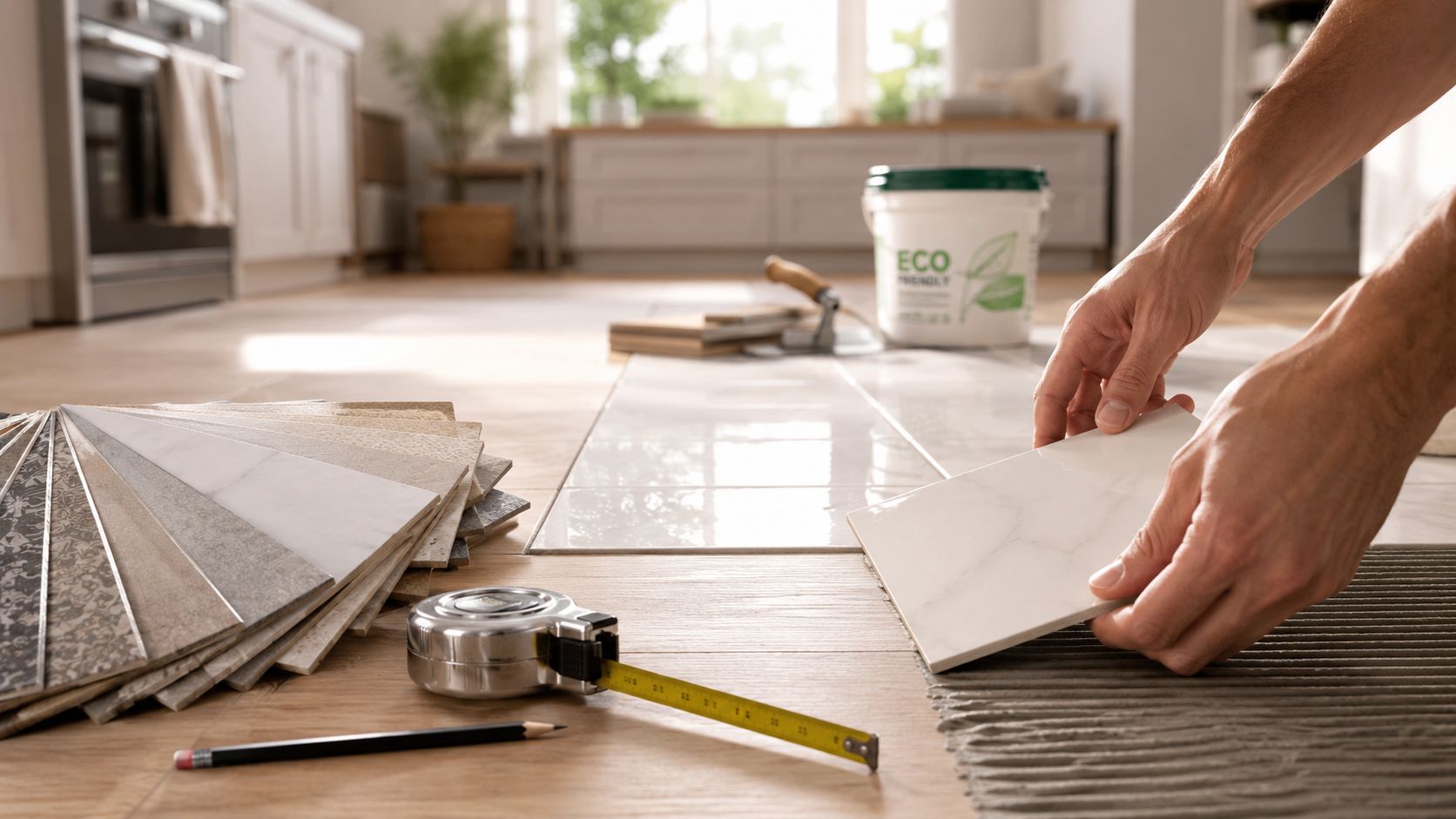
Ceramic tile installation price usually lands between $12 and $45 per square foot nationally, and in Massachusetts it averages $7.67 to $9.77 per square foot depending on tile grade and job complexity. If you're staring at a remodel budget and wondering why one quote looks manageable while another jumps fast, that spread is the reason.
You're probably comparing a bathroom floor, a kitchen backsplash, or a shower wall and trying to figure out what's fair before you call anyone back. The right number isn't a single price, it's a range shaped by labor, materials, prep, and how hard the space is to tile.
Table of Contents
- Labor is not just time
- Materials include more than the tile box
- Site preparation can change the whole project
Understanding ceramic tile installation price
A homeowner in Newton can collect two tile quotes for the same bathroom and assume one contractor is padding the bill. More often, one bid includes proper prep work, better setting materials, and cleanup, while the other assumes a perfect subfloor and a simple layout.
That is why ceramic tile installation price should be treated as a project estimate, not a shelf price. A broad U.S. pricing benchmark puts ceramic tile installation around $12 to $45 per square foot, with an average project cost of about $4,800 and a typical overall range of $1,300 to $7,500 depending on room size, prep work, and tile choice (Angi).
Why low quotes can mislead
The cheapest number often leaves out the work that protects the job later. If a contractor skips substrate repair, underestimates removal, or uses bargain materials, you may pay less on day one and more when tiles crack or grout fails.
Practical rule: compare what is included, not just the total. A fair quote names labor, materials, prep, and disposal clearly.
Use the national range as a ceiling and your local market as the primary check. For Massachusetts homeowners, local pricing matters more than an internet average from another region.
National and Massachusetts ceramic tile installation price ranges
A hallway project in Worcester can look cheap on paper until the quote starts adding in prep, layout, and cleanup. That is why national averages help as a reference point, but they do not tell you what a Massachusetts job should really cost.
Homewyse lists the national average cost to install ceramic floor tile at $16.38 to $20.21 per square foot in the U.S. Other market estimates place ceramic tile installation around $12 to $45 per square foot overall, with totals shifting based on room size, prep work, and tile selection (Homewyse).
Massachusetts sits in a tighter range. ProMatcher lists the cost of ceramic tile installation in Massachusetts at $8.72 per square foot, with a range of $7.67 to $9.77 per square foot including labor and a mid-grade tile (ProMatcher Massachusetts). Use that as a baseline, not a final answer. A flat quote that ignores removal, leveling, or grout usually leaves those costs for later.
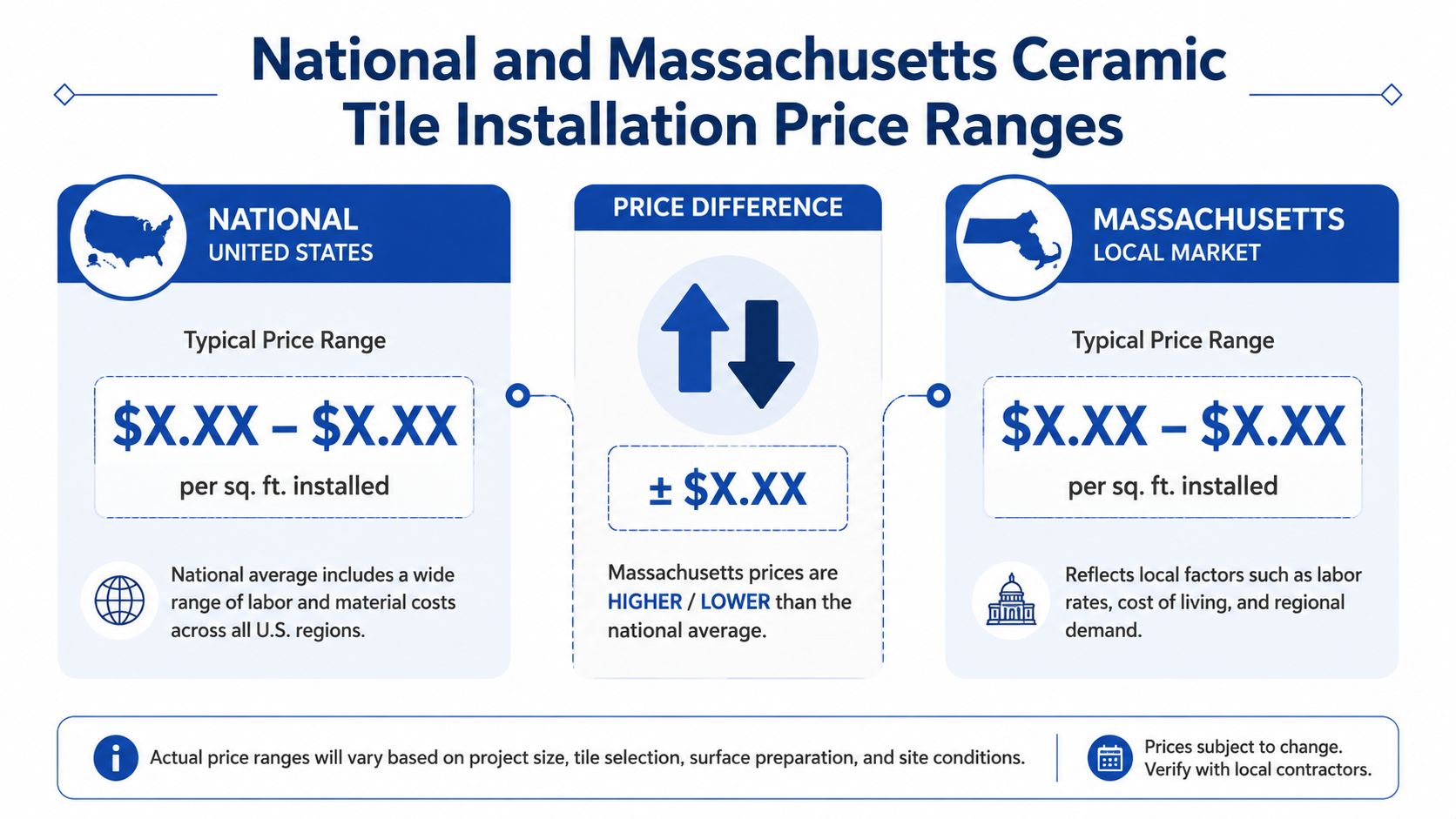
Boston-area pricing often follows its own pattern. HomeYou reports $7 to $11 per square foot for ceramic tile installation in Boston, with many smaller projects landing at $900 to $2,500 and larger homes reaching $4,500 to $9,500 (HomeYou Boston).
What the local spread tells you
The spread between national and Massachusetts pricing is the point. A homeowner in Wellesley or Quincy should not use a national average as a shopping target, because local labor rates, access issues, and room complexity change the quote fast.
Boston pricing often reflects tighter labor markets and more detailed project planning, so a low quote deserves a closer look, not automatic trust.
A quote that sits well below the local range needs a careful review of what is missing. Ask about substrate prep, removal, grout, and cleanup. If the number comes in much higher, ask what is driving it. The answer is usually hidden in the details. For a local planning reference, see this guide to tile pricing in Massachusetts.
Ceramic tile installation cost components breakdown
Labor, materials, and site preparation make up the full bill. HomeProjectCalculator's 2026 guide says ceramic tile material only runs $1 to $5 per square foot while labor adds $4 to $12 per square foot depending on tile size, pattern complexity, and region (HomeProjectCalculator). That split explains why two quotes for the same room can land in very different places.
Labor is not just time
Labor covers layout, cutting, setting, leveling, grouting, and finish work. A straight floor in a dry room is one kind of job. A shower or a room with awkward cuts is another, and the quote should reflect that difference.
Professional labor pricing also moves with the local market. One benchmark says professional tilers commonly charge $3 to $15 per square foot for labor, which is why labor often becomes the largest part of the final quote. For a local framing point, Sunny Day Pro Services' tile page shows the kind of ceramic tile work Massachusetts homeowners can compare against in the market (Sunny Day Pro ceramic tile services).
Materials include more than the tile box
The tile itself is only the starting point. Adhesive, grout, sealant, spacers, and underlayment all add to the total, and better tile grades push the price upward before labor begins.
A clear material budget starts with the tile, then checks the rest of the setup. For a broader breakdown of tile-related expenses, see this tile cost guide.
Watch the material line carefully: a quote that looks cheap on tile but vague on setting products can turn expensive once the job starts.
Site preparation can change the whole project
Prep is where hidden costs usually live. Old flooring removal, subfloor repair, and moisture protection take time, and skipping them risks a bad installation. In wet areas, that preparation matters even more because the margin for error is smaller.
Massachusetts homes often add another layer of cost here. Older floors, tight access, and uneven substrate conditions can push a quote higher even when the tile choice stays the same. A homeowner in Boston, Quincy, or Wellesley should read the prep section of a bid carefully, because that line often separates a realistic quote from a low one that will grow later.
If a quote does not clearly separate labor, materials, and prep, ask for a revised version. A good contractor can explain those line items without getting defensive.
Sample ceramic tile installation cost estimates
A small ceramic tile job in the Boston area usually gives you the clearest first check on price. Use the local range as a budget anchor, then compare each bid against the actual scope of work, because a bathroom floor, backsplash, and shower wall all carry different labor demands.
| Project type | Area (sq ft) | Estimated cost range |
|---|---|---|
| Bathroom floor | 100 | About $700 to $1,100 in Boston-area pricing |
| Kitchen backsplash | 30 | About $210 to $330 in Boston-area pricing |
| Shower wall | 50 | About $350 to $550 in Boston-area pricing before wet-area complexity |
Those sample numbers are useful because they keep quotes grounded in reality. A plain floor with a simple layout can stay close to the lower end, while a shower wall or a backsplash with many cuts will rise because the installer spends more time on layout, trimming, and finish work.
For a clear picture of how the job gets built, review the tile installation steps. The sequence matters because layout, cutting, setting, and grout all affect labor time and the final bill.
How to use sample numbers correctly
Start with square footage, then adjust for the room type. A backsplash often looks small until you price the outlets, corners, and edge details. A shower looks straightforward on paper until waterproofing and careful finishing enter the quote.
Use the sample costs as a quote check, not as a target to beat down every contractor. If a bid sits far below the expected range, the contractor likely missed prep, labor, or finishing work. If it sits far above the range, ask exactly what is included before you assume the number is inflated.
The right comparison is scope to scope. A fair quote matches the room, the tile layout, and the amount of detail work the job requires.
Factors affecting ceramic tile installation price
Project complexity creates the biggest swing in cost. Standard ceramic installs can land near $7 to $15 per square foot installed, while shower-area tile labor can reach $107.56 per square meter because waterproofing and detail work add time and risk (DGFloors).
The main cost drivers
- Room size: Bigger jobs spread some fixed setup time across more square footage, but they also raise the total bill fast.
- Tile type: Basic ceramic is easier to price than specialty layouts or denser products that take longer to cut and set.
- Location of the install: Dry floor space is simpler than a shower, where waterproofing and careful detailing matter more.
- Pattern complexity: Straight layouts are easier than diagonal, staggered, or tightly detailed work.
- Substrate condition: Uneven or damaged surfaces create extra labor before the first tile is set.
What changes the quote fastest
Wet zones are the clearest example. A shower is not just a tiled box, it's a moisture-managed assembly, and contractors price it that way. The more detail work involved, the more hours get built into the estimate.
If a job sounds simple but the contractor keeps mentioning prep, don't brush that off. Prep is usually where the quote gets honest.
The same rule applies to old flooring. If demolition, patching, or leveling is needed, the “tile price” is no longer just tile. It's a renovation package.
For a practical walk-through of how professionals sequence the work, review the tile installation steps before you accept any quote (tile installation steps).
Budgeting for ceramic tile installation and evaluating contractor quotes
Start with a realistic local budget, not a bargain number pulled from a generic estimate. In Massachusetts, old flooring, uneven subfloors, tight corners, and cleanup can push a quote higher fast, so the safest plan is to build in room for prep and surprises from the start.
A clean way to compare bids
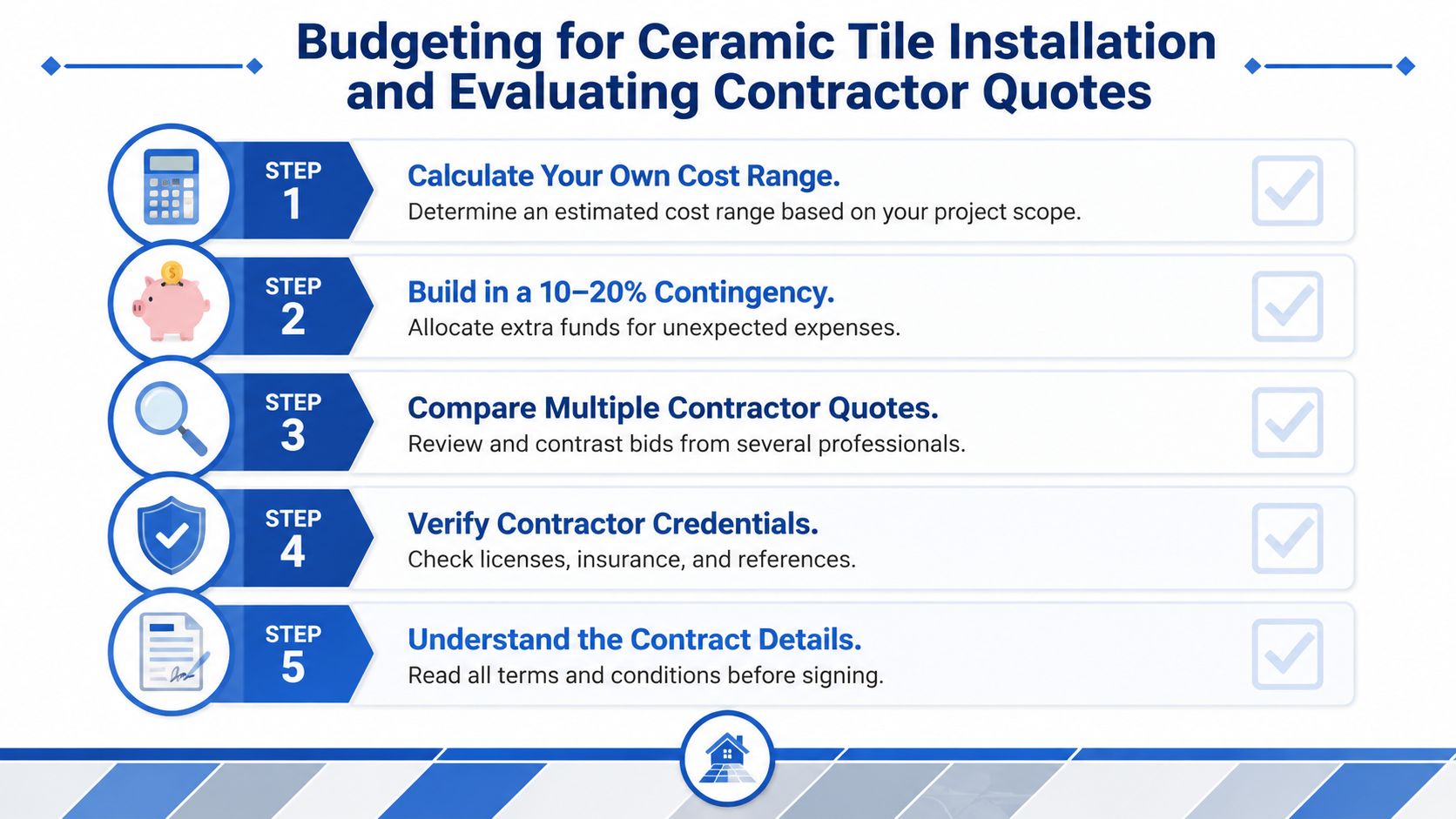
- Set your own cost range first. Use your square footage and the Massachusetts or Boston-area range to establish a baseline before you talk to contractors.
- Compare the pricing format. A per-square-foot bid is easier to judge than a vague lump sum, especially if one contractor breaks out labor and another does not.
- Ask exactly what is included. Removal, leveling, grout, sealant, and cleanup belong in the written quote, not in a casual conversation.
- Check credentials and references. Insurance, license status, and recent tile work matter more than a polished sales pitch.
- Read the contract before you sign. Change orders, warranties, and cleanup terms need to be written down clearly.
What a bad quote usually looks like
A suspiciously low bid usually leaves something out. The contractor may be undercounting prep, assuming the old floor is in perfect shape, or skipping disposal and debris handling. Those gaps do not disappear once the work begins.
A better quote gives you room to plan. If the estimate looks high but clearly lists each part of the job, you can decide whether to simplify the pattern, choose a different tile grade, or postpone part of the work.
One practical way to judge a local estimate is to compare it against a provider that states its tile services plainly, such as Sunny Day Pro ceramic tile services. That kind of benchmark helps you spot whether a contractor is pricing the full job or only the visible tile work.
Local ceramic tile installation with Sunny Day Pro Services
Massachusetts homeowners in Wayland, Newton, Needham, Wellesley, Weston, and nearby towns usually want two things, a clean install and a quote that doesn't change every time the job gets mentioned. That's where a local contractor with a defined process matters more than a flashy sales pitch.
Sunny Day Pro Services is a Massachusetts-based home services company that handles tile and flooring installation for homeowners who want clear communication and dependable timelines. If you're comparing ceramic tile installation price quotes, use their service page as one benchmark for what a local tile provider offers (Sunny Day Pro ceramic tile services).
The right next step is simple. Ask for a written estimate, compare it against the Massachusetts range, and make sure prep, materials, and cleanup are all included before you commit.
If you're ready to price your project properly, request an estimate from Sunny Day Pro Services.

