
Cleaning Service Quote: What to Expect and How to Compare
Get a clearer cleaning service quote with our practical guide. Learn what drives pricing, what questions to ask, and how to compare MA providers like Sunny Day
Most standard cleaning service quotes in the Wayland, Newton, and Greater Boston area fall between $150 and $280 per visit for a typical 2,000-square-foot home. The final number depends on the home's condition, service frequency, add-ons, layout, and the labor model behind the estimate.
You may be looking at three estimates right now and wondering how one provider can charge far less than another for what appears to be the same house. That gap doesn't automatically mean one company is taking advantage of you. Often, the quotes don't describe the same job.
A proper cleaning service quote should tell you what will be cleaned, who will clean it, how long the visit should take, which supplies are included, and what happens if the scope changes. The headline price matters, but the details determine whether you get a clean home or an argument at the end of the visit.
Table of Contents
What a Cleaning Service Quote Actually Covers
A cleaning service quote is a written, time-bound estimate tied to a specific property. It combines the expected labor, cleaning scope, materials, scheduling terms, and applicable fees into one proposal. It isn't a vague guess, and it shouldn't be treated like a universal menu price.
National benchmarks commonly place a standard residential visit around $120 to $280, with hourly pricing often around $35 to $75 per cleaner per hour, depending on the provider and market. Those ranges are useful only when the quoted work is comparable. A two-hour maintenance visit and a first-time deep clean aren't equivalent jobs, even if both involve the same number of rooms. Industry pricing guidance for residential cleaning explains why scope, frequency, and labor structure create such different estimates.
The details a reliable quote should show
Before you compare prices, check whether each proposal includes:
- Property profile: Address, approximate square footage, bedrooms, bathrooms, floor count, and any unusual access conditions.
- Crew and time: Number of cleaners, estimated visit duration, and whether the estimate is based on total person-hours or elapsed time.
- Room-by-room scope: Dusting, vacuuming, mopping, kitchen surfaces, bathrooms, trash removal, baseboards, interior appliances, and other tasks should be identified clearly.
- Supplies and equipment: The quote should say whether the provider brings products, vacuums, mops, microfiber cloths, specialty chemicals, and protective equipment.
- Frequency terms: One-time, weekly, biweekly, or monthly service can carry different rates and cancellation conditions.
- Fees and taxes: Travel charges, parking considerations, special-product charges, taxes, or minimum-service requirements should never appear as surprises.
- Validity window: A quote should state how long the price remains available, especially when scheduling or labor conditions may change.
Practical rule: If the scope is vague, the price isn't as useful as it looks.
A provider might describe a visit as “full house cleaning,” while another lists every bathroom fixture, kitchen surface, floor type, and excluded task. The second quote may look more expensive because it tells the truth about the work.
If your home needs accumulated-detail work, compare the proposal against a clearly defined deep cleaning service, not a routine maintenance checklist. Read each line item before focusing on the total. That habit will show you whether the providers are quoting the same service and whether the estimate is built on realistic assumptions.

The Four Main Pricing Drivers Behind Every Quote
Every residential cleaning service quote starts with four inputs: size and layout, condition, frequency, and add-on work. The square footage gets the most attention, but it isn't enough to price a home accurately.
Consider a 2,200-square-foot single-family home in Wayland that's lightly maintained and scheduled for biweekly service. That home may need a straightforward maintenance visit. Change the condition, cadence, or requested tasks, and the labor plan changes with it.
Size and layout
Square footage estimates the amount of surface area, but layout determines how efficiently a crew can work. A compact two-story home may take less time than a sprawling ranch with long hallways, multiple stair sections, and separated living areas. Extra bathrooms and difficult transitions between rooms add work without necessarily adding much square footage.
Condition and soil level
A lightly maintained home usually supports a predictable maintenance routine. A property with built-up soap film, neglected baseboards, pet hair, clutter, or a long gap since its last professional cleaning needs more labor. Deep cleaning commonly runs 1.5 to 2.5 times the price of a standard visit, according to residential cleaning pricing guidance.
Frequency
Recurring service lowers setup time and makes labor planning more predictable. Weekly service is often about 20% to 25% cheaper per visit than a one-time cleaning under the benchmark cited by the same cleaning cost guide. Monthly service generally allows more buildup between visits, so the per-visit quote may rise compared with a more frequent schedule.
Add-ons
Interior oven cleaning, refrigerator cleaning, detailed baseboards, interior cabinets, and similar tasks should be listed separately. If they're bundled into a flat price without explanation, ask how much time the provider has reserved for them.
| Driver | Scenario | Estimated Price Impact |
|---|---|---|
| Home size and layout | 2,200-square-foot home with multiple levels | More labor than a compact home with the same general room count |
| Condition | Light maintenance versus accumulated buildup | Routine pricing versus a higher-touch first visit |
| Frequency | Biweekly versus monthly service | More frequent visits generally reduce per-visit setup and buildup |
| Add-ons | Oven, refrigerator, baseboards, or interior cabinets | Additional time, products, and task-specific labor |
For the Wayland example, switching from a maintenance clean to a deep clean pushes the quote upward because the crew must address detail work that routine visits skip. Adding appliance interiors increases the scope again. Moving from biweekly to monthly service may reduce visit frequency, but it doesn't guarantee a lower per-visit price because the crew may face heavier buildup each time.
Two homes with identical square footage can therefore receive noticeably different quotes. Compare the four inputs before deciding whether a provider's number is high or low.
Hidden Factors That Quietly Shape the Final Price
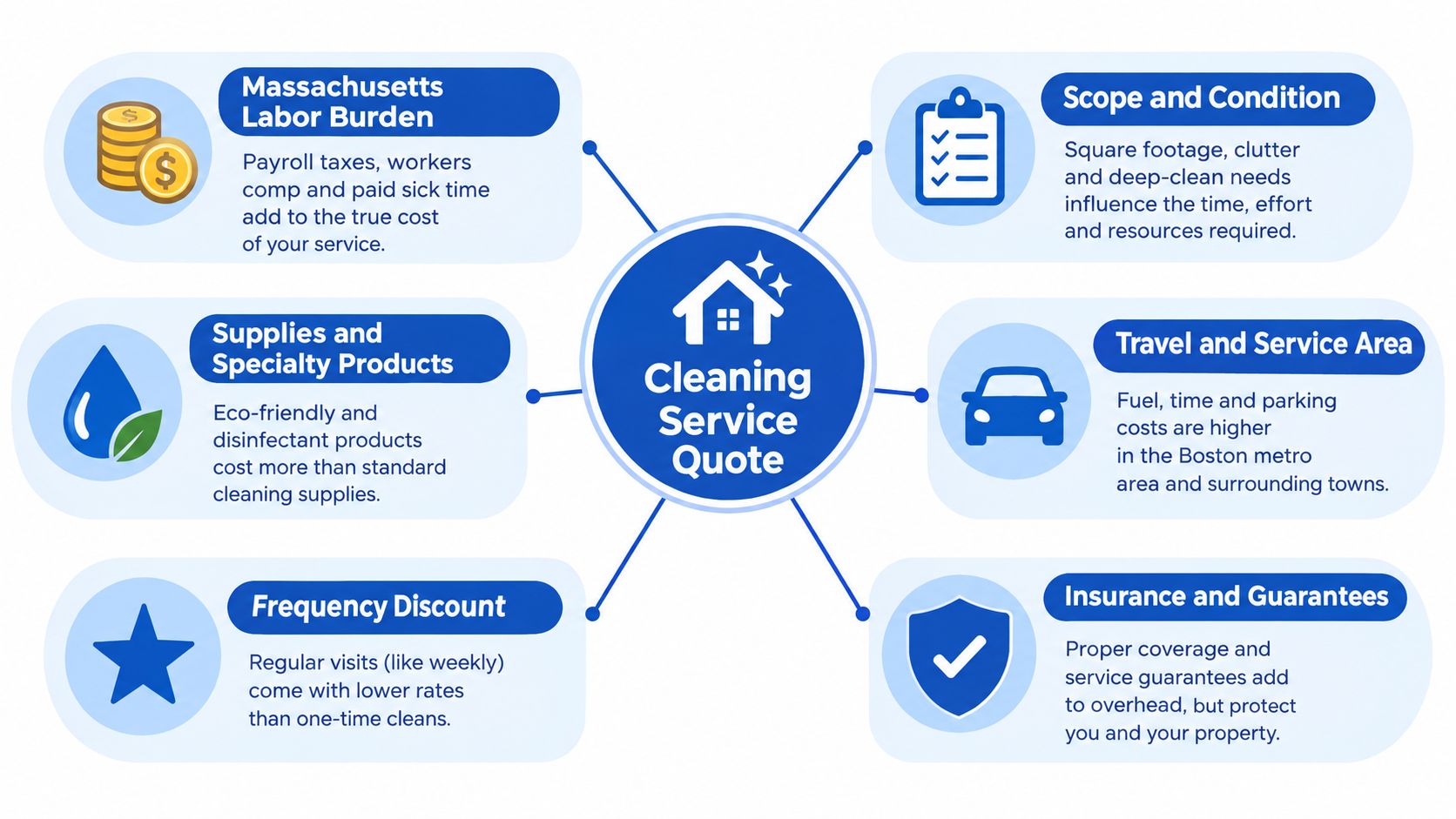
The visible quote usually shows a flat total or an hourly rate. Behind that figure sits a cost structure that includes more than a cleaner's wage.
A technically sound bid starts with a fully loaded labor rate. That rate accounts for base pay plus employer payroll taxes, workers' compensation, benefits, supervision, and overhead. One janitorial pricing guide notes that the full labor cost can rise 25% to 38% above wages in major United States, United Kingdom, and Canadian markets. The National Janitorial Authority pricing guide also recommends estimating billable hours from production rates, then adding supplies, equipment, insurance, and margin.
Local labor and operating realities
Massachusetts providers carry local employment and operating costs that a bare cash hourly rate doesn't show. Payroll taxes, workers' compensation, paid sick time, training, scheduling, and supervision all affect what a responsible company must charge.
Travel matters, too. A crew leaving Boston proper for Wayland, Newton, Needham, Wellesley, or Weston spends time and fuel reaching the property. Parking, tolls, traffic, and route density can affect the price even when the home itself is identical to one closer to the provider's base.
Complexity beyond square footage
A 2,000-square-foot home with two bathrooms, open rooms, and easy access doesn't require the same plan as a 2,000-square-foot home with several stair sections, high ceilings, narrow spaces, heavy furnishings, and multiple bathrooms. Pets, clutter, specialty flooring, and delicate surfaces can slow production and change the products a crew uses.
Supplies also vary. Standard products, eco-friendly formulas, disinfectants, microfiber systems, vacuums, floor tools, and protective materials all carry costs. Insurance and written guarantees add legitimate overhead, but they also protect the homeowner from relying on an uninsured operator.
Why quotes can separate
Two companies quoting the same square footage can still differ by 10% to 20% when their labor burden, travel assumptions, scope, supplies, and coverage aren't identical. That range is a practical comparison issue, not proof that one provider is dishonest.
A low quote is only a bargain if it buys the same labor, scope, protection, and follow-up.
Seasonal demand can affect availability and pricing pressure around spring cleaning and pre-holiday periods. Ask whether the proposal includes all travel, products, and requested tasks. If a cheaper company has omitted interior appliance work, reduced crew time, or excluded insurance-related protection, the lower total isn't a genuine apples-to-apples savings.
Realistic Price Ranges for Massachusetts Homeowners
Use price ranges as a sanity check, not a substitute for a written scope. In Greater Boston, labor costs commonly run above Western Massachusetts, and suburban access, home age, layout, and condition can move a quote within or beyond a typical band.
For a standard clean, a useful benchmark is $150 to $280 for a 2,000-square-foot home. A market guide also cites $150 to $200 as a commonly referenced U.S. benchmark for a standard 2,000-square-foot home, while hourly pricing can range from $25 to $80 depending on the provider and market. The cited house-cleaning market overview explains why location, home size, and service complexity matter.
Massachusetts planning bands
The following table applies the supplied Massachusetts planning ranges by home size. Treat the figures as directional. Condition, layout, frequency, and add-ons still control the actual proposal.
| Service Type | 1,000-1,500 sq ft | 2,000-2,500 sq ft | 3,000+ sq ft |
|---|---|---|---|
| Standard clean | Often below the Greater Boston benchmark for a 2,000-square-foot home | $150 to $280 | Typically above the 2,000-square-foot range |
| Deep clean | Usually below the larger-home band, depending on condition | $300 to $600 | Often above $600 when scope and labor expand |
| Recurring weekly | Often below the larger-home band | $120 to $220 per visit | Usually above the 2,000-square-foot band |
| Move-in or move-out | Often below the larger-home band | $400 to $800 | Often above $800 for large or demanding properties |
A deep clean costs more because it addresses detail work beyond routine maintenance. Move-in and move-out cleaning can cost more still because empty properties often expose cabinets, closets, appliances, trim, floors, and neglected surfaces throughout the home. The supplied benchmarks place move-out cleaning frequently in the $250 to $600 range nationally, while the Massachusetts planning band above reflects the higher-touch Greater Boston market and larger job assumptions.
Weekly recurring service can land around $120 to $220 per visit for the stated 2,000-square-foot planning band because predictable scheduling reduces setup and buildup. For a fuller explanation of household pricing variables, review this guide to professional house cleaning cost.
A quote below these bands deserves questions about scope, crew time, insurance, and supplies. A quote above them may be reasonable if the home has unusual access, heavy soil, specialty surfaces, or a demanding add-on list. Don't accept either number without seeing the work behind it.
How Providers Like Sunny Day Pro Services Build a Quote
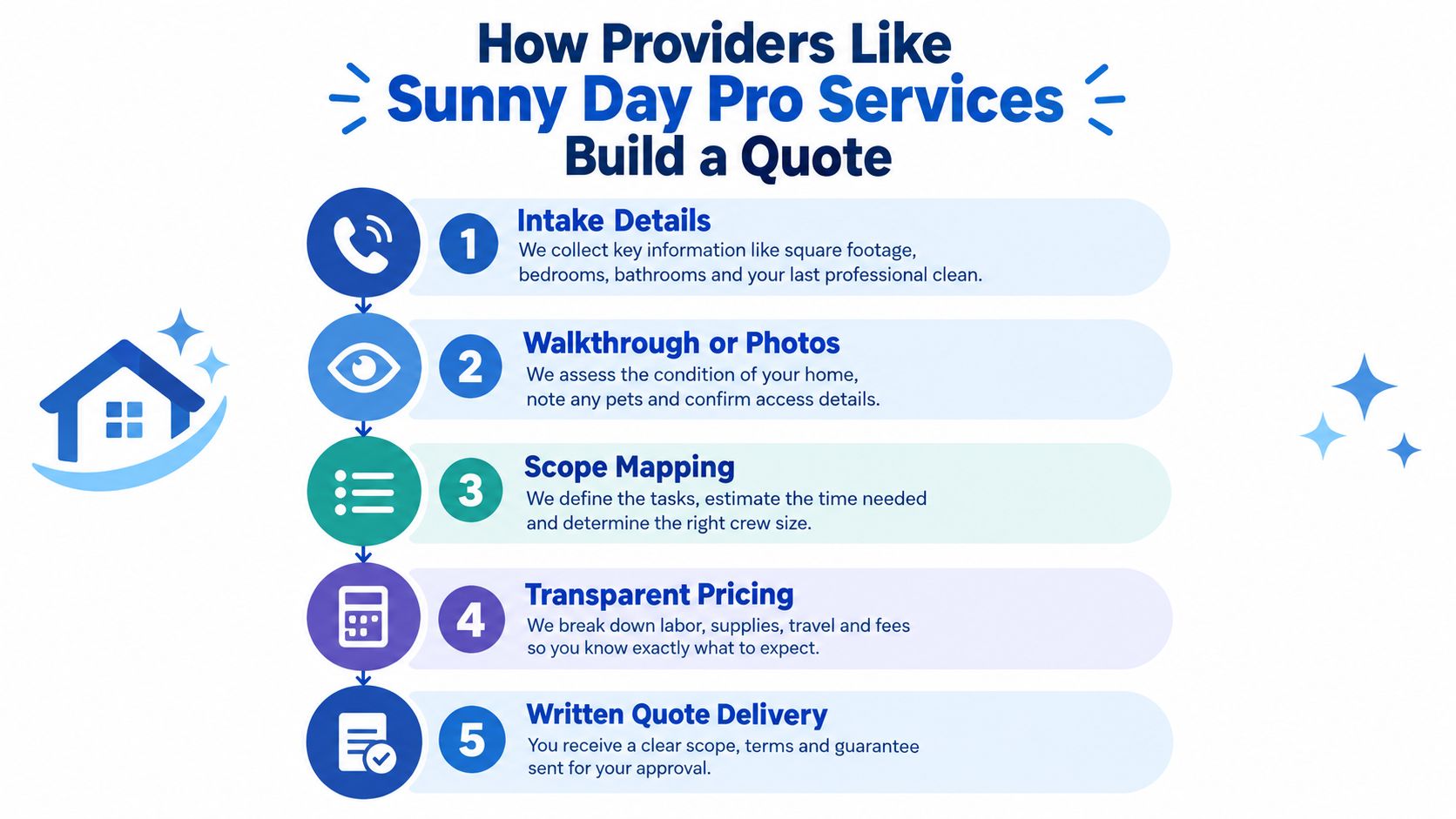
Established providers start with intake details, not a random flat number. The estimator needs the property's approximate square footage, bedroom and bathroom count, service type, last professional cleaning, pets, parking access, floor layout, and any rooms that need special attention.
The next step is converting that information into labor hours. A practical production assumption is roughly 1,000 to 1,500 square feet per cleaner per hour, but actual output depends on condition, surfaces, clutter, bathrooms, stairs, and the requested scope. The provider then applies a loaded labor rate and accounts for supplies, equipment, insurance, travel, and margin, following the cost-building approach described in this janitorial service pricing guide.
Why a walkthrough improves accuracy
Phone-only estimates are convenient, but they depend heavily on the homeowner's description. Photos, a video walkthrough, or an in-home assessment reveal details that square footage can't show, such as crowded rooms, high dust, pet hair, tall windows, multiple staircases, or difficult parking.
Sunny Day Pro Services is one Massachusetts option that uses property details and service preferences to prepare a customized quote. Its process is designed around recurring cleaning, deep cleaning, move-in or move-out work, and post-construction cleanup, so the estimate can match the requested service rather than rely on a generic package.
Prepare these answers before requesting a quote
- Property basics: Square footage, bedrooms, bathrooms, floors, and approximate home age.
- Cleaning history: Date of the last professional cleaning and whether the home receives routine maintenance.
- Condition details: Clutter, pet hair, soap buildup, dust, stains, or areas that have been skipped.
- Priority rooms: Identify the kitchen, bathrooms, bedrooms, basement, entryway, or other spaces that matter most.
- Add-ons: List oven interiors, refrigerator interiors, baseboards, cabinets, windows, laundry, or post-construction dust.
- Access logistics: Parking, stairs, door codes, elevators, pets, and preferred arrival windows.
The more accurately you describe the home, the less likely the crew is to discover a pricing problem at the door.
Ask whether the quote is fixed, what can trigger a change order, and how the provider handles work that takes longer than expected. Those answers matter as much as the initial total.
Comparing Quotes Side by Side Without Getting Burned
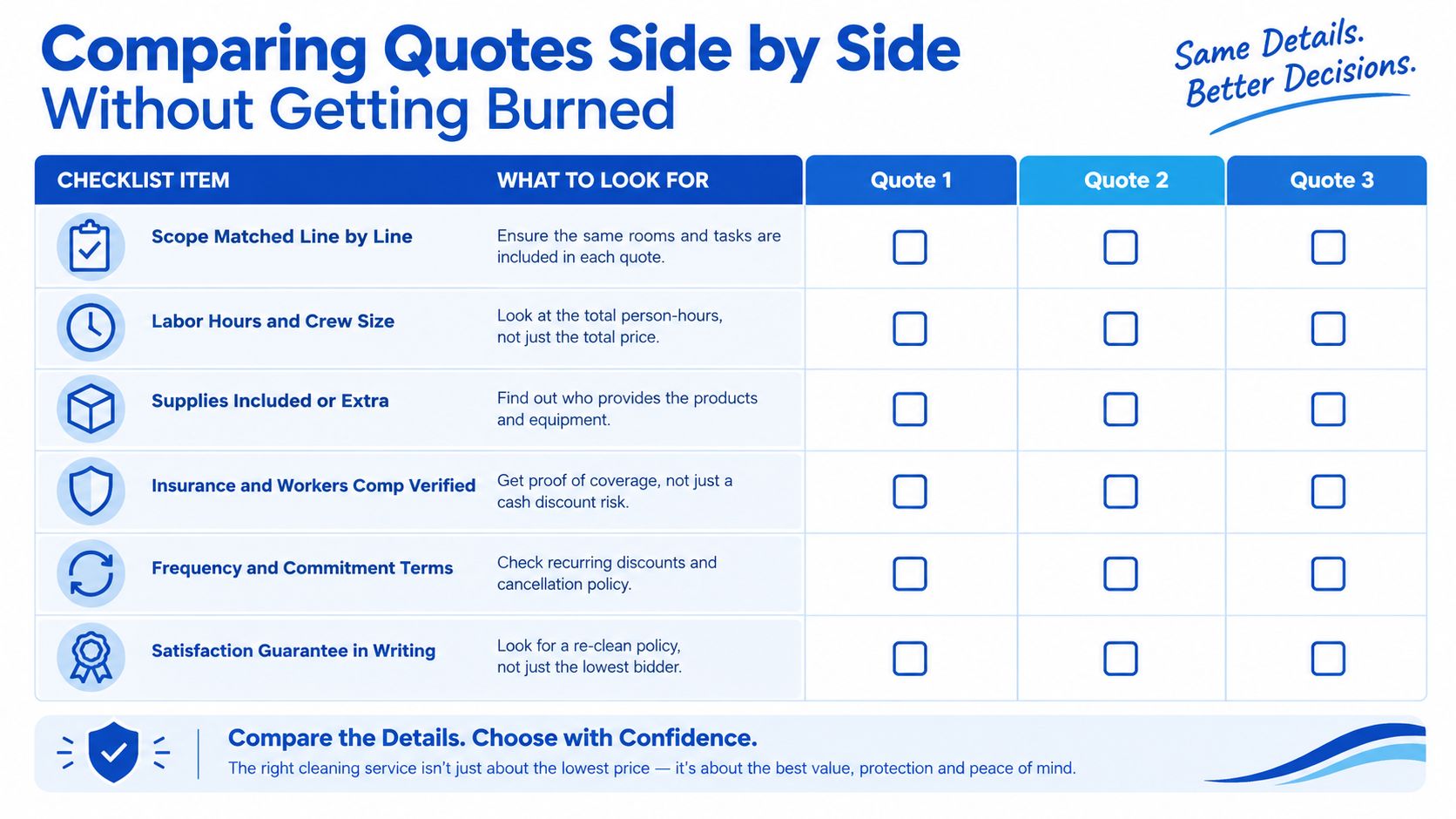
Put two or three proposals into a simple comparison sheet. Don't compare totals until each provider has answered the same questions and priced the same scope.
Start with the rooms and tasks. One quote may include dusting reachable surfaces, while another includes baseboards, doors, trim, and interior cabinets. Confirm whether the provider supplies equipment and products, whether the crew is insured, and whether workers' compensation coverage applies to the people entering your home.
Use these comparison questions
- Scope match: Are the same rooms, surfaces, and add-ons included?
- Labor basis: Does the proposal identify crew size, estimated duration, or total person-hours?
- Frequency: Are you comparing one-time service with weekly, biweekly, or monthly service?
- Supplies: Does the provider bring products and equipment, or will you provide them?
- Fees: Are travel, parking, taxes, minimums, and cancellation terms disclosed?
- Guarantee: Is the satisfaction or re-clean policy written into the proposal?
Check the company's public reputation on Google, Yelp, and the Better Business Bureau, then ask how it handles missed tasks or damage concerns. A verbal quote, a vague “whole house” description, no walkthrough option, and a demand for a large upfront deposit should make you slow down.
The safest approach is to send every provider the same property details, photos, priority list, and requested frequency. That creates a fair basis for comparing estimates, especially in Greater Boston where local labor and travel assumptions can vary.
For nearby service searches, use a focused local option such as house cleaning near me, then request the same written scope from each provider you consider.
A fair quote looks professional, detailed, and consistent with the home's actual requirements. The lowest total should win only when the labor, coverage, supplies, and completed work also match.
Taking the Next Step With Confidence
A cleaning service quote should reflect square footage, condition, frequency, add-ons, and local labor realities, not one unexplained flat number. Comparing scope and inclusions instead of chasing the lowest headline price is the simplest way to avoid surprises on visit day.
Gather your property details before you reach out. Have photos or a short walkthrough video ready, list priority rooms and add-ons, and ask each provider for a written proposal based on the same requested service. Request estimates from two or three Massachusetts providers, then compare crew time, scope, supplies, fees, insurance, and follow-up terms.
If the numbers differ, ask what changed. A clear answer is more valuable than a suspiciously low price.
Sunny Day Pro Services provides recurring, deep, move-in and move-out, and post-construction cleaning for homeowners across Wayland, Newton, Needham, Wellesley, Weston, and nearby Massachusetts communities. Gather your photos and priority list, then visit Sunny Day Pro Services to request a clear, customized quote you can compare with confidence.

