
Professional House Cleaning Cost: Your 2026 MA Guide
Uncover the professional house cleaning cost in MA for 2026. Get accurate pricing, understand factors, & budget smartly for your home.
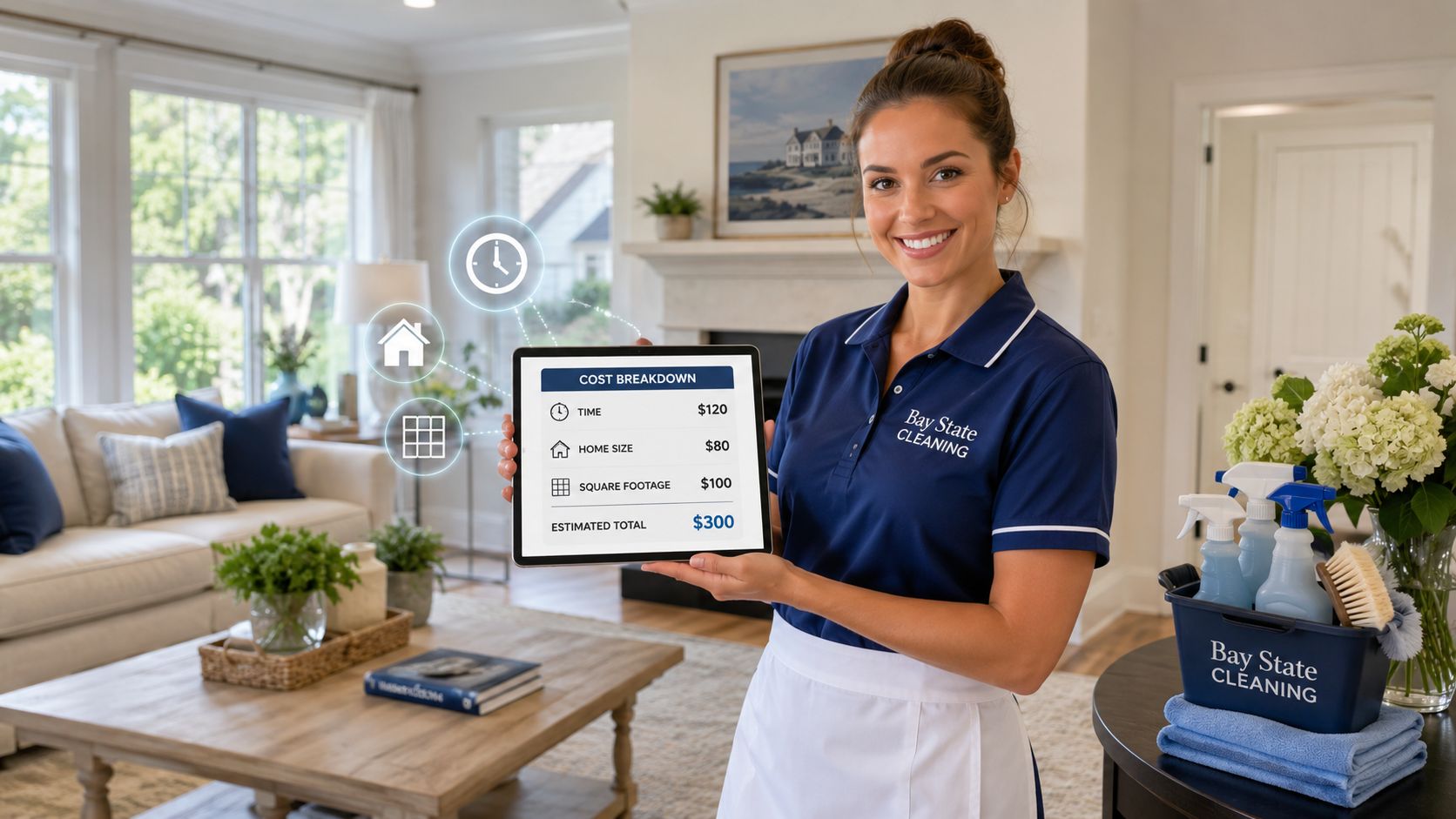
A standard professional house cleaning cost usually falls around $118 to $280 per visit, and hourly pricing commonly lands between $25 and $75 per cleaner. If you're trying to budget for a first cleaning in Massachusetts, those numbers are a solid starting point, but your actual quote depends on the size of the home, its current condition, and whether you need anything beyond a standard clean.
If you're reading this, you're probably doing what a lot of homeowners in Wayland, Newton, Needham, Wellesley, and Weston do. You're looking at your calendar, looking at your house, and realizing those two things are no longer cooperating. Cleaning keeps sliding to the bottom of the list, and at some point the main question stops being “Can I do this myself?” and becomes “What's a fair price to have this handled well?”
That's where pricing gets confusing. One company quotes by the hour. Another gives a flat rate. Another asks about bathrooms, pets, and whether you want the oven or fridge done. The numbers can seem inconsistent until you understand what cleaners are pricing.
A fair quote isn't just about the cheapest number. It's about labor, consistency, access, supplies, and whether the service matches what your home really needs. If you want a clearer sense of what goes into a realistic estimate, it also helps to understand the professional house cleaning supplies that shape the work itself.
Table of Contents
- What changes labor time the most
- Why recurring service usually costs less per visit
- A fast self-check before requesting a quote
- When a standard clean is not enough
- The eco-friendly and pet-safe pricing gap
- Post-remodel tile and grout cleanup
- Is it cheaper to hire an individual or a professional company
- Do I need to provide my own cleaning supplies
- How much should I tip for house cleaning
- Why are two quotes for similar homes so different
Is Hiring a House Cleaner Worth the Cost
For a lot of homeowners, the answer comes down to whether cleaning is stealing time from more important things. If your weekends are disappearing into bathrooms, floors, dusting, and kitchen reset work, hiring help often becomes less of a luxury and more of a practical household decision.
The important thing is to judge the service by results, not just sticker price. A professional cleaning visit can take recurring chores off your plate, keep buildup from getting worse, and make the house easier to maintain between visits. That matters even more in busy family homes where mess doesn't stay “light” for long.
What people are really paying for
You're not only paying for someone to wipe surfaces. You're paying for a system.
That system usually includes:
- Reliable labor: A scheduled crew or cleaner shows up ready to work.
- A repeatable checklist: Kitchens, bathrooms, floors, dusting points, and touch surfaces get handled in a defined order.
- Proper products and tools: Good cleaning depends on using the right microfiber cloths, vacuums, scrub tools, and surface-safe chemicals.
- Less catch-up later: Regular service prevents grime from turning into a bigger, slower, more expensive job.
Practical rule: The more often a home gets cleaned well, the less labor each future visit usually requires.
When it's worth it and when it isn't
Hiring a cleaner usually makes sense if your schedule is tight, your home has multiple bathrooms, you have pets, or you want the home consistently guest-ready without last-minute stress.
It may not feel worth it if you only need very light help, you enjoy doing the cleaning yourself, or your expectations don't match the level of service booked. A standard clean won't perform like a deep clean, and that mismatch is where disappointment often starts.
The best value comes when the service level matches the actual condition of the home. If the house needs detail work, buildup removal, or post-project cleanup, pretending it's a basic maintenance visit usually costs more in the end because someone has to come back and finish what the first appointment wasn't designed to do.
The 3 Main House Cleaning Pricing Models
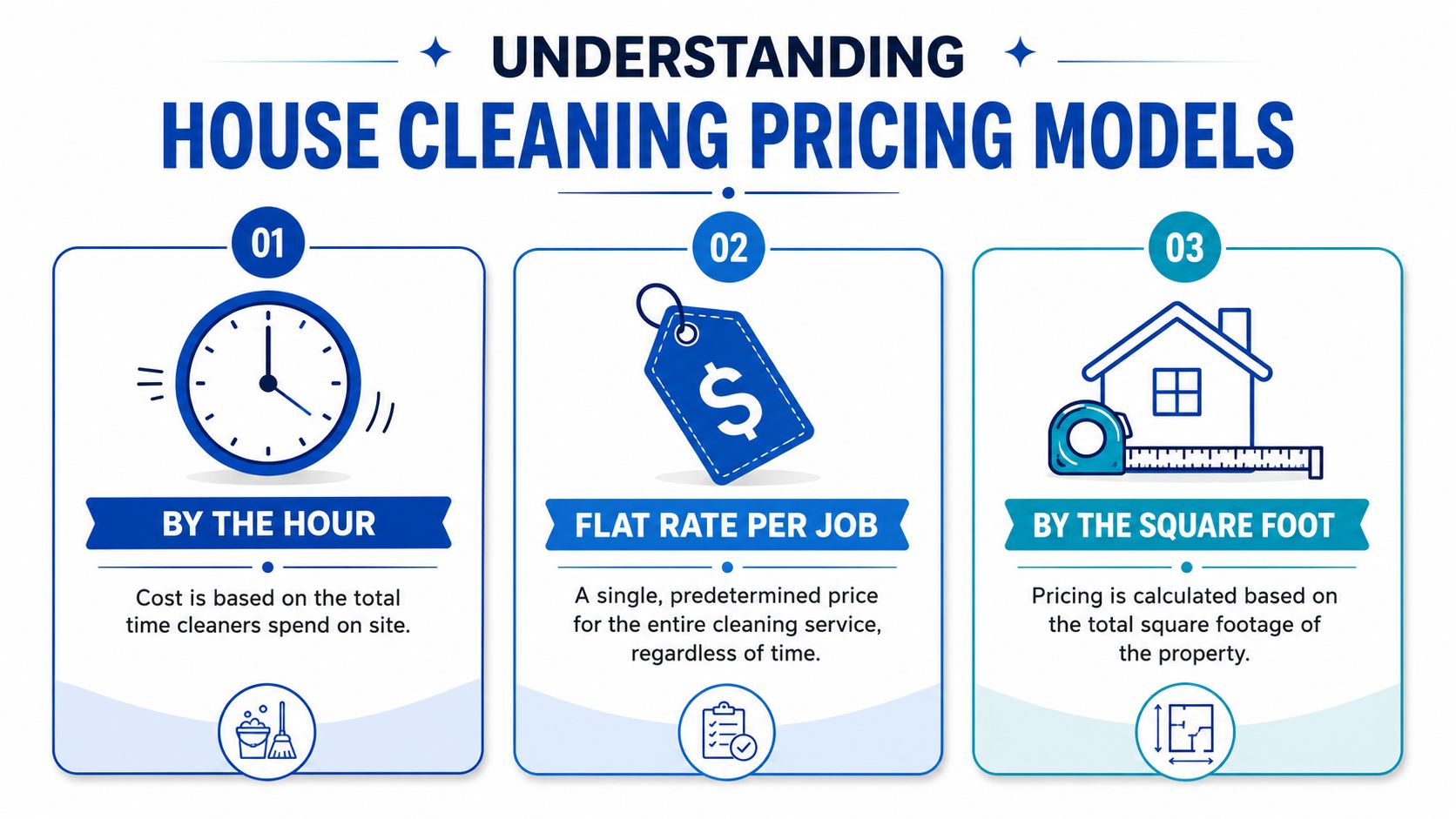
Most cleaning companies price in one of three ways: by the hour, by the visit, or by square footage. Across major markets, standard cleaning often clusters around $100 to $300 per visit, hourly labor often falls in the $25 to $80 per cleaner-hour range, and some pricing guides use $0.10 to $0.30 per square foot as a working model, as described in this house cleaning cost breakdown from eMaids.
Hourly pricing
Hourly pricing works a lot like hiring a consultant. You're paying for time on site.
This model can make sense when the scope is unclear. Maybe the home needs attention in selected areas only, or maybe you want the cleaner to work through a priority list until the booked time runs out. It's flexible, and that's the main appeal.
The downside is uncertainty. If the cleaner needs more time than expected, your bill can rise with it. Hourly pricing also creates tension when the customer expects a full-home result but the booking only covers limited labor time.
Good fit for:
- Priority-list cleanings: You want bathrooms and kitchen first, then whatever time allows.
- First-time visits with unknown condition: The company hasn't seen the home yet.
- Small custom jobs: You need targeted help rather than a full standard package.
Flat-rate pricing
Flat-rate pricing is usually easier for homeowners. The company evaluates the home, the service type, and the likely labor, then gives one number for the visit.
That makes budgeting simpler. It also aligns expectations better because the service is tied to a checklist, not a stopwatch. For recurring maintenance cleaning, this is often the cleanest way to price the work.
The catch is that flat-rate quotes depend on accurate information. If the home is much dirtier, more cluttered, or more detailed than described, the original quote may need to change.
A flat rate works best when both sides agree on scope before the crew arrives.
Square-foot pricing
Square-foot pricing is common when a company wants a fast estimating framework. It's useful because home size does correlate with labor, at least broadly.
But square footage alone never tells the whole story. A home with more bathrooms, more pet hair, heavier kitchen buildup, or difficult access can take much longer than another home with the same footprint. That's why many companies use square footage for the starting point, then adjust for complexity.
Good companies don't rely on square footage in isolation. They use it as the skeleton of the estimate, then layer in real-world details that affect labor.
Average House Cleaning Costs in Massachusetts
National benchmarks are useful, but Massachusetts homeowners usually want to know what those numbers mean locally. In high-demand communities, pricing often lands toward the upper end of national guidance because labor costs, scheduling pressure, and service expectations all tend to run higher.
What the national benchmarks tell you
According to Angi's house cleaning pricing guide, a standard house cleaning commonly falls around $118 to $280 per visit, the average hourly rate typically lands between $25 and $75 per cleaner, and a 2,000-square-foot home often falls around $200 to $400 for a flat-rate clean.
Those are useful anchors. If you get a quote far below that range, it's worth asking what's included and what isn't. If you get a quote above it, the home may have factors that increase labor, or the service may include more than a basic standard clean.
Why Massachusetts quotes often feel higher
In towns like Newton, Wellesley, Weston, and Needham, homeowners often expect more detailed finish work, strong communication, dependable scheduling, and fully equipped crews. Those expectations are reasonable, but they do shape price.
A few local patterns matter:
- Older homes need more touch work: Trim, baseboards, stair detail, and varied floor materials can slow a crew down.
- More bathrooms increase labor fast: Bathrooms are among the most time-intensive rooms in any cleaning visit.
- Family homes create uneven wear: Mudrooms, kitchens, play areas, and pet zones don't soil evenly.
- Parking, access, and layout matter: Multi-level homes and tighter access can add setup and movement time.
Here's the practical way to think about local budgeting. A smaller condo or apartment with normal upkeep may sit closer to the lower part of common market ranges. A larger single-family home with multiple baths, pet hair, or one-time buildup often lands much higher. The quote isn't just tied to zip code. It's tied to labor density inside the home.
The biggest pricing mistake homeowners make is comparing homes by bedroom count alone. Cleaning time follows bathrooms, kitchen condition, floor type, and overall upkeep much more closely than it follows a real estate listing.
That's why two homes that look similar online can receive very different estimates in real life.
Key Factors That Influence Your Final Price
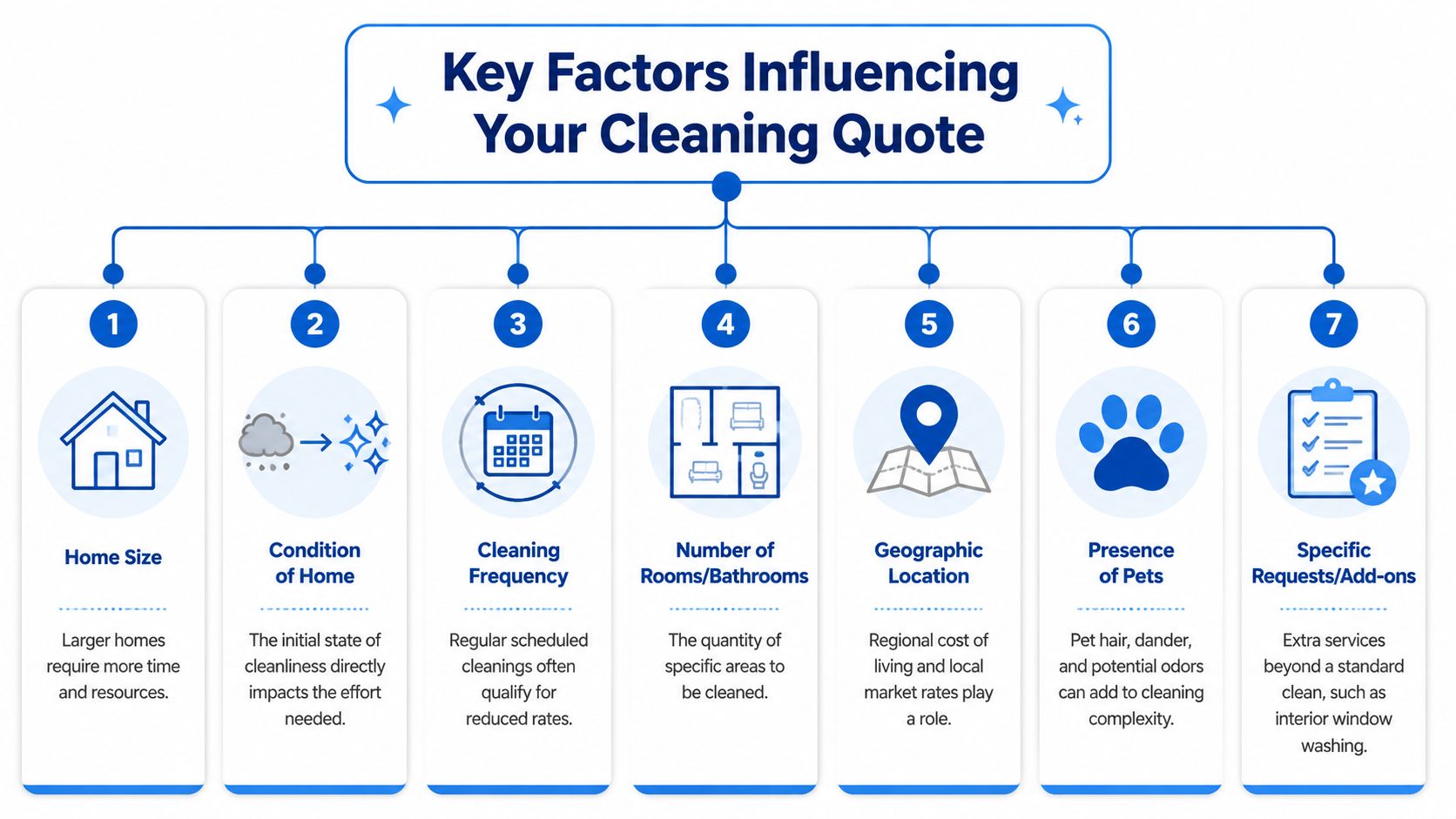
Most quote differences make sense once you look at what changes labor time. Cleaning companies aren't just pricing the square footage. They're pricing how long it takes to clean that specific home to the requested standard.
What changes labor time the most
Some factors have a modest effect. Others move a quote significantly.
- Home size: Larger homes require more vacuuming, mopping, dusting, and movement between rooms.
- Bathroom count: Bathrooms are dense with labor. Toilets, tubs, glass, fixtures, mirrors, tile, and floors all take detail work.
- Kitchen condition: A lightly used kitchen and a heavily used kitchen are priced very differently in practice.
- Current level of buildup: Soap scum, grease film, hard water marks, and neglected corners slow everything down.
- Clutter: Cleaners can clean surfaces faster than they can sort around household items. Heavy clutter usually reduces efficiency.
- Pets: Pet hair, dander, tracked-in debris, nose prints on glass, and odor treatment all increase effort.
- Special requests: Inside fridge cleaning, inside oven cleaning, interior windows, detailed baseboards, and hand-wipe extras all add time.
A common issue is that homeowners think of cleaning as one task. It isn't. Wiping an open countertop is quick. Cleaning around daily clutter, mail, chargers, kids' items, and decor is different work.
Why recurring service usually costs less per visit
Recurring cleanings often price lower than one-time visits because the home stays in better baseline condition. There's less accumulated grime, fewer surprise problem areas, and less need for recovery work.
That lower price isn't arbitrary. It reflects a different labor reality.
For recurring clients, cleaners usually spend more time maintaining cleanliness and less time restoring it. That makes service more predictable for both sides. It also tends to reduce re-clean issues because the home never falls too far behind.
A fast self-check before requesting a quote
If you want a quote that's close to final pricing, tell the company these things up front:
- How many bathrooms need full cleaning
- Whether pets live in the home
- If this is recurring or one-time service
- Whether the home is lightly maintained or needs catch-up work
- Any add-ons like oven, fridge, or interior windows
If you understate the condition of the home to get a lower quote, the cleaner still finds the real condition at the door. Accurate information saves time and avoids awkward pricing changes.
Specialized Services and Common Add On Fees
Standard cleaning covers routine home maintenance. It doesn't always cover the situations that cause the most pricing confusion. That's where homeowners often feel blindsided, especially when they ask for a healthy-product option or assume a recent remodel only needs a normal visit.
When a standard clean is not enough
A standard clean is built for maintenance. If the home hasn't been serviced in a while, if you're moving, or if dust and residue from a project are still present, you're usually in deep-clean or specialty-clean territory.
Examples include:
- Move-in or move-out cleaning: More detail inside cabinets, appliances, closets, trim, and empty-room edges.
- Deep cleaning: Better for buildup in kitchens, bathrooms, baseboards, and neglected surfaces.
- Post-construction cleaning: Fine dust, residue, and debris after renovation or repair work.
If you're comparing service types, this guide to deep cleaning services gives a useful picture of how a deeper scope differs from maintenance cleaning.
The eco-friendly and pet-safe pricing gap
This is one of the most overlooked parts of professional house cleaning cost. Homeowners ask for green, non-toxic, or pet-safe products all the time, but many pricing guides don't spell out what that does to the quote.
According to the American Cleaning Institute data provided in the verified brief, 68% of clients in the Northeast specifically request green cleaning, and most guides still omit the typical 15% to 25% cost increase, or about $30 to $60 per visit, for those premium services.
That premium usually reflects product cost and process. Certified eco-friendly, pet-safe, or lower-toxicity products can cost more, and they may require more deliberate product selection for stone, tile, sealed wood, food-prep zones, and pet-contact surfaces.
For Massachusetts families with pets, crawling kids, or chemical sensitivities, this add-on is often worth discussing early instead of treating it like a last-minute note in the booking form.
Post-remodel tile and grout cleanup
This is the other big blind spot.
Many people hear “post-construction cleaning” and assume it covers everything after a flooring or backsplash project. In practice, tile dust and grout haze cleanup can be much more specific. Fine ceramic or porcelain dust settles into grout lines, corners, and textured surfaces, and it often needs different tools and more careful chemistry than a normal maintenance visit.
Verified industry data in the brief notes that general post-construction cleaning averages $203 to $285, and the National Tile Contractors Association data cited there adds that tile and grout restoration cleaning after installation can add $0.15 to $0.30 per square foot.
Fresh remodel dust is deceptive. The room can look clean at first glance while grout lines, edges, and hard surfaces still hold fine residue that spreads every time someone walks through.
For a company that handles both cleaning and tile-related work, Sunny Day Pro Services can price these requests based on the actual surface conditions rather than treating all remodel cleanup as the same job.
Sample Cleaning Estimates for Massachusetts Homes
Sample estimates help turn general pricing into something more practical. These aren't universal rates, and they're not a substitute for a walkthrough or quote. They're examples of how common home types often map to common service types.
Example estimate table
| Service Type | Home Profile | Estimated Cost Per Visit |
|---|---|---|
| Recurring standard cleaning | Small apartment or condo with routine upkeep | Often falls near the lower end of standard market ranges |
| Recurring family-home cleaning | Single-family home with multiple bathrooms and active daily use | Often falls in the middle to upper portion of standard market ranges |
| One-time deep cleaning | Home needs catch-up work before guests, photos, or a seasonal reset | Usually priced above a standard maintenance visit |
| Move-out or post-remodel cleaning | Empty home, renovation dust, or tile and grout detail work | Can exceed standard pricing, especially when grout-line cleanup adds $0.15 to $0.30 per square foot based on the verified NTCA data in the brief |
The most important takeaway is that service type matters as much as home size. A tidy home booked for recurring service and a remodeled home booked for detail cleanup are not interchangeable jobs, even if the square footage is similar.
When homeowners get frustrated by pricing, it's often because they're comparing unlike-for-like services.
How to Get an Accurate Quote and Hire the Right Pro
A good quote starts with good information. The more clearly you describe the home and what you want cleaned, the more accurate the estimate will be.
What to have ready before you ask for a quote
Before you contact a cleaning company, gather the basics:
- Home details: Approximate size, number of bathrooms, and whether it's a house, condo, or apartment
- Service type: Standard recurring cleaning, first-time deep clean, move-in or move-out, or post-project cleanup
- Condition notes: Pet hair, heavy buildup, clutter, recent renovation dust, or surfaces that need extra care
- Add-ons: Interior oven, refrigerator, inside cabinets, or interior windows
- Schedule preference: One-time, weekly, biweekly, or monthly
If you're comparing local options, it helps to review a company's broader guidance on finding house cleaning near you so you know what standards to look for.
How to compare estimates the smart way
Don't compare quotes by price alone. Compare scope, professionalism, and clarity.
Ask questions like:
- What is included in your standard cleaning checklist
- Are supplies and equipment included
- Are you insured and bonded
- How do you handle first-time cleanings that take longer than expected
- Do you price eco-friendly products separately
- How do you quote post-remodel or dust-heavy jobs
A cheaper quote can be more expensive if it leaves out key tasks, uses vague language, or changes after arrival. A clear quote should tell you what's included, what's extra, and what conditions could affect final pricing.
The right pro doesn't just give a number. They make the scope understandable.
Frequently Asked Questions About Cleaning Costs
Is it cheaper to hire an individual or a professional company
Sometimes an individual cleaner may quote less. A company may offer more structure, clearer scheduling, backup coverage, training standards, and administrative support.
The better choice depends on what matters most to you. If reliability, documentation, consistent checklists, and easier communication matter, many homeowners prefer a professional company. If your needs are simple and you already know a trusted cleaner personally, an individual may work fine.
Do I need to provide my own cleaning supplies
That depends on the company. Some bring everything. Others can use homeowner-provided products on request, especially when clients want specific eco-friendly or fragrance-free items.
It's best to ask this before booking, especially if you have natural stone, specialty floors, sensitivities, or pets. Product choice affects both results and pricing.
How much should I tip for house cleaning
Tipping isn't always required, but it's a common way to show appreciation for good work. Many homeowners tip for one-time jobs, holiday visits, or especially demanding cleanings.
If you prefer not to tip each visit, some clients give a larger seasonal or holiday thank-you instead. The key is consistency and clarity, especially if the same team returns regularly.
Why are two quotes for similar homes so different
Because “similar homes” often aren't similar to clean. One may have more bathrooms, more clutter, pets, heavier kitchen buildup, or a much higher requested level of detail.
Quotes also vary based on whether a company is pricing a true standard clean, a catch-up clean, or a detail-heavy first visit. The lowest number doesn't always describe the same service.
If you'd like a straightforward estimate for your home, Sunny Day Pro Services serves homeowners across Massachusetts communities including Wayland, Newton, Needham, Wellesley, and Weston. Share your home size, service type, and any special requests, and you can get a no-pressure quote based on the actual work needed.

