
Granite Countertop Installation Near Me: A Homeowner's Guide
Granite countertop installation near me made simple — costs, process, prep checklist, and what to ask a Massachusetts installer before you book.
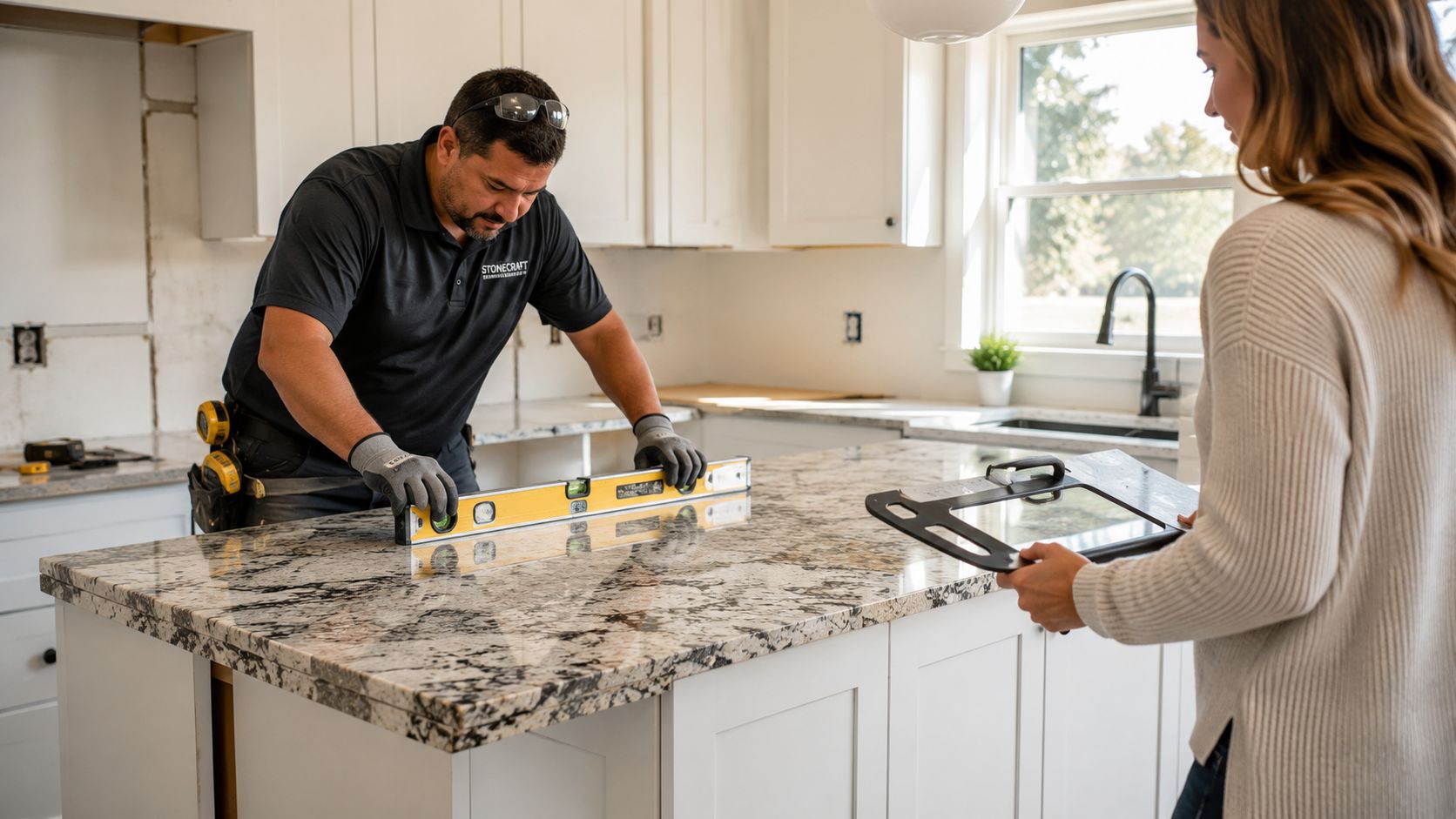
Granite countertop installation in a typical Massachusetts kitchen usually lands between $70 and $230 per square foot, which puts a standard 30-square-foot kitchen at about $2,100 to $6,900 installed. The slab matters, but the quote is where these projects go sideways, because the actual price gets shaped by fabrication, cutouts, removal, disposal, edge detail, and plumbing.
Table of Contents
- How much does granite countertop installation usually cost?
- Is granite really maintenance-free?
- How long does the job take from templating to install?
Why Granite Countertop Installation Matters Before You Search Near Me
Granite still dominates a lot of kitchen remodel conversations for a reason. In the U.S., granite accounted for 25% of all kitchen countertop installations in 2023, and 65% of U.S. kitchen countertop buyers select it as their primary material, with durability cited by 72% of consumers as the top reason WorldMetrics industry summary. That's not a fad. That's a material homeowners keep coming back to because it works in real kitchens.
The part most homeowners miss
The slab itself is only one piece of the job. The quote changes fast once you factor in regional labor, fabrication complexity, demolition, disposal, and edge detailing, which is why local estimates are more useful than a national average CountBricks pricing guide. In major metro areas, two kitchens that look almost identical can still price very differently.
Practical rule: If the installer can't explain the quote line by line, assume you're missing something.
That's the whole problem with most “granite countertop installation near me” pages. They make the search sound simple, but the job only stays simple when the scope is clean. A smooth project usually comes down to whether the installer handles the tear-out, template, fabrication, and final reset without sloppy handoffs.
Why granite still earns its place
Granite keeps showing up in kitchens because it has a strong combination of visual variety, hard-use durability, and long service life. It's a material people choose when they want a surface that feels permanent, not temporary. In a resale-minded market, that matters.
The right installer makes granite feel straightforward. The wrong one makes a solid product turn into a series of surprises.
What Granite Really Is and What That Means for Your Kitchen
Granite is a natural stone, so no two slabs look exactly alike. That's the beauty of it, and it's also why homeowners need to see the actual slab before they sign off. Color movement, veining, and mineral speckling can shift from one section of stone to the next, which affects how the finished kitchen reads once the counters are installed.
Thickness changes both look and structure
Most homeowners hear about 2 cm and 3 cm stone, but they don't get told what that really means on the jobsite. Thicker stone generally tolerates larger spans and more cantilever, which is why structure rules change with thickness. A widely cited natural stone code limits cantilevered overhangs to 150 mm for 20 mm-thick stone and 250 mm for 30 mm-thick stone, and limits unsupported spans between supports to 650 mm for 20 mm stone and 900 mm for 30 mm stone KSA Stone Manual.
Granite isn't fragile, but it isn't magic either. Once the load exceeds the stone's bending capacity, deflection and fracture risk rise fast, especially at breakfast bars, peninsula ends, and dishwasher openings.
That's why a competent installer talks about hidden steel bars or L-brackets once overhangs get beyond about 8 inches for 2 cm material or 12 inches for 3 cm material KSA Stone Manual. The best crews don't argue with physics, they build around it.
Hard surface, not zero maintenance
Granite is durable and heat-resistant, but it's not maintenance-free. It's still porous, which means periodic sealing belongs in the ownership conversation. If a salesperson says otherwise, keep walking.
A responsible quote should include that maintenance conversation before install day, not after the first stain or dull seam shows up. That's the difference between selling stone and installing it correctly.
The Granite Installation Process From Estimate to Final Walkthrough
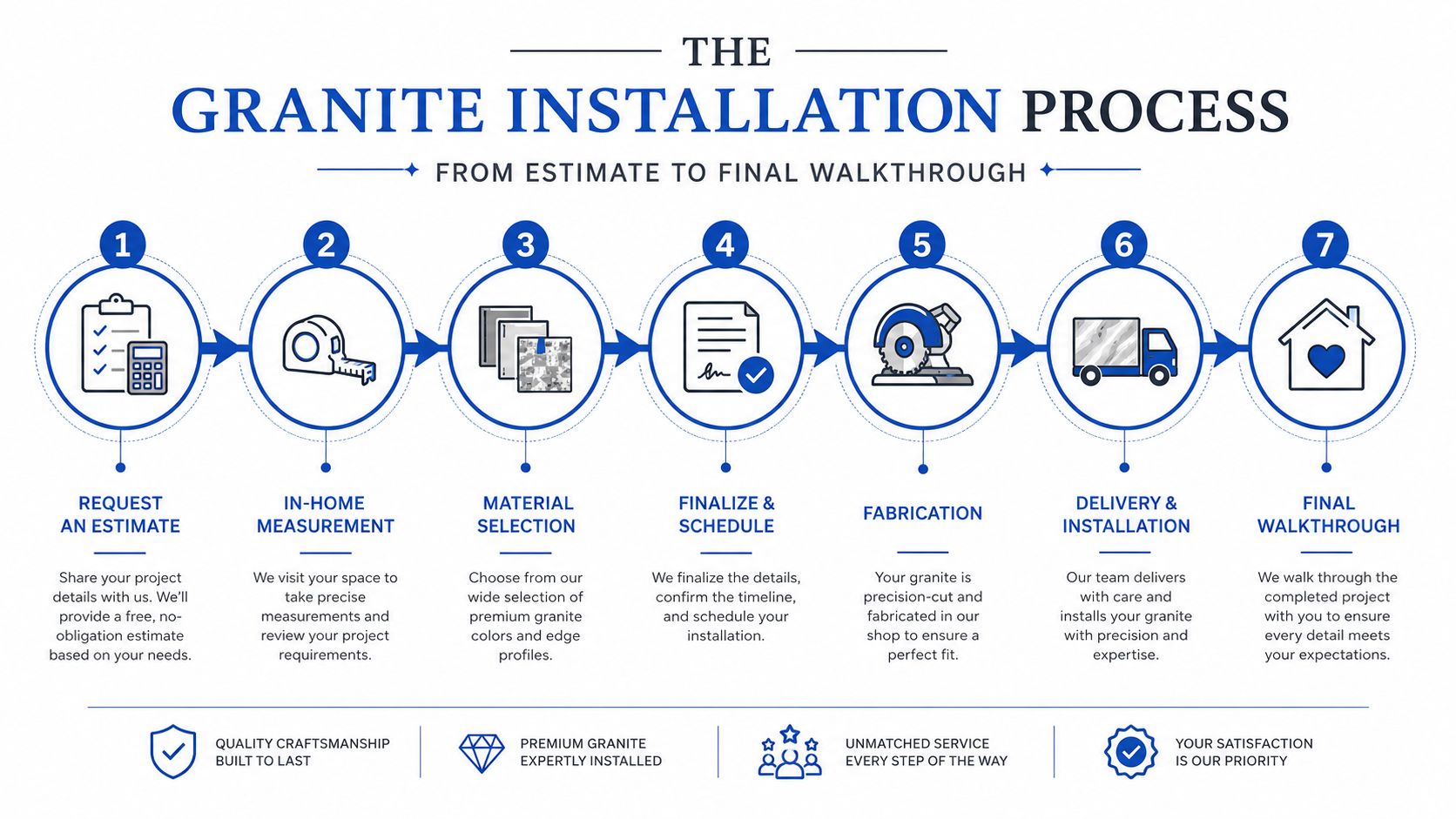
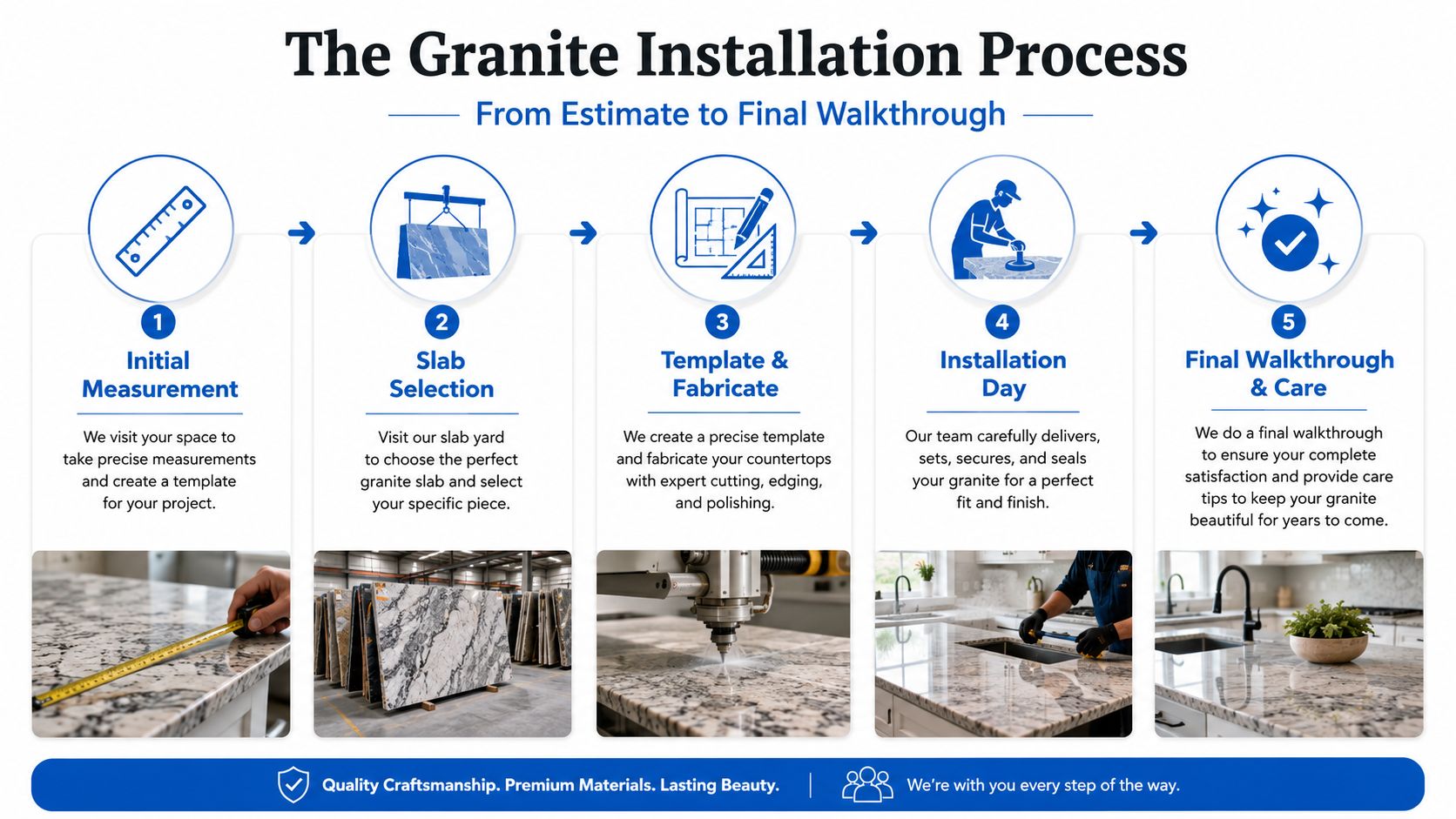
The process starts with a site visit or rough estimate, but the core job begins at templating. A reputable stone shop doesn't wing the layout. One independent stone company describes a sequence of planning, scheduling, stone selection, ordering, templating, and installation, and it notes that a deposit secures the materials and install date Cincinnati Stone Works.
What has to be ready before templating
By the time templating happens, the sink, faucets, and appliances need to be on site so the installer can measure around real fixtures, not guesses Cincinnati Stone Works. That detail matters more than people think. If the sink base is wrong, or the cooktop isn't there, the template can be off and the whole schedule starts sliding.
After templating, the slab goes to fabrication. That's where the crew cuts the sink opening, shapes the edge, finishes the seams, and checks the fit. On install day, old tops come off if needed, the new stone gets dry fit, the seams are set, and the tops are sealed and aligned. Plumbing reconnect usually follows within a day, once the adhesive and finish are ready.
Timing homeowners should plan around
The actual install day is often just a few hours to a full day, depending on layout and complexity Thumbtack granite installer guidance. After templating, homeowners often look at a 1 to 2 week window before the kitchen is fully back in service, and that's usually realistic for a straightforward job. Delays usually come from missing fixtures, late design decisions, or changes to the seam plan.
The crews that stay on schedule are the ones that control the seam layout, cutout tolerances, and final fit before anyone starts lifting stone into place. If the installer sounds casual about those details, expect the calendar to slip.
What a Real Granite Installation Quote Should Include
A bare-labor quote and a full-scope quote are not the same thing. One price covers the crew showing up to set stone. The other covers the job getting finished without surprise add-ons after the slab is on your cabinets. That gap is where homeowners get burned.
| Line Item | What It Covers | Commonly Included? | Homeowner Question to Ask |
|---|---|---|---|
| Slab material and grade | The granite itself, including quality tier and stone selection | Sometimes | Which slab grade is priced, and can I see the exact piece? |
| Fabrication and cutting | Measuring, cutting, polishing, and shaping the stone | Often | Is fabrication included in the quoted total? |
| Edge profile | Straight edge, beveled edge, ogee, and other finish details | Sometimes | Which edge profile is priced, and does a decorative edge cost extra? |
| Sink and cooktop cutouts | Openings for undermount sinks, drop-ins, and appliances | Sometimes | Are all cutouts included, or are some billed separately? |
| Old-counter removal | Tearing out existing tops before the new stone goes in | Sometimes | Does removal include disconnecting fixtures and hauling debris out? |
| Disposal and haul-away | Dumpster, dump fees, and cleanup after tear-out | Often omitted | What happens to the old counters after removal? |
| Delivery | Transport from fabricator to jobsite | Sometimes | Is delivery part of the installation price? |
| Installation labor | Setting, leveling, seam work, and fastening | Usually | Who is actually doing the install, your crew or a subcontractor? |
| Sealing | Initial stone sealing after install | Sometimes | Is sealing included, and what product do you use? |
| Final plumbing hookup | Reconnecting sinks, faucets, and related plumbing | Often omitted | Does your quote include final plumbing, or do I need a plumber? |
A quote that looks cheap on paper can turn into the expensive one once the missing pieces show up. A $2,100 price that leaves out demolition and disposal can outrun a cleaner $3,250 project once those extras are added, as shown in the granite installation cost breakdown. The lowest headline number is often the worst real-world deal.
Homeowner test: Every quote should be itemized. If a line can't be explained, priced, or removed, it's not a clean estimate.
Use the CountBricks pricing guide to compare what is being sold line by line, not just the sticker price. Ask for the slab, fabrication, edge detail, cutouts, demo, disposal, delivery, install labor, sealing, and plumbing as separate lines. If the installer pushes back on that, the quote is not transparent enough for a stone job.
How to Prep Your Massachusetts Kitchen Before the Install Crew Arrives
Massachusetts kitchens are often tight, older, and full of quirks that installers have to work around. That means prep matters. Cabinets need to be level and flat enough that the stone doesn't rock, because small substructure errors transfer right into the slab and show up later as rocking, visible joint irregularity, or seam mismatch Mystic Granite consumer standard.

What to clear and confirm
Clear the counters, empty the sink base, and move anything fragile out of the work zone. The crew needs clean access, especially around corners, appliance gaps, and seam locations. Pets and kids need to be out of the area too, because a stone job is not a family-walkthrough day.
Confirm these items before templating day:
- Sink base: Make sure the cabinet under the sink is open and accessible.
- Faucet and fixtures: Have the faucet on site so measurements match the actual hardware.
- Cooktop or range: Get it in place if the countertop cutout depends on its footprint.
- Appliances: Dishwashers and adjacent units need to be set, not still floating in layout limbo.
- Wall clearance: Leave the backsplash zone open so the crew can measure accurately.
Lock the plumbing plan early
Water shutoff should be coordinated with the plumber, not figured out on the spot. If the install includes a sink swap or final hookup, someone has to own that timing. A sloppy handoff here turns a one-day job into a frustrating return trip.
Small cabinet errors don't stay small. They show up later as seam mismatch, lippage, or a slab that sits just wrong across the opening.
Plan on avoiding sink and dishwasher use for 24 to 48 hours after install so the adhesive and final plumbing can settle properly. That's the right window to protect the job and keep from rushing the finish.
How to Choose the Right Granite Installer Near You
A good granite installer should feel boring in the right way. They show up with a clean process, explain the quote without dodging the details, and speak plainly about the structural parts of the job. If they can't do that, keep looking.
Start with proof, not promises
Verify license and insurance first, then ask for an itemized estimate that separates the slab, fabrication, delivery, installation labor, and old-counter removal Thumbtack installer guidance. That is basic professionalism, not a premium feature. Then look at the portfolio for tight seams, clean sink and appliance cutouts, and consistent overhangs. If the contractor won't show finished kitchens, they probably don't want you studying the details.
A labor-only middleman can work if the communication is tight, but many homeowners do better with a fabricator-installer who owns the whole sequence. One U.S. installer describes a full-service model that includes templating, fabrication, and installation for granite, quartz, quartzite, marble, and soapstone Quality Granite and Quartz. That kind of scope keeps responsibility in one place instead of bouncing the job between separate vendors.

Ask the questions that reveal weak contractors
The installer should bring up structural details without being prompted. Ask about cantilever limits, reinforcement for longer overhangs, and the expansion gap at the wall. If they do not mention support bars or L-brackets when the layout calls for them, they are not thinking like a stone professional. That is a bad sign.
Who is doing the install, your crew or a subcontractor? That question matters because some companies sell the job and send a different team on install day. That can still work, but only if the handoff is clear and the responsibility stays obvious. You want one company that owns the results, not a chain of excuses if something shifts during fitting.
Best practice: The right installer is not the one with the earliest opening. It is the one who explains slab-specific maintenance, checks porosity, and gives you a realistic reseal schedule.
I also look for a company that talks plainly about the finish work at the end of the job, not just the sale. If you want a local example, Sunny Day Pro Services handles granite as part of a broader tile and stone scope. That matters because the crews that care about finish work usually care about the whole project, from template to final cleanup.
Caring for Granite Countertops After Installation
Granite lasts a long time when you treat it like stone, not plastic. Use a pH-neutral cleaner, skip acidic products, and don't attack the surface with abrasives. That keeps the polish intact and avoids dulling the finish over time.
Sealing is part of ownership, not a one-time event. Search guidance repeatedly points homeowners to a 1 to 3 year reseal window, depending on porosity and use, and that's the right way to think about it. If water stops beading on the surface, the stone is telling you it's time.
What to watch for day to day
Edge chips happen, especially near sink fronts and corners. Seams can darken slightly with age, and standing water around the sink can leave a mess if it's ignored. Use trivets for very hot pans, and don't chop directly on the stone if you care about the finish.
If you get a stain, clean it quickly and don't scrub it into the polish. For post-project cleanup and residue removal around a newly finished kitchen, this after-construction cleaning guide is a useful follow-up. It's the kind of cleanup that protects the surface instead of grinding debris into it.
Simple habits that extend the life of the install
- Wipe spills fast: Especially near sinks, coffee stations, and cooking zones.
- Use soft cleaners: Harsh chemicals and abrasive pads are the fastest way to damage a polished surface.
- Respect overhangs: Don't sit or lean hard on unsupported edges.
- Keep water from pooling: Standing water is lazy maintenance, and granite will make you pay for it later.
Granite is forgiving if the install was done right and the owner stays on top of basic care. That's the whole deal.
Granite Countertop Questions Massachusetts Homeowners Ask Most
How much does granite countertop installation usually cost?
A typical installed project runs about $70 to $230 per square foot, which puts a 30-square-foot kitchen at roughly $2,100 to $6,900 CountBricks pricing guide. Quotes go up when the slab grade is premium, the edge profile is decorative, the layout has more cutouts, or demo and disposal are included. They go down when the job is simple, accessible, and the installer isn't carrying extra finishing work.
Is granite really maintenance-free?
No. That's marketing, not reality. Granite is durable and heat-resistant, but it's still porous and needs periodic sealing, usually in that 1 to 3 year range depending on the stone and how the kitchen gets used.
How long does the job take from templating to install?
For a straightforward kitchen, homeowners usually plan around 1 to 2 weeks after templating before the finished tops are back in place Cincinnati Stone Works. The install day itself is often just a few hours to a full day Thumbtack installer guidance. If the sink, faucet, or cooktop isn't ready on templating day, the schedule gets messy fast.
If you're in Wayland, Newton, Needham, Wellesley, Weston, or a nearby Massachusetts town, get a quote that spells out every line item before you sign. Sunny Day Pro Services handles tile and granite work with clear communication, dependable timelines, and a satisfaction guarantee that keeps the finish honest. Visit Sunny Day Pro Services and ask for a fast, itemized estimate so you can compare the full scope instead of guessing at the price.

