
Granite Installation Cost: 2026 MA Pricing Guide
Learn granite installation cost in Massachusetts for 2026. Get per-square-foot pricing, project estimates, and tips to budget smart for your remodel.
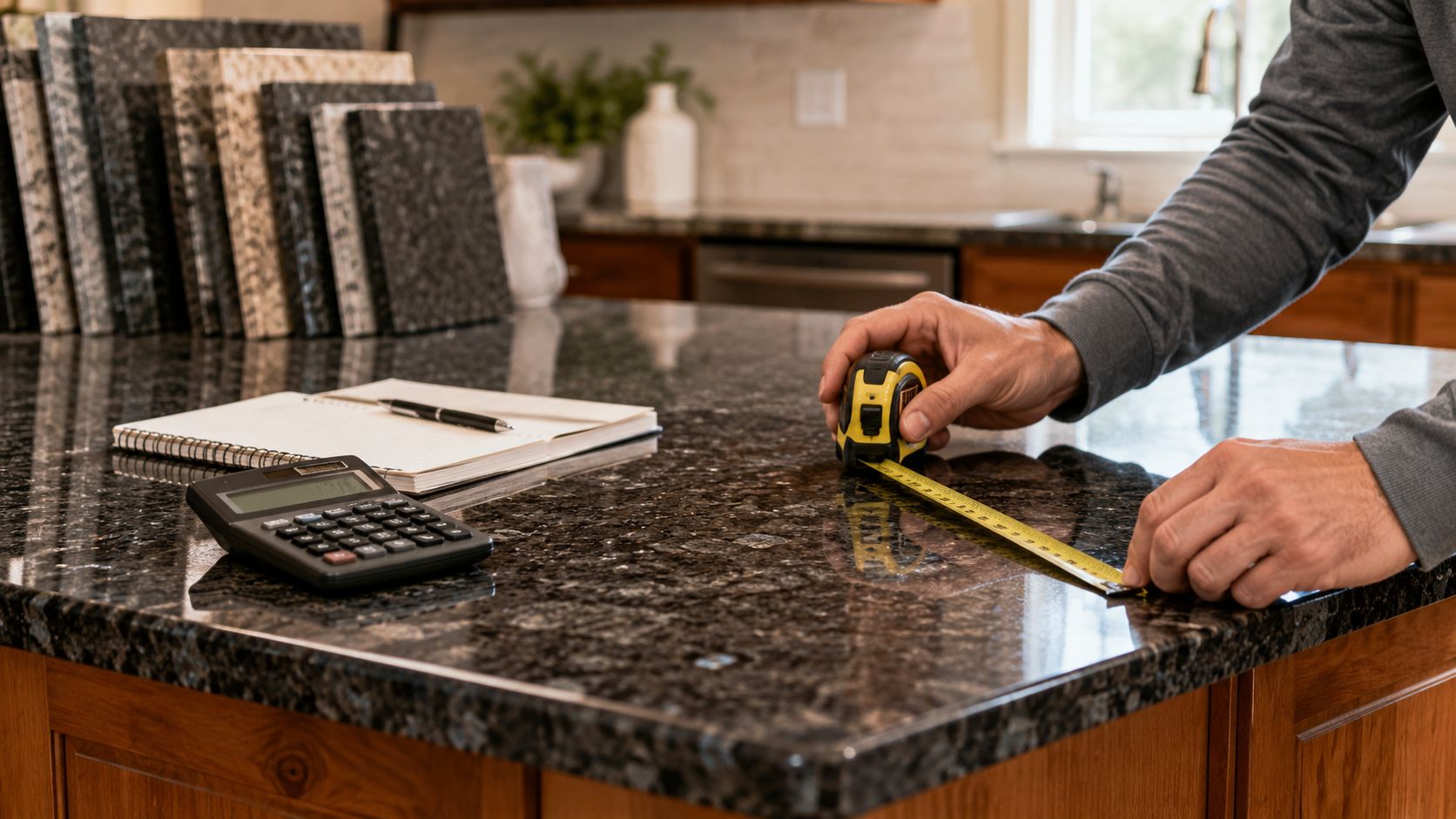
In 2026, most Massachusetts homeowners pay roughly $97 to $141 per square foot installed for granite countertops, and a typical 30 to 55 square foot kitchen lands around $2,900 to $6,000 all in. In Greater Boston, that number can move fast once you add edge work, sink cutouts, plumbing, and local labor.
You're probably standing in a kitchen or bath right now, tape measure in hand, staring at a quote that looks either suspiciously low or annoyingly high. That's exactly where homeowners get burned, because granite pricing is never just about the slab. It's about how much cutting, fitting, hauling, and problem-solving the job needs, and Massachusetts installers price that work like they should.
Table of Contents
- What Granite Installation Really Costs in Massachusetts Right Now
- Material grade and rarity
- Slab size, thickness, and yield
- Edge profile and finish work
- Cutouts and fixture complexity
- Regional labor in Greater Boston
- Send the right information first
- Templating only works after the base is ready
- Ask these four questions before you sign
What Granite Installation Really Costs in Massachusetts Right Now
You're standing in a Wayland kitchen with a tape measure, and the first quote on the counter is the number that matters. If it reads like a guess, treat it like one. Granite installation cost in Greater Boston is never a flat number, because labor, access, fabrication, and stone selection all change the final bill.
For installed granite countertops, a solid current benchmark is about $97 to $141 per square foot, with a wider market range of $50 to $200 per square foot depending on stone rarity, edge profile, and local labor Modernize. A recent national estimate lands in the same range at $96.58 to $141 per square foot in May 2026 Homewyse. For a typical 30 square foot bathroom vanity or small counter, that puts you around $2,900 to $4,200, while premium projects can climb past $6,000 when the stone, backsplash height, or fabrication gets more demanding.
Kitchens follow the same pattern. A standard 40 to 55 square foot kitchen often lands around $2,000 to $6,000 total, depending on the slab and the work involved Slabwise. Slab-only pricing in mainstream U.S. markets often sits around $40 to $60 per square foot, while installed projects commonly rise to about $59 to $78 per square foot for a typical kitchen and can exceed $100 per square foot when the job gets complicated Angi. Labor and fabrication commonly add about $30 to $60 per square foot on top of raw slab cost.
Granite floors are a different job. They use the same stone, but the labor, prep, and setting work are not priced like a countertop install. A Wellesley entry, for example, can look simple on paper and still cost more than a vanity because floor prep, layout, and finish work drive the labor up fast. That is why a quote for granite flooring should never be compared directly to a countertop quote.

Practical rule: if a quote only gives you one number, it is probably hiding the work that makes the number real.
The four levers that move the needle most are material grade, fabrication complexity, edge detail, and jobsite add-ons. Once you know those, the quote stops looking mysterious.
The Five Cost Levers That Move Your Granite Quote
A granite quote in Greater Boston starts with the slab, then it gets reshaped by labor, fabrication, and the parts of the job that do not show up in a pretty showroom sample. That is why one Newton kitchen can look straightforward and still come in higher than expected once the shop measures every cut, seam, and lift. Homeowners usually fixate on the stone price first, then get surprised by the final bill after templating.
Material grade and rarity
Common granite sits at the lower end of the market. Higher-grade stone, unusual colors, and imported material push the quote up fast because the slab itself costs more and the shop has less room to source a cheaper match. A neutral, everyday slab and an uncommon showpiece slab are priced for different buyers, and no installer should pretend otherwise Angi.
Slab size, thickness, and yield
The slab matters less than how much of it your layout can use. A small Newton kitchen with a simple run may fit cleanly into one slab, while a wider layout with an island, a breakfast bar, or awkward corners can waste material and force more fabrication work. That waste shows up in the final number, because the shop has to plan for seams, matching, and extra handling Slabwise.
Edge profile and finish work
Edge detail changes the look and the labor. A basic eased edge keeps the price in check, while more decorative profiles such as beveled, ogee, or mitered edges add machine time and polishing. In practice, edge upgrades can add about $8 to $25 per linear foot Slabwise.
Cutouts and fixture complexity
Cutouts are where quotes get messy if the contractor has not measured every fixture. Sink openings, cooktop cutouts, and undermount details all create more fabrication risk, and plumbing reconnection can add more work on site. One guide lists plumbing reconnection at about $150 to $400 and sink cutouts at about $150 to $350 each. A kitchen in Wellesley with a tricky undermount or a busy vanity layout in Wayland is exactly the kind of job where these line items creep up Slabwise.
Regional labor in Greater Boston
Greater Boston labor is not cheap, and the quotes should not pretend it is. Skilled fabricators, careful templating, and clean installation cost more here because the margin for mistakes is thin and the callback risk is real. That is also why granite floors in a Wellesley entry follow a different price logic than a countertop job, and why a homeowner comparing quotes should keep countertop work separate from flooring work. For a related stone install, see our guide on marble tile installation cost.
Bottom line: a $50 per square foot slab can turn into a $130 per square foot installed project once the layout, edges, cutouts, and jobsite work stack together.
Sample MA Project Estimates You Can Compare To Your Own
A homeowner does not need a theory lesson. They need a number that is close to the job in front of them. The right way to judge a granite installation cost is to compare projects with the same size, the same finish level, and the same site complexity.
Read the size first, then the details
A 25 square foot bath vanity in Wayland is a different job from a 55 square foot kitchen in Wellesley with an island. A granite floor in Weston is different again, because floor installation carries a separate labor profile and a different risk level. Angi's granite floor guidance puts average floor installation around $7,500, with a range from $4,000 to $32,000 and a per-square-foot span of $10 to $40 Angi. Countertop budgets do not carry over cleanly to floor budgets.
Here's a clean comparison you can use:
| Project | Size (sq ft) | Typical Slab Grade | Edge Profile | Low Estimate | High Estimate |
|---|---|---|---|---|---|
| Wayland bathroom vanity | 25 | Level 1 or Level 2 granite | Standard eased edge | $2,400 | $3,500 |
| Newton galley kitchen | 35 | Level 2 granite | Eased or pencil edge | $3,400 | $5,000 |
| Wellesley family kitchen with island | 55 | Higher grade granite | Upgraded profile, possibly mitered sections | $5,300 | $7,800 |
| Weston entryway granite floor | 120 | Durable floor-suitable granite | Floor finish and trim details | $4,000 | $32,000 |
The countertop estimates above sit in the same general range discussed earlier, while the floor project spreads much wider because the labor and layout risk are different. That is the part homeowners miss when they blur countertop pricing into floor pricing. The same material does not carry the same install math.
For a similar breakdown of another stone surface, compare it with this marble tile installation cost guide. It gives a useful point of reference for stone labor without pretending every material installs the same way.
If a Massachusetts quote lands far below these bands, assume something is missing. In practice, it is usually templating, removal, plumbing, or a real fabrication step.
The Jobsite Add-Ons Most Quotes Omit
The first price on a granite quote is usually only the starting point. That is how a lot of shops write bids before they know the full scope of the job. The mistake is treating those starter numbers as if they already cover the entire work.
The missing line items
These are the charges that turn a tidy bid into a real invoice:
- Removal and disposal: Old countertop tear-out, haul-away, and site cleanup take time and truck space.
- Plumbing disconnect and reconnect: Shutoffs, trap work, and reconnecting the sink usually sit outside the base stone price.
- Sink cutouts: Undermounts, apron-front sinks, and specialty openings add fabrication time.
- Edge upgrades: Basic eased edges are one thing, but decorative profiles add labor and finishing time.
- Outlet, faucet, and fixture adjustments: These jobs look small on paper, then stack up fast when the layout is tight.
- Cabinet leveling and reinforcement: Heavy stone exposes weak cabinets fast, and the installer has to correct that before the slab goes down.
A quote that looks fine at first can move up fast once the actual scope is on paper. A small Boston-area kitchen or bath vanity often picks up extra costs the moment tear-out, plumbing, and fabrication details are included. That is not padding, it is the job finally being priced accurately. The installers who tell you this up front are the ones worth listening to.
What good quoting looks like
A solid bid breaks the stone, the labor, and the extras into separate lines. If one contractor gives you a lump sum and another gives you a real breakdown, the second quote is the one to trust. The cheap quote can look better until you find out the sink cutout, plumbing reconnection, or disposal was never included.
For a broader reminder that surface prep and layout always change the final price, compare your stone bid with this flooring installation cost per square foot guide.
Ask for the quote you would want if the job were already half built. If the installer cannot itemize it, the number is not ready.
How to Get an Accurate Granite Quote in Massachusetts
A good granite quote starts before fabrication, not after. The homeowner who sends a real sketch and the right fixture details gets a real price. The homeowner who says “just give me an estimate” usually gets a placeholder.
Send the right information first
When you ask for a quote, send these items up front:
- Rough measurements: Lengths, depths, and any island dimensions.
- Sink model: Undermount, top-mount, apron-front, or a specialty size.
- Edge choice: Basic eased, pencil, beveled, or decorative profile.
- Cooktop and faucet details: The installer needs to know the openings before templating.
- Photos of the existing space: Cabinets, corners, overhangs, and any problem spots.
That list sounds simple because it is. It saves the fabricator from guessing, and it saves you from paying for a second trip.
Templating only works after the base is ready
Granite gets templated after the cabinets are installed and level, not before. If the cabinets move after templating, the stone won't fit the way it should. That one sequencing choice can save an extra trip, a remake, or a seam that lands in the wrong spot.
If you're comparing stone work to another trade, this flooring installation cost per square foot guide is a good reminder that surface prep and layout always matter more than people expect.
Ask these four questions before you sign
- Who fabricates the slab, your shop or a third party?
- Where will the seams go, and can I see that on the template?
- What workmanship warranty do you stand behind?
- Are removal, plumbing, and haul-away included or billed separately?
A quote should answer those questions without drama. If it doesn't, keep shopping.
Smart Ways to Save Without Cutting Corners on Granite
The easiest savings move is also the smartest one, keep the design simple where nobody will notice. Homeowners in Greater Boston don't need exotic stone in every room to get a sharp result. They need the right stone in the right place.
The savings that actually hold up
- Choose a common granite color: A neutral Level 1 or Level 2 slab usually gives you a cleaner price than chasing a rare import.
- Stick to a standard edge: An eased or half-bullnose edge keeps fabrication simpler.
- Use remnant slabs for smaller spaces: Bathrooms, laundry rooms, and powder rooms are perfect candidates.
- Batch the work with a broader remodel: If the crew is already on site for bathroom or kitchen work, the labor is easier to absorb.
- Buy your sink and faucet directly: That avoids contractor markup on fixtures.
- Schedule during slower shop periods: Fabricators are often more flexible when their calendar isn't packed.
Each of those choices can shave real money, but the biggest risk is chasing the cheapest bid in town. A low quote often means the shop is light on templating, seam planning, or install time. That's where the callback costs show up later.
Saving money on granite doesn't mean buying bad stone. It means refusing to pay premium money for details you don't need.
Timeline, Warranty, and Working With Sunny Day Pro Services
A Massachusetts granite job moves fast once the cabinets are set, the measurements are locked, and the slab is already chosen. Kitchens in Greater Boston usually go from template to install in a short window, but custom edges, special slab sourcing, or late fixture changes will slow the whole job down. If the cabinets are out of level or the plumber is still finishing rough-in work, the schedule slips. That is normal. A clean granite install depends on the rest of the room being ready first.
What a fair warranty should cover
A fair warranty should cover workmanship for about 1 year, while the slab itself may carry a manufacturer warranty. It should not read like a blank check. Sealing neglect, chips from impact, and staining caused by poor care are usually outside coverage. Granite is durable, but the install still has to be done right, and the stone still needs sensible use after it is in the room.

For homeowners who want one local team to handle the process from measurement through final set, Sunny Day Pro Services granite installation is the right place to start. That matters in Greater Boston, where a small Newton kitchen, a Wayland bath vanity, and a Wellesley entry floor all create different site conditions and different labor demands. Ask for a quote with photos and measurements, choose your service window, and book templating only after the cabinets are in place and level.
On install day, the crew should protect nearby surfaces, set the stone carefully, check seams, and walk the job with you before leaving. That applies to granite countertops and granite floors alike. The floor work usually takes more protection and more cleanup planning because traffic, transitions, and adjacent finishes can turn a simple install into a messy one if the quote was thin from the start.
For the first 30 days, keep the stone clean, stay away from harsh treatment at the edges, and treat the surface like the finished material it is. That is the straight story. Good granite work is not just about the slab, it is about timing, prep, and a crew that does not cut corners once the truck shows up.

