
How to Clean Granite Countertops Without Damaging the Finish
Learn how to clean granite countertops safely with daily routines, stain removal tips, and resealing advice that preserves your stone’s natural beauty.

You've probably wiped down a granite counter with a “safe” all-purpose spray and felt good about it, only to notice later that the finish looks a little flatter, a little hazier, or just harder to keep clean. That's the trap with granite, it doesn't usually fail from one dramatic mistake, it gets worn down by the wrong cleaner, too much soap, or a habit that seems harmless in the moment.
The good news is that how to clean granite countertops is simpler than most homeowners think. The right routine is fast, gentle, and repeatable, and it protects the stone far better than aggressive scrubbing or strong disinfectants ever will.
Table of Contents
Why Granite Gets Damaged Faster Than You Think
The most common granite mistake shows up on an ordinary Tuesday night. The counters get wiped after dinner with a vinegar spray, the kitchen smells clean, and nothing looks wrong right away. Weeks later, the surface starts to lose its sharp reflection, and the homeowner assumes the stone is just aging. In reality, the cleaner has been working against the finish the whole time.
Granite is durable, but it is chemically sensitive. Care guidance warns that vinegar, bleach, and ammonia can strip sealer or dull polished stone over time, which is why professional routines rely on quick spill cleanup and pH-neutral products instead of harsh detergents Slabwise. That matters because repeated chemical misuse is a common reason granite looks tired long before the stone itself is worn out.

What actually wears the finish down
The damage rarely starts with a dropped pan. It starts with repeated contact from products that do not belong on sealed stone, especially citrus cleaners, bleach-based sprays, and ammonia-heavy formulas. Those products can dull the polish or weaken the protective layer, and once the finish loses that tight, reflective look, dirt sticks more easily and the stone gets harder to keep looking fresh Westside Tile.
The first year is when habits become permanent. If the routine is too aggressive then, the countertop pays for it later.
For homeowners comparing granite installation or refresh options, it helps to know what kind of surface they are caring for in the first place, which is why a granite countertop installation near me overview can give useful context.
The practical lesson is simple. Granite care works best when it is boring, fast, and consistent. A light daily wipe, quick spill cleanup, and the right cleaner protect the surface far better than an occasional deep scrub with the wrong chemicals.
The Daily Cleaning Routine That Works
A granite counter that stays clean usually gets that way because the routine is short and repeatable. Wipe it after prep, dry it fully, and keep the cleaner mild. In a working kitchen, that approach protects the finish far better than frequent scrubbing or switching between harsh sprays Slabwise. Focus on removing residue before it dries, hazes, or attracts dirt.
The exact sequence
Start with loose crumbs, flour, and bits of food. Then use a barely damp microfiber cloth with warm water and a small amount of mild dish soap. Home Depot's guidance is specific, use no more than a half tablespoon of soap, work in small circular motions, rinse with plain water, and buff dry so the finish does not hold onto soap film or streaks Home Depot.
That order matters because too much soap is one of the easiest ways to create a cloudy look that homeowners mistake for stone wear. The residue does not just sit there, it collects dust and leaves a film that makes the countertop feel sticky or dull.
Practical rule: the cloth should be damp, not dripping. If water is pooling, the routine is already too wet.
A dedicated microfiber cloth for stone is a smart habit, especially if the same kitchen also uses towels for stainless steel, glass, or floor cleaning. Cross-contamination is one of those small issues that adds up, because the wrong rag can spread grease, cleaner residue, or grit right back across the countertop. For homeowners who wash cloths often, microfiber care matters too, and that is covered here: can I wash microfiber cloths.
What not to do
- Don't soak the surface: excess water leaves spots and can make drying harder.
- Don't scrub hard: light pressure is enough when the cloth and cleaner are right.
- Don't skip the dry pass: wiping the surface dry is what keeps the polish crisp.
- Don't use rough pads: abrasive tools can leave tiny scratches that dull the finish.
Work one section at a time and keep the motion light. On a normal day, a quick wipe after food prep and a dry buff are enough to keep granite looking cared for without turning cleaning into a project.
Safe Cleaners Versus Products That Ruin Granite
A granite countertop can look fine after a quick wipe, then turn cloudy months later because the wrong cleaner kept getting used. That is the trap in the first year. Homeowners often think they are caring for the stone, then slowly build up residue or weaken the sealer with products that are too harsh, too acidic, or used too often. The safe routine stays simple, and that is part of what keeps the finish looking right.
What belongs on granite
For routine cleaning and deeper sanitation, pH-neutral cleaners and isopropyl alcohol blends are the safer choices, not acidic or strongly alkaline household products Livingetc. Southern Living describes a mix of about 4 tablespoons of 70% isopropyl alcohol plus a few drops of dish soap in a liter bottle, left on the surface for 3–5 minutes before wiping Southern Living. Another Southern Living recipe uses a 50/50 alcohol-and-water mix for stone-safe sanitizing Southern Living. Those are the kinds of products that clean without turning daily care into a repair job later.
What quietly causes damage
Granite-care guidance consistently warns against vinegar, lemon or orange cleaners, ammonia, bleach, and abrasive scrubbers or powders because they can damage the stone or its sealer Westside Tile. A harsh cleaner can make a countertop look clean for a moment, but the finish often ends up flat and harder to keep looking good.
| Product Type | Safe for Granite | Potential Damage |
|---|---|---|
| pH-neutral stone cleaner | Yes | Low risk when used as directed |
| Warm water with mild dish soap | Yes | Soap film if overused |
| Isopropyl alcohol and water blend | Yes | Minimal risk with proper wipe-down |
| Vinegar spray | No | Can dull the finish and weaken sealer |
| Bleach cleaner | No | Can damage sealer and finish over time |
| Ammonia-based spray | No | Can strip protection and dull polish |
| Lemon or orange cleaner | No | Acidic residue can harm the surface |
| Abrasive pad or powder | No | Can scratch and haze the stone |
If you want to keep the product shelf simple and avoid guesswork, a chemical-free approach can narrow the options further. This guide to chemical free cleaning products helps sort out what belongs in a low-risk routine and what does not.
The main point is straightforward. The strongest cleaner is rarely the best cleaner for granite. A gentler product, used the right way, protects the polished look that made the stone appealing in the first place.
When to Disinfect and How to Remove Stubborn Stains
A granite counter can look spotless and still need a different kind of cleaning. After raw meat prep, eggs, or a household illness, a stone-safe disinfecting step makes sense. For crumbs, coffee rings, and everyday dust, that extra chemical exposure is usually unnecessary and can create more wear than benefit.
How to disinfect without harming the sealer
The safest common option is an isopropyl alcohol solution. Southern Living suggests mixing equal parts isopropyl alcohol and water, while another recipe uses 4 tablespoons of 70% isopropyl alcohol plus a few drops of dish soap in a liter bottle, then leaving it on the surface for 3–5 minutes before wiping Southern Living. The key trick is short contact time and a light wipe. Soak the stone, and you invite trouble with the finish.
Bleach, ammonia, and acid-based cleaners still have no place here. They target more than germs, and granite pays for that with a dulled surface or weakened sealer.
How to treat stains without scrubbing them in
Stains need a different response, and scrubbing usually drives them deeper or spreads them wider. Oil-based stains often respond to a poultice made with baking soda and water, while water-based stains can call for baking soda and hydrogen peroxide CNET. CNET describes leaving the mixture on the surface for several hours under a cover before removal, and The Spruce gives a similar paste formula of 1/2 cup baking soda plus 1/2 teaspoon hydrogen peroxide for stained areas The Spruce.
A stain inside the stone will not come out faster because you press harder. The paste and the wait do the work. Scrubbing pads usually leave the area hazy and can make the mark harder to blend out later.
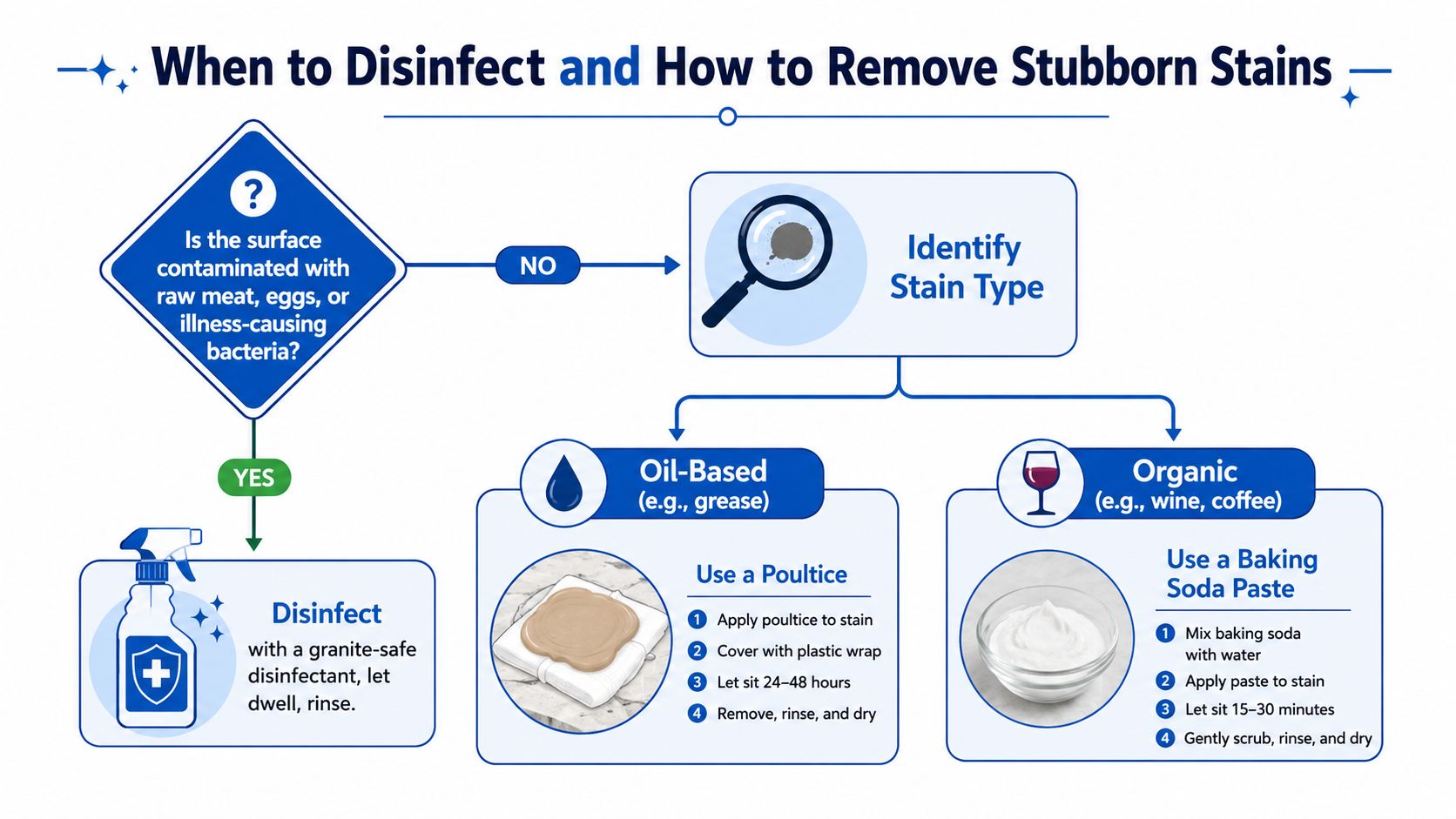
Oil stains from cooking grease and organic stains from coffee or wine often need different treatments, so identifying the stain type first saves time and reduces the chance of making the mark larger. Once the poultice comes off, clean the area lightly and dry it fully. Do not chase the spot with a scrub pad.
Resealing Granite on a Schedule That Makes Sense
Granite's finish does not come only from cleaning. It depends on the sealer sitting in the pores and slowing down stain absorption. A counter can look spotless and still drink in spills fast if that protection has worn thin.
A lot of homeowners miss that in the first year. They wipe with whatever spray is under the sink, clean too often, and assume the stone is fine because it still looks shiny. The problem shows up later, when water stops beading and oil marks start hanging around longer than they should.
How to test your own countertop
The simplest check is the water-bead test. Put a few drops on the surface and watch what happens. If the water soaks in and darkens the stone, the sealer is failing. If the water beads after about 5 minutes, the sealer is still performing American Quartz Granite.
That test turns guesswork into something visible. It also beats relying on a calendar alone, because traffic, food prep habits, and the stone itself all affect how quickly the sealer wears.
A schedule that fits real use
Care guidance commonly recommends resealing active kitchen granite about once a year or every 1–3 years, while some lighter stones may need attention every 6 months and lower-traffic bathroom vanities can often go 2–3 years between applications American Quartz Granite. That range makes sense because the busiest counters take more spills, more wiping, and more chemical exposure. If someone has been over-cleaning with the wrong products, the sealer usually fails earlier than they expect.
For a homeowner who wants a simple rule, this works well:
- High-use kitchen island: test annually.
- Busy perimeter counters: watch them during heavy cooking seasons.
- Bathroom vanity: test less often, but do not ignore it completely.
- Lighter-colored granite: pay closer attention, since some stones need earlier resealing.
Before resealing, the surface should be clean, fully dry, and free of residue. A quality impregnating sealer should protect the pores without changing the look of the stone, which is the point. From the field, the biggest mistake is treating sealer like a polish. It is a barrier, not a shine product, and it keeps stains from becoming permanent headaches.

Building a Realistic Granite Maintenance Plan
Granite stays beautiful when the routine is small enough to happen. A busy household doesn't need a complicated maintenance ritual, it needs a simple sequence that covers everyday cleaning, occasional disinfection, stain treatment when needed, and resealing on a sensible schedule.
A plan that fits normal life
A practical year looks like this, daily light cleaning after meal prep, targeted sanitizing only when there's a reason, stain treatment only when a mark won't lift, and a water-bead check before resealing decisions. That keeps the work focused instead of turning the kitchen into a project every weekend.
Seasonally, the best moments for a quick product audit are when the household shifts habits. Before holiday cooking, clear out the harsh cleaners that don't belong on stone. In spring, check whether water still beads. During a quieter month, inspect the sink cutout and the most-used prep zone, because those are usually the first places to show wear.
Practical rule: if the granite looks dull, don't reach for a stronger cleaner first. Check whether the finish needs protection, not punishment.
When etching, deep staining, or failed sealer has gone beyond DIY repair, professional stone restoration is the smarter move. Sunny Day Pro Services offers house cleaning and granite-related tile services for homeowners in Massachusetts, which makes it a useful option when the surface needs more than a routine wipe-down. For ongoing care, it helps to keep the routine light and repeatable so the stone keeps its polish instead of slowly losing it.
If your granite already looks hazy, stained, or uneven, Sunny Day Pro Services can help you reset the surface and keep it on a cleaner maintenance track. Visit Sunny Day Pro Services to ask about professional cleaning support, granite-related services, and a maintenance plan that fits your kitchen and your schedule.

