
Marble vs Ceramic Tile: A Practical Homeowner Guide
Marble vs ceramic tile compared on durability, cost, maintenance, and style to help busy homeowners choose the right surface for every room.
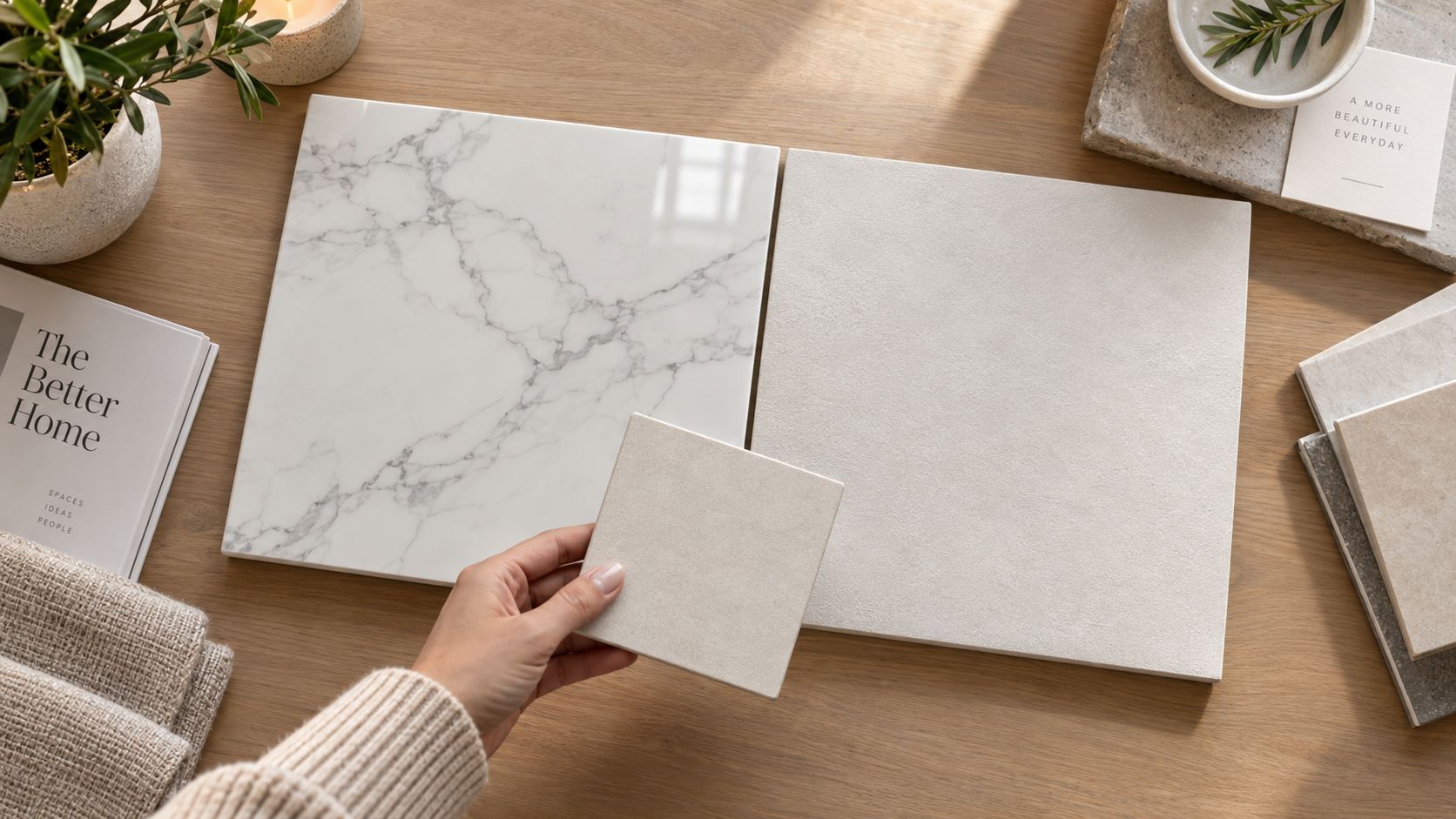
You're standing in a gutted bathroom with two tile samples in your hands. One is real marble, with veining that looks different in every piece. The other is ceramic, clean and convincing, but easier to dismiss as the practical option. Then you remember the kitchen floor, muddy boots, spilled coffee, a dropped pan, and the Labrador who treats the house like a racetrack.
That's where the marble vs ceramic tile decision becomes real. It isn't only about which sample looks better under showroom lights. It's about what the surface will demand from you over the next 10 to 20 years, including resealing weekends, etch marks, chipped corners, replacement difficulty, and the repair bill nobody thinks about during demolition.
My Massachusetts tile-installer opinion is straightforward. Marble earns its keep when its natural character is the main design feature and you're willing to maintain it. Ceramic earns its keep when the room has to tolerate ordinary household abuse without constant supervision. The right choice depends less on taste than on how your home functions.
Table of Contents
- Can marble go in a shower?
- How often does marble need resealing?
- Does ceramic tile improve resale value in New England?
- What happens when one tile chips?
When the Tile Decision Actually Feels Real
A renovation feels different once the walls are open and the old flooring is in the dumpster. Pinterest has done its job. Now you're looking at actual samples, actual layout drawings, and a project budget that has to survive contact with a contractor's estimate.
A homeowner may choose marble for a primary bathroom because the veining gives the room depth that manufactured tile can't perfectly reproduce. That same homeowner may choose ceramic for the kitchen because the kitchen sees coffee, tomato sauce, grit, chair legs, and dropped cookware every day. Neither choice is contradictory. They solve different problems.
The surface has a job to do
On a quiet bathroom wall, marble can be a pleasure to own. On a busy kitchen floor, the same material may become a daily reminder that beautiful surfaces need rules. Marble can show scratches, stains, and acid etching, while glazed ceramic avoids the same acid sensitivity because its fired surface protects the tile body. Industry guidance explains why marble's calcium-carbonate composition makes acidic cleaners and liquids a particular risk.
Ceramic isn't indestructible. A hard impact can chip a tile, and poor installation can contribute to cracking. The advantage is practical: a damaged ceramic tile can often be removed and replaced without refinishing an entire visual field.
A useful job-site rule: Choose the material for the worst ordinary day in the room, not the best photograph of it.
Regret usually arrives later
Most homeowners don't regret marble because it looks bad. They regret it when a lemon, wine spill, or harsh cleaner leaves a dull spot, or when the sealing schedule gets ignored during a busy year. They don't regret ceramic because it lacks personality. They regret it when they choose a low-quality product, a slippery finish, or a layout that makes the room feel generic.
Look at the room:
- Busy kitchen: Favor ceramic or porcelain, especially around sinks, ranges, and exterior doors.
- Primary bathroom: Marble can work when the finish, waterproofing, sealing, and cleaning routine are handled correctly.
- Mudroom or entry: Ceramic is the safer everyday choice for tracked-in grit and abrasion.
- Formal room: Marble can make sense when visual drama matters more than low-maintenance ownership.
Tile is installed once, but you live with its behavior every day. That's why the best decision starts with traffic, moisture, cleaning habits, and repair tolerance before it gets to color.
What Marble and Ceramic Tile Actually Are
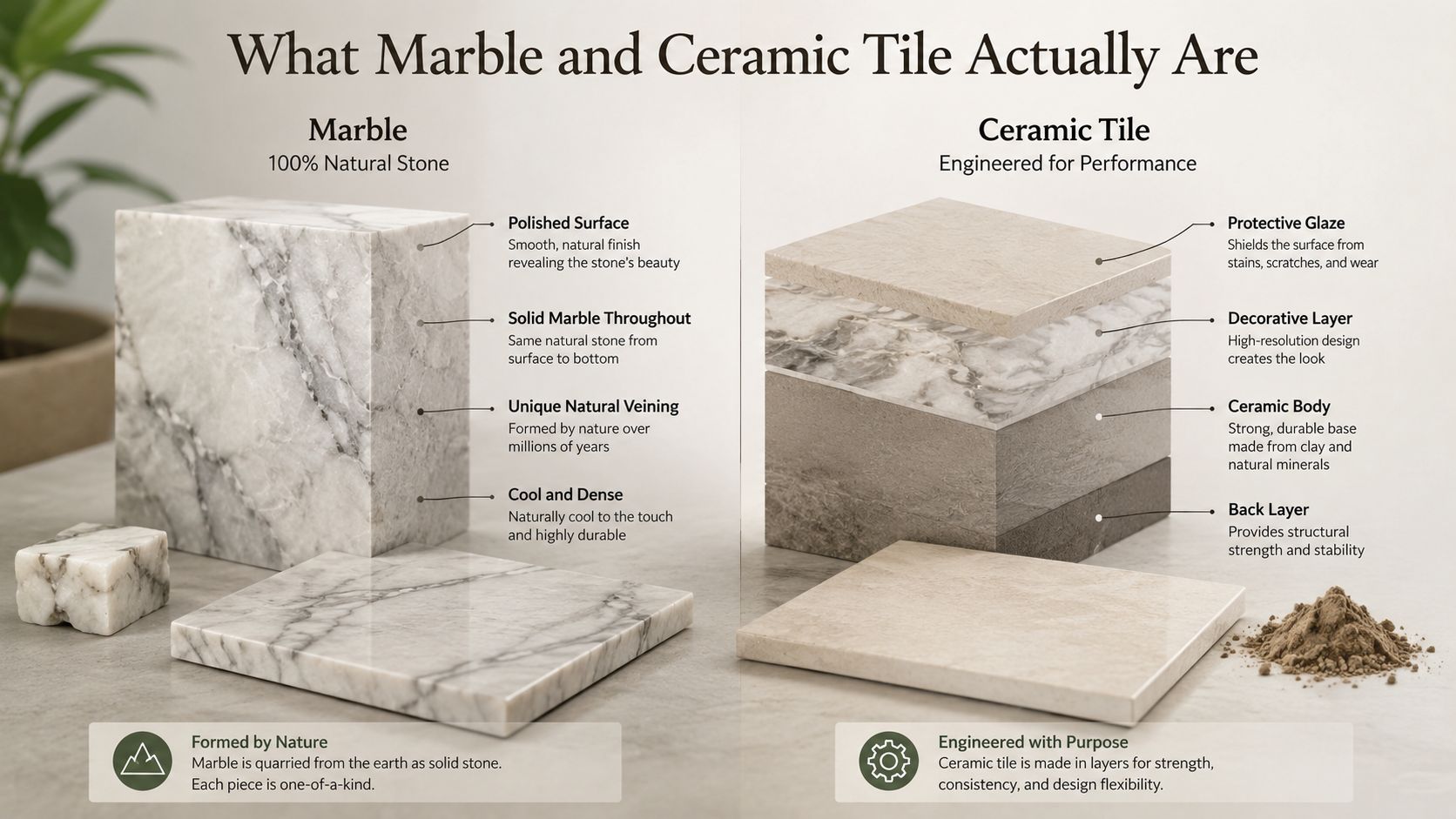
Marble is a natural stone quarried from large blocks. Fabricators cut those blocks into slabs or tiles, then polish, hone, brush, or otherwise finish the surface. The veining comes from minerals and geological formation, so each tile carries variation that isn't fully controlled from one piece to the next.
That variation is marble's strongest design advantage. A well-laid marble floor has movement and depth because the pattern isn't repeating like a printed image. It also creates an installation challenge. The installer has to sort pieces, plan the visual flow, and account for shade and vein changes before setting the tile.
Ceramic starts in a factory
Ceramic tile is manufactured from clay and other mineral materials. The mixture is pressed into shape, fired in a kiln, and often covered with a glaze that supplies the visible color, pattern, and protective surface. That process gives manufacturers control over dimensions, finish, and design consistency.
A store may place ceramic and porcelain in the same aisle, but they aren't identical. Porcelain is the denser, less porous cousin of ceramic, manufactured to achieve lower water absorption. Under ANSI classifications, impervious tile absorbs 0.5% or less, vitreous tile absorbs 0.5% to 3%, semi-vitreous tile absorbs 3% to 7%, and non-vitreous tile absorbs more than 7%. These tile-rating categories are summarized in this guide to ANSI tile classifications.
What arrives at the house
Marble and ceramic both come in a broad range of formats, from small mosaics to large rectangular pieces. Marble may arrive as polished or honed tile with natural edge variation, while ceramic often arrives with sharper manufactured edges and a consistent thickness.
The product's origin affects nearly everything that follows. Marble needs more careful handling, material selection, sealing, and cleaning. Ceramic generally offers more predictable sizing, easier routine care, and broader design consistency. Porcelain adds stronger moisture performance when the project calls for it.
Side-by-Side Performance Comparison
The five performance questions that matter most are simple: Does it look right, will it scratch, how does it handle moisture, is it safe underfoot, and can it remain serviceable for the life of the room?
Marble wins the appearance argument when you want authentic, one-of-a-kind veining and a surface that develops character. Ceramic wins the practical argument in most high-abuse rooms because the glazed surface is easier to clean and the tile body is generally harder.
The numbers that affect daily use
Marble is commonly reported around Mohs 3 to 5, while modern ceramic tile is often around Mohs 5 to 7, depending on the product and finish. This material comparison outlines the typical hardness difference and its effect on scratch resistance. A separate tile-care guide describes marble around Mohs 3 to 4 and glazed ceramic commonly around Mohs 6 to 7. That comparison reinforces why ceramic generally handles everyday abrasion better.
Water absorption needs more careful interpretation. Marble is naturally porous, and a commonly cited range is about 0.5% to 2.0%, while ceramic floor tiles are often classified around 3% to 10%, with wall tiles frequently higher. Porcelain is defined as below 0.5% absorption. This marble and ceramic comparison explains why glazed ceramic and porcelain are often preferred in moisture-prone rooms.
ASTM and ANSI classifications complicate the shorthand. ASTM C503 caps absorption at 0.20% for calcite marble and 0.75% for dolomite or serpentine marble, while ANSI A137.1 includes ceramic classes from impervious through non-vitreous. The practical lesson is that a specific tile's technical rating matters more than the word “ceramic” or “marble” on a sample label.
| Metric | Marble | Ceramic Tile |
|---|---|---|
| Appearance | Natural veining, unique variation, authentic depth | Wide design range, consistent patterns, marble-look options |
| Hardness | Commonly Mohs 3 to 5 | Often Mohs 5 to 7, depending on product |
| Water absorption | Varies by stone, finish, and classification | Ranges from non-vitreous to impervious, porcelain is below 0.5% |
| Slip resistance | Depends heavily on finish, polished marble is a poor wet-floor choice | Textured and matte options can improve wet traction |
| Long-term ownership | Can last for decades with appropriate care | Can last for decades when correctly selected and installed |
Slip resistance deserves a product question
Don't choose a bathroom tile by appearance alone. For level interior floors expected to be walked on when wet, ANSI A137.1 uses a minimum wet DCOF AcuTest value of 0.42 or greater. This reference discusses the wet DCOF threshold homeowners should ask about for wet interior floors.
Polished marble on a shower floor or stair tread is a bad call in my book. Use a honed, textured, or small-format option when marble is appropriate, and ask the supplier for the product's wet-traction information rather than relying on a sales label.
Upfront Cost vs Twenty-Year Ownership Cost
On a real Massachusetts job, the lowest shelf price rarely decides the twenty-year cost. Marble starts higher, then asks for more attention through resealing, stone-safe cleaning, polishing, and careful repairs. Ceramic usually costs less to install and is easier to live with when a busy household skips a maintenance task.
For planning, ceramic material commonly runs about $1 to $15 per square foot, while marble runs about $10 to $40 per square foot. Professional installation may add roughly $5 to $10 per square foot for ceramic and $15 to $30 per square foot for marble. Use a marble tile installation cost guide to understand how demolition, substrate repairs, layout, trim, tile size, and local labor conditions can change the final price.
A simple project comparison
For a 200-square-foot kitchen, illustrative math from those cited planning ranges puts a mid-range ceramic installation around $1,200 and a mid-range marble installation around $9,000. These are calculated examples, not bids. The point is the size of the starting gap before ownership costs enter the discussion.
| Cost Category | Ceramic Tile | Marble Tile |
|---|---|---|
| Material only | About $1 to $15 per square foot | About $10 to $40 per square foot |
| Professional installation | About $5 to $10 per square foot | About $15 to $30 per square foot |
| Maintenance | Routine cleaning, no tile sealing | Resealing, stone-safe cleaning, possible polishing |
| Repair exposure | Individual chips can often be replaced | Etching, staining, cracking, and visual matching can complicate repairs |
| Ownership concern | Lower recurring maintenance burden | Higher recurring care and refinishing exposure |
The maintenance bill is measured in time too
Marble typically needs resealing every 6 to 12 months, while glazed ceramic does not need sealing because its fired glaze supplies the protective layer. This tile-cost comparison explains the sealing interval and the difference in annual maintenance burden. Under that comparison's ownership assumptions, marble carries a much heavier annual maintenance burden than ceramic over a 20-year horizon.
Professional marble sealing may cost roughly $200 to $500 per visit, and periodic polishing may add about $1 to $3 per square foot. Those costs, combined with refinishing and repair exposure, can make marble's twenty-year ownership cost reach two to four times its installation price under the cited assumptions. Ceramic still needs regular cleaning and occasional grout attention, but it usually does not require a recurring stone-care appointment.
For homeowners with packed schedules, the recommendation is plain. Choose marble when its veining and feel justify the maintenance routine. Choose ceramic when predictable upkeep and lower repair stress matter more than natural-stone character.
Ownership test: If you know you'll skip maintenance during a busy year, ceramic is usually the more forgiving material.
Best Rooms for Marble and Best Rooms for Ceramic
A good installer doesn't ask only, “Which tile do you like?” The better question is, “What happens in this room every day?”
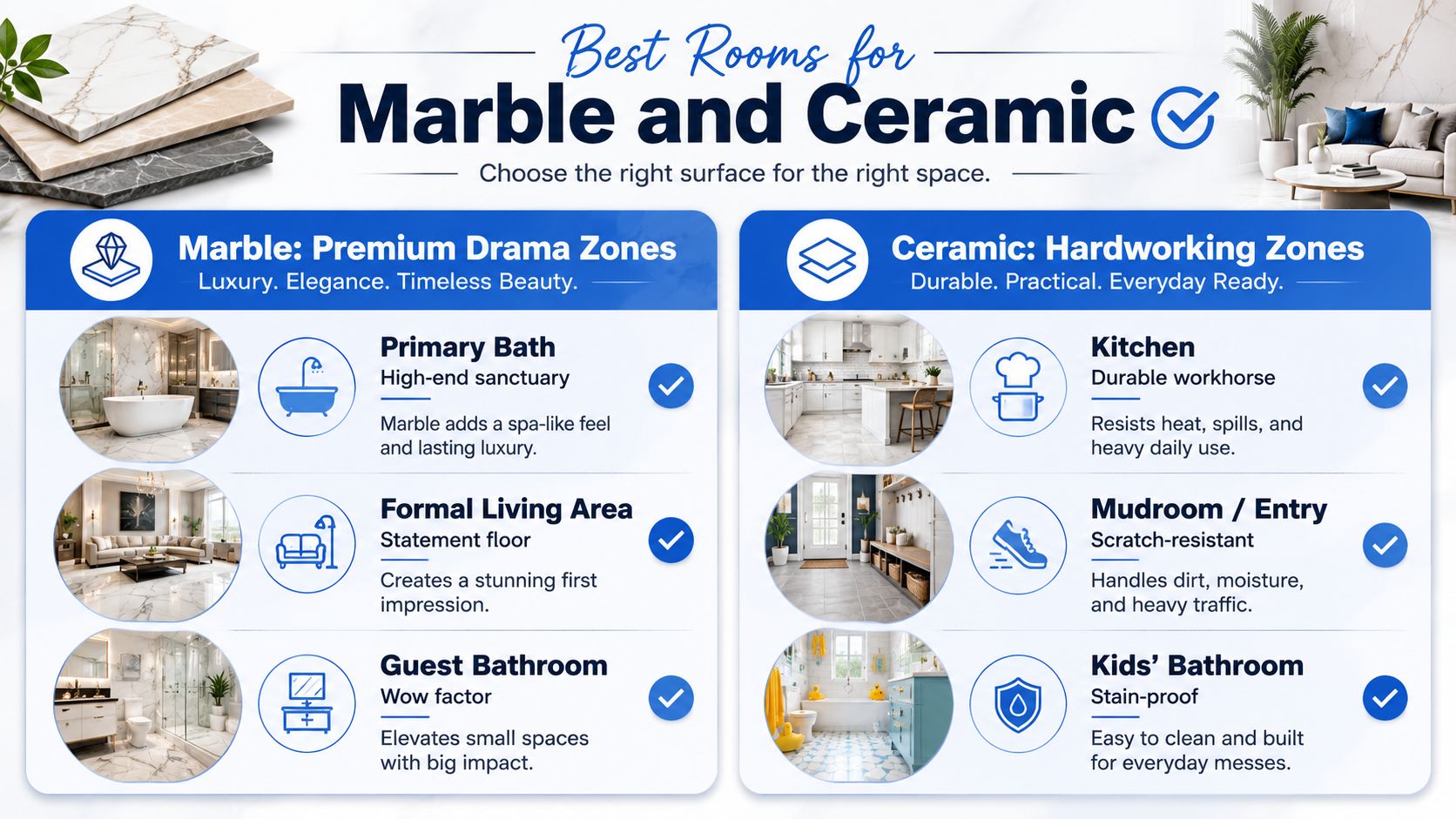
Marble belongs in spaces where its veining is visible and the abuse is controlled. Ceramic and porcelain belong in rooms where grit, spills, pets, children, and wet footwear are part of the schedule.
Where marble makes sense
A primary bathroom can be an excellent marble location, especially on shower walls or a floor using an appropriate honed finish and careful sealing. A fireplace surround, formal living area, dining room, or powder room can also showcase marble without exposing it to constant splashing and acidic food.
A guest bathroom is another reasonable use because it often has lower traffic than a family bathroom. The stone can provide the “wow” factor without taking the full daily punishment of a kitchen or mudroom.
Use marble thoughtfully:
- Primary bath: Choose a suitable finish and confirm the waterproofing system beneath the tile.
- Fireplace surround: Marble can create a strong focal point where foot traffic is limited.
- Formal living or dining room: Natural variation works well when the floor is part of the room's visual design.
- Powder room: A smaller, lower-abuse space makes maintenance easier to control.
Where ceramic earns the floor
Ceramic or porcelain is my default recommendation for kitchen floors, mudrooms, entries, laundry rooms, and children's bathrooms. These spaces collect grit, water, food, and impact. A glazed, appropriately rated tile gives you a more forgiving surface and a simpler cleaning routine.
A polished marble shower floor is not a shortcut to luxury. Wet polished surfaces can be slippery, and outdoor marble deserves particular caution in Massachusetts freeze-thaw conditions. I wouldn't put polished marble on stair treads or a shower floor, and I'd avoid marble patios where winter exposure can turn a beautiful installation into a maintenance problem.
For bathroom-specific layout, finish, and moisture decisions, use this bathroom tile selection guide.
Why Marble-Look Ceramic Is Changing the Decision
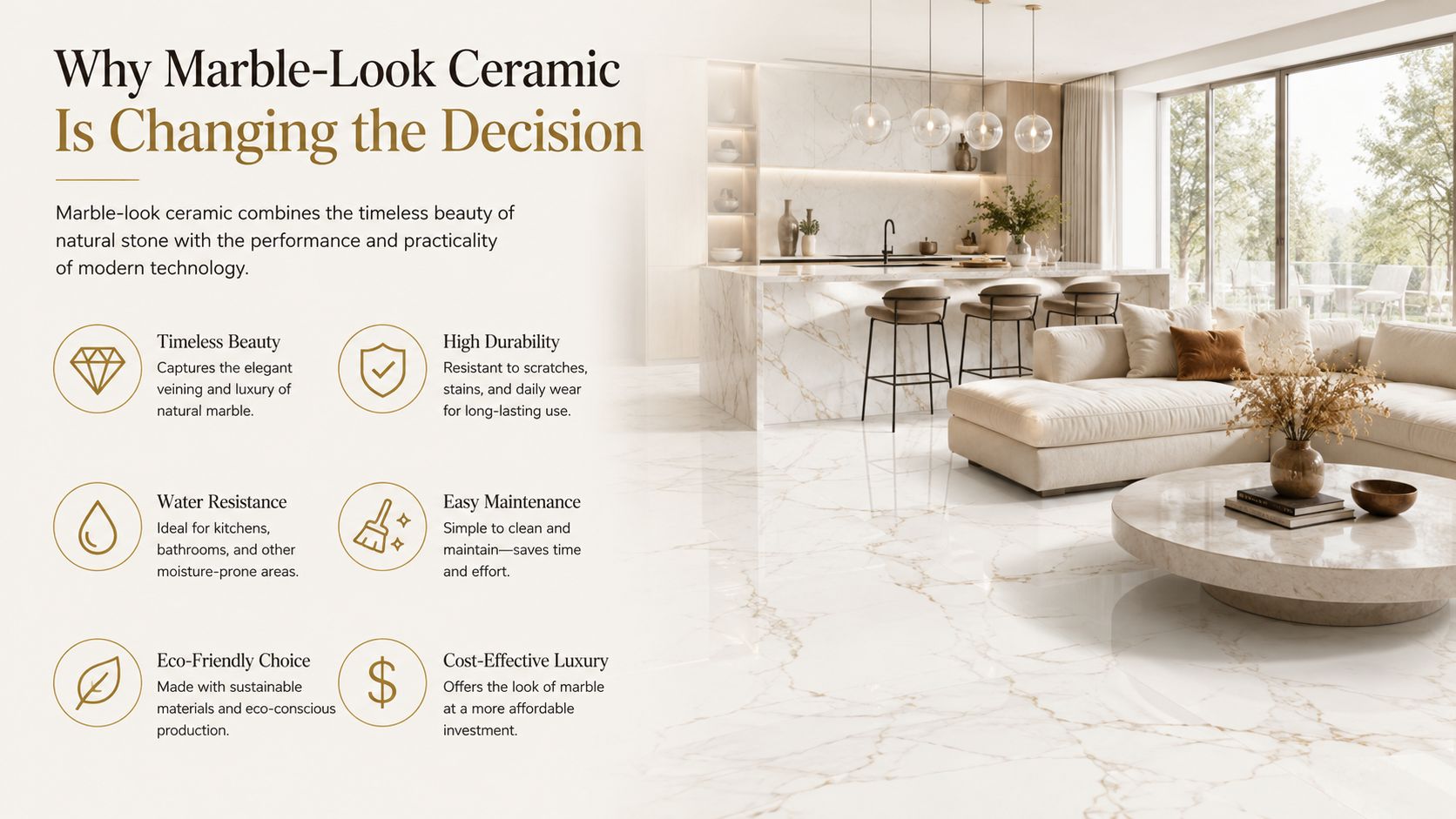
The old argument treated ceramic as a cheap imitation and marble as the premium answer. That argument is outdated. Modern marble-look ceramic and porcelain can deliver convincing veining, coordinated field tile, trim, mosaics, and large-format surfaces without asking the homeowner to manage natural stone every week.
The design industry is using marble veining, stone textures, and full-room tile applications in increasingly coordinated ways. 2025 tile trend coverage from Coverings highlights marble-inspired surfaces and whole-room “tile drenching” as part of current design direction.
Performance now comes with the look
High-definition printing allows manufacturers to reproduce the visual rhythm of Carrara, Calacatta, and Statuario-inspired stone. Pressed-edge manufacturing and large formats can create a calmer installation with fewer grout joints, provided the floor is flat and the installer has the right equipment and experience.
The important distinction is that the verified performance data supports porcelain as an impervious category when absorption is below 0.5%. Don't assume every marble-look product has that rating. Ask for the actual technical sheet, confirm whether the tile is porcelain, and verify whether the finish is approved for the intended floor.
The honest case for natural marble
Real marble still wins on authenticity. No printed surface reproduces geological variation perfectly, and homeowners who love the idea of owning a unique natural material may find the variation worth the extra work.
But most busy households aren't buying a museum piece. They're buying a kitchen floor or family bathroom that has to look good after years of ordinary use. In that situation, marble-look porcelain is often the smarter design choice, not a consolation prize. It gives you coordinated visual control, easier cleaning, and less concern about acid etching.
Choose real marble when the stone's individuality is the point. Choose marble-look ceramic or porcelain when you want the visual language without the same maintenance burden.
Which Tile Should You Actually Choose
Use five questions before you approve the final order.
Start with your household
If children, pets, muddy shoes, and frequent cooking define the room, choose ceramic or porcelain for the working surfaces. If the room is a low-traffic primary bath, powder room, fireplace surround, or formal space, marble becomes easier to justify.
Ask yourself:
- Do I want unique natural veining, or consistent design control? Choose marble for geological variation. Choose marble-look ceramic for predictable pattern placement.
- Will the surface see acidic food and frequent spills? Choose ceramic or porcelain for kitchen floors and other high-spill areas.
- Am I willing to reseal regularly? Marble demands a maintenance routine. Glazed ceramic doesn't require tile sealing.
- Is the floor frequently wet? Favor a product with suitable wet-traction information and avoid polished marble underfoot.
- How would I feel about a visible repair? Ceramic often makes individual replacement simpler. Marble repairs can be harder to match because every piece varies.
Split decisions are often the best decisions. You can use marble on a bathroom floor and ceramic in the shower, marble on a kitchen island surround and ceramic across the working floor, or marble on a shower wall with a more practical tile underfoot.
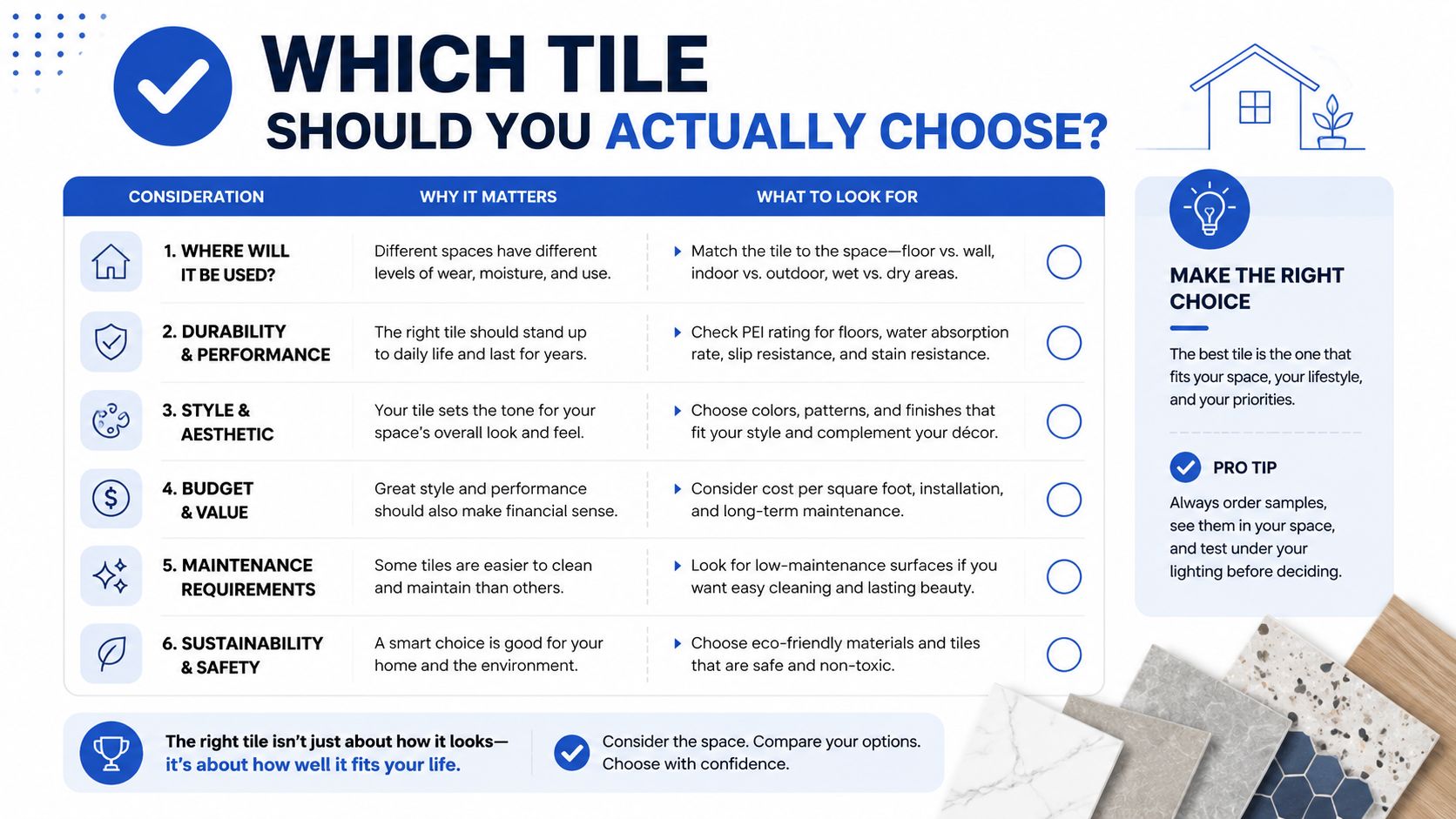
My final verdict is clear. Choose marble for controlled, design-led spaces when you want natural stone and will maintain it. Choose ceramic or porcelain for busy floors, wet areas, children's rooms, and households that want fewer chores. Choose marble-look porcelain when you want the appearance to carry the room but don't want the stone-care schedule.
You can change your mind while the installer is measuring and ordering. After the tile is set, changing the material means demolition, disposal, substrate work, and a second installation, so settle the performance decision before the pallet arrives.
Frequently Asked Questions About Marble and Ceramic Tile
Can marble go in a shower?
Yes, marble can be installed on shower walls or floors with the right finish, waterproofing, sealing, and cleaning routine. Use honed or textured marble rather than polished marble for a shower floor, and treat ceramic or porcelain as the safer mainstream choice for wet areas.
How often does marble need resealing?
Plan on resealing marble every 6 to 12 months in demanding applications, with some lower-moisture areas stretching longer. This marble cleaning guide covers stone-safe cleaning and maintenance practices for marble tile. A simple water-bead check can help: place a small amount of water on a clean area, wait briefly, and watch whether the stone darkens or absorbs it. Confirm the method with your sealer manufacturer.
Does ceramic tile improve resale value in New England?
Ceramic tile can support resale appeal when it's well installed, visually consistent, and appropriate for the room. In Massachusetts and the broader New England market, buyers generally notice workmanship, cleanliness, practical layouts, and durable finishes more than the material label alone. Don't install marble solely for resale. Install it because the room and your ownership habits support it.
What happens when one tile chips?
Ceramic can often be repaired by removing the damaged tile and setting a matching replacement. Marble can also be replaced, but natural variation may make the new piece visibly different, especially across a prominent floor. A tile-out-and-replace job may add typical labor of $3 to $8 per square foot, depending on access and scope, so keep spare material from the original installation.
If you're deciding between marble, ceramic, or marble-look porcelain for a Massachusetts kitchen or bathroom, Sunny Day Pro Services can help with material selection, substrate preparation, layout planning, and professional installation. Request a quote before the installer measures, so you can choose a surface that fits both the room and the way your household lives.

