
Marble vs Granite Flooring: 2026 Guide
Compare marble vs granite flooring for your home. Explore durability, maintenance, slip resistance, and room-by-room advice from Massachusetts tile experts.
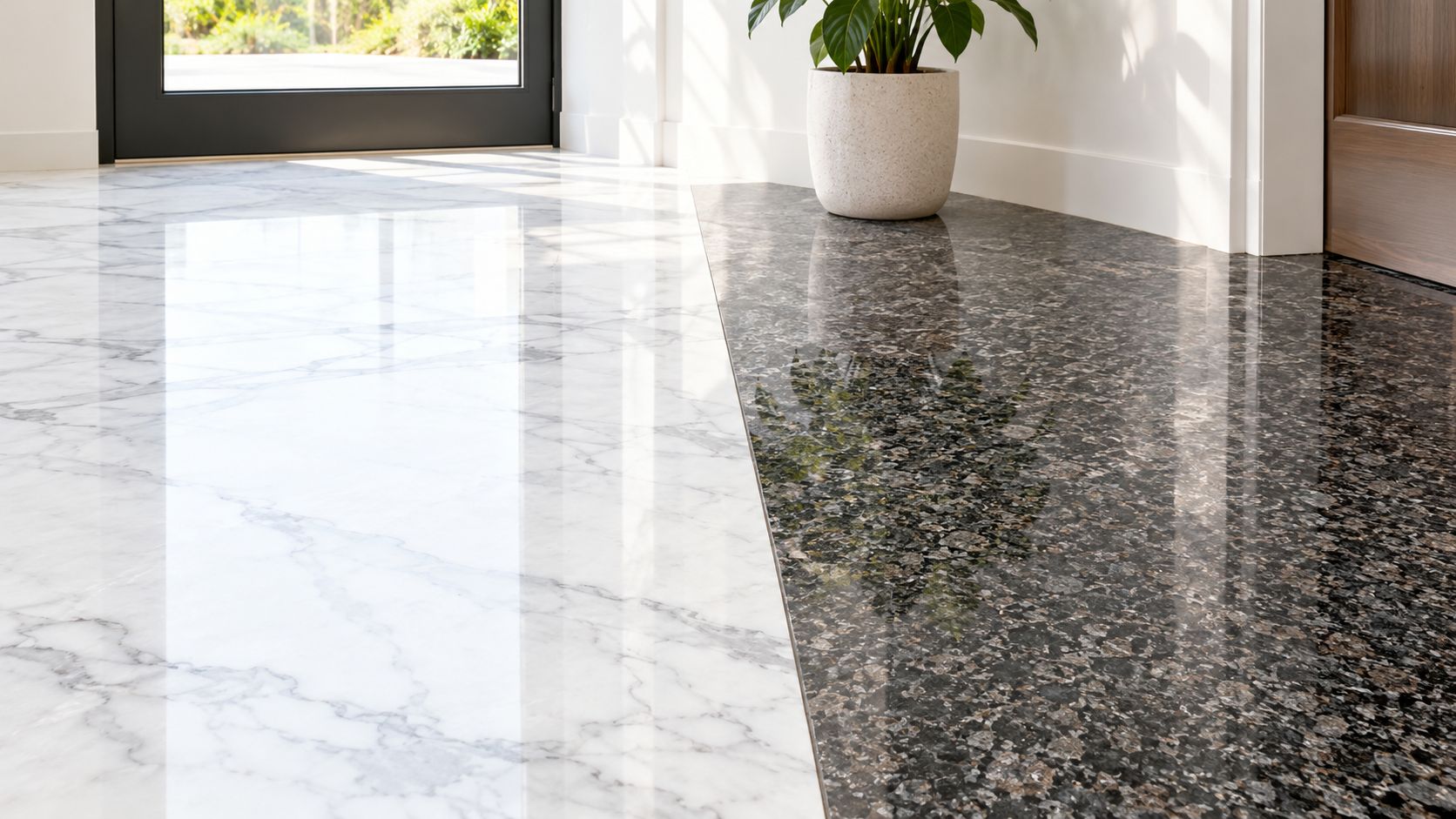
You're standing in a Massachusetts showroom with two samples in front of you. One has dramatic veining that would make the foyer feel finished before the furniture arrives. The other has a tighter, speckled pattern that looks ready for muddy boots, a large dog, and years of kitchen traffic. Both are natural stone, but they won't behave the same way once winter grit, spills, furniture, and daily cleaning become part of the picture.
The best choice in marble vs granite flooring isn't based on appearance alone. Stone hardness, porosity, surface finish, slip resistance, sealing habits, and the room's traffic pattern all matter. A polished marble floor can be beautiful and practical in the right setting, while a textured granite floor may be the safer, lower-maintenance option for a busy entry or kitchen.
Table of Contents
- Can natural stone work over radiant floor heating?
- Will marble or granite automatically increase resale value?
- What should you do with an existing stone floor?
- Is granite maintenance-free?
- Which finish is safest for a wet floor?
Understanding Natural Stone Flooring Options
A recent remodel in a mature Massachusetts home often starts with replacement rather than new construction. The homeowner may be updating a dated foyer, opening a kitchen, or replacing a worn floor before listing the property. That context matters because natural stone performs differently in an established home than it does in a lightly used showcase space.
Marble and granite begin with different geological histories. Marble is a metamorphic stone, formed when an existing limestone or similar carbonate stone changes under heat and pressure. Its mineral structure creates the veining and movement many homeowners want, but it also makes marble comparatively softer and more vulnerable to scratching, etching, and staining.
Granite is an igneous stone, formed from cooled magma. Its interlocking mineral structure generally gives it greater density and hardness. That doesn't make every granite slab identical, and it doesn't eliminate the need for care, but it gives granite a stronger starting point for floors exposed to abrasion.
The broader market helps explain why both materials remain relevant. The global stone flooring market is projected to rise from USD 13.51 billion in 2025 to USD 16.62 billion by 2031, representing a 3.52% CAGR from 2026 through 2031, according to Mordor Intelligence's stone flooring market analysis. Marble represented 32.20% of that market in 2025, while remodeling and retrofit applications are projected to grow at a 5.74% CAGR through 2031, faster than new construction.
Why renovation changes the decision
Those projections are especially relevant to homeowners in Wayland, Newton, Needham, Wellesley, Weston, and nearby communities. Existing homes often have established traffic routes, older subfloors, narrow entries, and rooms that must handle daily family use immediately after installation.
A separate natural stone market analysis from Mordor Intelligence estimates the global market at USD 37.89 billion in 2025, with granite holding 31.02% of market share. Another major report cited in that analysis found granite held 39.6% of natural stone revenue in 2024, while the U.S. natural stone market was valued at USD 2.20 billion in 2024 and projected to grow at a 4.1% CAGR from 2025 to 2030.
The practical conclusion is straightforward. Marble remains a major design-led flooring category, especially for premium interiors, while granite has a stronger position where durability and long service life drive the purchase. Neither material is automatically right for every room.
Installer's rule: Choose the stone for the room's abuse level, then choose the finish for the room's safety and maintenance needs.
Evaluating Hardness and Daily Wear Resistance
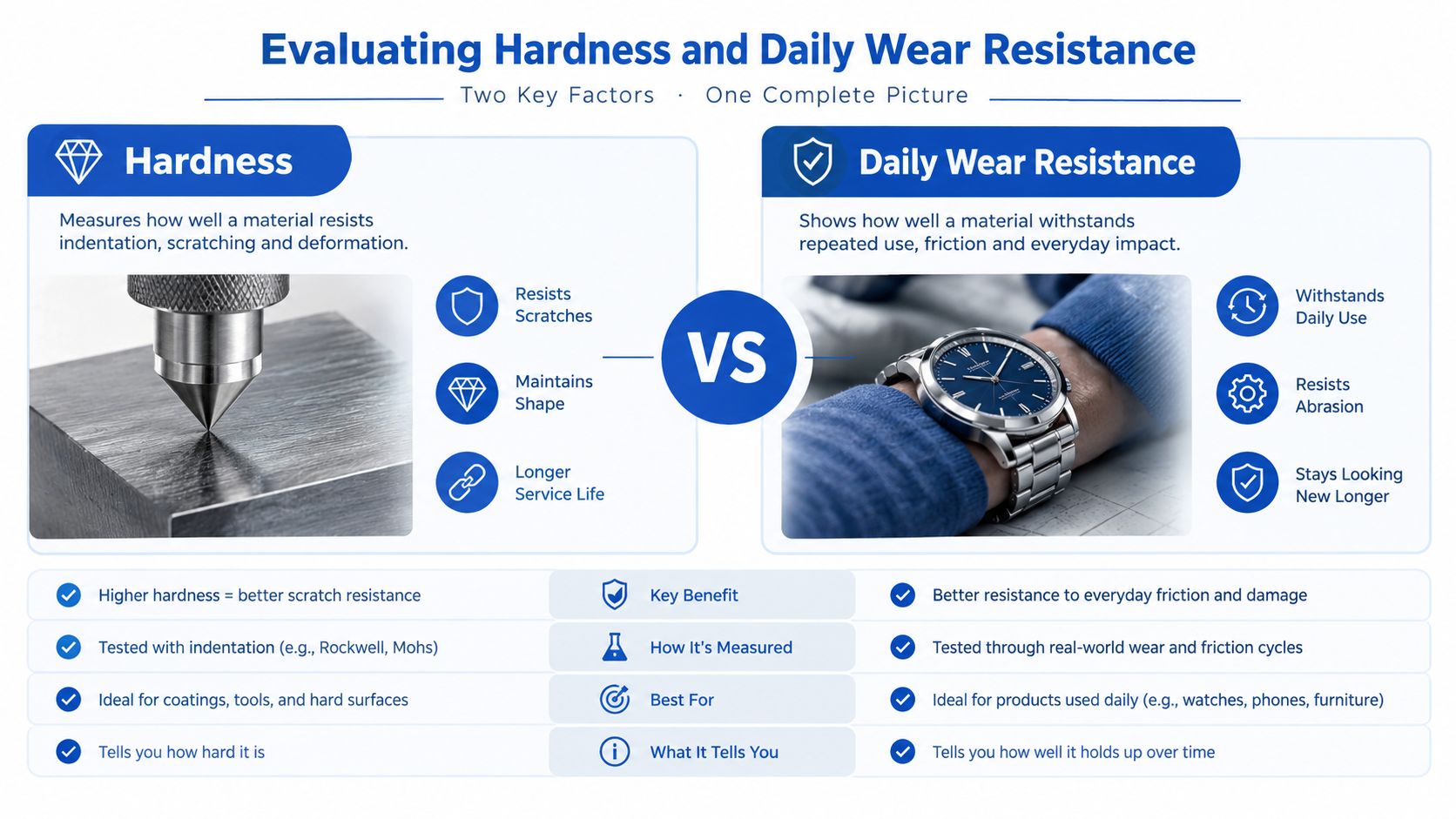
For a busy household, hardness is the first serious filter. The Mohs scale compares how readily one mineral scratches another. It isn't a complete durability rating, but it provides a useful way to understand why two polished floors age differently.
Granite typically measures around 6 to 7 on the Mohs scale, while marble generally measures around 3 to 5, according to this trade comparison of marble and granite flooring hardness. Another natural stone cleaning guide places marble more specifically around 3 to 4, with granite around 6 to 7.
That gap is substantial in daily use. Grit tracked in from a driveway or sidewalk can act like an abrasive under footwear. Pet claws can create fine scratches during sudden turns. Dining chairs and stools can mark a softer polished surface when someone drags them instead of lifting them.
What hardness looks like in real rooms
Granite generally maintains its surface better in:
- Front entries, where sand and winter salt arrive on shoes
- Kitchens, where chairs, stools, dropped objects, and frequent cleaning add wear
- Mudrooms, where moisture and grit combine
- Hallways, where repeated foot traffic follows the same path
- Commercial-like residential zones, such as open-plan homes with little separation between rooms
Marble can still work in these areas, but it demands a more forgiving visual expectation. Fine scratches, dull pathways, and small changes around frequently used zones may become part of the floor's patina rather than a defect to be eliminated.
Polished marble presents a second issue beyond scratching. Abrasive dirt can dull the reflective surface, while acidic materials can etch it. Citrus juice, wine, vinegar-based products, and some bathroom cleaners can leave pale marks or cloudy patches. Cleaning may remove residue, but it won't restore an etched polish. Restoration usually requires professional honing or polishing.
Match the material to household habits
A quiet formal living room and a kitchen used by children every day shouldn't receive the same recommendation. A household with indoor pets, frequent entertaining, or direct access from an unpaved walkway will place more abrasive material on the floor than a home where shoes stay at the door.
For more room-by-room ideas, homeowners can compare natural stone with other options in this guide to flooring for high-traffic areas. The useful question isn't "Which stone is harder?" It's "How much visible change can this room tolerate before the floor looks neglected?"
Comparing Aesthetics and Long-Term Upkeep
Marble makes a design statement through movement. Veins may run softly across a pale background or create strong directional drama across a larger floor. No two pieces look exactly alike, which is part of the appeal and part of the installation challenge. The layout must account for variation instead of treating every tile as interchangeable.
Granite usually offers a more granular or speckled appearance, with patterns that can feel visually consistent across a room. That predictability suits kitchens, transitional interiors, and homeowners who want natural stone without strong veining. Some granites are quiet and uniform, while others are highly patterned, so the sample still needs to be viewed in the actual room's lighting.
Maintenance separates the two materials more sharply than appearance does. Granite's lower porosity generally allows longer intervals between sealing, while marble benefits from more frequent protection and faster response to spills. A sealer reduces absorption, but it doesn't make stone stain-proof or prevent scratching.
Maintenance and aesthetics at a glance
| Feature | Marble Flooring | Granite Flooring |
|---|---|---|
| Visual character | Dramatic veining, flowing movement, classic luxury | Speckled or granular patterns, broad design range, visual consistency |
| Scratch resistance | Lower, especially on polished surfaces | Higher because of its greater mineral hardness |
| Stain response | Requires prompt spill cleanup and careful sealing | Generally less absorbent, but spills still need attention |
| Sealing routine | Usually more demanding over the life of the floor | Often less frequent because of lower porosity |
| Best visual aging | Homes where patina and gradual surface change are acceptable | Homes where a consistent, resilient appearance matters |
One flooring source notes that granite may need sealing only once every 1 to 3 years, while marble generally benefits from more frequent sealing and immediate spill cleanup, as described in this marble and granite sealing comparison. Actual timing depends on the stone, finish, sealer, cleaning products, and how heavily the room is used.
The overlooked cost of keeping marble pristine
Upkeep has an environmental dimension as well as a labor dimension. A life-cycle assessment found that the maintenance phase for marble flooring contributed 17% of total CO2 emissions, largely because of periodic sealants, while soap cleaning contributed little, according to the Polycor life-cycle assessment for stone flooring.
That doesn't make marble an irresponsible choice. It does mean the long-term decision includes more than the purchase and installation. A homeowner who chooses marble should plan for protective treatments, careful product selection, spill response, and the possibility of periodic professional restoration.
For routine care, use a neutral stone cleaner, a soft microfiber mop, and clean water rather than acidic or abrasive household products. This guide to cleaning marble tile offers practical guidance for avoiding common maintenance mistakes.
Room-by-Room Suitability and Finish Selection
The finish can change the performance of a floor as much as the stone type. Polished, honed, leathered, and flamed surfaces reflect light, grip footwear, show wear, and handle spills in different ways. A granite floor with a highly polished surface can still be slippery, while a honed marble floor may offer a more forgiving walking surface.
Wet rooms deserve special attention. Published Dynamic Coefficient of Friction, or DCOF, values for polished marble are around 0.38 to 0.45, while polished granite is roughly 0.40 to 0.48. Both ranges are near or below the commonly used 0.42 ANSI A326.3 benchmark for residential wet areas, according to this marble and granite flooring slip-resistance comparison.
Start with the finish
- Polished: Reflective and formal, but more likely to show scratches, etching, smudges, and water-related slip concerns. Reserve it for dry areas with controlled traffic.
- Honed: Smooth but low-sheen, with less glare and a softer visual character. It's often a more practical choice for floors, although it can still absorb spills and needs appropriate sealing.
- Leathered: Textured with a tactile surface that can disguise minor wear and fingerprints. It suits homeowners who want a less formal finish with visual depth.
- Flamed: Rougher and strongly textured, making it useful where traction matters. The texture can collect dirt, so cleaning takes more attention.
Recommendations by room
Kitchen floors usually favor granite when the household produces heavy traffic, dropped food, dragged stools, or frequent grit. A honed or leathered finish can reduce glare and make small marks less conspicuous. Marble can work in a carefully maintained kitchen, especially when the homeowner accepts etching as part of the material's character.
Bathrooms require a finish-first decision. Avoid assuming polished stone is safe because it's expensive or natural. Honed or textured marble and granite are generally more suitable than polished surfaces for floors exposed to splashes, wet feet, and condensation.
Mudrooms and entries put abrasion and moisture together. Granite is typically the more forgiving material, but a textured finish may matter more than choosing a dramatic stone pattern. Use mats at exterior doors, remove grit promptly, and keep the cleaning routine simple.
Living rooms and formal spaces offer the greatest flexibility. Polished marble can create a refined effect where spills are limited and furniture remains mostly stationary. Granite can provide a quieter, more durable foundation for open-plan rooms that connect directly to the kitchen or entry.
Safety advice: For a wet Massachusetts entry, bathroom, or mudroom, specify the finish and slip performance before choosing the color.
Installation Realities and Professional Care
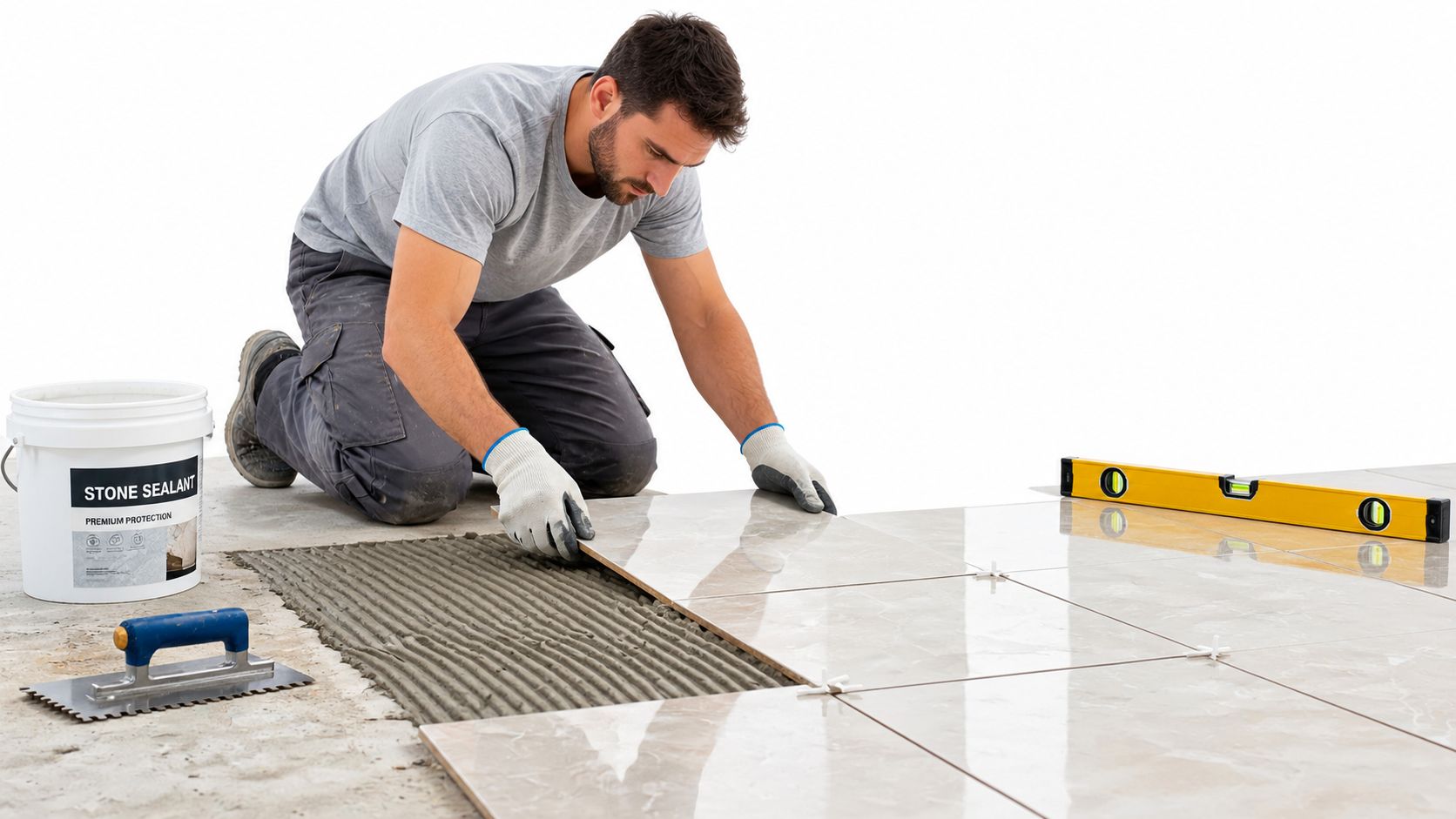
Natural stone installation starts below the tile. The subfloor must be stable, appropriately supported, and sufficiently flat for the selected tile format. Large or heavy stone pieces can expose movement, deflection, or unevenness that a smaller ceramic tile might tolerate without obvious failure.
A qualified installer evaluates the substrate, checks transitions to adjoining flooring, plans the layout, and chooses setting materials compatible with the stone. The installer may need to reinforce the floor, correct uneven areas, manage movement joints, and use a leveling system to control lippage. Marble can also require careful layout because veining direction and shade variation affect the finished composition.
What a careful installation includes
Before setting tile, the crew should confirm:
- Subfloor condition: Movement, moisture, and deflection are addressed before stone installation begins.
- Tile layout: Veining, pattern variation, door swings, cabinets, and sightlines are coordinated.
- Setting method: Mortar coverage and product selection suit the stone and installation environment.
- Transitions: Height changes are planned at doorways and connections to wood, vinyl, or existing tile.
- Protection: The finished surface is protected from trades, grit, paint, and construction debris.
Homeowners considering granite can review the practical stages involved in granite tile installation. The same principle applies to marble. Installation quality determines whether the stone looks intentional and remains stable, but maintenance determines how well that result survives.
After grouting and curing, the stone may receive an appropriate penetrating sealer. The sealer should be selected for the stone and finish, not applied as a universal coating. Daily care should remove grit before it gets walked across the floor, clean spills without delay, and avoid vinegar, lemon-based products, scouring powders, and harsh degreasers unless a stone professional confirms compatibility.
The hidden cost is time. A floor that needs careful spill response and periodic sealing asks more from the homeowner than a floor that can handle casual cleaning. That time should be part of the installation decision, not a surprise after the first stain appears.
Making the Final Decision for Your Home
The right choice becomes clearer when you describe the household rather than the stone.
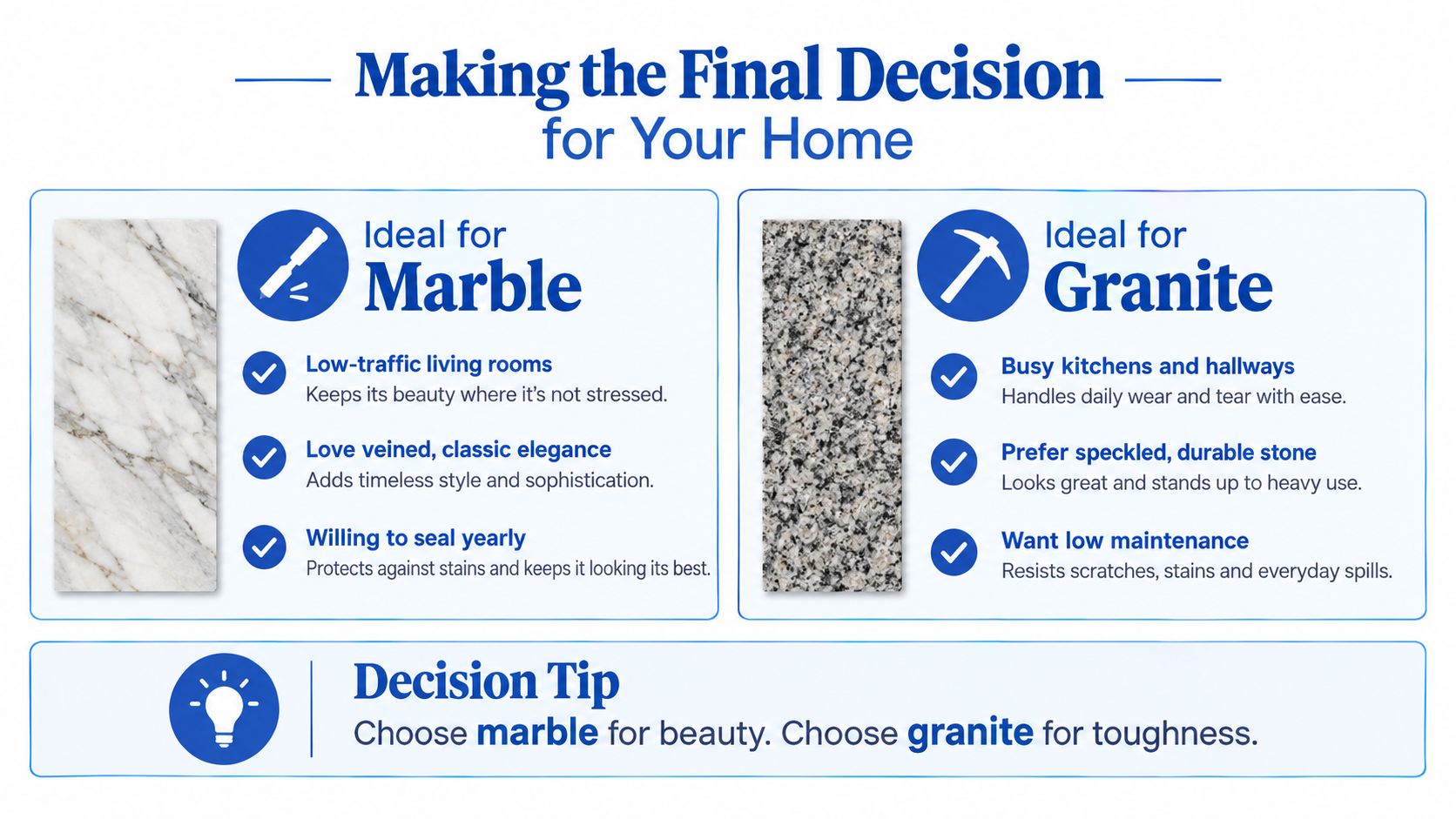
Marble fits a homeowner who values distinctive veining, wants a classic or high-design interior, and accepts that the surface may develop subtle changes. It makes the most sense in lower-traffic living areas, formal entries with strong grit control, and spaces where the owner will respond quickly to spills and schedule maintenance.
Granite fits a household that needs a tougher surface for kitchens, hallways, entries, pets, children, or frequent entertaining. Its pattern can still be refined, but its greater hardness makes it more practical when visible scratching would be a constant frustration.
Use this decision filter
- Choose marble if visual movement is the main priority and the room has manageable traffic.
- Choose granite if abrasion resistance and easier upkeep carry more weight.
- Choose a honed or textured finish if glare, traction, and visible wear concern you.
- Choose polished stone only after considering moisture, footwear, spills, and cleaning habits.
- Price the full project, including substrate preparation, layout complexity, setting materials, sealing, cleaning, and future restoration.
Material cost alone won't reveal the better value. A less suitable stone can become expensive if it needs premature refinishing, stain treatment, or replacement. Conversely, a carefully selected marble floor can serve well when installed in the right room and maintained according to its limitations.
For a home in Wayland, Newton, or the surrounding Massachusetts communities, an on-site assessment is more useful than choosing from a sample board alone. The installer can evaluate the subfloor, traffic pattern, moisture exposure, existing transitions, and finish options before you commit.
Expert Answers to Common Stone Flooring Questions
Can natural stone work over radiant floor heating?
It can, provided the heating system, substrate, mortar, movement accommodation, and installation materials are compatible. Stone conducts heat well, but the installer must follow the heating-system manufacturer's requirements and avoid trapping the system beneath an unsuitable assembly. A professional should inspect the substrate and confirm the installation sequence before tile is ordered.
Will marble or granite automatically increase resale value?
Neither stone guarantees a higher sale price. Buyers usually respond to a floor that looks appropriate for the home, feels well installed, and doesn't present obvious maintenance problems. In a competitive Massachusetts market, a polished stone floor may appeal to one buyer and concern another if it appears slippery, dated, or difficult to maintain.
What should you do with an existing stone floor?
Start with diagnosis, not aggressive cleaning. Check whether the problem is surface residue, failed coating, grout deterioration, staining, etching, scratches, or uneven wear. A professional may recommend cleaning, honing, polishing, grout repair, or localized replacement depending on the condition.
Old marble can also develop yellow, cream, or amber discoloration from wax, coatings, moisture-related changes, iron staining, residue, or years of incompatible maintenance. Scrubbing harder won't correct every cause. Test cleaning products in an inconspicuous area and avoid applying a new coating over a floor that hasn't been properly assessed.
Is granite maintenance-free?
No. Granite still needs suitable cleaning, spill response, and periodic evaluation of its sealer. Its lower porosity and greater hardness can reduce maintenance demands, but they don't eliminate staining, surface wear, or installation-related problems.
Which finish is safest for a wet floor?
A honed or textured finish is generally a better starting point than polished stone for bathrooms, mudrooms, and other moisture-prone spaces. Confirm the selected product's slip-resistance information and consider how the finish will be cleaned, because deeper texture can hold dirt.
Sunny Day Pro Services offers marble and granite tile installation, along with tile finishing and flooring work for kitchens, bathrooms, entries, and other high-traffic spaces. If you're planning a natural stone remodel in Wayland, Newton, Needham, Wellesley, Weston, or nearby Massachusetts communities, visit Sunny Day Pro Services to request a quote and discuss the right stone, finish, substrate preparation, and care plan for your home.

