
Porcelain Tile Flooring Cost Per Square Foot in 2026
Porcelain tile flooring cost per square foot is about $12–$25 installed. Compare material and labor, price drivers and Massachusetts budget tips.
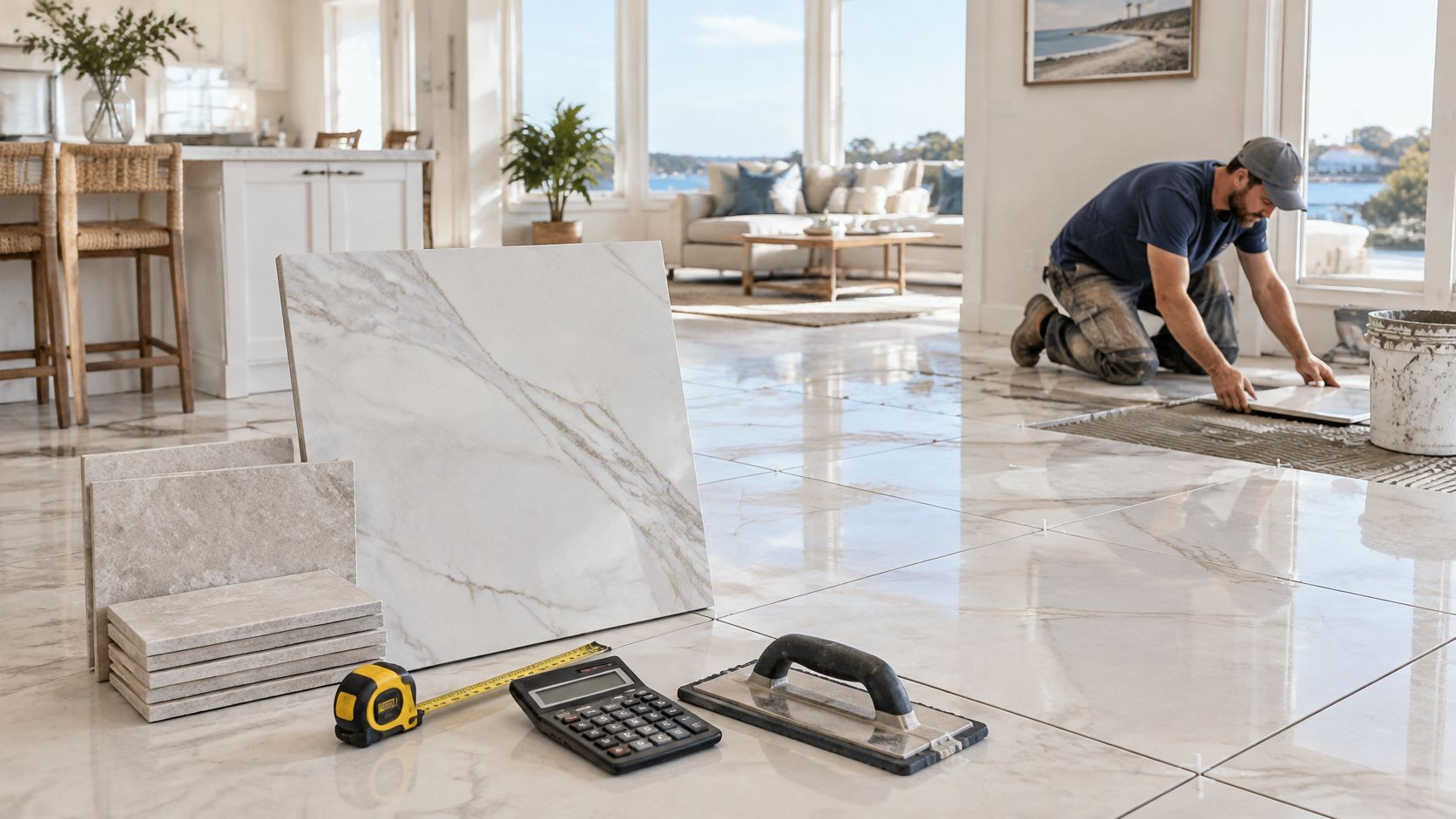
Porcelain tile flooring costs about $12–$25 per square foot installed for a standard residential project. That base figure excludes demolition, delivery, furniture moving, taxes, and unusual substrate repairs.
The surprise isn't necessarily the price of the tile. Labor can represent roughly 30%–60% of the combined tile-and-installation price, according to Flooring Clarity's porcelain flooring guide. For Massachusetts homeowners, the useful question is therefore not just what porcelain costs, but what the installer has included in the quoted rate.
Table of Contents
- Installed Porcelain Tile Cost per Square Foot at a Glance
- How Tile Quality Changes the Price
- How Layout and Subfloor Prep Push Costs Up
- Sample Budgets for Common Porcelain Floors
- Whether Porcelain Pays Off Over Time
- Porcelain Tile Flooring Questions Readers Ask
- Massachusetts Quote Checks and Next Steps
Installed Porcelain Tile Cost per Square Foot at a Glance
A standard residential installation provides a useful starting budget, not a complete renovation allowance. Using the benchmark above, a hypothetical 200-square-foot room has a base installed cost of $2,400–$5,000, before the excluded work and charges.
The component ranges below show where that budget comes from. They're cost sources, not an additive formula: contractors may bundle setting materials into labor, include basic preparation, or price removal separately. Adding every low or high value won't reproduce the reported installed range.
| Cost component | Typical range per sq ft | When it applies |
|---|---|---|
| Porcelain tile material | $3–$10 | Every project |
| Professional installation labor | $7–$15 | Every project |
| Mortar, grout, backer board, membrane | $1–$5 | Most installations |
| Substrate leveling or reinforcement | $2–$5 | When the subfloor is uneven or weak |
| Removing an existing floor | $1–$4 | Replacement projects |
| Typical installed total | $12–$25 | Standard residential project |
Flooring Clarity supplies the tile, labor, preparation, removal, and standard installed benchmarks used here. Its separate porcelain installation cost breakdown places supporting materials, including thinset, grout, backer board, waterproof membranes, and leveling compounds, at approximately $1–$5 per square foot.
Read the scope behind each row
Tile material should identify an actual product, not just a color allowance. The quote should name the manufacturer, collection, size, finish, and purchase quantity so you can tell whether competing bids specify equivalent flooring.
Installation labor needs a defined task list. Setting tile isn't the same scope as removing the old floor, correcting the substrate, installing an underlayment, setting tile, grouting, and finishing the thresholds.
Preparation deserves particular attention. A contractor who includes minor scraping hasn't necessarily included flattening the floor or repairing damaged sheathing. Ask what condition the installer assumes will exist when setting begins.
Budgeting rule: Use the published installed rate to start a conversation. Use the written scope to decide whether the estimate is complete.
Identify what remains outside the allowance
Before comparing totals, mark each item as included, excluded, or subject to inspection:
- Demolition and disposal: Confirm whether removal includes the existing underlayment and adhesive.
- Delivery and handling: Identify who receives, stores, and moves the tile.
- Furniture and access: Establish who clears the room and protects adjacent finishes.
- Taxes and repairs: Separate known charges from work that can't be priced until the floor is opened.
The strongest bid isn't necessarily the one with the most line items. It's the one that makes responsibilities and exclusions clear enough that you can compare the same finished result.
How Tile Quality Changes the Price
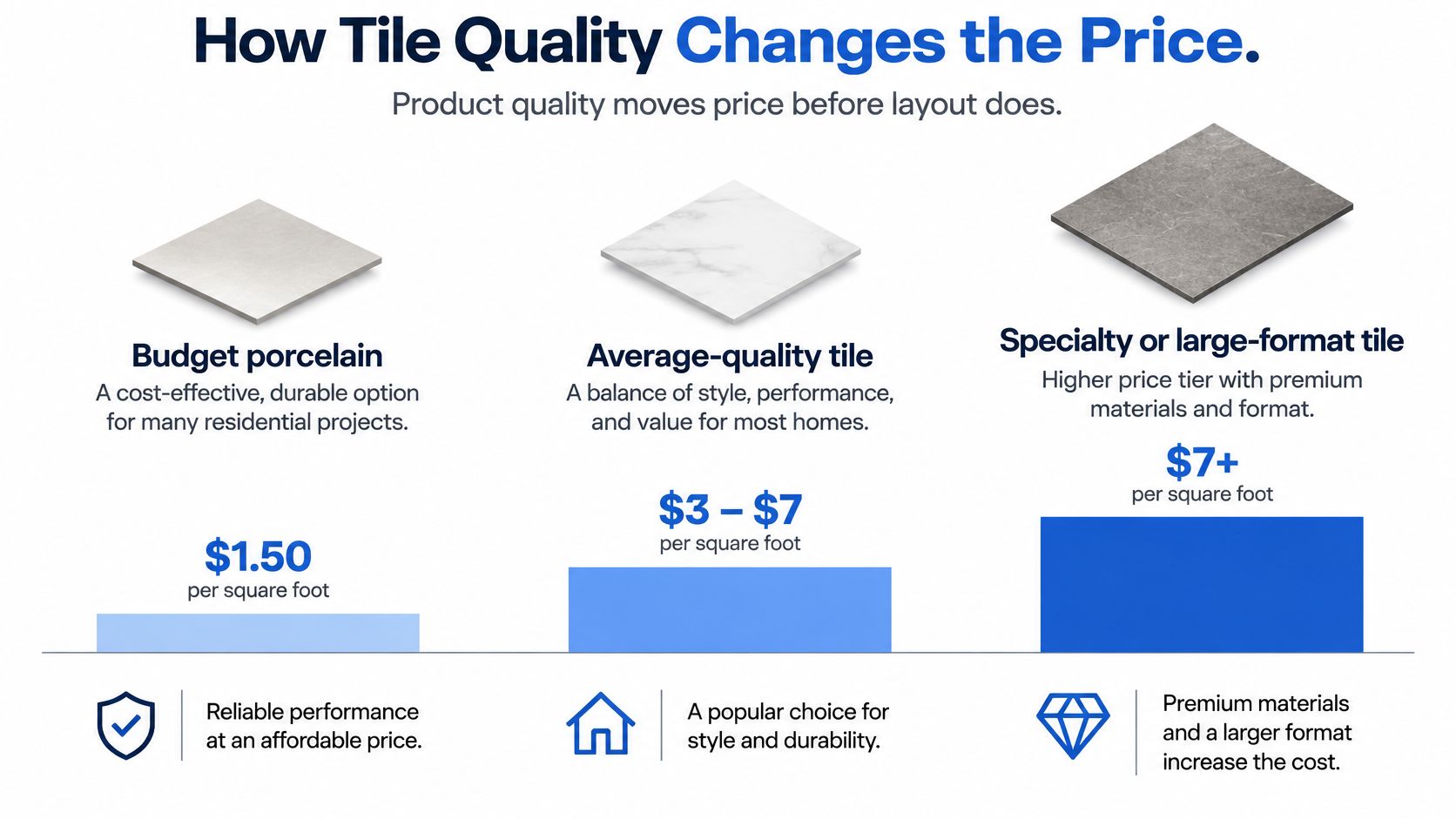
Two porcelain floors can carry the same advertised installed rate and still produce very different bills, because the published rate assumes a tile your quote may not include. Product quality moves the material line before labor is even priced, so a straightforward job on a ready substrate can land below the standard residential benchmark while a premium tile pushes the same room above it.
The quality-tier prices and installed guidance below come from the Flooring Clarity installation breakdown cited earlier in this article. Treat the room suggestions as selection guidance rather than proof that a higher-priced tile performs better.
| Tier | Material per sq ft | Installed per sq ft | Best fit |
|---|---|---|---|
| Budget porcelain | From about $1.50 for the lowest-priced lines | Toward the low end of the $12–$25 standard installed range, and sometimes below it when prep work is minimal | Low-traffic rooms and rentals |
| Average-quality porcelain | $3–$7 | $8–$16 for a straightforward mid-range job | Kitchens, baths, and family rooms |
| Specialty or large-format porcelain | Above $15 | Above $30 with difficult layouts | Showpiece floors and wide open plans |
The $1.50 entry point sits below the $3–$10 material range used elsewhere in this article. It describes the cheapest stocked lines, and it reconciles with the broader range only because that range centers on mid-tier product. The same logic applies on the installed side: a budget floor on a flat, ready substrate can finish under the $12–$25 benchmark precisely because the benchmark assumes mid-range material and ordinary preparation.
Pay for a specification, not a label
Budget porcelain can make sense when the product is approved for the intended floor and you're comfortable with its appearance. Inspect samples for surface texture, edge consistency, and variation between pieces rather than assuming price alone establishes suitability.
Average-quality porcelain gives homeowners room to balance appearance and installation expense. A familiar format in a simple layout can leave more of the budget available for substrate correction, which is less visible but directly affects the finished floor.
Specialty products require a more deliberate decision. You might be paying for a distinctive surface, a premium design, or a format that changes handling and installation requirements. Ask which feature accounts for the premium and whether that feature matters in your room.
Porcelain versus ceramic
Porcelain's denser body and harder firing typically support higher material and handling costs. That doesn't make it the automatic winner for every project.
Ceramic tile is cost-effective and ideal for walls and floors, and Sunny Day Pro Services installs both materials. The practical choice should follow traffic, moisture exposure, appearance, and budget rather than the product name alone. Our porcelain-versus-ceramic comparison helps frame that decision.
Before requesting installation bids, get the exact product designation and current supplier price. If the supplier uses terms such as premium or commercial grade, ask what documented property the term describes. Otherwise, you may compare a measurable installation service against an undefined marketing category.
How Layout and Subfloor Prep Push Costs Up
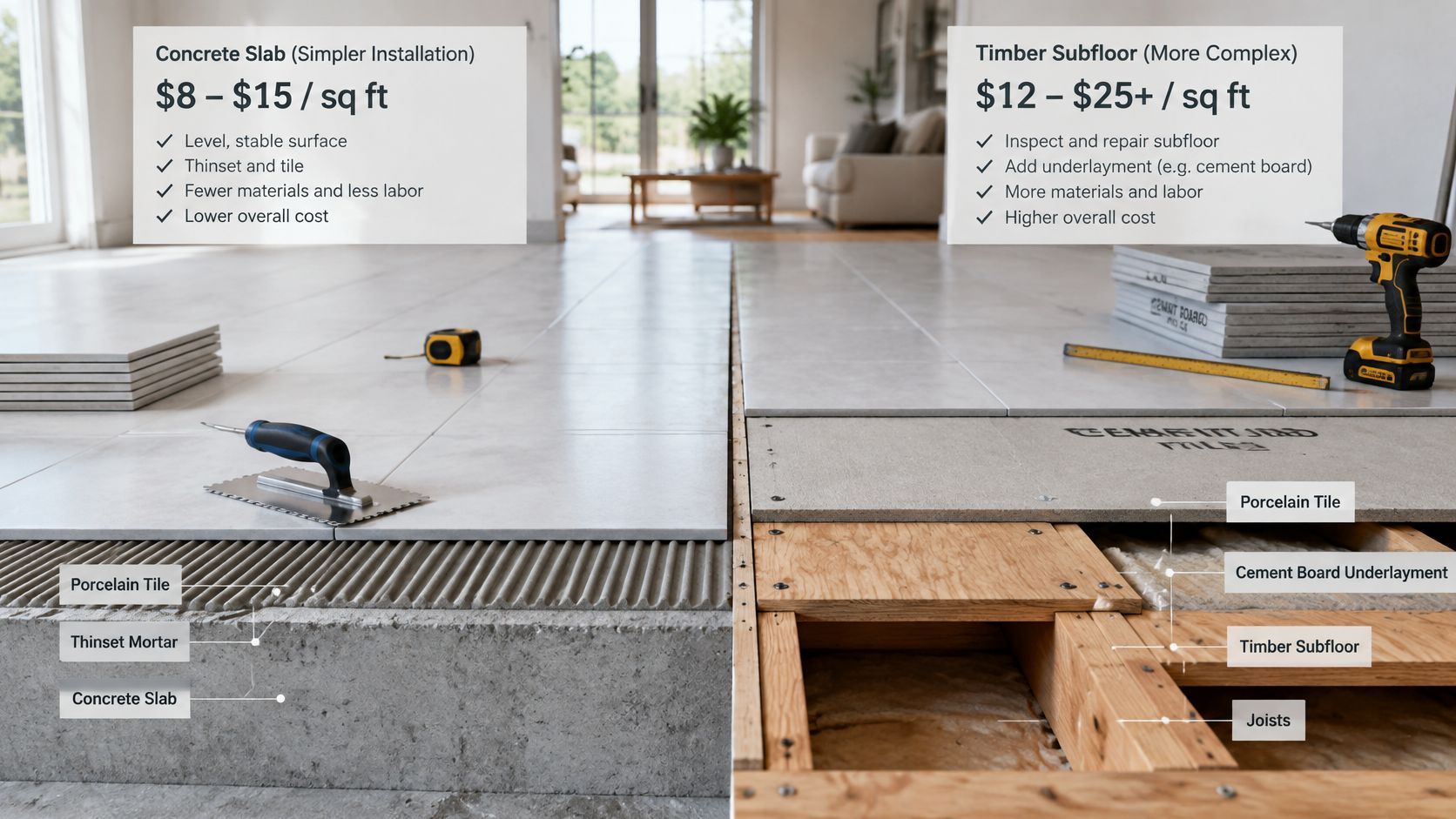
The floor underneath the tile determines what the installer can safely build above it. A sound, flat concrete slab may need cleaning and compatible setting materials, while a timber floor may require removal, structural correction, an appropriate underlayment, and flattening.
Neither concrete nor wood is automatically ready for tile. Concrete can have cracks, contamination, or moisture concerns; a timber floor can move or contain damaged panels. Covering either problem with attractive porcelain doesn't resolve it.
Flatness and format change the work
Large-format and rectified porcelain require careful handling and layout control. Installers must account for unevenness, tile warpage, edge alignment, and the planned grout joints rather than trying to compensate with excessive mortar.
Angi's tile flooring cost guide identifies substrate correction, tile format, pattern complexity, waterproofing, and access as reasons installed prices span a broad range. Those are distinct tasks, not interchangeable explanations for an unexplained labor surcharge.
A diagonal layout creates different perimeter cuts from a square-set layout. Herringbone requires repeated alignment checks, while an irregular bathroom may involve many small cuts around door jambs, plumbing penetrations, and fixtures.
Fewer grout lines don't necessarily mean less installation work. Larger pieces can require more demanding cutting, handling, and floor preparation even when the finished surface looks simpler.
Wet areas need an assembly, not just tile
Porcelain is the visible finish. In a shower or another designated wet area, the installer must also specify the waterproofing system, seams, penetrations, and connections to drainage components.
Backer board and waterproofing aren't interchangeable terms. A quote should describe what each layer does and where it will be installed. Our porcelain tile installation guide explains the relationship between preparation and the finished surface.
Use this room-check sequence before approving a layout:
- Confirm the subfloor type. Identify concrete, plywood, or another assembly, including what's beneath the existing finish.
- Check flatness. Use a long straightedge to locate gaps and high spots, then have the installer assess the selected tile's requirements.
- Choose the format. Share the actual product information rather than a similar inspiration photo.
- Decide the pattern. Mark the main sightline and discuss cuts at entrances, cabinets, and thresholds.
- Separate the conditions. Request distinct allowances for correction, underlayment, waterproofing, removal, and disposal.
A lower tile price won't compensate for an installation method that leaves the substrate problem unresolved.
When one bid is double another, inspect these conditions before assuming the difference is markup. The contractors may be pricing different work beneath the same porcelain.
Sample Budgets for Common Porcelain Floors
A useful room budget separates finished floor area, purchased tile quantity, and the area or scope used to calculate labor. They aren't necessarily identical.
KNR Constructions' tile estimating guidance uses about 10% extra field tile for a straightforward allowance and notes that cut-heavy or complex layouts can require more. For the hypothetical living room below, that produces a purchase quantity of 220 square feet for a 200-square-foot floor.
The examples apply the published rates already identified to hypothetical room sizes. They're arithmetic illustrations, not Massachusetts quotes, and they exclude unpriced project extras.
| Scenario | Area | Installed rate | Estimated installed total |
|---|---|---|---|
| Living room, square-set 12×24 tile on a flat slab | 200 sq ft | $12–$25 per sq ft | $2,400–$5,000 base |
| Open-plan area at mid-range installed rate | 500 sq ft | $8–$16 per sq ft | $4,000–$8,000 base |
| Open-plan area with premium or complex layout | 500 sq ft | Above $30 per sq ft | Above $15,000 |
| Small bathroom, cut-heavy layout | 60 sq ft | $12–$25 per sq ft base | $720–$1,500 before complexity and minimum charges |
| Purchase quantity for the 200 sq ft room with 10% waste | 220 sq ft purchased | Tile purchase only | Multiply purchase quantity by the selected tile price |
Read the scenarios as different scopes
The living room is the clearest starting point: an open working area, a square-set pattern, and an assumed ready substrate. Even here, the installer must confirm that the slab meets the requirements rather than pricing readiness from a photograph.
The open-plan floor shows why specification choices matter across a larger area. The difference between the listed mid-range endpoints is $4,000, calculated from the example rates, before taxes or demolition. A premium layout is a separate specification, not just the upper end of the same job.
The small bathroom is a warning against relying on multiplication alone. The table's base calculation doesn't price the extra cuts, waterproofing where applicable, or minimum-job charge. Those additions belong on the estimate rather than being hidden inside a misleading room average.
Order tile for the layout you'll build
Measure closets, recessed entrances, and connected floor areas that are part of the work. Door jambs and angled walls affect cutting, while pattern alignment can prevent an offcut from being reused elsewhere.
Ask the installer to approve the order quantity before purchasing. Field tile, decorative trim, and specialty edges should be counted separately; an allowance for the main floor doesn't establish how many matching trim pieces you need.
Keep spare pieces labeled with the product and batch information for future repairs. Don't assume the same appearance will remain available later.
Carry forward the room total and the purchase quantity. A per-square-foot rate alone tells you neither the complete bill nor how much tile to order.
Replace every illustrative rate with the rate from your written quote. Then add the separately priced work once, checking that allowances haven't already been included elsewhere.
Whether Porcelain Pays Off Over Time
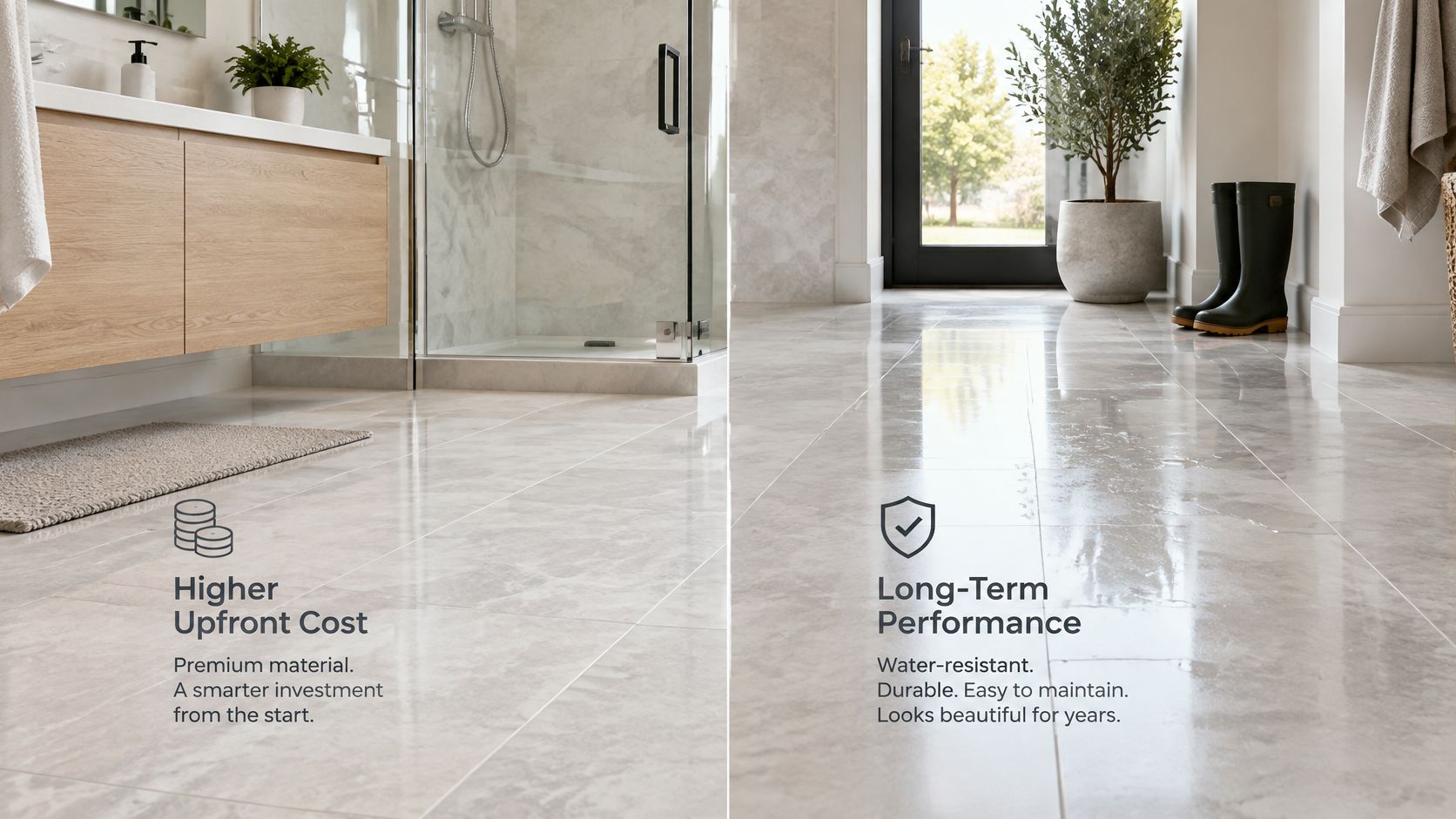
The cheapest tile isn't necessarily the least expensive floor to own. Porcelain tile is durable and well suited to high-traffic areas, but its value depends on selecting an appropriate product and installing it correctly.
The technical basis matters: the GoSource porcelain buying guide describes true porcelain as having water absorption of 0.5% or less. It also summarizes lifecycle modeling with an initial cost of approximately $11.38 per square foot, cumulative lifecycle cost of $73.16 per square foot, and an estimated 75-year service life over a 75-year analysis period.
Model results aren't homeowner guarantees
Those lifecycle figures depend on assumptions about maintenance, replacement, discount rates, and installation conditions. They don't establish your purchase price, promise a particular lifespan, or predict what a future owner will spend.
Low absorption also describes the tile body, not the entire floor. Grout joints, penetrations, movement, and drainage still matter. A moisture-resistant finish can't correct a failed waterproofing connection or an unstable substrate.
A better decision asks how much useful service you expect from the complete installation. Compare the upfront cost with your planned ownership period and the consequences of replacing the floor, including disruption to cabinets, fixtures, and adjacent finishes.
Match the investment to the room
- Family kitchen: Heavy daily use strengthens the case for durable porcelain and a carefully prepared substrate.
- Basement: Moisture conditions and the installation assembly must be assessed before choosing the finish.
- Frequently damp bathroom: Suitable slip performance and a properly detailed wet-area assembly matter more than appearance alone.
- Light-use, short-term rental: A premium decorative product may offer less practical value if a suitable lower-cost option meets the room's needs.
Verify the floor-use classification, slip information, grout specification, movement-joint plan, and substrate requirements. For maintenance, remove abrasive grit and use cleaners compatible with the tile and grout rather than assuming every surface needs the same treatment.
Correct installation protects the investment. Savings on material can disappear if cracking, debonding, or moisture damage forces premature replacement.
Porcelain Tile Flooring Questions Readers Ask
Can I install porcelain tile myself?
A careful DIYer can handle a small, simple floor, but porcelain leaves little margin for error. Its dense body needs suitable cutting tools and careful setting; breakage or substrate mistakes can erase labor savings quickly. Review the layout and preparation requirements before deciding.
What does porcelain cost before installation?
Retail porcelain commonly costs about $4–$10 per square foot at major home-improvement retailers, according to This Old House's tile cost guide. That figure is the tile itself; setting materials, prep, demolition, and labor belong in the installed cost breakdown.
Is porcelain more expensive than ceramic?
Porcelain usually carries higher material and handling costs because it is denser and harder to cut and set. Ceramic remains a cost-effective choice for walls and floors, so compare traffic, moisture, and budget through the quality and material comparison rather than the label alone.
Massachusetts Quote Checks and Next Steps
A Massachusetts estimate should describe your room, not just apply a national average. For homeowners in Wayland, Newton, Needham, Wellesley, Weston, and nearby communities, a site inspection is more useful than assuming that a published range predicts the local bill.
HomeCostKit's tile installation breakdown places substrate preparation at about $0.50–$3.00 per square foot, more extensive leveling or backer-board work at roughly $2–$6 per square foot, and separately charged demolition and disposal at approximately $100–$600 per project. These are alternative scope-based allowances, not charges to stack automatically onto every estimate.
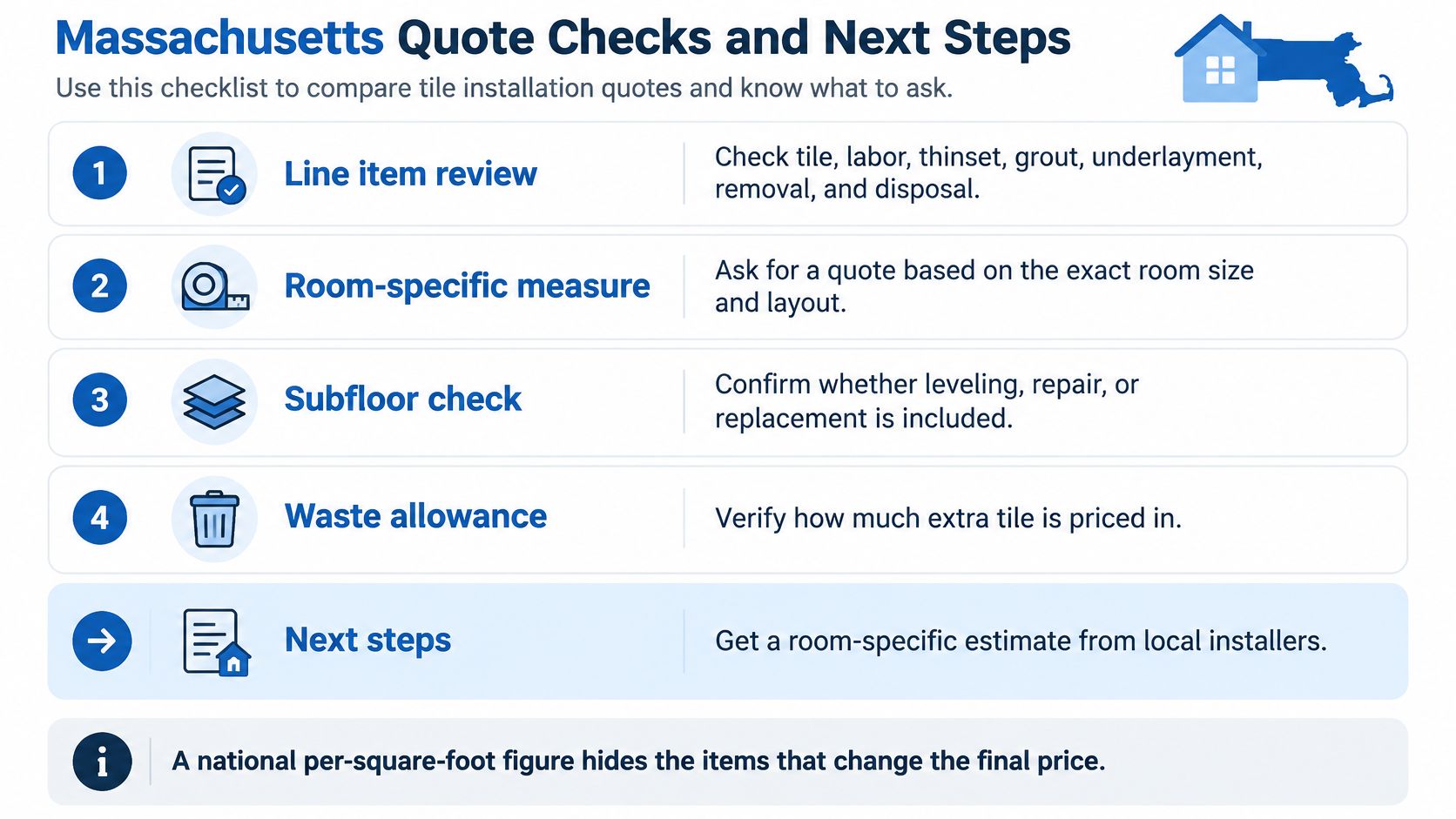
Check the exclusions before the total
Small bathrooms and entryways can carry a higher effective rate because mobilization and preparation don't shrink in direct proportion to floor area. Ask whether the contractor charges a minimum separately or incorporates it into labor.
Use this checklist to resolve the remaining uncertainties:
- Product and finish: Confirm the exact tile, floor classification, surface finish, and grout specification.
- Preparation and moisture: Identify floor-flatness testing, moisture assessment, mitigation, underlayment, and repair responsibilities.
- Edges and joints: Include transitions, trim, perimeter movement accommodation, and planned expansion joints.
- Removal and cleanup: Distinguish demolition, hauling, disposal, and protection of adjacent rooms.
- Allowances and changes: Record waste, spare tile, minimum-job charges, and how hidden substrate work will be authorized.
Our porcelain tile installation service is part of our tile and remodeling work across porcelain, ceramic, marble, granite, backsplashes, kitchens, bathrooms, and flooring. Our tile installation comes with a guaranteed high-end finish.
Prepare for a room-specific estimate
- Measure the floor. Include closets, doorway recesses, and connected areas within the project.
- Choose the quality tier. Confirm the selected product and supplier price.
- Describe the existing assembly. Note the subfloor, current flooring, visible damage, and moisture concerns.
- Request an itemized scope. Separate tile, setting materials, preparation, removal, disposal, and trim.
- Normalize the bids. Compare the same tile specification, pattern, purchase allowance, and finished scope.
Collect at least two itemized bids and keep a contingency for concealed substrate problems. Before committing, confirm how the contractor will document additional work and obtain your approval. That process makes porcelain tile flooring cost per square foot a useful comparison tool rather than a number that conceals the final bill.
Sunny Day Pro Services offers porcelain flooring installation and kitchen, bathroom, and tile remodeling for Massachusetts homeowners. Visit Sunny Day Pro Services to request an estimate, and share your room measurements, selected tile, existing flooring, and preferred layout so your quote can reflect the work your floor needs.

