
Porcelain vs Ceramic Tile: A Homeowner's Guide
Porcelain vs ceramic tile explained for homeowners. Compare durability, cost, moisture, and best rooms to choose the right tile for your remodel.
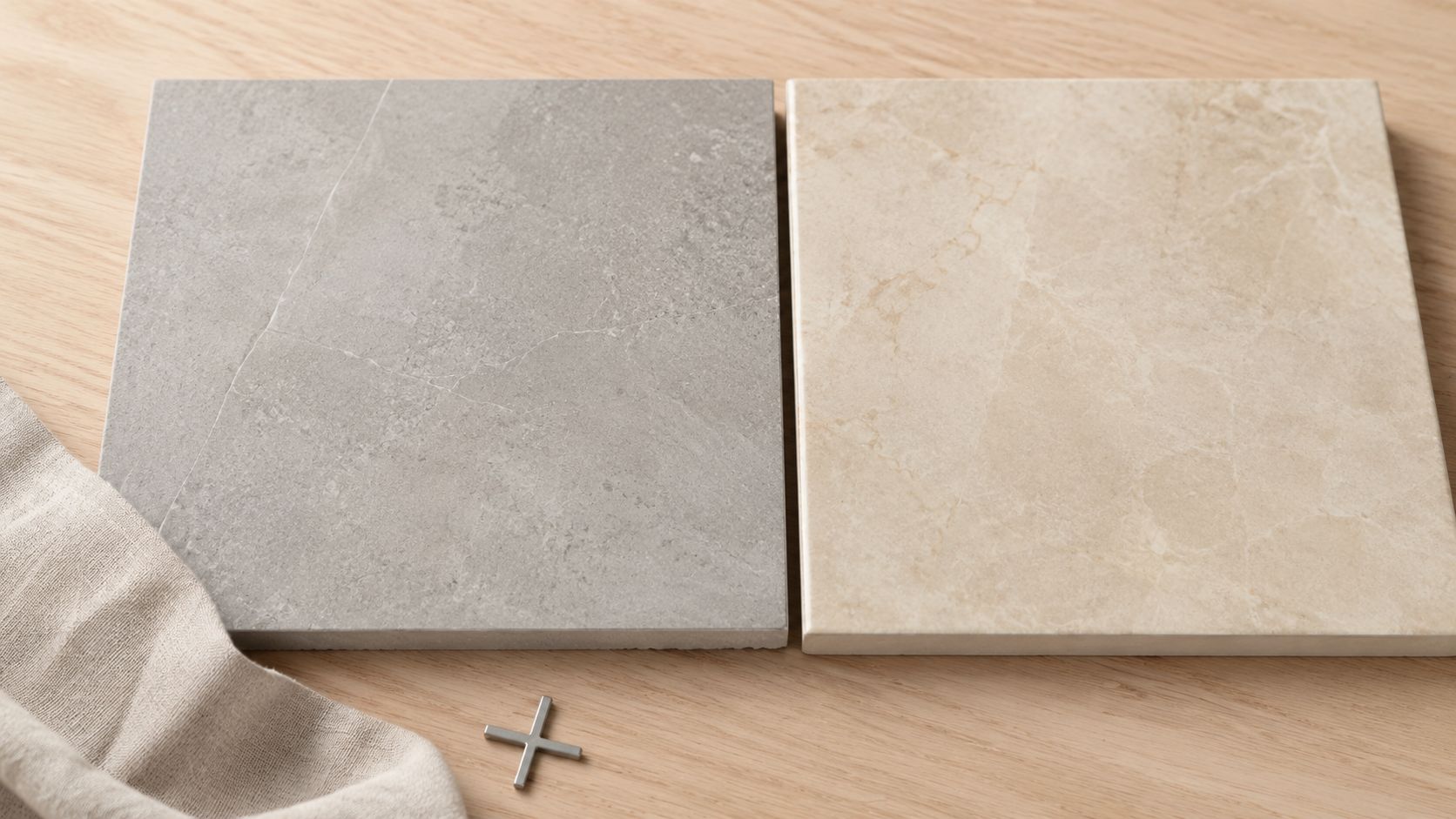
Porcelain is not automatically the better tile. That advice is convenient, memorable, and often wrong for the room you're remodeling. A Massachusetts kitchen, basement entry, shower wall, and outdoor patio place very different demands on a tile installation.
The right choice depends on moisture, traffic, freeze-thaw exposure, tile format, and subfloor condition. Porcelain usually wins where water, grit, weather, and heavy use are involved. Ceramic often wins on walls, backsplashes, decorative layouts, and projects where easier cutting matters more than maximum density.
The distinction is technical, but the decision is practical. Here's how I'd evaluate porcelain vs ceramic tile for a home in Wayland, Newton, Needham, Wellesley, Weston, or a nearby Massachusetts community.
Table of Contents
- Do porcelain or ceramic tiles need sealing?
- How often should grout be resealed?
- How long will tile last in Massachusetts freeze-thaw conditions?
- Can porcelain go over radiant heat?
- Is ceramic easier to repair if one tile cracks?
- Is porcelain worth the extra cutting time in an older home?
Why Porcelain vs Ceramic Tile Is the Wrong Question
The popular question is, “Which is better, porcelain or ceramic?” A tile installer should ask something more useful: Where will the tile live, and what is underneath it?
A homeowner remodeling a 1990s Cape may choose porcelain for a kitchen floor because it has a harder, denser body. That sounds sensible until the installer finds a wavy plywood subfloor. Large, rigid porcelain pieces can make unevenness more visible, create lippage problems, and demand more preparation. A suitable ceramic floor tile might have been easier to cut, easier to handle, and better matched to the layout, provided its rating and installation requirements fit the room.
A basement mudroom presents the opposite problem. Ceramic may be affordable and attractive, but an unconditioned space exposed to moisture, road salt, sand, and temperature swings needs a tile rated for the environment. The issue isn't prestige. It's whether the tile body can handle the conditions without absorbing enough moisture to become vulnerable during freezing weather.
Massachusetts homes add real complications
New England houses see more than ordinary indoor foot traffic. Winter boots bring in ice-melt residue, grit, and moisture. Older homes may have uneven plywood, settling, patched concrete, or basement slabs affected by moisture migration. Three-season rooms and exterior steps face temperature changes that a dry hallway never sees.
Practical rule: Choose the tile for the room's abuse, then choose the format and finish for the installation.
Porcelain tile has become a major part of the tile economy, not a specialty product. The global ceramic tiles market was estimated at US$58.7 billion in 2020 and projected to reach US$86.6 billion by 2026, with porcelain projected to reach US$40.9 billion by 2026. The market overview from StrategyR helps explain why retailers position porcelain as a premium, performance-focused choice.
That still doesn't make it right everywhere. A well-selected ceramic tile can be the smarter installation for a bathroom wall or backsplash, while porcelain earns its additional labor on a mudroom floor, shower floor, or properly specified exterior surface.
How Porcelain and Ceramic Tile Are Actually Made
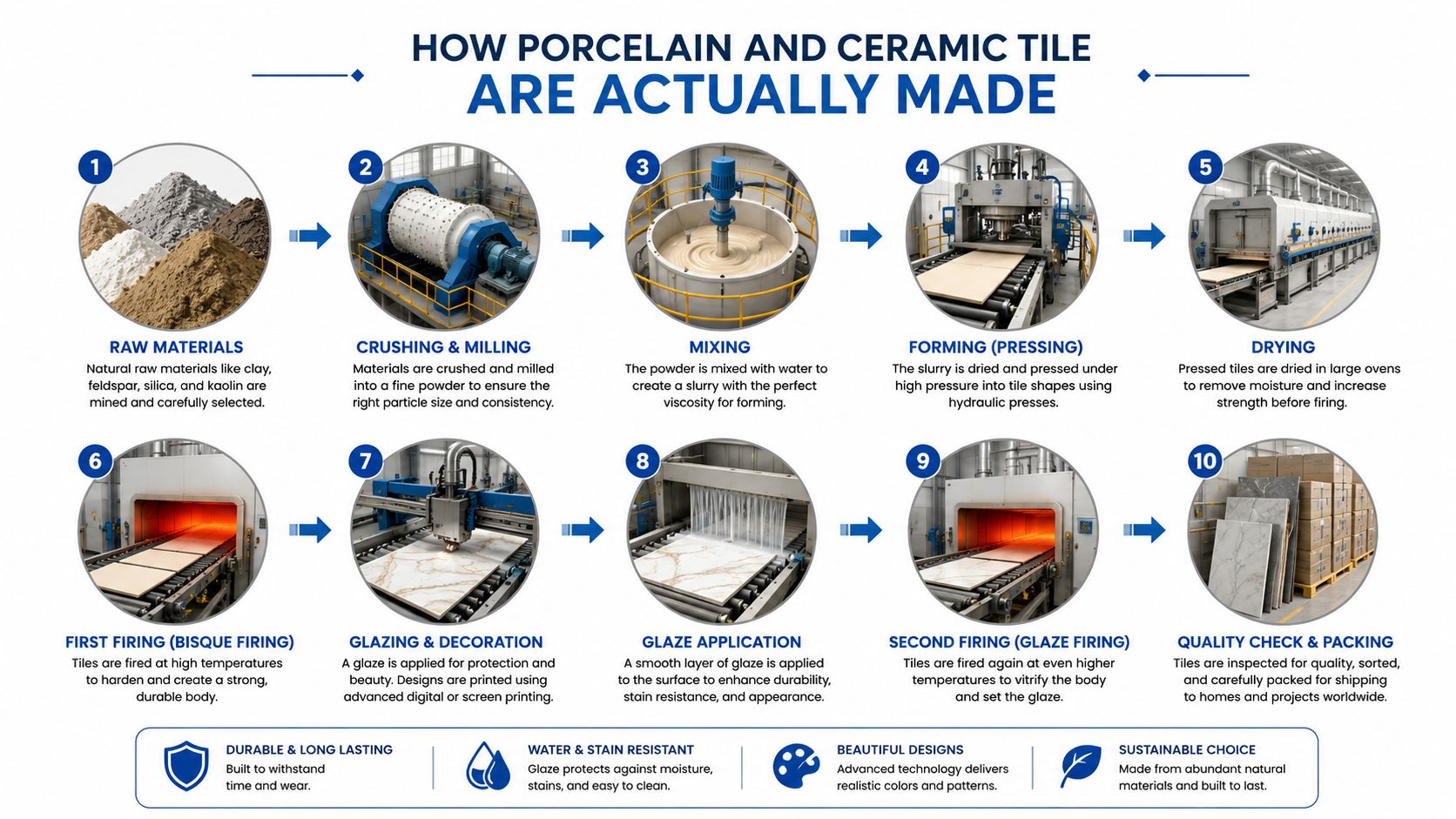
Both products begin with clay and mineral materials, but manufacturing separates them in ways you'll feel during installation and daily use. Ceramic generally uses a less refined clay body, while porcelain uses more refined materials and is pressed under greater pressure before firing.
The kiln process also differs. Porcelain is fired at higher temperatures than standard ceramic, which fuses the body into a denser, less porous material. That density explains porcelain's lower moisture absorption, harder cutting characteristics, and resistance to many forms of wear.
The absorption standard matters more than the label
Porcelain is classified under ANSI A137.1 and referenced by ASTM and related industry standards as ceramic tile with a fired-body water absorption rate of 0.5% or less. ANSI's explanation of the porcelain tile definition identifies that threshold as the meaningful classification point.
Tiles fall into practical absorption categories. Impervious tile absorbs 0.5% or less, vitreous tile absorbs more than 0.5% up to 3.0%, semi-vitreous tile absorbs more than 3.0% up to 7.0%, and non-vitreous tile absorbs above 7.0%. This tile standards reference shows why “ceramic” covers a broad range rather than one uniform performance category.
Some industry comparison information places standard ceramic floor tiles around 3% to 10% water absorption and ceramic wall tiles above 10%, while porcelain remains at 0.5% or less. Niro Granite's discussion of tile water absorption provides that practical contrast.
Glaze and body color affect repairs
Most ceramic tile gets its visible color and pattern from a glaze applied over the body. Porcelain can also be glazed, but through-body or full-body porcelain carries more of its color through the tile. A chip on a through-body product may be less conspicuous than a chip that exposes a contrasting ceramic body beneath a glossy surface.
That doesn't mean porcelain can't chip. Hard, dense tile still breaks under sharp impact, especially if the substrate moves or the edge lacks support. Manufacturing improves the body, but installation still determines whether the finished floor performs as intended.
Strength, Water Absorption, and Daily Wear Compared
Three specifications deserve attention before you compare colors: water absorption, breaking strength, and surface wear rating. They answer different questions, and no single number tells you whether a tile belongs in your home.
Water absorption addresses how much moisture the fired body can take in. Breaking strength concerns the force needed to break the tile under test conditions. A PEI rating, where provided for glazed tile, addresses resistance to surface wear. Ask for all three when you're selecting a floor product.
| Performance Spec | Porcelain Tile | Ceramic Tile |
|---|---|---|
| Water absorption | 0.5% or less, classified as impervious under the cited standards | Often more absorbent, with common industry comparisons placing floor tile around 3% to 10% and wall tile above 10% |
| Moisture performance | Strong choice for wet rooms, shower floors, and properly rated exterior applications | Works well for many interior walls and lower-stress areas, but product specifications matter |
| Body density | Denser and less porous | Generally lighter and more porous |
| Cutting and drilling | Harder to cut, drill, and shape cleanly | Usually easier to cut and fabricate |
| Surface wear | Often preferred for demanding floors and heavy-use areas | Suitable for many residential floors when the wear rating fits |
| Freeze-thaw exposure | Preferred when specifically rated for exterior use | Not a default exterior choice in freezing climates |
Wear ratings must match the traffic
PEI is a surface-wear classification used mainly for glazed tile. A PEI 4 ceramic tile can handle a residential kitchen when the rest of the product specifications and installation are appropriate. A PEI 3 product may be acceptable in a lower-traffic room but is a poor choice for an entryway that receives constant grit and winter debris.
Porcelain's dense body can resist wear and moisture, but don't confuse body density with a guaranteed scratch-proof surface. A polished finish can behave differently from a textured or matte finish, and abrasive sand can affect surfaces over time. The glaze, finish, cleaning routine, and entry conditions all matter.
Stronger doesn't mean more forgiving
Porcelain's higher density and breaking strength can help a floor handle impact, including a dropped heavy pan. The same rigidity can work against an uneven or deflecting subfloor. Tile doesn't bend with a moving floor. It cracks, debonds, or develops lippage when the supporting assembly fails to meet the installation requirements.
For practical guidance on selecting tile for demanding floors, compare this guide to high-traffic tile flooring. In Massachusetts, also consider ice-melt salt and sand. They may not damage every tile immediately, but they can soil grout, dull unsuitable finishes, and expose weaknesses in an entry system that lacks proper cleaning and maintenance.
Finishes, Sizes, and What Installation Really Demands
The tile body is only half the decision. Finish, edge, size, and layout can change the installation more than the word “porcelain” on the box.
Glazed ceramic remains a strong choice when you want broad color variety, decorative patterns, mosaics, or a lightweight wall product. It's particularly practical for backsplashes, bathroom walls, fireplace surrounds, and shower walls when the selected tile is appropriate for the application.
Porcelain offers polished, matte, textured, and through-body options. A polished surface can create a refined appearance, but a matte or textured surface is often more sensible where wet shoes and bare feet create slip concerns. For bathrooms and entries, ask about the product's slip-resistance documentation, including DCOF where applicable, rather than choosing solely by appearance.
Large format changes the labor equation
Large porcelain formats such as 12 by 24, 24 by 24, and 24 by 48 inches demand a flat substrate. A long tile bridges more of the floor, so dips and crowns become harder to hide. Rectified edges can create clean, tight grout lines, but they also make installation errors easier to see.
A porcelain installer may need a quality wet saw and suitable blade, specialty drilling tools, appropriate mortar, careful back-buttering, and a leveling system. The exact mortar should follow the tile manufacturer's requirements and the conditions of the installation. Ceramic is generally lighter and easier to cut, which keeps wall and backsplash work more manageable.
| Factor | Ceramic Tile | Porcelain Tile |
|---|---|---|
| Cutting | Usually faster and easier to shape | Requires more capable cutting and drilling tools |
| Weight | Lighter, useful on many walls | Heavier, especially in large formats |
| Subfloor tolerance | Still needs proper preparation, but smaller formats can be more forgiving | Demands careful flatness and layout control |
| Format options | Strong range for decorative and wall applications | Particularly common in large-format floor designs |
| Edge visibility | Standard edges can disguise minor layout variation | Rectified edges show inconsistent joints and lippage |
| Labor | Often simpler for backsplashes and walls | More time-intensive for large floors and complex cuts |
Porcelain installation can run 20% to 30% more in labor than a comparable ceramic floor because cutting, handling, substrate preparation, and layout take more time. That figure is a planning benchmark, not a universal quote. The actual difference depends on tile size, room geometry, stairs, niches, transitions, and the condition of the existing surface.
Cost, Lifecycle, and Maintenance Over Time
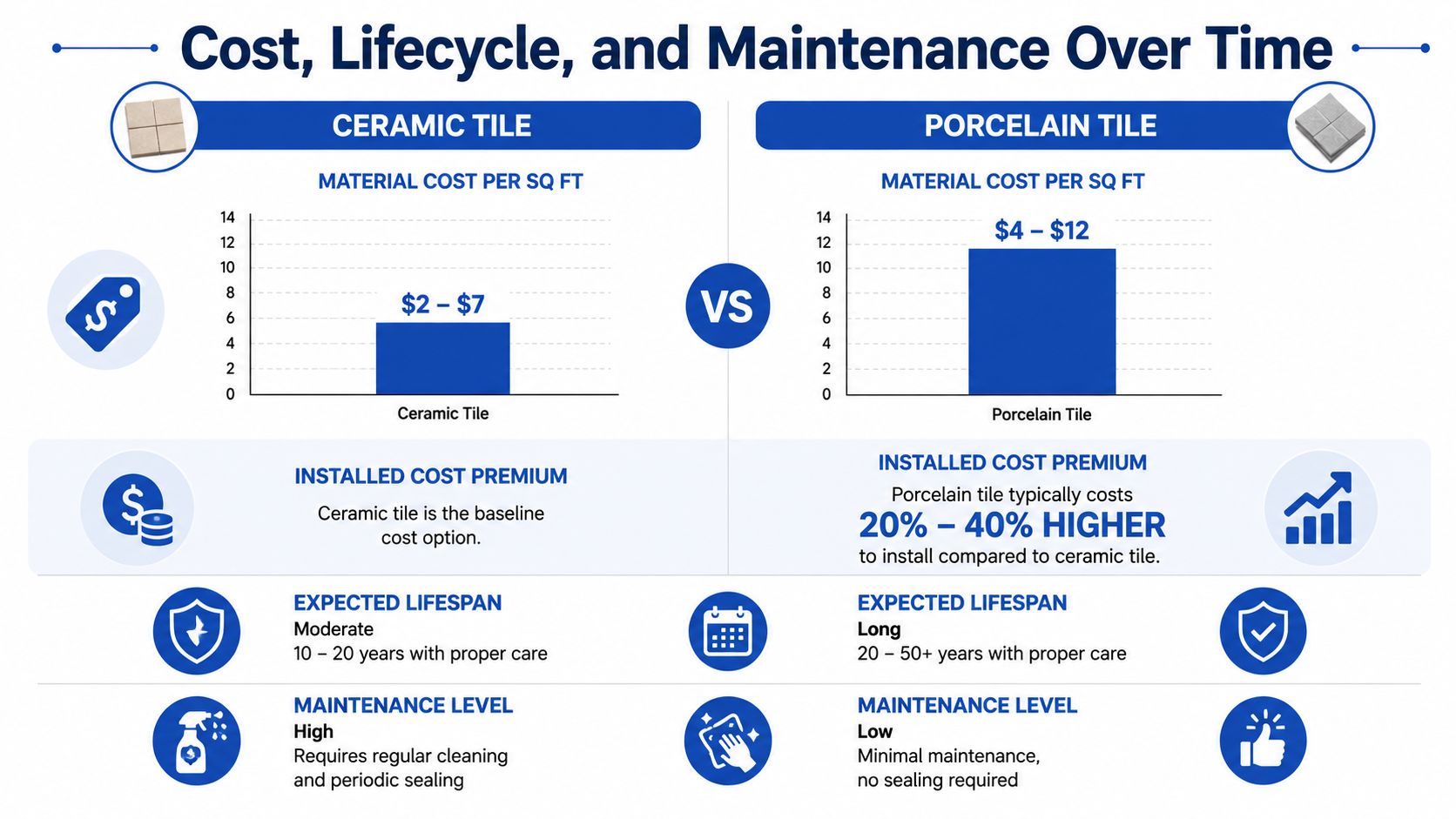
The box price doesn't tell you what the project costs. Ceramic material commonly runs $2 to $7 per square foot, while porcelain commonly runs $4 to $12 per square foot. This ceramic tile installation price guide offers useful context for separating material selection from the labor and preparation that complete the installation.
Installed porcelain commonly lands 20% to 40% higher than ceramic because it may require slower cuts, more demanding handling, specialized mortar, and tighter substrate tolerances. The market comparison source covering porcelain and ceramic installation also emphasizes the overlooked trade-off: porcelain is denser but can be more brittle during fabrication and harder to cut.
Lifecycle value depends on the assembly
Both tile types can provide a long service life when the installer prepares the substrate, uses the correct mortar, respects movement requirements, and installs grout properly. Tile body selection can't compensate for deflection, moisture problems, poor coverage, or movement at the perimeter.
Porcelain's harder surface is useful in entries and mudrooms where grit creates daily abrasion. Through-body porcelain can also make small edge damage less noticeable. Ceramic can still deliver excellent value on walls and moderate-stress interior areas, where its lower material cost and easier fabrication reduce the project burden.
Maintenance is mostly a grout and finish issue
Glazed ceramic and glazed porcelain are generally straightforward to clean. Use a pH-neutral cleaner, avoid harsh products that can attack grout or finishes, and wipe spills before they sit. Grout remains the vulnerable part of most tile installations, regardless of the tile body.
Plan to reseal grout every 1 to 3 years, depending on the grout product, location, cleaning routine, and manufacturer guidance. Unglazed tile may need additional protection, while glazed tile surfaces generally don't require sealing. A low-maintenance tile can still look neglected if salt residue, sand, and dirty grout are left in a Massachusetts entryway.
Room-by-Room Recommendations for Massachusetts Homes
A tile decision should follow the room, not the showroom display. The same homeowner may reasonably use porcelain on a mudroom floor, ceramic on a bathroom wall, and a different product entirely on a decorative backsplash.
| Room | Recommended Tile | Why |
|---|---|---|
| Kitchen floor | Porcelain, or properly rated ceramic on a controlled budget | Handles frequent traffic, grit, spills, and impact |
| Kitchen backsplash | Glazed ceramic | Lightweight, easy to cut, and available in broad decorative styles |
| Bathroom walls | Ceramic or porcelain | Both can work when the product and waterproofing system are appropriate |
| Shower floor | Porcelain | Low absorption and suitable small-format options support wet-area use |
| Mudroom or entry | Exterior-rated porcelain where conditions demand it | Better fit for moisture, salt, grit, and heavy daily use |
| Conditioned basement | Porcelain or suitable ceramic over a properly prepared slab | Moisture and substrate conditions determine the choice |
| Unheated porch or patio | Exterior-rated porcelain | Better suited to freezing exposure when the product is approved for it |
Kitchens and bathrooms
For a kitchen floor, I generally favor porcelain. Cast-iron cookware, chair movement, grit from an icy driveway, and regular spills create a tougher environment than a quiet hallway. A well-rated glazed ceramic can work, but it shouldn't be selected only because the sample is cheaper.
Bathroom walls are more flexible. Ceramic's lighter weight, easy cutting, and broad color range make it a practical choice for shower surrounds and accent walls when the waterproofing system is correctly built. For a shower floor, porcelain is usually the safer recommendation because its absorption classification better suits persistent moisture.
Use this bathroom floor tile guide when you're comparing size, finish, and wet-area requirements.
Mudrooms, basements, and exterior areas
Mudrooms and entries need a surface that can tolerate winter boots, sand, salt, and repeated cleaning. Choose porcelain specifically rated for the intended use, especially in an unheated porch or three-season room.
A basement deserves a substrate inspection before a tile selection. Porcelain over a properly installed uncoupling membrane can be a strong approach where moisture migration is a concern, but a membrane doesn't replace moisture evaluation or correct slab preparation. Ceramic may work in a fully conditioned, dry basement with a stable slab.
Outdoor patios, walkways, and pool decks require products approved for exterior use and freezing conditions. Standard interior ceramic isn't a safe default for a Massachusetts patio. Frost exposure can turn absorbed moisture into a serious problem.
Your Decision Checklist and Questions for the Installer
Bring more than a tile sample to the estimate. Bring the room's actual conditions.
Start by recording the intended use, moisture exposure, traffic, and substrate type. Note whether the room is heated, whether boots and salt enter the area, and whether the existing floor is plywood, concrete, or an older tiled surface.

Check the quote before comparing prices
Ask the installer these questions:
- Product suitability: What PEI rating and water absorption classification fit this room?
- Substrate preparation: Will you check flatness, deflection, cracks, moisture, and movement before pricing the work?
- Setting materials: Does the quote identify the thinset or mortar and explain why it suits the tile?
- Layout details: What grout joint width, edge profile, transitions, and movement joints are included?
- Scope of work: Are demolition, disposal, underlayment, membrane, leveling, and trim included?
- Warranty terms: What does the workmanship warranty cover, and what exclusions apply?
A quote based only on square footage is a warning sign. Porcelain and ceramic may have different labor demands, and an older Massachusetts home can hide preparation work behind an apparently simple floor.
Compare written scopes, not just totals
Put two or three quotes side by side. Compare the tile allowance, preparation, setting materials, grout, trim, disposal, transitions, schedule, and warranty. The lowest total may omit the floor preparation that prevents cracked tile and loose grout.
Good estimating starts with the substrate, not the showroom sample.
A professional installer should be able to explain why the selected tile fits the room and what must happen before the first tile is set. That explanation is more valuable than a confident promise that one tile type is always superior.
Frequently Asked Questions About Porcelain vs Ceramic Tile
Do porcelain or ceramic tiles need sealing?
Glazed porcelain and glazed ceramic generally don't need sealing. Some unglazed products may need protection, and grout often benefits from sealing. Follow the tile and grout manufacturer's instructions rather than sealing automatically.
How often should grout be resealed?
A common maintenance interval is 1 to 3 years, but the right schedule depends on the grout, location, cleaning routine, and manufacturer guidance. Entries exposed to salt and sand deserve closer attention than a lightly used wall installation.
How long will tile last in Massachusetts freeze-thaw conditions?
There's no single lifespan that applies to every installation. Interior tile can last for decades when the substrate and setting system are sound. Exterior work needs tile specifically rated for freezing conditions, correct drainage, and installation practices that limit moisture problems.
Can porcelain go over radiant heat?
Yes, porcelain is commonly compatible with radiant-heating systems when the heating system, underlayment, mortar, movement joints, and tile manufacturer requirements are followed. Don't install over radiant heat without confirming the complete system.
Is ceramic easier to repair if one tile cracks?
Usually, yes. Ceramic is generally easier to cut and fabricate, so matching a replacement can be less difficult. Keep spare tiles from the original installation, because batches, finishes, and colors can change.
Is porcelain worth the extra cutting time in an older home?
For a wet room, mudroom, entry, or properly rated exterior area, usually yes. For an uneven older subfloor, the installer must correct the substrate first. Porcelain won't solve movement or flatness problems, and ceramic may be the more sensible choice for a wall or decorative application.
Sunny Day Pro Services installs porcelain and ceramic tile, including kitchens, bathrooms, backsplashes, and high-traffic floors, with attention to substrate preparation and finish details. Visit Sunny Day Pro Services to request a quote and discuss the right tile system for your Massachusetts home.

