
Post Construction Cleaning Services: A Complete Guide
Post construction cleaning services explained. Get pricing, phase checklists, safety tips, DIY vs pro guidance, and Massachusetts hiring advice.
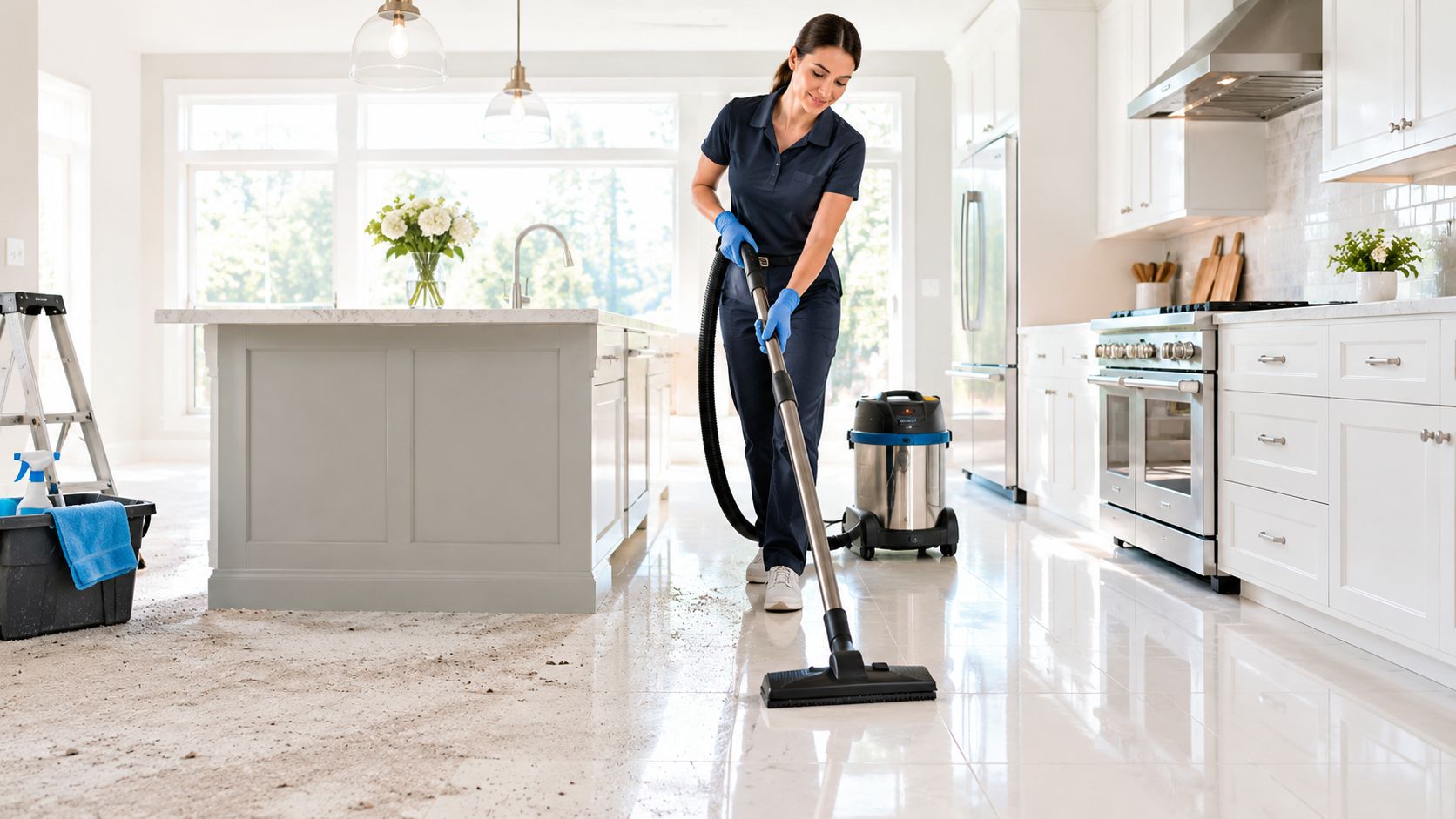
Post construction cleaning services turn a finished remodel into a room you can safely breathe in, cook in, and live in, with verified limits of 25 μg/m³ as an action level and 50 μg/m³ as an 8-hour limit for respirable crystalline silica shaping how that dust must be removed. That cleanup isn't about making a counter shine for photos. It's the last step that decides whether fine dust stays in the air, in your vents, and on every surface you touch.
Table of Contents
- Kitchens and bathrooms carry the heaviest residue
- Living areas, bedrooms, and the places dust resettles
- How soon after the walkthrough should the crew come in
- What belongs in the cleaning scope of work
- Can eco-friendly products still remove grout haze
- How do you protect new tile, grout, and stone during cleanup
The Day the Wrench Comes Down
The contractor loads the last bucket, the truck pulls away, and the house goes quiet. The new kitchen is standing there in full daylight. Then you run a fingertip across the counter and it comes back gray, and you don't want to set a coffee cup down yet.
That's the moment most Massachusetts homeowners underestimate. The tile is set, the cabinets are hung, and the floors look finished from the doorway. Up close, there's drywall dust on the window tracks, grout haze on the tile, sawdust inside the drawers, and adhesive residue where protective film used to be.
Why the last part feels so stubborn
Construction dust doesn't behave like everyday house dust. It's fine enough to settle on top of door frames, inside closet shelves, and along the ledges you never dust during a normal week. Wipe a surface dry and you often just move it. Mop too soon and you can spread it into grout joints and textured flooring instead of removing it.
Crews handle this in phases for a reason. Bulk debris comes out first, then surfaces get a lighter clean while punch list work is still happening, then a final detail clean happens right before you move furniture back in. Each phase catches what the last trades leave behind.
A visibly clean room isn't necessarily a clean room. The test is what comes off a damp white cloth, what's inside the cabinets, and what's sitting in the return grille.
This isn't a niche problem tied to a few big builds. The U.S. Census Bureau June 2025 construction spending release put total construction at a seasonally adjusted annual rate of $2.1362 trillion, with residential construction at $883.1 billion. Every kitchen, bath, addition, and whole-home renovation inside that pipeline ends the same way, with a space that needs a proper handoff clean.
For homeowners in Wayland, Newton, Needham, Wellesley, Weston, and nearby Boston suburbs, that handoff is local work. Older housing stock, tight renovation schedules, and families often living on site during part of the project make the cleanup plan matter as much as the finish selections.
What Post Construction Cleaning Actually Means
Regular housekeeping maintains a home that's already livable. You're removing cooking splatter, bathroom moisture spots, tracked dirt, and weekly dust. Post construction cleaning starts earlier in the life of a room, when the surfaces are new but the residues are industrial.
Move-out cleaning sits somewhere in between. It can be deep and detailed, but it usually doesn't involve paint specks on glass, stickers baked onto appliances, grout film on fresh tile, or fine particles from sanding and cutting. Those residues need different tools and a different order of operations.
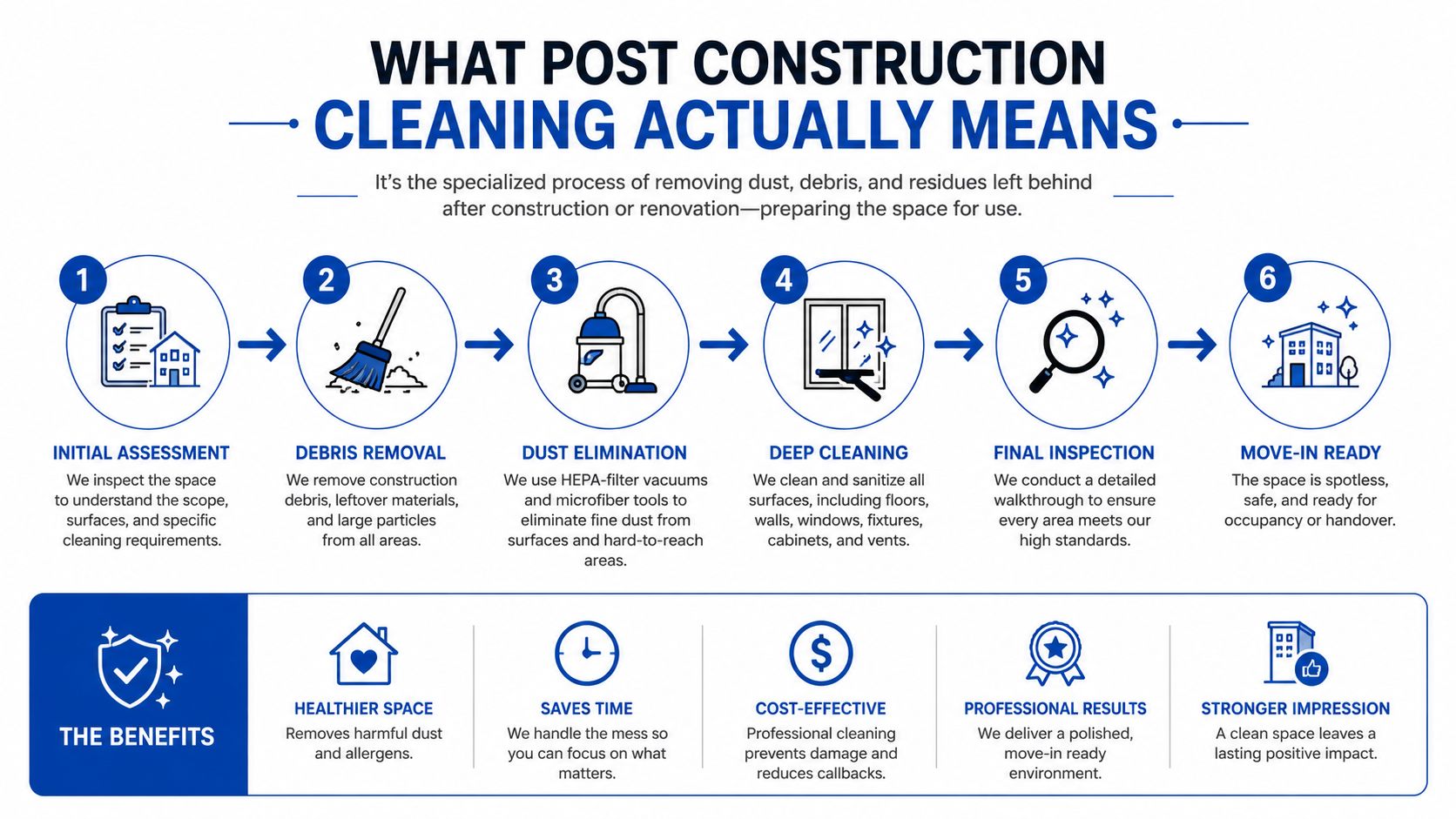
The three phases crews actually follow
Rough clean happens while work is wrapping up. The crew removes packaging, leftover trim pieces, protective cardboard, loose debris, and bulk dust so other trades aren't grinding grit into new floors. Pathways get cleared, waste gets bagged, and obvious hazards come out of the space.
Light clean follows once the major trades are done but touch-ups remain. Cabinet interiors, window tracks, baseboards, fixtures, and walls get attention, and floors get vacuumed rather than just swept. This pass often reveals punch list items, like a paint drip on a hinge or caulk smear on a tub edge.
Final detail clean is the occupancy pass. Glass, mirrors, polished fixtures, appliance faces, tile, and floors get finished, fingerprints come off, and settled dust from the light clean gets removed. Homeowners sometimes buy only this phase for a small bathroom remodel, while a whole-home renovation usually needs all three.
Why each residue needs its own method
Grout haze is a mineral film, not loose dirt, so it needs the right remover and rinse for the tile type. Adhesive and label residue need patience and plastic scrapers, not aggressive pads that scar glass or stainless steel. Sawdust packs into cabinet runners and closet corners, while silica-bearing dust from concrete, mortar, stone, and drywall calls for controlled vacuuming and damp methods.
Demand for that sequence isn't seasonal in the way people assume. U.S. Census data for January 2025 reported residential construction at a seasonally adjusted annual rate of $932.7 billion, which reflects improvement work generating final cleaning needs throughout the year, not only during peak building months. A January bath remodel in Needham leaves the same haze and dust as a July one.
Ask your contractor which phase, if any, is included in your contract. Many builders broom clean and haul their own debris, and that's not the same promise as a final detail clean ready for linens, dishes, and bare feet.
The Room-by-Room Final Clean Checklist
A useful checklist names surfaces, not good intentions. Hand this order of work to a crew, or use it to audit your own effort, and you'll quickly see where most DIY cleanups stop short. The pattern is consistent. People clean what catches light at eye level and miss interiors, edges, grilles, and tracks.
Kitchens and bathrooms carry the heaviest residue
- Cabinet interiors and faces: Vacuum drawers, shelves, hinges, and runners, then damp wipe. Dust hides under shelf pins and along drawer bottoms, and it'll transfer straight onto dishes and towels.
- Appliances and range hoods: Remove film and labels, clean interiors where construction dust entered, wipe handles and controls, and check hood filters and undersides for gritty film.
- Counters and backsplashes: Clear grout haze and adhesive spots with products matched to stone, quartz, porcelain, or ceramic, then rinse so no cleaner residue dulls the finish.
- Bathroom glass, mirrors, and fixtures: Polish chrome and glass without abrasive pads, detail faucet bases, and clean exhaust grilles where sanding dust collects.
- Tile and grout: Vacuum before any wet work, address haze in sections, and finish with a clean-water rinse. Homeowners planning long-term care should also review grout cleaning and sealing basics before sealing anything that still carries film.
Living areas, bedrooms, and the places dust resettles
Walls need dusting, not just spot checks, especially behind where doors stood open during sanding. Trim, baseboards, switch plates, outlet covers, ceiling fan blades, and light fixtures all hold a fine layer that drops back onto floors after you think you're done. Closet shelves, rods, window sills, blinds, and the tops of interior doors belong on the same pass.
Windows deserve their own sequence. Vacuum the tracks first, since they're full of grit that'll scratch glass if you wipe blindly. Remove stickers and paint specks with appropriate scrapers, clean the glass, then detail sills and frames again after the tracks are empty.
Floor rule: Vacuum first, wet clean second. Water on heavy construction dust makes a slurry that spreads into grout, wood grain, and textured tile instead of lifting out.
Finish at the edges of the project. Entryways, garage floors near the work zone, walk-off mats, and siding or porch areas with splatter tell you whether debris was contained. If those transition zones are dusty, the interior won't stay clean for long, because every trip inside carries the job site back with it.
Safety, Dust, and Indoor Air Quality
The cosmetic question is whether the room looks finished. The more consequential question is what you're breathing when the heat or air conditioning kicks on that first night. Tile cutting, demolition, drywall sanding, and mortar work create particles fine enough to become airborne again long after the tools stop.
What the silica limits mean for a homeowner
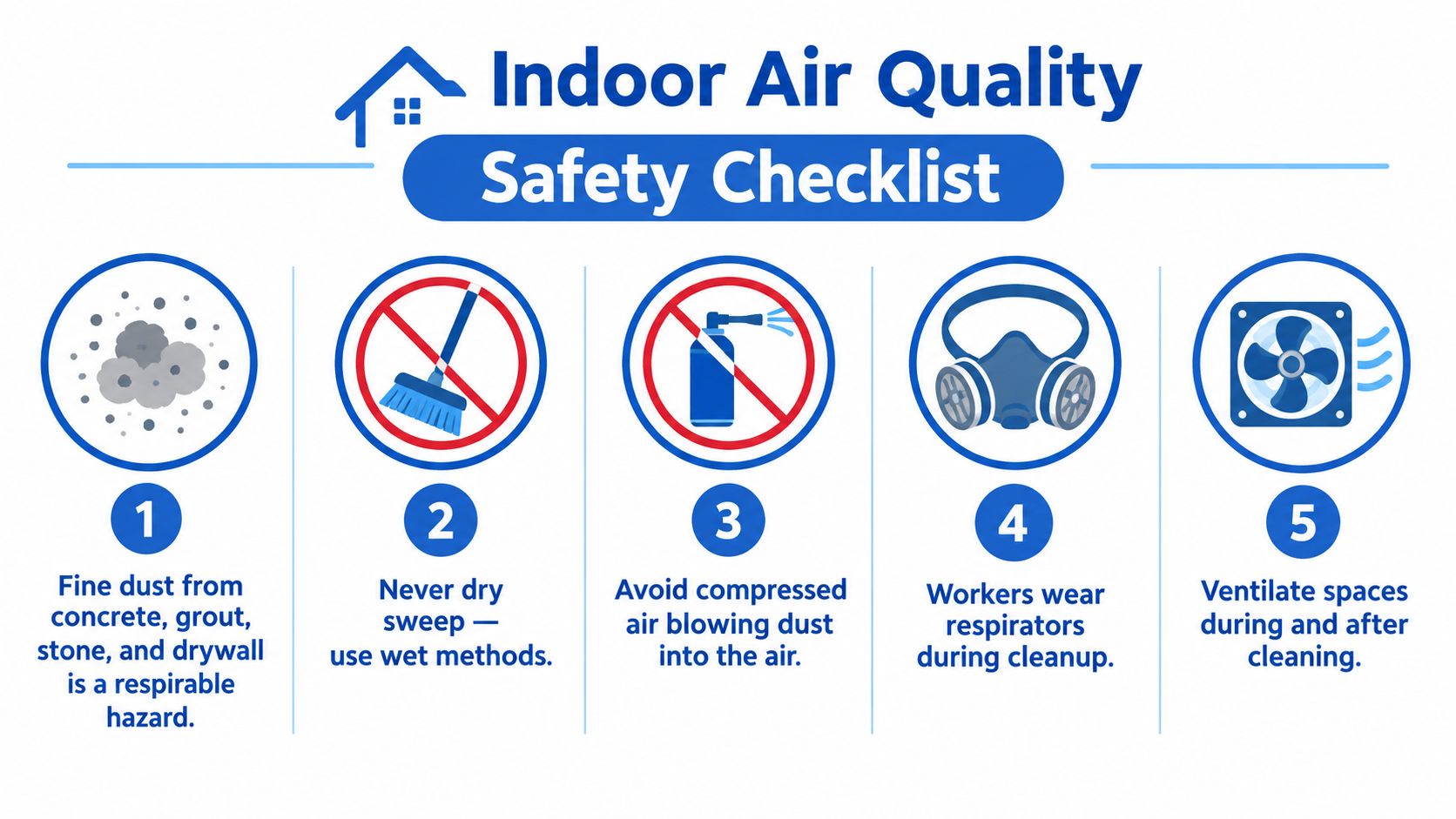
Dust from concrete, grout, mortar, stone, and some drywall work can contain respirable crystalline silica. The OSHA construction silica guidance sets an action level of 25 μg/m³ and a permissible exposure limit of 50 μg/m³, each as an 8-hour time-weighted average. Those are workplace exposure measures, but they explain why technique matters in your kitchen too.
That same guidance requires employers to avoid dry sweeping and dry brushing where wet methods or HEPA-filtered vacuuming are feasible. A broom feels efficient because the floor looks clearer in minutes. In practice, it launches the finest fraction back into the breathing zone, where it resettles on counters, bedding, and upholstery.
Controls you can verify before anyone moves back in
- Isolate the zone: Temporary plastic barriers and closed doors keep remaining dust from drifting during cleanup.
- HEPA vacuum first: Work top to bottom across ledges, vents, trim, floor edges, and horizontal surfaces with a properly maintained HEPA unit.
- Damp wipe second: Use wet wiping and damp mopping only on compatible surfaces, after vacuuming, so moisture doesn't turn dust into spreadable slurry.
- Protect the HVAC path: Cover supply and return grilles during dusty work, clean registers at handoff, and inspect or replace filters after the job.
- No blowing dust around: Leaf blowers and compressed air move the problem, they don't capture it.
If drywall work drove your project, the sequence in this drywall dust cleaning guide is worth comparing against any crew's proposed method. Ordinary household vacuums without suitable filtration can exhaust fine particles back into the room, which is why a homeowner can clean for hours and still find a fresh film the next morning.
For Massachusetts kitchen and bath remodels, ask one direct question before booking. How will you keep dust out of my ductwork, and how will I know it worked? A credible answer names barriers, grille covers, filter checks, HEPA equipment, and a final visual inspection, not scented products or labor hours alone.
Pricing, Timelines, and DIY vs Hiring a Pro
There's no honest flat price for post construction cleaning without seeing the space. A powder room retile and a whole-home renovation share a category name and almost nothing else. What you can evaluate, before a walkthrough, is what drives a quote and where DIY stops being a savings.
What actually moves the number
Home size matters, but surface count matters more. Multiple bathrooms, extensive tile, tall windows, interior cabinet cleaning, heavy grout haze, and leftover debris all add labor. New hardwood that needs careful, low-moisture methods prices differently from durable tile that can tolerate a fuller rinse.
Access and timing also count. A crew working around painters, punch list carpenters, and appliance installers will move slower than a crew entering an empty, finished home. If you want an apples-to-apples number, use a structured cleaning service quote request that separates rough, light, and final phases instead of asking for one vague cleanup price.
| Project Type | Typical Price Range | Crew Days | Best Fit |
|---|---|---|---|
| Single bathroom remodel | Lowest relative tier, driven by tile and glass | Part to full crew day | Final detail only, debris already removed |
| Kitchen remodel | Mid relative tier, driven by cabinets and appliances | Full crew day or more | Light plus final clean |
| Whole-home renovation | Highest relative tier, driven by surface count | Multiple crew days | All three phases, staged with trades |
| New build handover | Quoted by walkthrough and finish level | Multiple crew days | Rough, light, and final with walkthrough |
Where DIY works, and where it gets expensive
DIY can work for a small, contained project if bulk debris is gone, you have suitable HEPA filtration, and you're willing to repeat passes as dust resettles. Budget your time realistically. Cabinet interiors, tracks, grilles, and high ledges turn a Saturday plan into a multi-day project for most homeowners.
The risks are quiet ones. The wrong pad scratches new glass, an acidic haze remover can damage natural stone, and dry sweeping spreads the finest dust into rooms that were never part of the remodel. Renting equipment, buying extension poles and specialty removers, and replacing HVAC filters also narrows the supposed savings.
A professional crew brings sequencing as much as labor. They vacuum before wet work, protect finishes by material, and know which residue needs dwell time rather than scrubbing. Eco-friendly and low-VOC product requests are reasonable to make, but raise them during quoting, since product choice can affect haze removal method, ventilation needs, and scheduling.
Hiring a Post Construction Cleaning Crew in Massachusetts
References from friends help, but they don't replace documents and a written scope. Post construction work puts a crew around fresh stone, new hardwood, unsealed grout, and expensive appliances, often while contractors are still coming and going. Vet it like a trade hire, because it is one.

Paperwork and proof to ask for up front
- Insurance and workers' comp: Ask for current documentation, not a verbal assurance, especially if ladders, tall glass, or multi-day access are involved.
- Background-checked staff: Confirm who will be in the home and whether the same crew returns across phases.
- Written estimate by phase: Rough, light, and final work should be separated, with debris handling stated plainly.
- Contractor references: Remodelers who reuse a cleaning crew are telling you something about reliability and finish care.
- Surface experience: Ask specifically about porcelain, ceramic, marble, granite, quartz, and newly finished hardwood.
Put two questions in writing before you sign. Who removes debris, and where does it go? Which methods will you use on my tile, grout, stone, and wood? Vague answers at the quoting stage become arguments at the walkthrough stage.
Containment habits are another useful tell. EPA indoor air quality checklists for renovation areas recommend temporary barriers to seal work zones, covering supply and return grilles, and cleaning debris at least daily so pollutants don't migrate into occupied space. A crew familiar with that logic will talk about preventing spread, not just reacting to it.
Local options include specialist cleaning companies, contractor-arranged cleanup, and home service firms such as Sunny Day Pro Services that handle post-construction cleaning alongside tile and flooring work. That combination can be practical when grout haze, new tile care, and final cleaning overlap, since the same conversation covers how the surface was installed and how it should be cleaned.
The booking path should stay simple. Request a quote, walk the space or share the remodel scope, choose the phase and date, and confirm the checklist in writing before anyone arrives with a mop.
Putting Your Plan Together
A good cleanup plan is mostly sequencing. Book too early and painters undo your final clean. Book too late and you're sleeping in a finished house that still smells and feels like a job site. Work backward from the day you want full use of the space.
A homeowner timeline that holds up
- During the project: Confirm barriers, covered grilles, and routine debris removal with your contractor, rather than assuming one heroic clean at the end will fix months of migration.
- As trades finish: Schedule rough removal so packaging, offcuts, and bulk dust leave before final paint and fixture touch-ups.
- After punch list work: Book the light clean, then walk the space in daylight for paint specks, caulk smears, and haze the cleaning revealed.
- Right before occupancy: Lock the final detail clean, followed by filter inspection or replacement and a room-by-room visual check before furniture and linens move in.
Debris disposal belongs in that sequence, not as an afterthought. The EPA construction waste management specification targets a minimum of 75% of construction waste recycled or salvaged and diverted from landfill, with remaining debris removed through authorized landfills or incinerators and transported so it doesn't spill onto adjacent surfaces. Your project may not follow a formal federal spec, but asking what gets salvaged, recycled, and hauled separates professional cleanup from sweeping everything into a pile.
Protect the finishes during the cleanup itself. Fresh grout, natural stone, and new wood floors can be damaged by the wrong chemistry or too much water, even by well-meaning help. If you prefer eco-friendly products, confirm them surface by surface, because a gentle cleaner that's fine on painted trim may not cut grout haze on porcelain.
For homeowners in Wayland, Newton, Needham, Wellesley, Weston, and surrounding communities, the practical move is to get the cleaning phase quoted while the remodel schedule is still flexible. You'll have dates held, methods agreed, and one less surprise waiting on the day the tools leave.
Questions homeowners ask
How soon after the walkthrough should the crew come in
Schedule the final clean after punch list work is complete, not merely promised. If a painter returns after your detail clean, you'll need another touch-up pass on floors, fixtures, and glass. For small projects, a final clean close to occupancy usually works best, since settled dust keeps appearing for a short period after sanding and cutting stop.
What belongs in the cleaning scope of work
Name the phase, rooms, surfaces, and exclusions. State whether cabinet interiors, appliance interiors, window tracks, garage areas, debris hauling, and filter handling are included. Add the methods that matter to you, such as HEPA vacuuming before wet cleaning, and note any stone or wood finishes that need specific products.
That written scope should also rule out shortcuts. The OSHA silica construction FAQs state that compressed air must not be used to clean clothing or surfaces when it could contribute to respirable silica exposure, unless ventilation effectively captures the dust. If a crew plans to blow out your garage, trim, or floor edges, ask what capture method they're using.
Can eco-friendly products still remove grout haze
Often, yes, but it depends on the haze, the tile, and how long the film has cured. Mild products and mechanical effort may handle light haze on porcelain, while heavier cementitious film can need a dedicated remover. The honest answer comes from a test spot in an inconspicuous area, not from a product label promise.
How do you protect new tile, grout, and stone during cleanup
Match chemistry to material, vacuum grit before wiping, use non-abrasive pads, and rinse with clean water so residue doesn't dry back onto the surface. Don't seal grout or stone until haze is fully removed, or you'll lock the film underneath. Ask your installer about cure times, then give that information to the cleaning crew before they quote.
If your remodel is finished but the dust, grout haze, and cabinet grit are still keeping you from living in it, Sunny Day Pro Services provides post-construction cleaning for Massachusetts homeowners alongside tile and flooring expertise that helps protect those new finishes. Request a fast quote, choose your cleaning phase and date, and hand the final handoff to a trained, background-checked local crew by visiting Sunny Day Pro Services.

