
Professional Post Construction Cleaning: The Complete Guide
Learn what professional post construction cleaning involves, from staged checklists to pricing and tile care. A practical guide for homeowners and contractors.

You can tell a renovation is “done” before it's ready to live in. The cabinets are hung, the tile is set, the keys are in your hand, but a fine drywall film still clings to the trim, grout lines look cloudy, and every time the HVAC kicks on, another layer of dust shows up on the brand-new finishes. That gap between construction complete and move-in ready is exactly where professional post construction cleaning earns its place.
Table of Contents
- Rough clean comes first
- Detail clean handles the surfaces people actually notice
- Final clean happens after everything else is done
- Grout haze and residue need more than mopping
- HEPA equipment is the right tool for fine dust
- Sequence still matters on finished floors
What Professional Post Construction Cleaning Means
The first time I walked into a finished Newton kitchen after a remodel, the homeowners were thrilled for about ten seconds. Then the afternoon light hit the quartz island, the matte black faucet, and the tile backsplash, and the room showed what the contractor's punch list had missed, a powdery coat on the baseboards, a thin haze on the tile, and faint residue where tape had been peeled off too soon. The space was built, but it still needed a proper closeout.
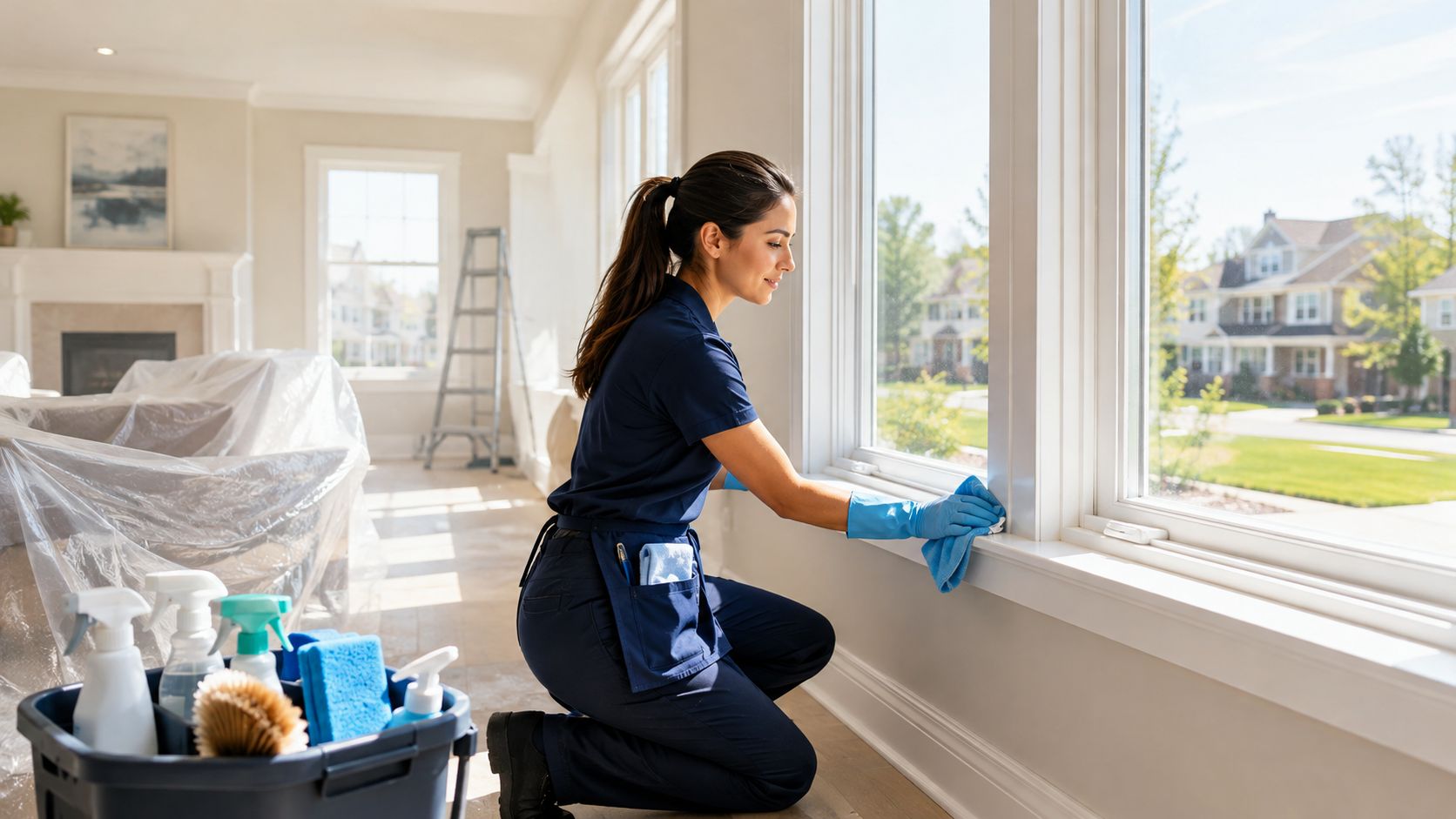
Professional post construction cleaning is a specialized closeout service for drywall dust, silica, grout haze, adhesive residue, paint overspray, and construction debris. Those materials behave differently from normal household soil. Standard maintenance tools may clear what sits on top, but they usually do not handle what settles into vents, seams, trim joints, window tracks, and finish edges.
Why regular cleaning misses construction mess
Construction dust is finer and more persistent than everyday dirt. It settles into trim joints, hangs on glass, and keeps resuspending when someone walks through the space or turns on the air. That is why a finish can look clean in a dim room and still look rough as soon as daylight comes through the windows.
The work also depends on timing. A space cannot be treated as finished if painters still need to touch up, flooring installers still need to return, or a final inspection has not happened yet. The cleanup has to support the handoff, not work against it.
Practical rule: if the cleaning crew is using the same playbook they would use for a routine deep clean, the job is probably under-scoped.
For homeowners in Massachusetts, that distinction matters even more when you are coordinating with tile installers, painters, or a move-in deadline. A real closeout clean is about making a newly renovated room look complete under daylight, overhead lighting, and the first round of normal use.
The hidden issues show up fast. Grout haze softens tile color, caulk smears catch the light around sinks and tubs, and HVAC dust keeps drifting out after the visible debris is gone. A crew that knows what to look for will check those details before the homeowner finds them later.
For a closer look at how fine particles settle across new finishes, see this guide to drywall dust cleaning. It helps explain why post construction cleanup takes more than a quick wipe, especially on recently painted walls and freshly installed trim.
A good crew also understands local conditions. In Massachusetts, older homes, tight remodel schedules, and mixed construction materials can make cleanup more complicated than it looks on paper. Sunny Day Pro and similar local providers have to account for that mix, especially when a job includes new cabinetry, stone counters, detailed millwork, and glass that shows every missed mark once the curtains open.
The Staged Cleaning Workflow From Debris Removal To Final Walkthrough
The best crews don't treat post-construction work like a one-time sweep. They move in stages, because construction dust keeps shifting long after the obvious debris is gone. That's why a rough clean, detail clean, and final clean are separate phases, not interchangeable labels.
Rough clean comes first
Rough clean is where the site becomes workable again. Crews remove large debris, haul out construction trash, and do the initial sweeping or vacuuming that clears the path for other trades. If a flooring installer needs to come back, or a painter needs a touch-up pass, this is the phase that makes that possible.
A solid rough clean also keeps the next trades from grinding dust and scraps deeper into finished surfaces. That matters in real jobs because every extra pass over the floor, baseboard, or threshold adds more cleanup later.
Detail clean handles the surfaces people actually notice
Once the active work is finished, detail clean takes over. Crews dust horizontal and vertical surfaces, wipe door frames, light switches, outlets, and fixtures, and remove paint overspray, adhesive residue, and caulk smears. These are the marks that make a remodel feel unfinished if they're left behind.
For homeowners who want a deeper dive into drywall dust behavior, the material on drywall dust cleaning is a useful reference point because drywall dust doesn't respond well to casual cleanup. It likes to move, settle, and reappear.
Final clean happens after everything else is done
The final clean belongs right before the owner walkthrough or move-in. By then, the goal is to catch the dust that resettled after earlier work, plus fingerprints, footprints, and minor debris introduced by late trade activity or inspections. That's the pass that makes the space feel handed off rather than merely vacated.
Clean high surfaces first, floors last. Gravity takes care of the rest, and the job should too.
A top-to-bottom sequence matters because dust falls. Crews should clean ceilings, fixtures, and wall details before they touch the floors, otherwise the floor becomes the catchall for everything that's still drifting down. In a proper workflow, cleaning and trade sequencing work together, not in isolation.

Pricing Drivers And Typical Timelines For Post Construction Projects
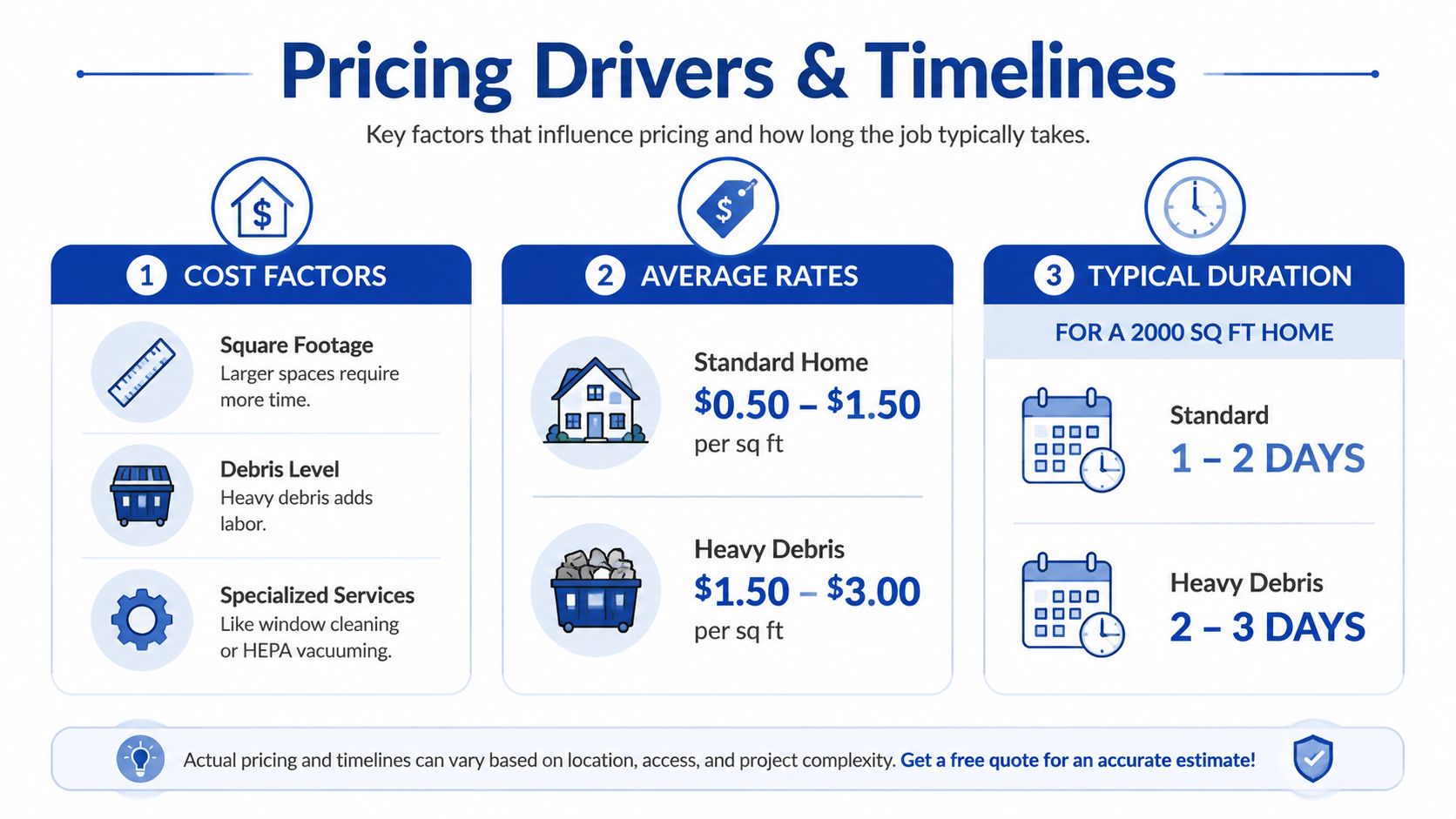
A construction closeout can look finished at first glance, then the light changes and every missed detail shows up. Grout haze on tile, caulk smears along trim, HVAC dust in returns, and adhesive residue near thresholds are the kinds of problems that separate a basic cleanup from professional post construction cleaning. Those details also explain why pricing and timing stay tied to the actual condition of the site, not just the size of the space.
The market continues to treat this work as a specialized service, with published estimates pointing to growth rather than a simple commodity model market report analytics. The exact market figures vary by source, so the practical takeaway is simpler. Owners, builders, and property managers keep paying for crews that can handle the dust, residue, and finish work that show up after the trades leave.
What drives the price up
Labor is the main cost driver. One industry cost guide says labor can account for around 90% or more of total cost, which fits what shows up on real jobs, because the work is detailed, repetitive, and slow compared with routine cleaning ServiceMaster Clean cost guide. Square footage matters, but finish detail, debris load, and how much hand work the job requires matter just as much.
Commercial pricing often falls around $0.15 to $0.75 per square foot, with some guides extending that to $0.15 to $0.80 per square foot ServiceMaster Clean cost guide. A 5,000-square-foot suite can land around $1,500 to $3,000 for a final clean, depending on the scope and the condition the crew walks into ServiceMaster Clean cost guide.
Residential jobs still scale with complexity
Residential pricing follows the same pattern, just at a smaller scale. One estimate puts the typical total at $274 to $707, with an average of $477, while another reports a national average range of $210 to $379 and notes that larger jobs can reach $592+ ServiceMaster Clean cost guide. Those numbers shift with debris level, finish sensitivity, and whether the site needs staged cleaning instead of one straight pass.
Timelines move the same way. A small, straightforward job can turn over quickly, but a remodel with tile, glass, paint touch-ups, and HVAC dust usually needs more than one visit. In Massachusetts, local weather, tighter move-in schedules, and the amount of dust pushed into ductwork during interior work can stretch the closeout plan, so a crew like Sunny Day Pro has to price the actual hand work and the return visits, not just the floor plan.
Budgeting takeaway: the cheapest quote usually assumes the least amount of hand work, and post-construction hand work is where the most intensive labor is.
Tile And Flooring Specific Cleanup Requirements
Generic cleanup guides often fall short. A floor can appear “mostly clean” yet still fail inspection because grout haze coats the tile, adhesive residue clings along the edge, or a small smear of caulk catches the light at an unflattering angle. These specific details are precisely why the finishing stage requires its own dedicated process.
Grout haze and residue need more than mopping
Grout haze isn't the same as dust. It's a film left behind on tile after installation, and it can make even a premium porcelain or ceramic floor look dull if it isn't removed properly. The same goes for paint overspray and construction adhesive, both of which need deliberate removal instead of a quick pass with a mop.
On marble and granite, the margin for error is even tighter. Those surfaces don't forgive abrasive treatment, so crews need the right pads, the right solution, and enough discipline to stop treating every floor like it's the same material.
For tile-specific care, the grout cleaning and sealing guide is worth reviewing if you're trying to understand why a floor can look unfinished even after the grout has cured. The visual difference often comes down to residue management, not just installation quality.
HEPA equipment is the right tool for fine dust
True HEPA filtration is a key technical benchmark because certified filters capture at least 99.97% of particles at 0.3 microns Green Planet Cleaning Services. That matters for fine drywall dust, silica, and renovation debris that standard sweeping can send back into the air.
Professional crews should rely on sealed HEPA vacuums and HEPA air scrubbers, not dry sweeping in enclosed rooms. When dust gets stirred up, it can circulate through HVAC returns and settle again on freshly finished surfaces. That's how a room can look clean at noon and dusty again by the time the sun moves across the floor.
Sequence still matters on finished floors
The clean should start above the floor line and end at the floor line. If crews vacuum or mop too early, they just create a landing zone for dust that still hasn't fallen from ceiling fixtures, trim, or vents. This is the difference between a surface that looks wiped down and a surface that stays clean after move-in.
For homeowners in Greater Boston, that's especially important on tile projects where finish quality shows every defect. A provider like Sunny Day Pro Services, which handles both tile installation and post-construction cleanup, is one example of the kind of local team that should understand how to protect new materials rather than treat them as interchangeable.
Safety Standards And Eco Friendly Cleaning Options
Construction closeouts carry more risk than normal housekeeping. Crews deal with sharp scraps, nails, chemical residue, ladders, and surfaces that aren't always fully finished yet. That's why training matters, and it's one reason to ask about credentials before anyone steps onto the site.
Safety training should be part of the conversation
One post-construction cleaning checklist states that crews should have OSHA 10 certification at minimum, with OSHA 30 required for supervisors and crew leads Construction Cleanup Specialist. That's a concrete threshold, not a nice-to-have.
Those certifications matter because cleanup teams often work around active trades, exposed hardware, and unstable debris. A crew that understands site safety is less likely to damage finishes, injure a worker, or miss a hazard that's still sitting in a corner.
Eco friendly products can still do the job
Families moving into a remodeled home usually want the dust gone without leaving behind harsh chemical smells or sticky residue. Eco-friendly products can fit that need if the crew knows how to pair them with the right process. The product matters, but so does the method.
The eco friendly cleaning products guide is a good starting point for homeowners who want lower-impact options without giving up results. In practice, the goal is simple, remove construction soil cleanly and leave the space ready for living, not just visually improved.
If a provider can't explain what they use on glass, tile, trim, and fixtures, they probably don't have a real post-construction system.
The best question isn't whether a company "uses green products." It's whether those products, along with the crew's equipment and workflow, can handle residue, dust, and finish marks without creating a second cleanup problem.
How To Choose A Reliable Local Post Construction Cleaning Provider
A low bid looks good until the dust starts showing itself again after move-in. That happens a lot on real closeouts, especially in Massachusetts homes where fine drywall dust settles into vents, trim joints, and floor edges long after the trades have left. The right provider is the one that understands those hidden details, not just the visible mess.
Compare scope before comparing price
A real estimate should split rough clean from final clean. If a quote gives one flat number and never says what gets removed, wiped, vacuumed, or revisited, the scope is too vague to trust. Massachusetts homeowners should also ask how the crew handles dust resettling, trade return visits, and touch-up timing after painters, flooring installers, or punch-list work are still in motion.
Ask these questions directly:
- Do you document rough clean and final clean separately?
- What HEPA equipment do you bring to a job?
- How do you handle HVAC vents, glass, grout haze, and adhesive residue?
- Do you use background-checked teams and offer a satisfaction guarantee?
- Can you show recent local project references?
Look for proof, not promises
The strongest providers speak in process terms. They can explain how they coordinate with painters, flooring installers, and final walkthrough deadlines, and they know what happens if dust keeps settling after the first pass. That matters on closeouts where grout haze, caulk smears, and HVAC dust only become obvious under normal lighting after the unit is occupied.
A local option worth considering in Massachusetts is Sunny Day Pro Services, which offers detailed post-construction cleaning along with tile installation services. That combination matters because crews that work around new flooring and finish surfaces usually understand where residue hides, and they are less likely to scratch, smear, or leave a finish looking clean only from a distance.
Red flag: if the provider won't say how they clean vents, glass, and tile separately, they're not quoting the actual job.
For homeowners in Wayland, Newton, Needham, Wellesley, Weston, and nearby towns, the better fit is usually the company that can explain the sequence, show the equipment, and commit to a final walkthrough that checks the room under real light. Ask how they handle baseboards, switch plates, and the dust line that appears where cabinets meet the wall. Those are the details that separate a real closeout clean from a surface-level pass.
Final Walkthrough Checklist And Frequently Asked Questions
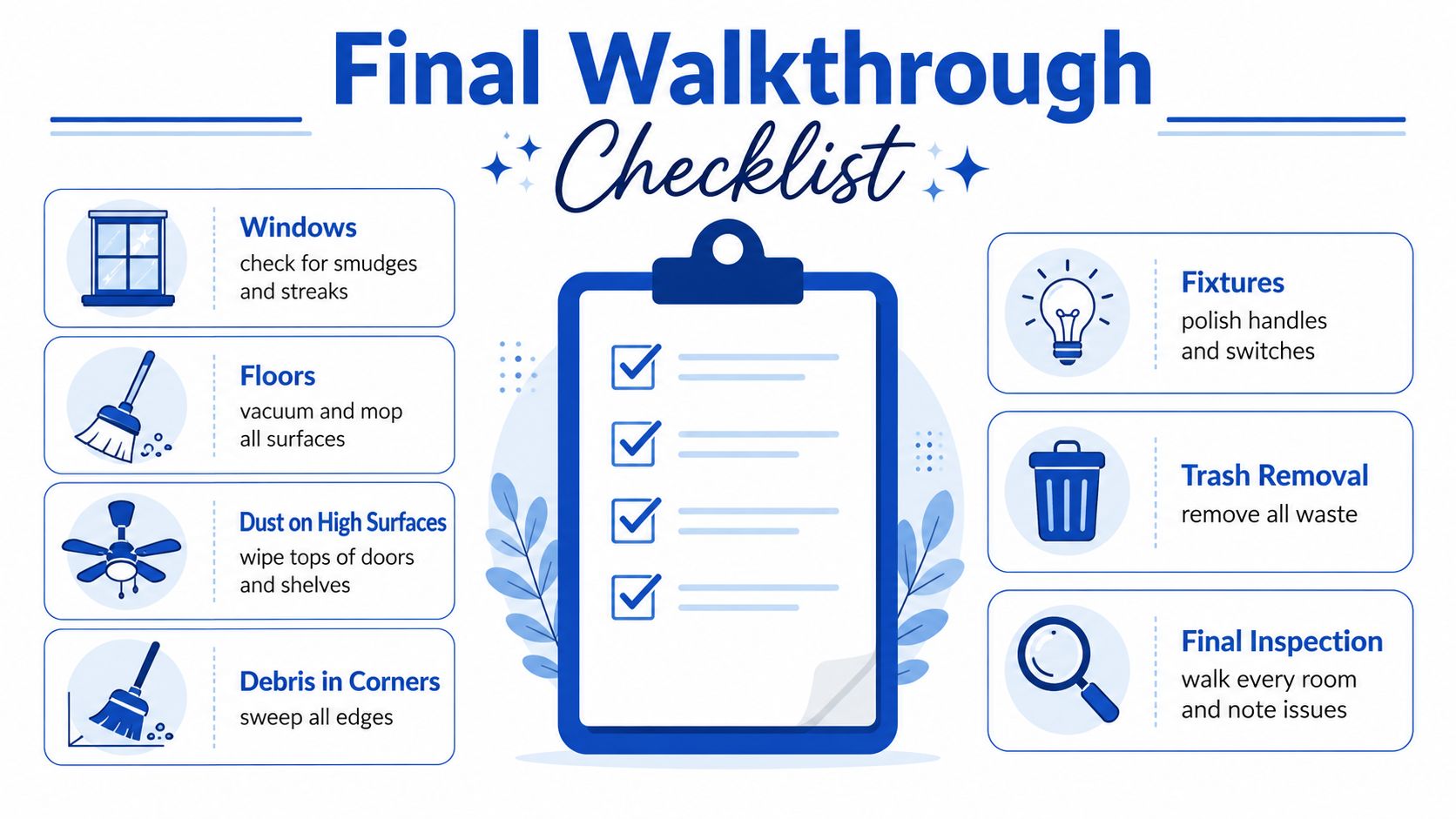
A proper final walkthrough catches the things people miss when they're relieved the project is over. Use this as a closeout check before you sign off on a cleanup job:
- Windows and glass, no smudges, tape residue, or streaks.
- Floors, fully vacuumed and mopped, including edges and corners.
- High surfaces, tops of doors, shelves, fixtures, and trim free of dust.
- Tile and grout, no haze, residue, or visible film.
- Fixtures and switches, wiped and polished.
- HVAC vents, clean with no visible dust blowout.
- Trash and debris, removed from the site.
- Walkthrough pass, every room checked under normal lighting.
FAQ
Should I try to do post-construction cleaning myself?
You can handle light debris in small areas, but professional work is a better fit when you're dealing with fine dust, new tile, vents, or a full home renovation. The difference shows up in residue, not just in visible dirt.
Why does staging matter so much?
Because construction dust keeps moving. A single-pass clean usually misses the dust that settles after painters, flooring installers, or inspectors have been through.
What if the final walkthrough still shows missed spots?
Point them out room by room before sign-off. A proper closeout should include a touch-up pass, especially if dust has resettled after the main detail clean.
How many times does a space need to be cleaned before it's really move-in ready?
That depends on the job, but a rough clean, detail clean, and final clean are the standard sequence when the project has real dust, residue, or late-stage trade work.
If you're planning a renovation or finishing a new build in Massachusetts, Sunny Day Pro Services can handle post-construction cleanup with the same attention to detail they bring to tile and flooring work. Visit Sunny Day Pro Services to request a quote and line up a cleanup plan that leaves the space ready for move-in.

