
Real Estate Cleaning Services: The Complete 2026 Guide
Learn how real estate cleaning services work, what they include, typical pricing, and how to hire a pro. Practical guide for sellers, agents, and homeowners.

You're standing in a vacant house that closed yesterday, with a photographer coming in two days and a stager already texting about access. The floors look decent from the doorway, but the windows catch every smudge, the kitchen still has construction dust in the corners, and somebody has to decide whether this job is a quick photo-ready wipe-down or a full turnover with add-ons. That's where real estate cleaning services stop being generic housekeeping and start being a scope decision.
Get the scope wrong, and you lose time, money, and sometimes the listing window. Get it right, and the property is ready for showings, move-in, or handoff without a scramble.
Table of Contents
What Real Estate Cleaning Services Actually Cover
A listing agent in Wayland doesn't need a lecture on cleaning. She needs a property ready before the photographer shows up, and she needs the job done without guesswork. That's the core point of real estate cleaning services, they're scoped, time-boxed jobs tied to a transaction, not a weekly housekeeping visit with extra ambition.
Know the moment first, then book the service
The job changes depending on where the property sits in the process. Pre-listing prep is for making a home show well. Move-out cleaning is for the last tenant or owner leaving the space. Move-in cleaning resets a home before the next person brings in furniture. Post-construction cleanup handles the mess after trades are done, not while they're still cutting trim and sanding drywall.
Recurring maid service is a different product. It's built for occupied homes on a schedule, not for vacant properties, rental turnovers, or handoffs under deadline. If you book the wrong one, you end up paying for the wrong scope and waiting for the wrong crew.
Practical rule: if the property is vacant, newly renovated, or being staged, ask for the turnover scope in writing. Don't assume a standard house clean will cover that job.
Match the property type to the work
Occupied homes usually need lighter, faster work because the family is still living there. Vacant homes need more attention on visible surfaces, fixtures, and presentation. Renovated homes are a different animal, because dust and residue settle everywhere and can come back fast if the job is sequenced badly.
| Service Type | Best For | Typical Trigger |
|---|---|---|
| Pre-listing cleaning | Sellers and agents preparing photos and showings | Listing prep before marketing starts |
| Move-out cleaning | Vacating tenants or owners | End of occupancy, final walk-through |
| Move-in cleaning | New occupants before unpacking | Keys received, empty property access |
| Post-construction cleanup | Renovated homes and remodels | Trades finished, punch list closing out |
| Recurring rental turnover | Property managers and landlords | Tenant changeover between leases |
The market tells you this isn't a niche category. The global cleaning services market was valued at USD 442.1 billion in 2025 and is projected to reach USD 770.8 billion by 2033, with a 7.3% CAGR from 2026 to 2033, and North America held 31.8% of revenue in 2025, according to Grand View Research. That's the scale behind why transaction cleaning has become its own discipline.
Service Types and the Moments They Fit
Many talk about cleaning packages as if they're interchangeable. They're not. The right choice depends on whether the property is being sold, handed off, lived in, or finished after a remodel.
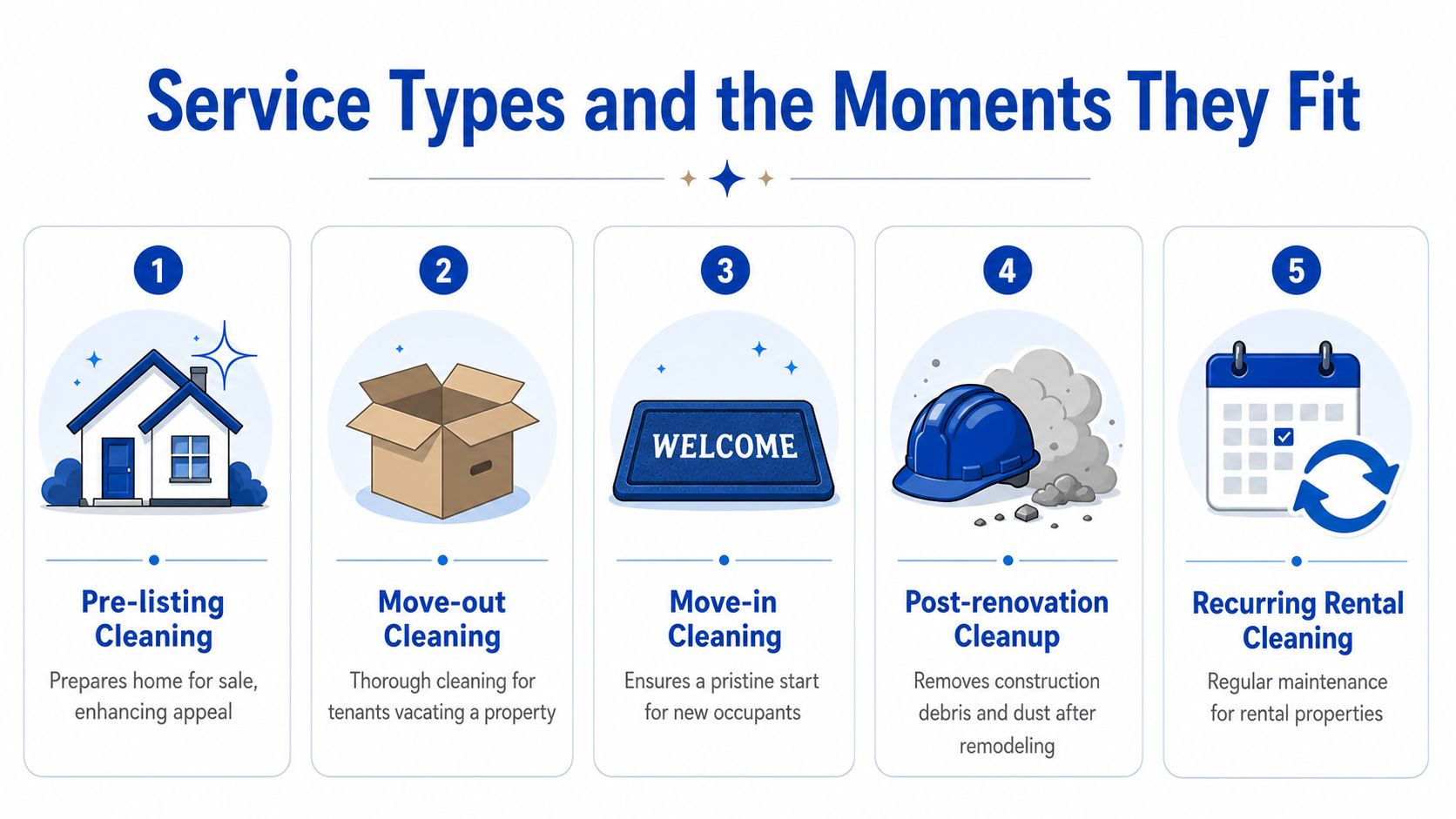
The five scopes that show up again and again
Pre-listing cleaning is fast, visual work. It's about making kitchens, baths, floors, and fixtures look sharp for photos and showings, not rebuilding a lived-in home from scratch. Sellers and agents book it when the property needs to look clean on camera and inviting in person.
Move-out cleaning is the deeper reset. This is the one tied to vacating a property and getting it back to a clean handoff standard. Landlords, tenants, and owners care about different details here, but the core idea is the same, the place should be ready for the next person, not just good enough for a quick glance.
Move-in cleaning serves the incoming occupant. It matters even when the previous owner cleaned, because new residents want a fresh baseline before boxes arrive. That's especially true in kitchens and baths, where unseen grime and old residue are hard to ignore once the family settles in.
Renovation and turnover work need different timing
Post-renovation cleanup is its own category because construction dust behaves differently from normal soil. Adhesive residue, caulk, and fine debris need the right sequence and tools, and the work usually happens after the trades finish, not before. For a useful checklist of what belongs in that phase, this post-construction cleaning checklist is a practical companion.
Recurring rental turnover sits between move-out and move-in. Property managers use it to keep units ready on a predictable cadence, which is a very different job from a one-time deep clean. The main value is reliability, because a late turnover can hold up marketing, photography, or lease start dates.
For real estate, the bigger question isn't “what's the most thorough clean?” It's “what moment are you in, and what result do you need by that deadline?” That's the decision that prevents scope creep.
Scope clarity beats overselling. A vacant listing that needs to be photo-ready doesn't always need every cabinet scrubbed twice. It needs the right rooms, the right surfaces, and the right timing.
The residential cleaning segment in the U.S. reached USD 18.8 billion in industry revenue and is projected to grow at 3.2% CAGR, while the broader janitorial and building-cleaning workforce was about 2.4 million jobs in 2024 with a median hourly wage of USD 17.27 in May 2024, according to IBISWorld. That scale is why these service types are standard, not specialty oddities.
How a Turnover or Post-Construction Job Is Sequenced
A bad sequence wastes labor. A good sequence keeps dust from coming back after you've already cleaned it off. That's why turnover and renovation jobs should be handled in phases, not as one big wipe-down.
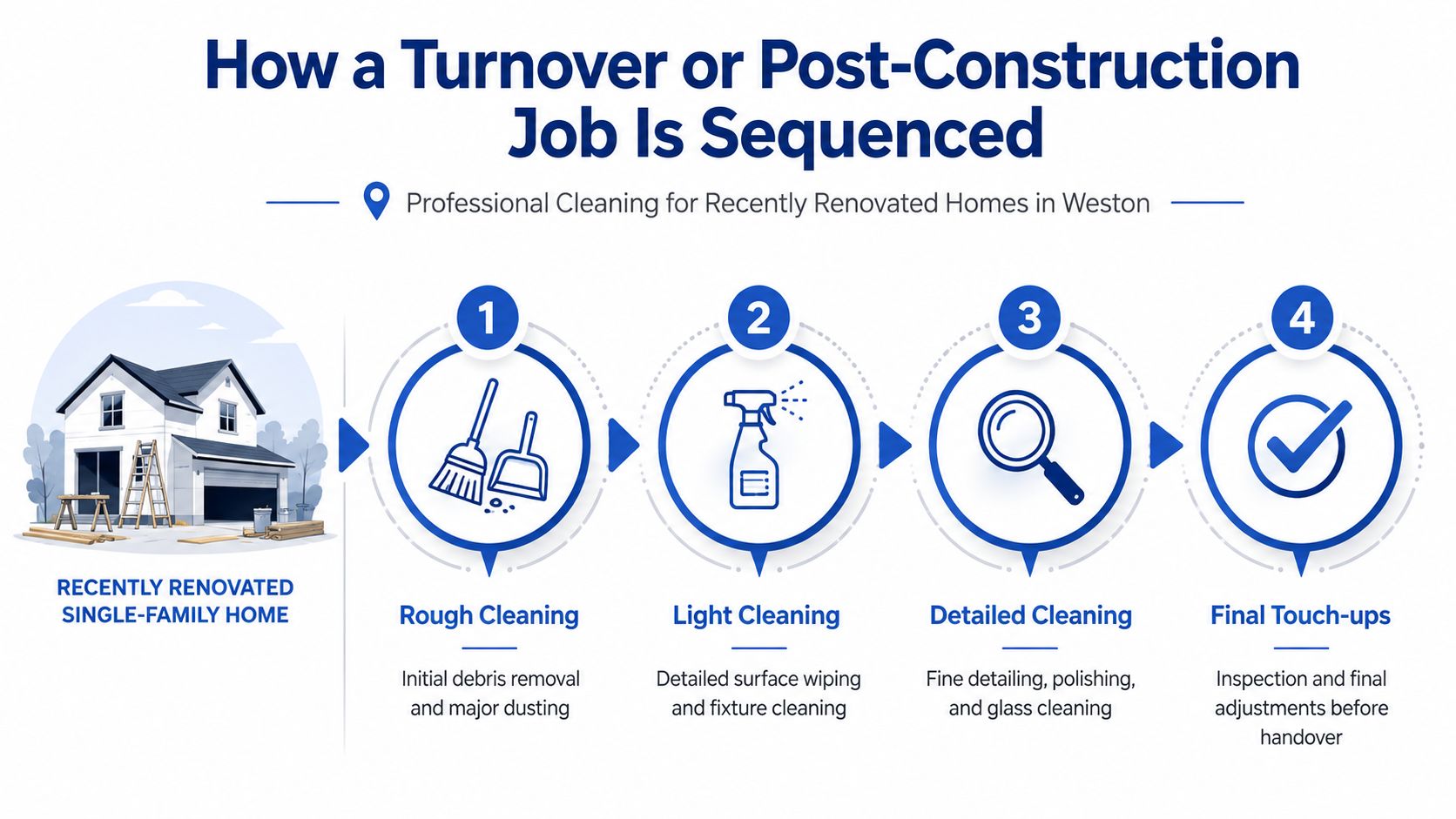
Rough clean comes first
Rough cleaning happens while the project is still finishing. Crews remove larger debris, construction dust, and the obvious mess left behind by trades. If you skip this stage, you end up polishing surfaces that are about to get covered again.
Final cleaning comes after the punch list is close to done and before photography or occupancy. That's when fingerprints, adhesive residue, caulk overspray, and fine dust get removed from finished surfaces. It's the phase that makes the home look like a finished property instead of an active jobsite.
Touch-up cleaning is the last pass. It catches scuff marks, stager debris, and the fingerprints that show up the minute multiple people start walking through the property. If a photographer, stager, or move-in crew is still coming through, this pass matters.
Don't let later work ruin earlier cleaning
People burn money. If painters, electricians, or installers keep working after the final clean, the place gets dirty again. Then you pay for rework. A sequenced job protects both the budget and the timeline.
Pre-1978 buildings can bring lead-safe concerns into the picture during post-construction cleanup, so the crew needs to know what they're walking into before they start. That's not a place for guesswork.
Sequence first, detail second. A beautiful final clean means nothing if another trade walks in with sawdust and shoe tracks right after it.
If you're trying to coordinate a renovation handoff, the timing has to line up with the final punch list, not the contractor's wishful estimate. The best crews clean at the right stage, then get out of the way.
Sample Checklists for Showings and Turnovers
The easiest way to avoid surprise charges is to ask what's standard and what's extra before the quote is written. Most disputes happen because one side assumed interior glass, appliance interiors, or cabinet interiors were included by default, and the other side treated them as add-ons.
Photo-ready pre-listing checklist
| Area | Default Scope | Usually an Add-On |
|---|---|---|
| Kitchen surfaces | Wipe counters, sinks, and visible fronts | Appliance interiors, cabinet interiors |
| Bathrooms | Clean toilet, vanity, mirror, and shower surfaces | Deep grout work, specialty stain removal |
| Living areas | Dust accessible surfaces and vacuum or mop floors | Inside vents, detailed fixture work |
| Windows | Exterior glass wipe if included in scope | Interior windows, full window detailing |
| Entry points | Main visible touch areas | Exterior touchpoints and doors |
Full move-out turnover checklist
| Area | Default Scope | Usually an Add-On |
|---|---|---|
| Kitchen | Cabinets exteriors, counters, sink, floors | Appliance interiors, cabinet interiors, heavy degreasing |
| Baths | Fixtures, mirrors, tubs, toilets | Scale removal, deep detail on grout and tile |
| Floors | Vacuuming and mopping | Carpet cleaning, upholstery cleaning |
| Glass | Accessible visible glass | Interior windows, track cleaning, full window detailing |
| Outside handoff points | Basic entry presentation | Exterior touchpoints, porch details, garage-facing areas |
The move-out conversation gets easier if you know what you want before anyone climbs the stairs with a quote sheet. If you're comparing a tenant turnover to a full move, this move-related cleaning guide can help you frame the scope more clearly.
Coordinate the cleaning after the stager is done, but before the photographer arrives. If contractors still have tools on site, the cleaning crew ends up protecting the job instead of finishing it. That's not efficient, and it usually shows in the final walkthrough.
Pricing Ranges and What Drives the Cost
Price comes down to time, condition, and scope. If a provider quotes without asking about those three things, they are guessing or padding the job.
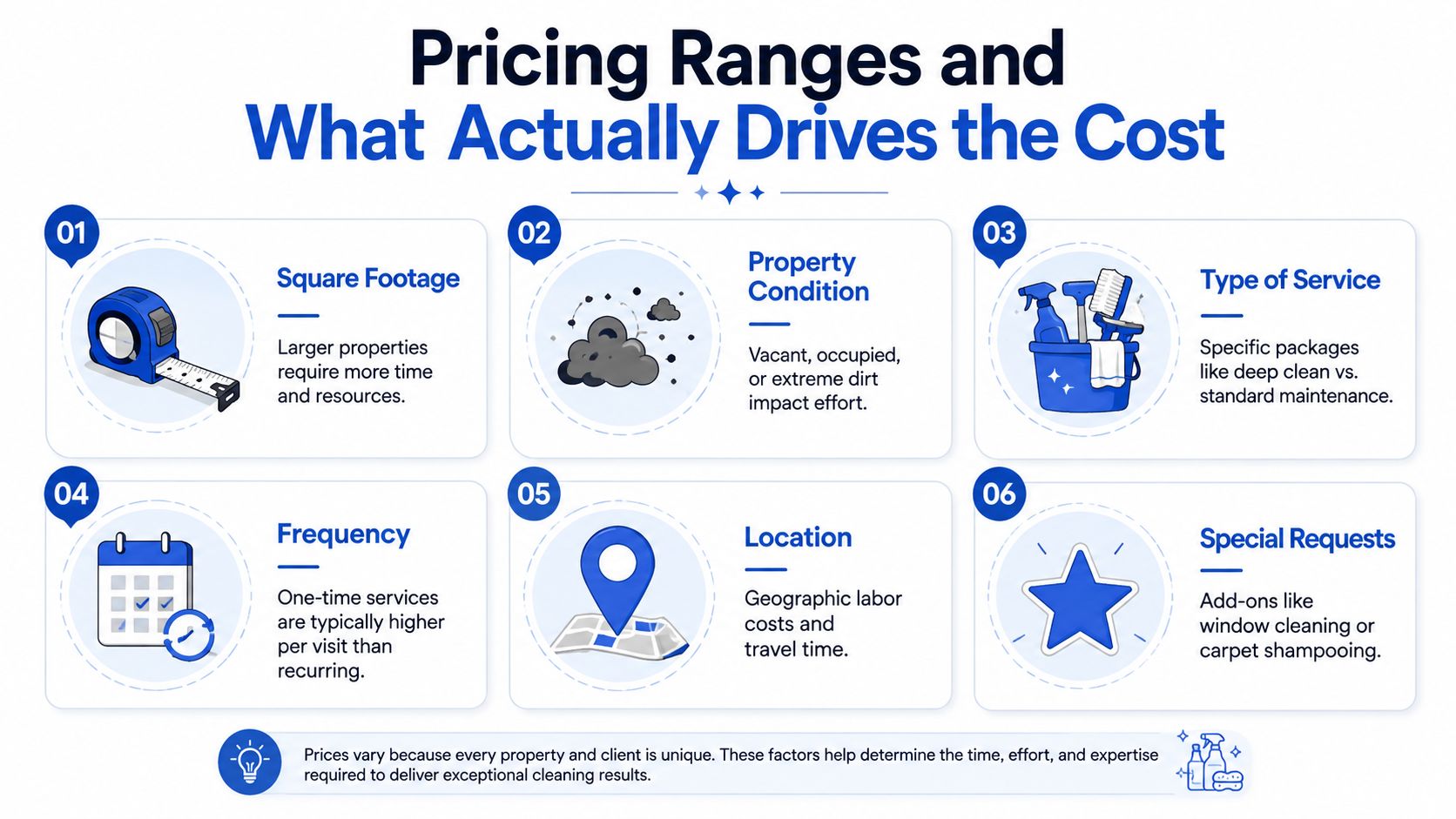
What changes the quote first
Square footage drives labor and supply use. Bigger properties take longer, and they usually need more product, more passes, and more time on details. Property condition matters even more, because a vacant home, an occupied home, and a post-renovation property demand very different levels of work. Type of service changes the whole scope, since a standard maintenance visit is not the same as a deep turnover or a post-construction clean.
Frequency changes the pricing conversation too. One-time services usually cost more per visit than recurring maintenance, because there is more buildup to remove and less routine upkeep to build on. Location affects labor and travel time. Special requests like window cleaning or carpet shampooing push the quote higher again because they add separate work and equipment.
Compare quotes on the same scope
Do not compare two quotes unless the scope matches. If one company includes interior windows and appliance interiors while another treats those as add-ons, the numbers are telling you different stories. Carpet cleaning and upholstery cleaning work the same way. Ask for a written scope that clearly separates default tasks from extra charges.
Here is the red flag list I would watch for:
- Too Cheap To Be Real: If a quote is vague and far below the others, it usually means the scope is thin.
- Overbuilt Scope: If every surface is priced like a premium extra, you are paying for line-item inflation.
- No Timeline Detail: If they cannot explain how the work fits the handoff date, the quote is not useful.
Ask for the scope before you ask for the discount. Once the room list is clear, the pricing conversation gets honest fast.
A home with hardwood and tile often cleans differently than one with a lot of carpet, because the labor and equipment mix changes. That is one of the simplest reasons two houses that look similar on paper end up in very different ranges. The cleaner is pricing the work, not the address.
What to Expect From a Professional Crew
A professional crew should act like a restaurant kitchen, not a weekend cleanup crew. Everyone knows the order, the scope is clear, and specialty work stays separate from routine work. That's the standard I expect in real estate cleaning services.
Standards, guarantees, and specialty work
Green Seal's GS-49 sets criteria for residential cleaning programs, and it explicitly excludes specialized work like restorative deep carpet cleaning, upholstery cleaning, and mold remediation, according to Green Seal. That matters because a credible provider doesn't blur those lines. They separate routine cleaning from specialty remediation and use the right equipment for each.
A good walkthrough should cover the room list, the add-ons, the timeline, and the final handoff standard. If the company offers eco-friendly products, that's useful for households with kids or pets, especially in a freshly staged home where strong residue is a bad look. A written satisfaction guarantee matters too, but it should say what gets corrected and how fast.
Background-checked, trained teams matter because the crew is working inside someone's home, often on a deadline. You want clear communication, a specific arrival window, and a person who can tell you what's included without spinning up sales language.
What matters most in a vacant listing
For vacant, recently renovated, or staged properties, the deepest clean isn't always the smartest buy. Scope clarity and turnaround reliability protect the listing timeline better than extra polishing nobody asked for. If the property needs to hit the market tomorrow, that wins.
Sunny Day Pro Services is one option that offers deep cleaning and post-construction cleaning for homes and renovation handoffs in Massachusetts, alongside recurring maintenance and move-related service. That's the kind of range you want from a crew that understands transaction timing instead of treating every house like the same checklist.
Hiring Locally in Massachusetts and Booking With Confidence
If you're in Wayland, Newton, Needham, Wellesley, Weston, or a nearby town, hiring locally saves headaches. The crew gets there faster, knows the pace of the market, and can usually handle short-notice access better than a generic out-of-area operator.
Use a short vetting sequence
Start with Massachusetts registration and insurance. Then ask about background checks and crew training, because people will be working inside an occupied or newly vacated home. After that, ask for a written scope that lists defaults and add-ons separately so you can compare quotes fairly.
Check reviews that mention listing prep, move-out cleaning, or turnover work, not just broad “they were nice” comments. Those reviews tell you how the company performs under deadline. If your timeline is tight, confirm scheduling flexibility before you book.
The U.S. janitorial and building-cleaning workforce was about 2.4 million jobs in 2024, with a median hourly wage of USD 17.27 in May 2024, according to industry labor data. That kind of scale means you've got options, but it also means process and trust matter more than ever.
Good local crews don't hide the scope. They spell out what's standard, what costs extra, and when they can get the property ready.
If you're still comparing providers, this local cleaning search guide is useful for checking what to ask before you hand over the keys. A clear quote beats a cheap surprise every time.
Sunny Day Pro Services works with homeowners, agents, and property managers across those Massachusetts towns, and the company offers a satisfaction guarantee, so if something isn't right, it gets fixed. If you need recurring maintenance, move-in or move-out service, deep cleaning, or post-construction cleanup, ask for a fast quote and get the timeline locked down early.
Questions Homeowners and Agents Ask Most
Does real estate cleaning include carpet and windows? Not always. Interior windows, carpet cleaning, and upholstery are often add-ons, so get those listed in writing before you book.
How far in advance should pre-listing cleaning be scheduled before photos? Book it after the final clutter is out and before the photographer arrives, with enough time for touch-ups if the stager changes anything.
Do I still need move-in cleaning if the previous owner paid for move-out cleaning? Yes, if you want a true fresh start. Move-out and move-in are different scopes, and the new occupant usually cares about different details.
How is post-construction cleanup priced if the renovation isn't fully done? It should be tied to phase and access, not just square footage. If trades are still coming in and out, the crew may need a rough clean first, then a final clean later.
If you want the job handled without scope confusion, Sunny Day Pro Services can cover recurring cleaning, move-in and move-out service, deep cleaning, and post-construction cleanup for homes in Wayland and the surrounding Massachusetts towns. Visit Sunny Day Pro Services to request a fast quote and get the right cleaning scope on the calendar before your listing, closing, or renovation handoff slips.

