
10 Tile Installation Patterns for Any Room
Compare 10 tile installation patterns by style, cost, complexity, room, maintenance, and when to hire Sunny Day Pro Services.
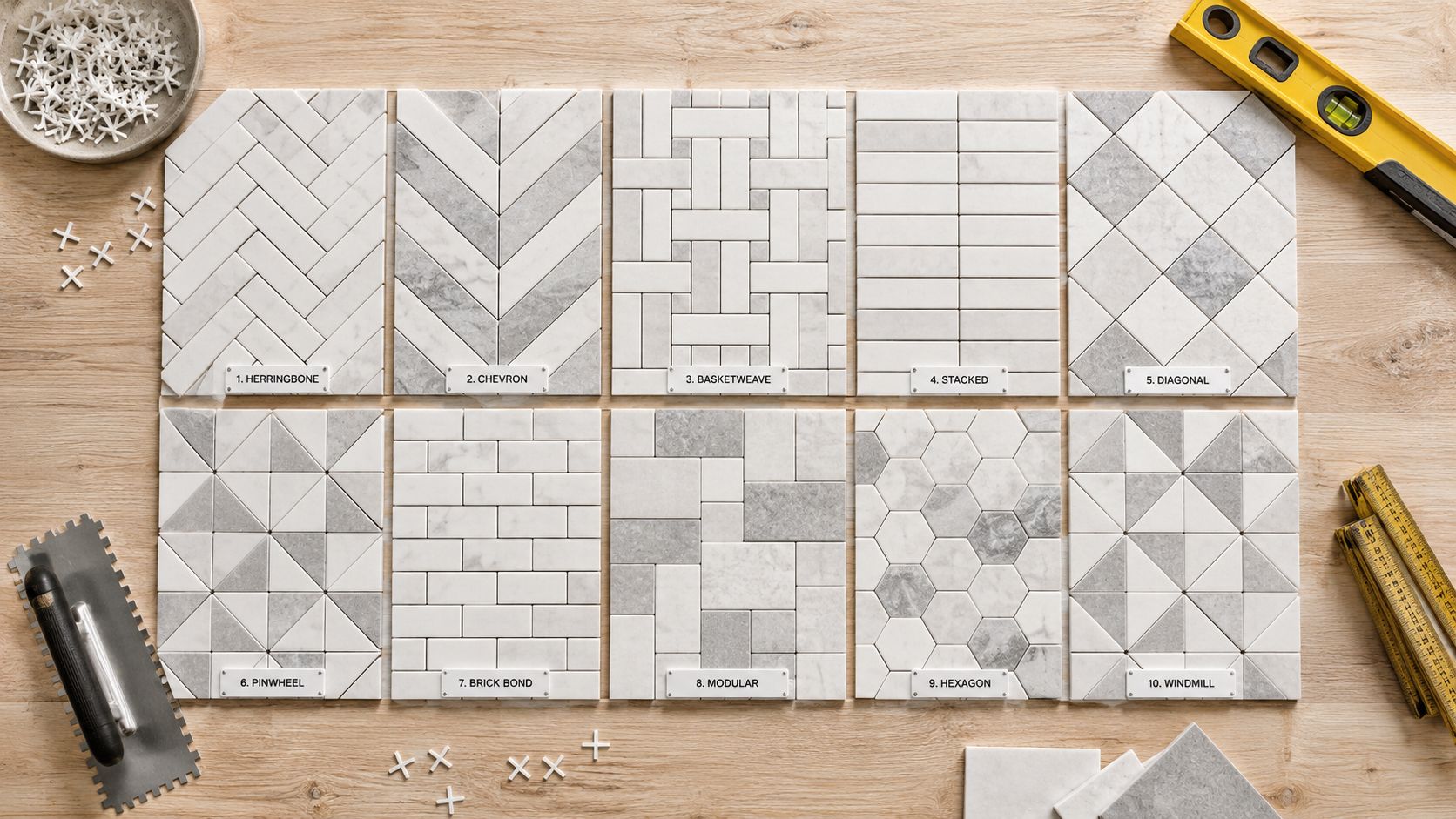
The best-looking tile pattern isn't automatically the best choice for your home. A layout that looks impressive in a showroom can create excessive cuts, expose an uneven floor, demand tighter grout control, or make routine cleaning more tedious. Room proportions, tile format, substrate condition, grout visibility, material waste, labor, and the design style you want all belong in the decision.
Tile installation patterns describe how individual tiles are arranged across a floor, wall, backsplash, shower, entryway, or other surface. The same material can feel traditional in a running bond, architectural in a grid, or highly decorative in herringbone, chevron, or Versailles layouts. These tile layout ideas also affect how a room reads. Straight lines can visually organize a space, while diagonal movement can soften awkward proportions and draw attention through a room.
This visual roundup compares 10 tile patterns for floors and walls using the same homeowner questions: What does it look like? Which tile and room suit it? How difficult is installation? How much cutting and waste should you expect? How will grout and maintenance affect daily life? And when does professional installation become the safer value?
Complex layouts benefit from an experienced installer, especially when the room has uneven walls, multiple doorways, large-format tile, natural stone, or highly visible transitions. Use the comparisons below to narrow your direction before requesting a quote.
Table of Contents
1. Straight Stack Running Bond Pattern
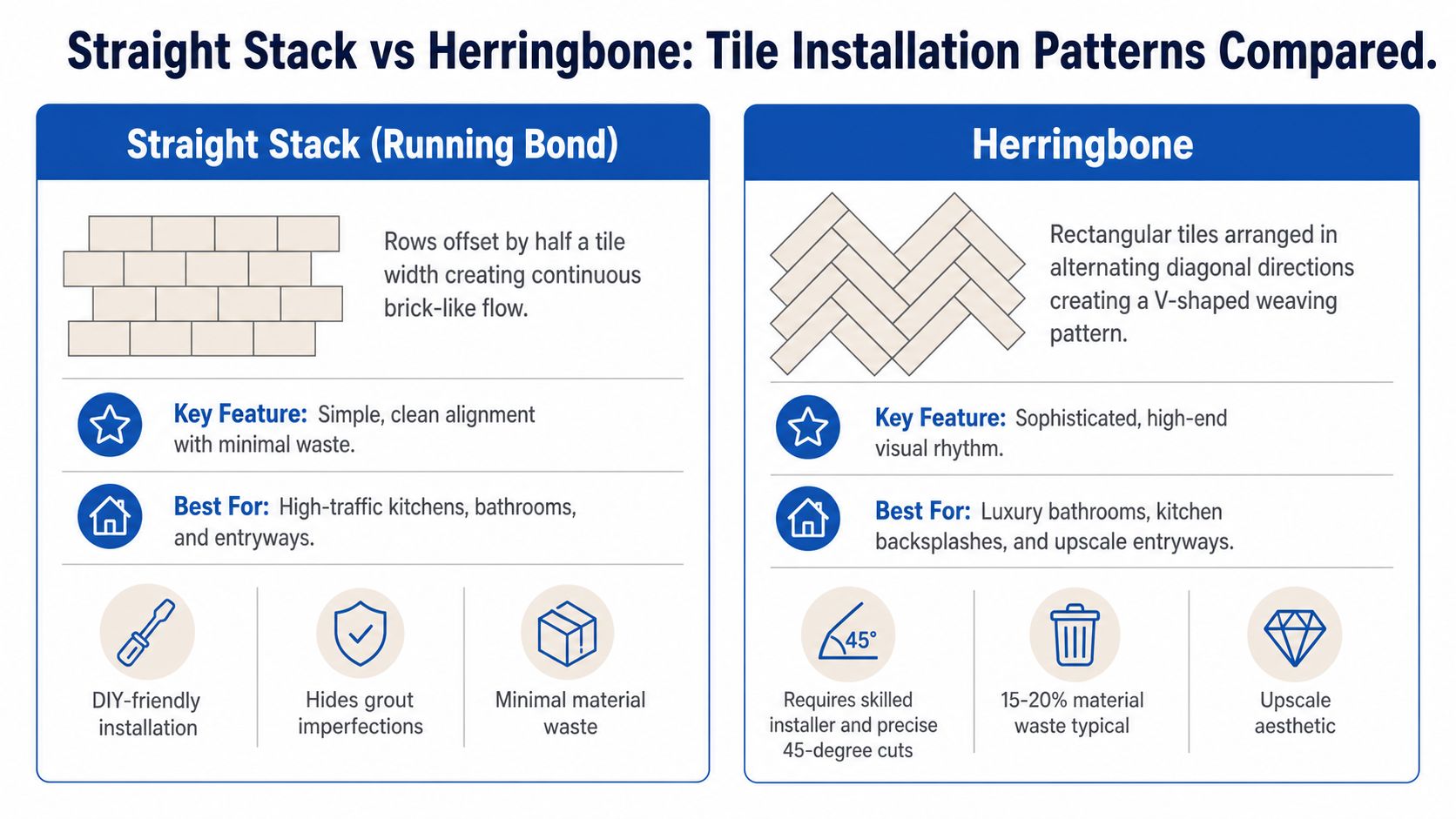
Straight stack, often called running bond, gives a room a familiar brick-like rhythm. Rectangular tiles are laid in horizontal or vertical rows, with each row shifted from the one above it. The eye follows the repeated offset, making this one of the most versatile tile installation patterns for backsplashes, bathroom floors, and feature walls.
Classic subway tile in a farmhouse kitchen is an obvious example, but the pattern also works on contemporary bathroom floors and entryway features in Newton or Wellesley renovations. Restaurant and café kitchen walls often use the same practical arrangement because the pattern is easy to understand, repair, and extend.
The layout is forgiving compared with more intricate designs, but it still needs accurate planning. A centerline and level reference help keep the visible edge cuts balanced. Consistent spacers matter because irregular joints can make the offset look accidental rather than intentional.
What works and what doesn't
Use a straight stack when you want a continuous surface without excessive visual activity. It suits ceramic, porcelain, and many rectangular stone tiles. Dark grout can conceal everyday dirt, but it also makes every line more prominent. Light grout creates a quieter appearance while showing discoloration sooner.
Practical rule: Set the pattern from a reliable centerline, not from the first wall you reach. Walls and corners are rarely perfectly square.
For floor installations, the mortar bed must match the tile and substrate requirements. Wall work needs careful coverage without allowing thinset to squeeze into the joints. A quality cutter helps preserve clean edge pieces so the pattern remains aligned at corners and openings. Straight layouts are among the most material-efficient options, typically requiring only 5–10% extra tile according to tile pattern planning guidance.
2. Herringbone Pattern
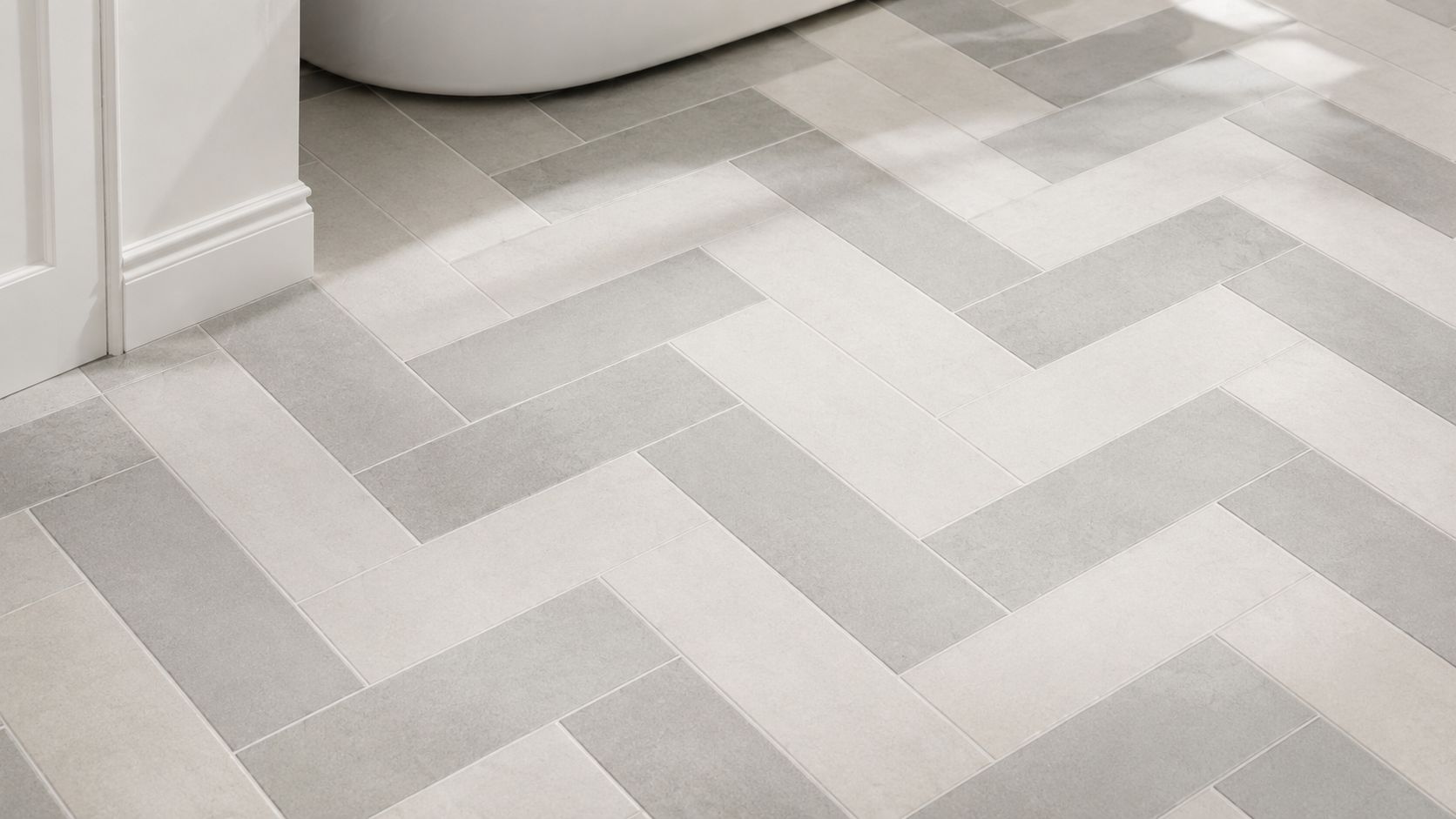
Herringbone creates a woven V-shaped movement by placing rectangular tiles in alternating directions. The pattern can make a bathroom floor feel designed rather than merely covered, which explains its popularity in luxury kitchens, primary bathrooms, entryways, and spa-inspired spaces.
The visual effect depends heavily on scale. Smaller tile creates a busier surface with more grout intersections. Larger rectangular pieces produce a calmer, contemporary interpretation, but they also expose substrate problems and cutting errors more readily. In Wayland, Wellesley, and Newton remodels, herringbone often works best as a feature floor, backsplash, or defined zone rather than an automatic choice for every room.
Layout accuracy controls the result
Begin with a centered layout and establish precise reference lines before spreading mortar. A laser level or string line can keep the repeated angles from drifting. Dry-lay enough of the pattern to check how the points meet walls, cabinets, thresholds, and plumbing fixtures.
Herringbone also demands more cutting than a straight layout. One guide estimates 15–20% additional material for herringbone, while broader pattern guidance places diagonal and herringbone layouts in a higher-waste range because of angled cuts and perimeter offcuts. Build that overage into the estimate before ordering.
The substrate must be flat and stable. A dip that might disappear beneath a simple grid can become obvious as the diagonal pieces change direction. If you're comparing this pattern with a simpler installation, Sunny Day Pro Services' guide to tile installation steps provides useful context for planning, setting, grouting, and finishing.
3. Chevron Pattern
Chevron resembles herringbone at first glance, but its tile ends are cut so they meet in continuous points. The result is a more deliberate arrow or zigzag, with every line directing attention along the same path. That geometry suits a modern kitchen floor, a bathroom feature wall, or a statement backsplash in white, gray, beige, or veined porcelain.
A chevron layout can give an open-concept Newton or Wayland home a strong visual axis. It can also define a kitchen island or entryway without relying on a contrasting color. The pattern is less forgiving than it looks, though. Slight differences in angle, tile length, or joint width can interrupt the continuous points.
Plan the points before setting tile
A full-size paper mockup is worth the effort. It shows whether the arrows center on the room, align with an island, or terminate awkwardly at a doorway. A laser level or carefully secured string guide establishes the main direction, while a wet saw with a precision fence helps maintain repeatable cuts.
Chevron typically consumes 18–25% extra material, according to installation guidance on herringbone and chevron waste. The same guide identifies chevron as a V-shaped arrangement made by cutting tiles at 45-degree angles so the pieces meet continuously. That cutting requirement affects both ordering and labor.
The pattern should be judged from the room's main sightline, not only from a close-up sample.
Larger tiles create a bolder, calmer statement, while smaller formats increase movement and grout visibility. Professional installation becomes the safer value when the room has several corners, a prominent center axis, natural stone, or expensive oversized pieces. A poorly centered chevron is difficult to disguise after the mortar cures.
4. Basketweave Pattern
Basketweave gives tile a woven appearance by alternating the direction of rectangular or square pieces in repeating groups. It has more texture than a plain grid but usually feels less forceful than herringbone. That balance makes it useful for traditional bathrooms, powder rooms, mudrooms, and transitional entryways.
A Wellesley colonial bathroom might pair a light field tile with a darker accent to emphasize the weave. In a Needham powder room, a subtle two-tone version can add interest without competing with a patterned wallpaper or detailed vanity. Natural stone, porcelain, and ceramic can all work, provided the dimensions repeat accurately.
The repeated block must stay square
The visual unit may use a group of tiles arranged in alternating directions, so a small alignment error can multiply across the room. Mark the starting point and confirm each rotation before spreading mortar. A laser level helps prevent the design from slowly drifting across a long floor or backsplash.
Use consistent spacers so the joints remain uniform. A narrow joint keeps the basketweave refined, while a wider joint emphasizes each block and may require more cleaning. Neutral grout tends to soften the pattern. Contrasting grout makes the weave easier to read but highlights every variation.
Basketweave can be a practical compromise when a homeowner wants a decorative layout without the continuous angled cuts of chevron. It still needs a level substrate, balanced edge cuts, and a dry layout. Professional help is sensible when the pattern must wrap around a room, continue through a doorway, or coordinate with borders and drains.
5. Grid Straight Pattern
The grid, also called straight lay, places tiles in aligned horizontal and vertical rows. It's the cleanest choice for minimalist bathrooms, utility areas, commercial kitchens, and open-concept rooms where furniture, cabinetry, or architectural details already provide visual interest.
Large-format tile in a Wayland living area can create broad planes with restrained grout lines. A small square tile in a service area offers a different look but follows the same installation logic. The pattern doesn't hide poor preparation, however. Every grout line acts like a ruler, so a wavering wall or uneven substrate becomes easier to notice.
Where the grid earns its reputation
A carefully established centerline keeps edge cuts balanced. A quality laser level is particularly useful across long walls or open floors. Spacers maintain the joint width, while a deliberate grout color controls how strongly the grid reads. Light grout emphasizes the geometry. Dark grout reduces the visual brightness of the joints but makes the pattern more graphic.
The grid is often the best starting point for a budget-conscious or schedule-sensitive project because it uses one repeating orientation and usually minimizes cutting. It's also easier to repair. A replacement tile can follow the existing rows without recreating a complex sequence.
Clean grout residue promptly rather than allowing it to harden on the tile face. This matters especially with textured porcelain, matte surfaces, and stone with open pores. If the room has an uneven floor, the right solution is substrate correction before tile setting, not trying to force aligned tile over the problem.
6. Diagonal 45-Degree Angle Pattern
A diagonal layout turns square or rectangular tile so the main lines run at an angle across the room. It can make a compact bathroom, irregular entryway, or open kitchen feel more expansive because the eye travels across the surface rather than stopping at parallel wall lines.
The pattern offers some of the visual movement of herringbone without requiring every piece to change direction. It works well with larger square tile in upscale Wellesley or Weston renovations, dramatic entryways, and contemporary kitchens where a standard grid feels too static.
Cutting determines the finish
Set the room's center point and establish the angle with a laser level. Perimeter pieces will need careful measurement, and pre-cutting them can reduce interruptions during installation. A wet saw with a precise fence produces cleaner diagonal edges than improvised scoring and snapping.
Diagonal layouts often require 20–30% additional material, according to tile pattern waste guidance. The source also notes that straight or diagonal arrangements can help small or crooked spaces appear larger, but the visual benefit doesn't eliminate the cost of perimeter cuts.
A diagonal pattern can improve a room's proportions, but it won't correct an uneven substrate.
Larger tiles generally create cleaner diagonal lines. Small tile produces more joints and a busier surface, which may suit a traditional bathroom but increases grout maintenance. Hire a professional when the room has many angles, a centered focal point, expensive tile, or transitions that must align precisely with adjacent spaces.
7. Versailles Pattern
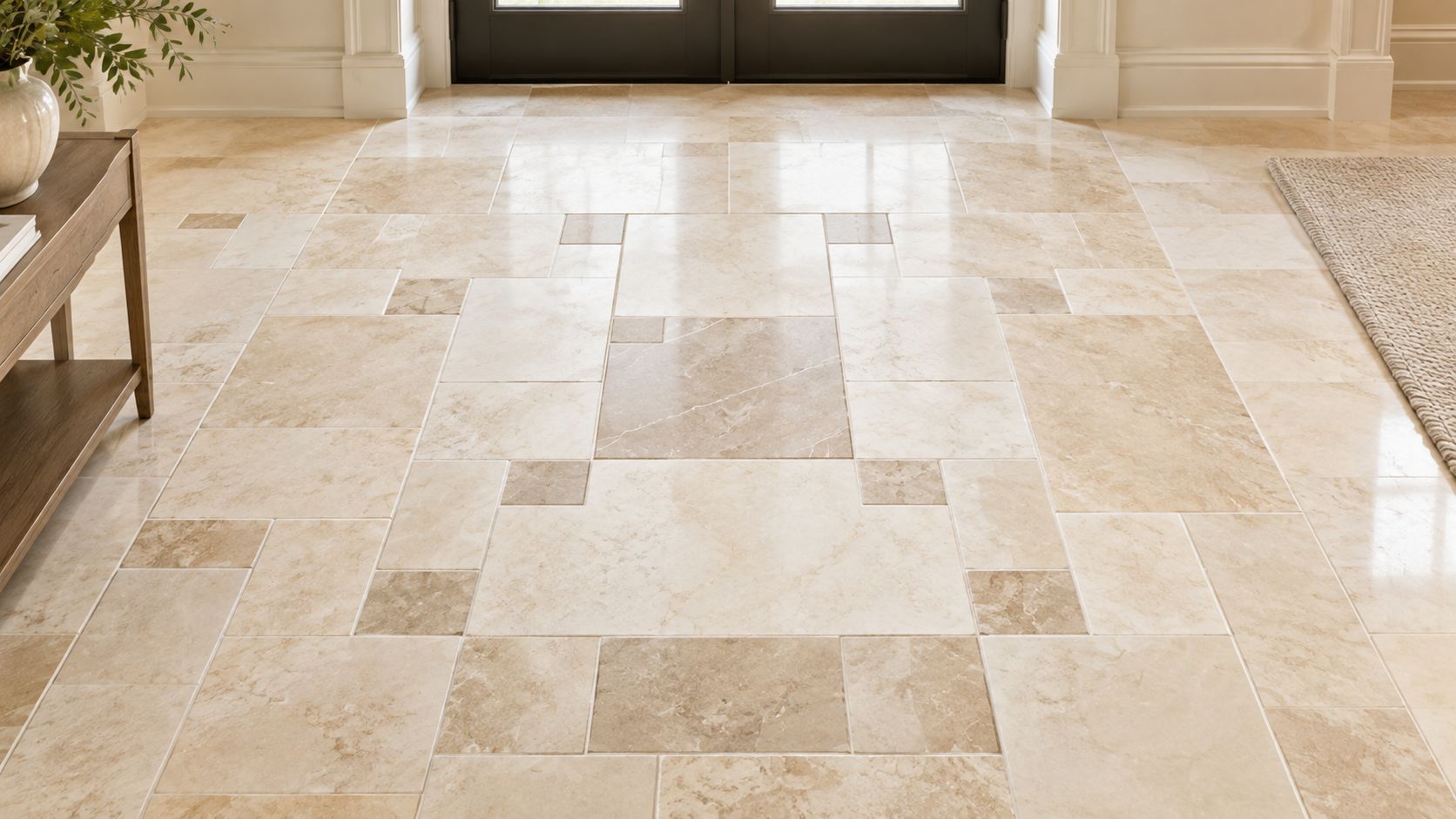
The Versailles pattern uses multiple tile sizes in a repeating French-inspired arrangement. Its formal geometry feels established and architectural, making it a natural fit for high-end foyers, stone kitchens, primary bathrooms, historic Newton properties, and estate-style homes in Wellesley or Weston.
The pattern's apparent complexity is part of its appeal, but it leaves little room for guesswork. Each piece must relate to the others in a repeatable sequence. Natural marble, limestone, or another traditional stone reinforces the design, while porcelain can provide a more controlled and durable interpretation.
Treat the pattern as a measured system
Create a detailed layout diagram and, when possible, a full-size mockup before ordering. Quantities must be calculated by tile size, not just by total square footage. Ordering too little of one component can interrupt the repeating design and force an awkward substitution.
The substrate needs to be flat and properly prepared. Multiple sizes create frequent transitions, so dips and high spots can produce uneven edges. A specialized saw capable of accurate cuts across different formats also matters. Light grout can keep the arrangement legible and elegant, while a darker color gives the pattern more contrast.
Versailles isn't a sensible DIY choice for most homeowners. It demands planning, sorting, accurate cuts, and a consistent installation sequence. The professional value comes from reducing layout mistakes before material is permanently set. That's particularly important in an entryway where visitors view the pattern from several directions and where edge cuts remain highly visible.
8. Random Ashlar Pattern
Random ashlar imitates fitted natural stone blocks. It looks spontaneous, but a successful installation follows calculated rules so the grout lines don't form distracting continuous runs. The organic surface suits slate floors, limestone, flagstone patios, fireplace surrounds, rustic kitchens, and textured bathroom accent walls.
A traditional Wayland kitchen might use earth-tone stone to complement wood cabinetry. A Wellesley entryway could use natural slate for a durable, informal first impression. The same concept can work outdoors, but the tile or stone, setting materials, drainage, movement accommodation, and freeze-thaw exposure must all suit the location.
Random does not mean unplanned
Use a layout diagram and dry-lay the full pattern before applying mortar. Pre-sort pieces by size so the installation progresses deliberately rather than by convenience. Many established ashlar arrangements avoid grout lines running longer than two tiles in a direction, which keeps the surface from looking like a simple staggered grid.
Three or four tile sizes can create a convincing fitted-stone appearance, but the pieces still need to be compatible in thickness and edge treatment. Natural variation in slate, limestone, or flagstone adds character. Neutral or earth-tone grout supports the organic effect, while strong contrast makes every joint more noticeable.
Professional installation is especially valuable when the room has several transitions, a fireplace opening, a curved feature, or irregular natural stone. A rushed “random” layout often develops accidental lines, awkward slivers, and poor balance at the perimeter. Dry layout is the quality-control step that prevents those problems.
9. Subway Tile Pattern
Subway tile is a material and a layout tradition as much as a style. The familiar rectangular tile, often associated with the classic 3-inch by 6-inch format, is commonly installed in a running bond. Modern versions include smaller and larger rectangles, glossy ceramic, matte porcelain, handmade-look surfaces, and dark colors with contrasting grout.
The pattern remains a reliable choice for kitchen backsplashes, bathroom walls, shower surrounds, and laundry rooms. White subway tile with light gray grout feels restrained. Black tile with white grout becomes graphic and contemporary. A larger rectangle gives a backsplash a quieter, more current scale, while a smaller format creates a more traditional rhythm.
Grout and alignment carry the design
Draw a vertical centerline and a level horizontal reference before setting the first row. Working outward helps keep cuts balanced at the visible ends. Consistent spacers are important because the running bond exposes every change in joint width.
Glossy tile reflects light and can brighten a darker kitchen. Matte tile tends to look softer and hides minor surface variation more effectively, but textured or handmade-look products can collect residue around their edges. Select grout with cleaning in mind. A contrasting color makes the offset obvious and highlights alignment. A close color creates a more continuous surface.
For a practical backsplash sequence, compare Sunny Day Pro Services' kitchen backsplash installation guide. Professional installation makes sense when the wall isn't flat, outlets interrupt the pattern, the tile has uneven edges, or the backsplash must meet finished cabinetry cleanly.
10. Large-Format or Slabstone Pattern
Large-format and slabstone installations use oversized tile in a grid or controlled offset to create broad, quiet surfaces with fewer visible grout lines. The look suits modern bathrooms, open-concept living areas, luxury kitchens, showers, hotel-style spaces, and wood-look porcelain floors in Newton homes.
The visual simplicity can be misleading. Large tile doesn't make substrate preparation less important. It makes flatness, coverage, handling, joint width, and offset control more demanding. TCNA guidance cited by large-format tile installation references calls for a substrate flat within 1/8 inch in 10 feet and 1/16 inch in 24 inches when tiles have at least one edge over 15 inches. The same guidance limits running-bond offsets to 33% for tiles with sides greater than 18 inches to reduce lippage risk.
Plan the tile, joint, and substrate together
Manufacturers and industry guidance commonly call for at least 1/8-inch grout joints with rectified large-format tile and 3/16-inch joints with calibrated tile in offset patterns, depending on tile warpage and installation conditions. A 50% brick offset may look familiar, but it can place the high point of one tile beside the low point of another. A reduced offset often produces a flatter finished surface.
Installers need the appropriate large-format mortar, trowel technique, and back-buttering to achieve full contact. Very large pieces may require multiple people or lifting equipment. Cutting and handling also create additional breakage risk, so ordering should account for the project's actual layout rather than relying on a minimal measurement.
Lippage tolerance is specification-driven. ANSI A108.02-derived guidance cited by tile lippage reference material allows 1/32 inch plus inherent warpage for joints narrower than 1/4 inch, and 1/16 inch plus warpage for joints 1/4 inch or wider. Gauged porcelain tile, panels, and slabs are often held to 1/32 inch without an added warpage allowance. Those limits explain why large-format floors and showers are safer with an installer experienced in substrate correction, layout, and handling.
Comparison of 10 Tile Installation Patterns
| Pattern | Implementation Complexity | Resource Requirements | Expected Outcomes | Ideal Use Cases | Key Advantages |
|---|---|---|---|---|---|
| Straight Stack (Running Bond) | Moderate, staggered rows, precise offset alignment | Low–Moderate materials, minimal waste, basic tools | Classic brick-like flow, durable and visually continuous | Kitchens, bathrooms, entryways, high-traffic areas, DIY projects | Hides grout imperfections, cost-effective, versatile |
| Herringbone | High, precise 45° cuts, experienced installer recommended | High materials (≈15–20% waste), wet saw, laser level | Sophisticated V-shaped flow, high-end visual impact | Luxury bathrooms, upscale kitchens, large open plans | Strong directional flow, perceived value increase, dramatic look |
| Chevron | High, exact angled cuts and symmetry required | High materials (≈15–18% waste), skilled labor, precision saw | Bold continuous arrow/zigzag, modern geometric statement | Feature walls, entryways, accent flooring, contemporary kitchens | Strong directional movement, trendy modern aesthetic |
| Basketweave | Moderate, careful 2x2 rotations and alignment | Moderate materials, lower waste than diagonal patterns, common tools | Woven/interlaced texture with repeating rhythm | Bathrooms, powder rooms, kitchens, traditional/transitional homes | Distinctive woven look, easier than diagonal patterns, modest waste |
| Grid (Straight) | Low, simplest straight lay, fastest to install | Low materials waste (<5%), minimal tools, DIY-friendly | Clean, uniform grid; modern and minimal appearance | Minimalist interiors, commercial areas, large-format tile installs | Fast, most cost-effective, minimal waste, highly versatile |
| Diagonal (45° Angle) | High, extensive angle cuts and perimeter work | High materials (≈20–30% waste), skilled installers, wet saw | Diagonal lines enlarge perceived space, sophisticated effect | Entryways, bathrooms, kitchens seeking visual expansion | Makes rooms appear larger, adds directional sophistication |
| Versailles | Very high, multiple sizes and intricate repeating units | Very high materials & labor, expert installers, detailed planning | Formal, timeless geometric layout; strong focal statement | Luxury entryways, formal rooms, high-end remodels | Exceptionally elegant, timeless, increases home value |
| Random (Ashlar) | High, calculated randomness, complex layout planning | High (multiple sizes), potential waste, experienced installers | Organic, natural-stone appearance; unique non-repetitive look | Rustic kitchens, patios, fireplace features, stone installations | Authentic natural-stone aesthetic, hides imperfections, unique |
| Subway Tile Pattern | Low–Moderate, running bond with small rectangles | Low materials, minimal waste, widely available tiles | Iconic, timeless backsplash/wall look; versatile finish options | Backsplashes, bathroom walls, kitchen walls, accent walls | Timeless and affordable, easy installation, highly adaptable |
| Large-Format / Slabstone | High, requires perfectly flat substrate and careful handling | High per-unit cost, specialized adhesives/equipment, skilled crew | Seamless, expansive surfaces with minimal grout lines | Open-concept floors, contemporary bathrooms, luxury finishes | Minimal grout for easier maintenance, modern seamless aesthetic |
Choose the Pattern That Fits Your Project
Start with the room, not the photograph. A small bathroom with several corners may benefit from a straight grid or a carefully planned diagonal because both can keep the visual field orderly. A large entryway can support Versailles, ashlar, or herringbone because the pattern has room to breathe. A backsplash has different priorities from a floor, including outlet cuts, cabinet transitions, wall flatness, splash exposure, and the way grout interacts with cooking residue.
Next, match the pattern to the tile. Rectangular subway tile naturally supports running bond, stacked arrangements, basketweave, herringbone, and chevron. Square tile works especially well in a grid or diagonal layout. Natural stone can make Versailles or ashlar feel authentic, but it may bring variation in thickness, porosity, edge shape, and maintenance. Porcelain offers broad format and finish choices, while ceramic is often practical for walls and backsplashes.
Use this selection sequence
- Confirm the substrate: Check flatness, strength, moisture conditions, transitions, and movement requirements before choosing a complex layout.
- Estimate waste and labor: Straight and stack-bond layouts typically need only 5–10% extra tile, while diagonal, herringbone, and chevron patterns generally require more because of angled cuts and perimeter waste, as explained in tile pattern efficiency guidance.
- Choose grout deliberately: Joint color changes how strongly the pattern reads and affects how readily dirt or residue shows.
- Plan maintenance: More joints create more areas to clean. Textured tile and natural stone may need more careful cleaning than smooth porcelain.
- Check the focal point: Center points, islands, doorways, drains, niches, and thresholds should be part of the layout before mortar is spread.
For a fast, economical installation, a grid or straight stack is usually the most practical starting point. Herringbone, chevron, Versailles, and calculated ashlar create stronger statements, but they need more planning and cutting. Diagonal tile can improve the visual flow of a small or crooked room, while large-format tile creates a restrained surface only when the substrate and offset are controlled.
Frequently asked questions
What is the easiest tile pattern to install?
A straight grid is usually the simplest because tiles repeat in one orientation and cuts are easier to predict. Straight stack is also practical, especially on walls, but the offset must remain consistent. Neither pattern excuses poor substrate preparation or unbalanced edge cuts.
What's the difference between herringbone and chevron?
Herringbone uses rectangular tiles that alternate direction, creating a broken zigzag. Chevron uses angled tile ends that meet in continuous points. Chevron looks more uniform and directional, but those points make angle and cutting accuracy especially important.
How much extra tile should I plan for?
The amount depends on the pattern, room shape, tile format, and number of corners. Straight and stack-bond layouts typically require 5–10% extra tile, while herringbone commonly requires 15–20% and chevron commonly requires 18–25%, based on the cited installation guidance. Diagonal layouts may require 20–30% additional material, so your installer should calculate the overage from the actual dry layout rather than applying one universal allowance.
What does large-format tile require?
Large-format tile requires a flatter substrate, careful mortar coverage, coordinated joint width, and controlled offset. TCNA guidance cited in industry references uses 1/8 inch in 10 feet and 1/16 inch in 24 inches as flatness benchmarks for tiles with an edge over 15 inches. Large tiles may also require back-buttering, specialized handling, and more than one installer.
Is dark grout harder to maintain?
Dark grout makes dirt and variation more visible in a different way than light grout. The best maintenance result depends on the grout type, tile texture, room use, sealing requirements for the selected material, and how quickly spills or residue are cleaned. Textured tile and porous natural stone generally demand more careful cleaning than smooth glazed surfaces.
When should I hire Sunny Day Pro Services?
Request a quote from Sunny Day Pro Services for complex patterns, large-format or natural-stone installations, difficult cuts, uneven substrates, full-room remodels, or projects where reliable scheduling and a satisfaction guarantee matter. The company installs porcelain, ceramic, marble, and granite, along with custom backsplashes and full-room tile work in Wayland, Newton, Needham, Wellesley, Weston, and nearby Massachusetts communities.
A service page for tile installation can help you identify the right next step, while a tile-care discussion should be part of the project before installation, not after the first maintenance problem. For search visibility, this article would suit Article schema, and the questions above could support FAQ schema if the visible page content and structured data remain consistent.
Sunny Day Pro Services can help you compare tile installation patterns, prepare the substrate, calculate layout and material needs, and install porcelain, ceramic, marble, granite, backsplashes, or full-room tile work. Visit Sunny Day Pro Services to request a fast quote and schedule dependable service for your Massachusetts home.

