
70 30 Microfiber Towels: What the Blend Means for Cleaning
Learn what 70 30 microfiber towels are, where they perform best, how to launder them, and how they compare with other blends for home cleaning.
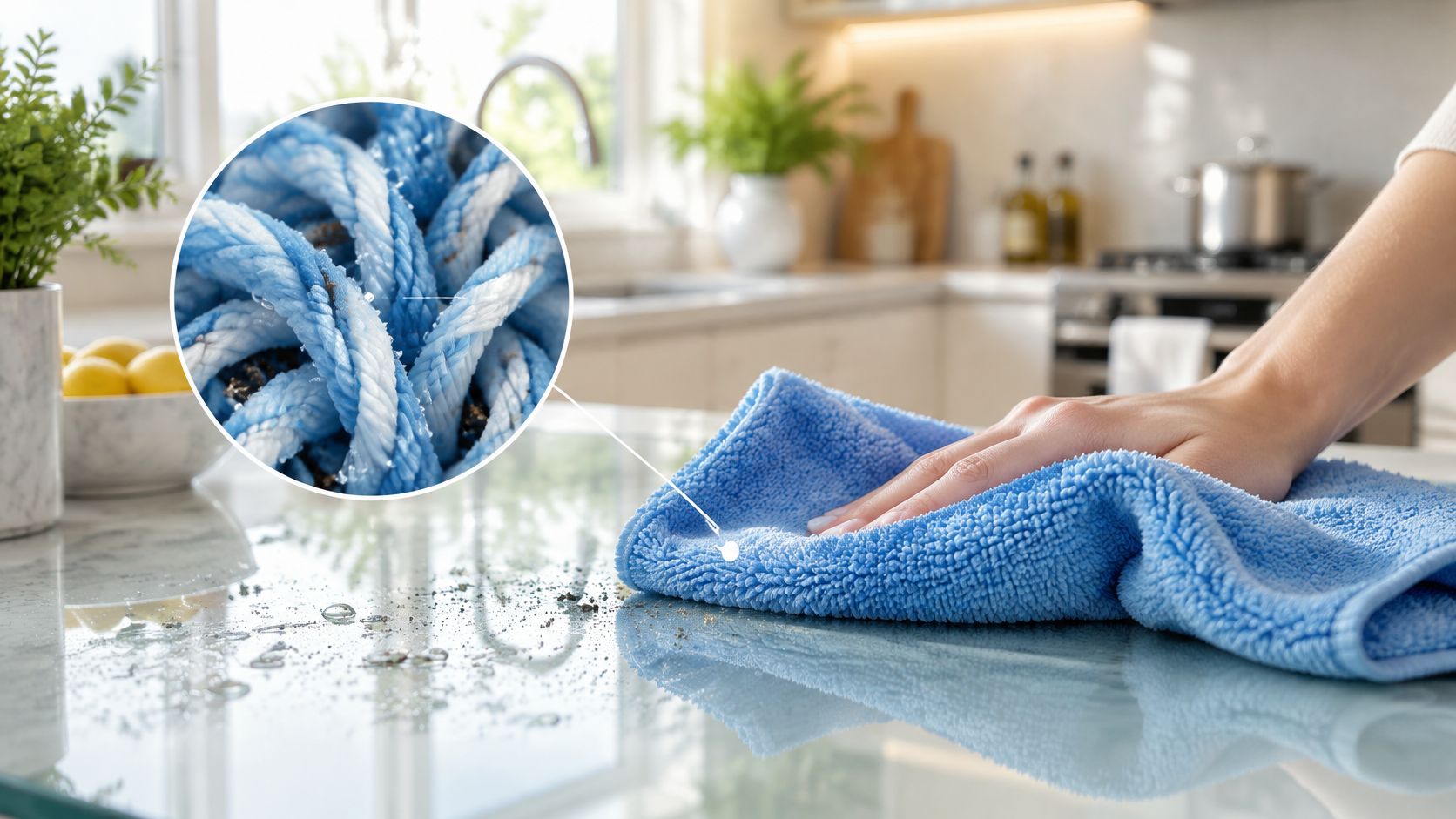
A 70/30 label is often treated like a quality grade. Buy the ratio, and the towel should dust, polish, and dry without streaks. That assumption falls apart the first time a “premium” cloth drags grit across a glossy backsplash, or leaves a film on a mirror after one wash with softener.
The blend is a starting spec, not a promise. Polyester and polyamide do different jobs, and folding, pile, and the wash decide whether those jobs show up on finished surfaces in a Newton kitchen or a Wellesley bath. I would read the label, then judge the cloth by what it still does after a few washes.
Table of Contents
- Are 70/30 towels safe for painted and polished surfaces?
- Can I use 70/30 towels on glass?
- Do 70/30 towels replace cotton?
- Do I need fabric softener?
- Which GSM is best for everyday cleaning?
- Can they go on granite or sealed stone?
- When should I replace a towel?
What a 70/30 Blend Means for Your Cleaning
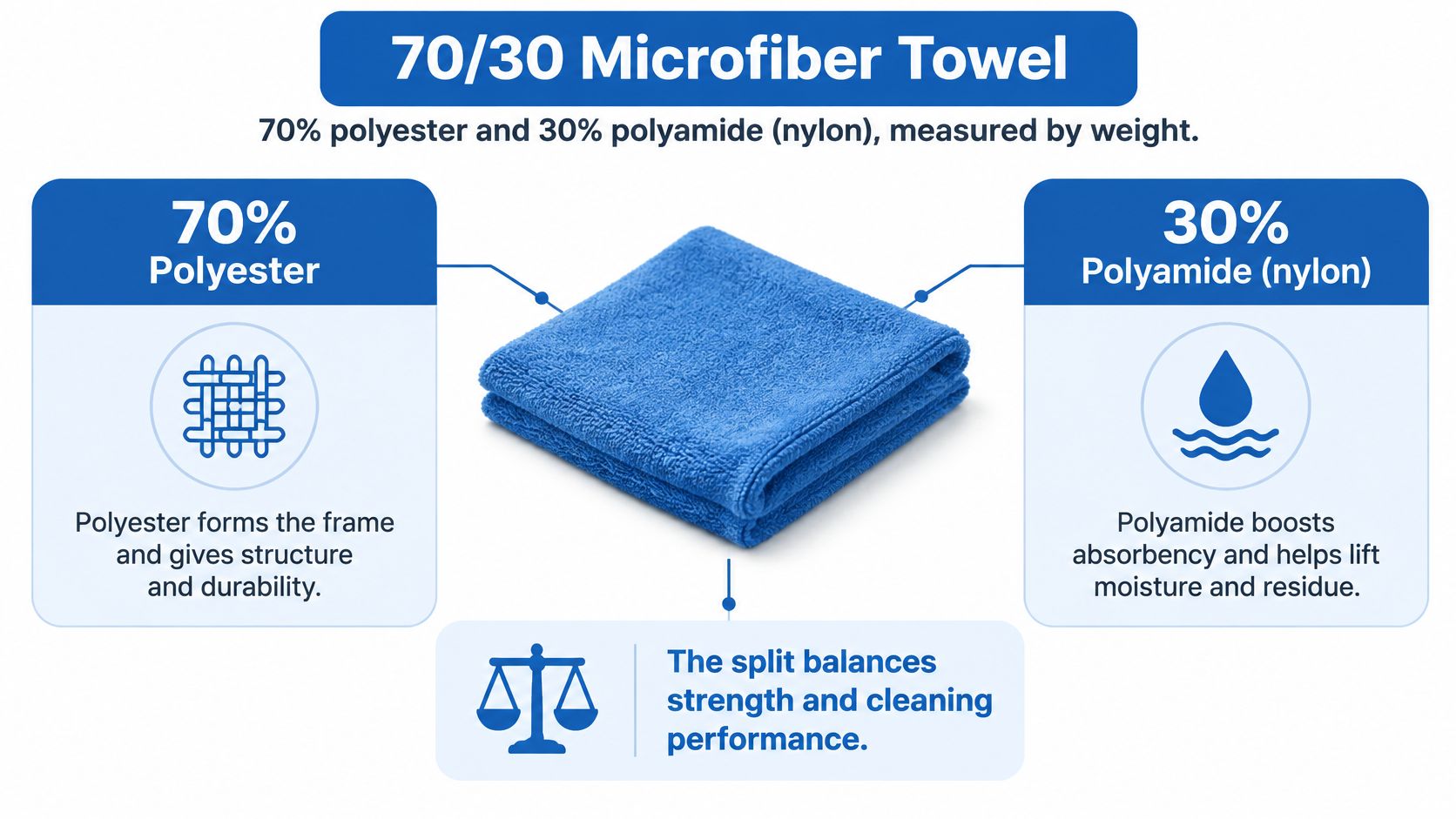
A 70/30 microfiber towel is 70% polyester and 30% polyamide (nylon), measured by weight. Polyester forms the frame. It supplies structural strength, abrasion resistance, and faster drying. Polyamide is the more hygroscopic fiber. It adds softness, flexibility, and liquid-wicking capacity. A microfiber materials guide cites a technical comparison that puts moisture absorption at about 0.4 to 0.8% for polyester fiber versus 3.5 to 4.5% for polyamide fiber. That gap is why raising the polyamide share generally improves wet pickup and hand feel.
Think of a work jacket with a fleece lining. The shell takes the abrasion and keeps its shape. The lining is what makes the garment comfortable and able to hold moisture. The towel splits the same way. Polyester keeps the cloth from collapsing under a wipe. Polyamide drinks water and bends into tile texture, cabinet profiles, and appliance curves.
Fiber jobs side by side
| Fiber | Share by weight | Main job | Moisture absorption | Feel in use |
|---|---|---|---|---|
| Polyester | 70% | Structure, durability, mechanical scrubbing, faster drying | about 0.4 to 0.8% | Firmer, holds its shape under pressure |
| Polyamide (nylon) | 30% | Softness, flexibility, liquid pickup | about 3.5 to 4.5% | Softer, conforms to uneven surfaces |
For residential wiping, this is a middle-ground spec. The cloth is durable enough for repeated passes on countertops, cabinets, appliances, and tile, and softer than polyester-heavy blends. Construction still decides the result. A 300 GSM towel contains 300 grams of fiber per square meter. It generally holds more liquid and cushions more than a lightweight 200 GSM cloth, though it may dry more slowly. Specs commonly list these towels at about 300 to 350 GSM and around 40 × 40 cm, a practical size for folding into several working faces.
Practical rule: Read blend, GSM, and size together. The percentages alone are not a quality grade.
A printed ratio can be wrong. Yarn diameter, split filaments, pile, and edge finish change absorbency and scratch risk even when the label looks right. Sort towels by task and color, bathrooms, kitchens, glass, and post-construction dust, so each cloth stays on the job it was bought for.
Where 70/30 Towels Work Best and Why
Split filaments are the reason these cloths pick up soil instead of skating over it. Product notes for 70/30 microfiber towels describe that split-fiber construction as the capture mechanism. Fine channels and a large surface area pull in dust, dirt, and liquid rather than pushing debris across glass, electronics, paint, or everyday hard surfaces. Filament fineness, whether the fibers are split, weave density, edge construction, and weight still change lint and scratch risk.
Match the face to the job
Say you are refreshing a kitchen after dinner. Cabinet faces get one folded towel. Backsplash tile gets a second. Grout lines do not get either of those. That split keeps food film off the wood and keeps grit out of the polish.
| Cleaning task | Suitable 70/30 spec | Why it works |
|---|---|---|
| Dusting furniture and electronics | Plush face, clean edges, lower GSM | Fine filaments trap dust rather than spreading it |
| Polishing glass and stainless steel | Shorter pile, clean unused face | Low lint release and better streak control |
| Wet wiping counters, cabinets and tile | Mid-weight, about 300 to 350 GSM | Holds liquid and lifts light film without excess water |
| Drying showers and mirrors | Higher GSM, fully dry before reuse | Absorbs more water per pass |
| Post-construction dust | Dedicated towels, vacuum first | Keeps abrasive grit from scratching finishes |
| Grout scrubbing or rough residue | Not recommended for 70/30 | Use a stiffer scrub pad or a more durable towel |
Dusting wants a plush, clean-edged face so screens and painted trim do not get a hard seam dragged across them. Glass and stainless want a shorter pile and a face that has not already picked up dust. Wet work on counters and tile wants a mid-weight cloth that carries enough water to lift film without flooding the surface. Showers and mirrors want more fiber weight so one pass drinks the water. Post-construction dust wants its own towels, and only after a vacuum, because drywall grit acts like sandpaper.
These towels are not scouring tools. They will not replace a stiff pad on grimy grout or a rough residue left by adhesive. Pushing them into that job frays the pile and risks the finish next to the grout.
How to Use 70/30 Towels for Wet and Dry Cleaning
The ratio does not decide whether soil stays in the cloth. Technique does. Split or ultrafine yarn creates capillary pathways that draw water, oils, and fine particles into the fabric, as a blend performance brief describes. Polyester gives enough stiffness for light agitation. Polyamide helps the face conform to textured tile and uneven surfaces. A soiled face puts that soil back down.
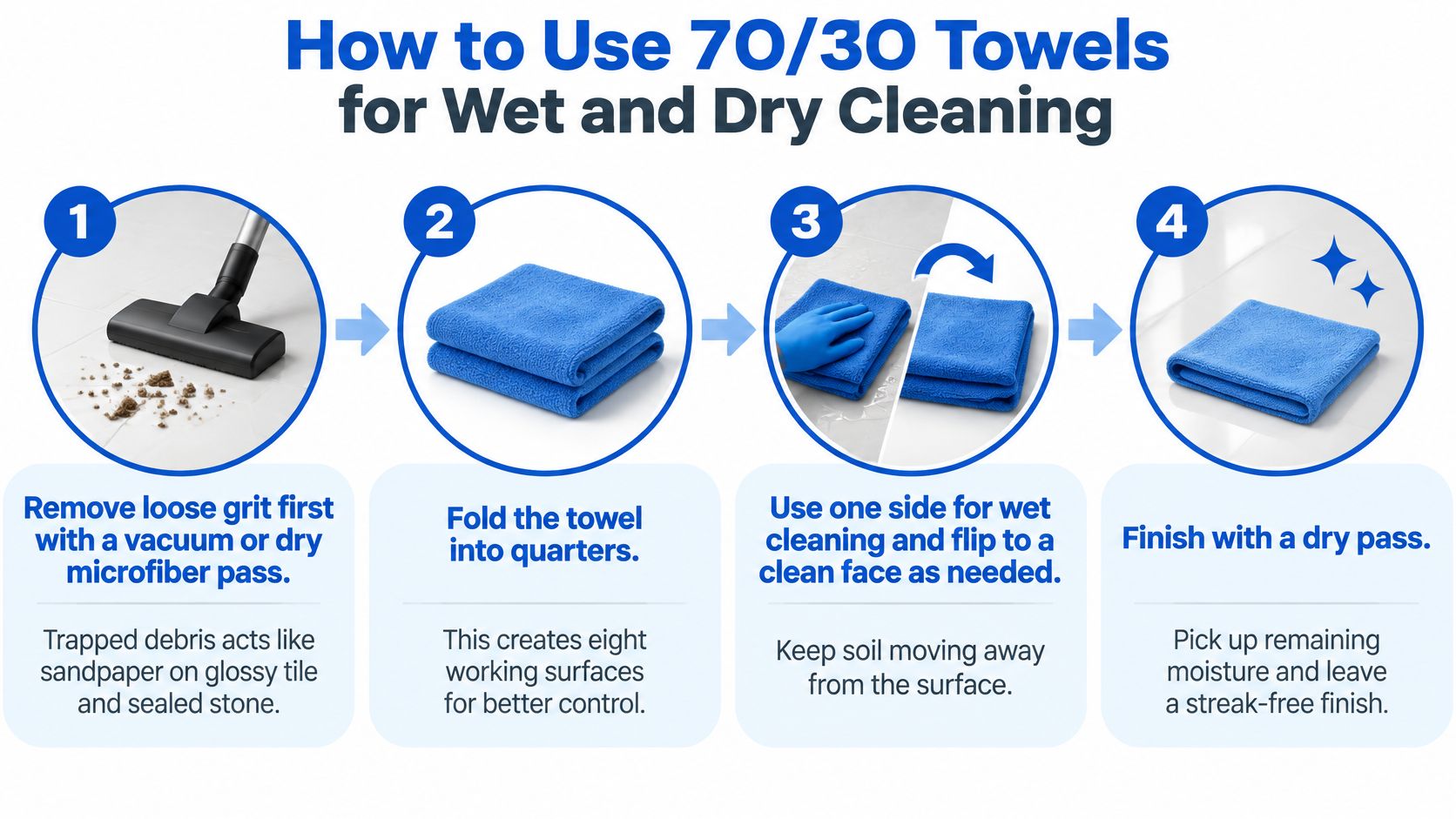
- Remove loose grit first. Vacuum or take a dry microfiber pass before any damp wipe. Trapped debris cuts glossy tile, sealed stone, and appliance finishes.
- Fold into quarters. On a 40 by 40 cm cloth that gives eight working faces. One face covers one defined area, then you refold.
- Dampen, then wring. A dripping towel leaves ridges on glass and pools in grout. The cloth should feel cool and barely damp.
- Wipe in overlapping S-shaped passes. Light, steady pressure lets the filaments grab film. Heavy pressure just smears it.
- Retire a face as soon as it looks dirty. Wiping again with that side pushes particles back onto glass, polished stone, and finished floors.
- Buff with a clean, dry face. Glass, polished stone, and stainless need that last pass to lift leftover moisture.
- Test a hidden spot first. Fresh sealers, polished stone, and painted trim can mark even when the blend looks right.
- Bag used towels by task. Kitchen, bathroom, and dust cloths never share a pile.
On a shower wall, a damp towel with a fresh face lifts soap film in one overlapping pass. The same face, already gray, paints that film back onto the next tile. Higher-GSM cloths suit liquid pickup. Lower-GSM, shorter-pile cloths suit polishing and edges. For the floor sequence around those walls, the best way to clean tile floors keeps grit from riding into the next room.
Laundering and Shedding Routine for 70/30 Towels
Streaks, lint, and a towel that stops drinking water usually start in the machine, not on the counter. Softener leaves a coating that gums the filaments and cuts liquid pickup. Chlorine bleach can break down polyester and polyamide microfilaments, which shortens life and weakens capture, which is why microfiber care guidance keeps both out of the routine. A mild liquid detergent is the better default. Powder can leave residue in the pile.
Heat, loads, and the care label
Washing instructions for microfiber towels commonly set a firm upper limit of 30 to 40°C (86 to 104°F). Some specialist notes warn that microfiber can begin to melt at approximately 60°C (140°F). Wash at the lowest temperature that removes the soil, use liquid detergent, and skip high heat in the dryer. A pre-soak in microfiber detergent helps heavy soil. Hotter water is not automatically cleaner, and the towel's own care label wins if it is stricter.
Wash microfiber apart from cotton and other lint-shedding fabrics. Transferred lint ruins streak-free glass. Sort by job too: glass, bathroom, kitchen, and heavy-soil or automotive towels stay in separate loads. Wash new dark towels apart from light ones so dye does not migrate. More wash detail sits in this note on whether you can wash microfiber cloths without killing the pile.
| Factor | Use | Avoid |
|---|---|---|
| Water temperature | 30 to 40 degrees Celsius (86 to 104 degrees Fahrenheit), lowest effective setting | Near 60 degrees Celsius (140 degrees Fahrenheit) or very hot water |
| Detergent | Mild liquid detergent, microfiber detergent for heavy soil | Powder residue and harsh additives |
| Fabric softener | None | Any liquid softener or dryer sheet |
| Bleach | None | Chlorine bleach of any strength |
| Load makeup | Microfiber only, or washed apart from cotton and lint-shedding fabrics | Mixing towels with cotton towels or clothing |
| Drying | Air dry or low heat, fully dry before storage | High-heat tumble drying that stiffens and damages fibers |
Shedding you can actually reduce
Polyester and polyamide are synthetic. Washing synthetic textiles is a documented route for microplastics into wastewater. A 2026 scientific coalition fact sheet estimates that a typical laundry load can release more than 9 million microfibers, and it recommends shorter, colder cycles plus washing-machine filtration. Cold water alone is not the whole fix. Long cycles, overloaded drums, heavy agitation, softener, and hot tumble drying all add wear and shed more fiber. Shake or vacuum loose dust before the wash. Empty filter or lint waste into the trash, not down the drain.
Retire a towel when edges fray or pill, absorbency drops after a correct wash, or streaks remain on glass. Reassign those cloths to garage spills or pet cleanup before you throw them out.
How 70/30 Compares With Other Microfiber Blends
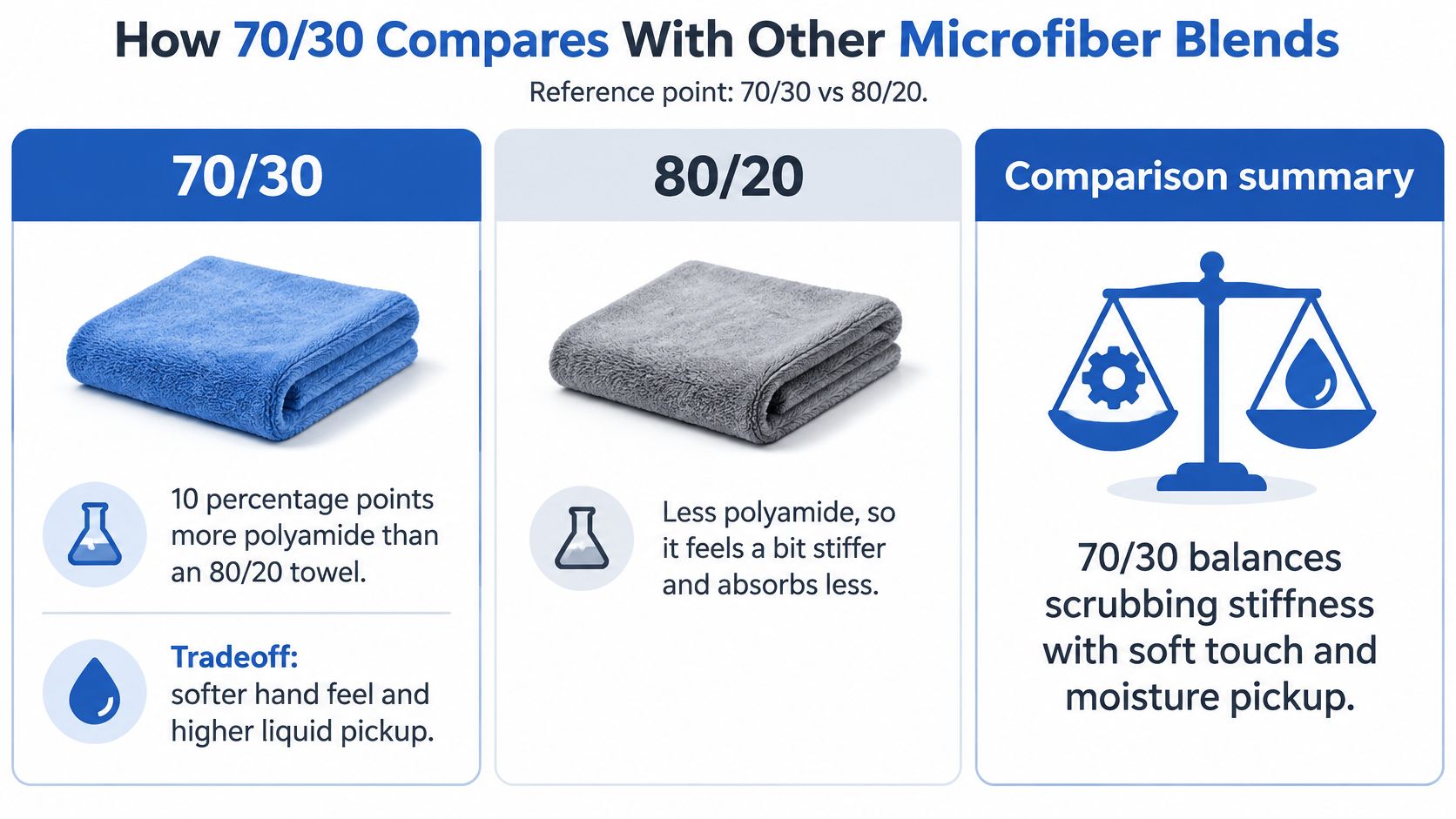
A 70/30 cloth has 10 percentage points more polyamide than an 80/20 towel, so it trades some scrubbing stiffness for a softer hand and higher liquid pickup. Industry descriptions of common blends list 70/30, 75/25, and 80/20 as usual polyester–polyamide ratios, plus cloths made only of polyester or only of polyamide. Fiber diameter, splitting, construction, pile height, edge treatment, and laundering still move absorbency, lint, and scratch risk. The ratio is a useful spec. It is not a complete quality standard.
Three things worth comparing
I compare blends on scrubbing strength, absorbency and softness, and lint or streak risk. More polyester usually means a firmer wipe and less water held in the pile. More polyamide usually means a softer face and faster moisture uptake. Lint and streaks track construction and wash habits as much as the ratio. A well-built 80/20 can beat a poorly split 70/30 on glass. Do not let the label outrank the cloth in your hand.
| Blend | Fiber split | Main strengths | Trade-offs | Best fit |
|---|---|---|---|---|
| 80/20 polyester-polyamide | 80% polyester, 20% polyamide | Stronger scrubbing power and durability | Firmer feel and lower liquid pickup | Heavy wiping, scrubbing and grimy surfaces |
| 75/25 polyester-polyamide | 75% polyester, 25% polyamide | Balanced durability and absorbency | Fewer specialized strengths | All-purpose wiping around the home |
| 70/30 polyester-polyamide | 70% polyester, 30% polyamide | Softer, higher liquid pickup, good glass and polish results | Less stiff for aggressive scrubbing | Dusting, polishing, glass and general wet cleaning |
| 100% polyester | 100% polyester | Durable and fast drying | Lower absorbency and firmer feel | Shop rags and abrasive tasks |
| 100% cotton | 100% cotton | Familiar and inexpensive | Sheds lint, dries slowly, can streak glass | Lint-tolerant jobs and rough cleanup |
80/20 suits heavy wiping and grimy surfaces where you want stiffness. 75/25 is the all-purpose middle when you do not want a specialist cloth. 70/30 is the one I would keep for dusting, polishing, glass, and general wet cleaning on finished surfaces. Polyester-only shop rags dry fast and take abuse, and they feel too firm for paint and mirrors. Cotton still earns a spot for rough cleanup where lint does not matter. It does not earn a spot on windows.
Separate towels by task, and wash them without fabric softener, or the blend advantage disappears in a month.
What to Check Before You Buy for Home or Business
A 70% polyester and 30% polyamide label does not prove absorbency, low lint, abrasion resistance, or paint-safe performance. Independent technical guidance on GSM, blend, and pile notes that each factor affects performance and that none of them, alone, equals overall quality. Even a 70/30 towel can mark paint-sensitive trim when the yarn or the construction is poor. Claimed ratios can be inaccurate. Laboratory fiber analysis is more reliable than a datasheet or an informal burn test.
GSM is weight per area, not a score. A heavier towel can trap more residue, take longer to dry, and be harder to launder. That matters after a remodel, when grit in the pile matters more than the marketing line.
Buying checklist in order
- Ask for lab fiber analysis before a bulk order. Do not trust the pack print alone, and skip burn tests as a buying method.
- Match GSM to the job. Lighter towels, about 200 to 250 GSM, suit dusting and glass. All-purpose wet cleaning sits around 300 to 350 GSM. Heavier plush towels suit drying showers and mirrors.
- Confirm a size near 40 by 40 cm so you can fold real working faces, not a floppy scrap.
- Inspect pile and edges. Clean or tightly sewn edges matter on scratch-sensitive finishes. A raw, fraying hem will mark gloss before the fibers do.
- Ask if the towel is sold as split-fiber. That is the capture construction you are paying for. Unsplit yarn mostly pushes dust.
A heavier cloth is not automatically a better cloth. If it stays damp in the closet, it will smell and streak.
Homeowners in Wayland, Needham, Weston, and nearby towns usually do fine with a set of 10 to 12 towels sorted by room. Crews and property managers need color by task and a replacement rule for worn stock, not one giant beige pile. Before you commit, wipe an inconspicuous spot on polished stone, a fresh sealer, glossy cabinetry, or painted trim. Use plush, clean-edged towels on finished surfaces. Keep lower-pile or tougher cloths for grout and construction residue.
Set Up Your Towel System Before You Restock
Buy the system before you buy the refill. I would start with about 12 towels in three color-coded groups for kitchen, bathroom, and glass, plus a separate set for dust and post-construction residue. Label each group. Sort the dirty bin the same way, so a glass cloth never lands in the kitchen load.
Then run that starter set through two or three laundry cycles on the settings you already use for microfiber. Track three things only.
- Absorbency after each wash: Does the cloth still drink a spill, or does water bead on it?
- Streaks on glass: A clean, dry face should finish a mirror without haze.
- Lint on polished surfaces: If fibers stay behind on stone or stainless, the cloth or the load is wrong.
If absorbency holds and streaks stay away by the third cycle, the blend and the weight fit your work. If results fade, change the wash before you blame the ratio. Retire the towels that still fail, and move them to low-risk jobs.
A written kit list helps when you are restocking for a move-out or a remodel. This professional house cleaning supplies list is a useful cross-check so towels are not the only tool in the caddy. Homeowners who'd rather hand the routine off can request a quote from Sunny Day Pro Services for recurring cleaning, move-in and move-out cleans, and post-construction cleanup at sunnydaypro.com.
Frequently Asked Questions About 70/30 Microfiber Towels
Are 70/30 towels safe for painted and polished surfaces?
Test a hidden spot first. The blend does not guarantee a paint-safe wipe, because yarn quality and construction matter as much as the ratio. A poor edge or trapped grit can mark trim even when the label is correct.
Can I use 70/30 towels on glass?
Yes, with a clean, dry face and a shorter pile for the last polish. Skip any face that already picked up dust, or you will chase streaks in a circle.
Do 70/30 towels replace cotton?
On most finished surfaces, yes. Cotton still fits rough cleanup where lint is acceptable and glass is not involved.
Do I need fabric softener?
No. Softener coats the filaments and cuts liquid pickup. Leave it out of the wash and skip dryer sheets.
Which GSM is best for everyday cleaning?
About 300 to 350 GSM covers most wet cleaning. Lighter towels suit dusting and glass. Heavier plush towels suit drying, not scrubbing.
Can they go on granite or sealed stone?
Only after you vacuum loose grit and test a small spot. Grit left in the pile works like an abrasive on a gloss finish.
When should I replace a towel?
Retire it when edges fray or pill, absorbency drops after a correct wash, or streaks remain after laundering. Those cloths can still handle garage spills.
Marking this block with FAQ schema, alongside Article schema for the page, helps search engines read the questions as direct answers.
Sunny Day Pro Services handles recurring house cleaning, move-in and move-out cleans, and post-construction cleanup for homeowners across Wayland, Newton, Needham, Wellesley, Weston, and nearby Massachusetts towns, including the tile and finished surfaces these towels are meant to protect. If you'd rather have a trained crew set the towel routine and the wash standard, request a quote and pick a schedule. Visit Sunny Day Pro Services to get started.

