
Basement Flooring Options: Best Choices for MA Homes
Explore top basement flooring options for your MA home. Compare vinyl, tile, epoxy for durability, cost, and moisture. Expert advice from Sunny Day.
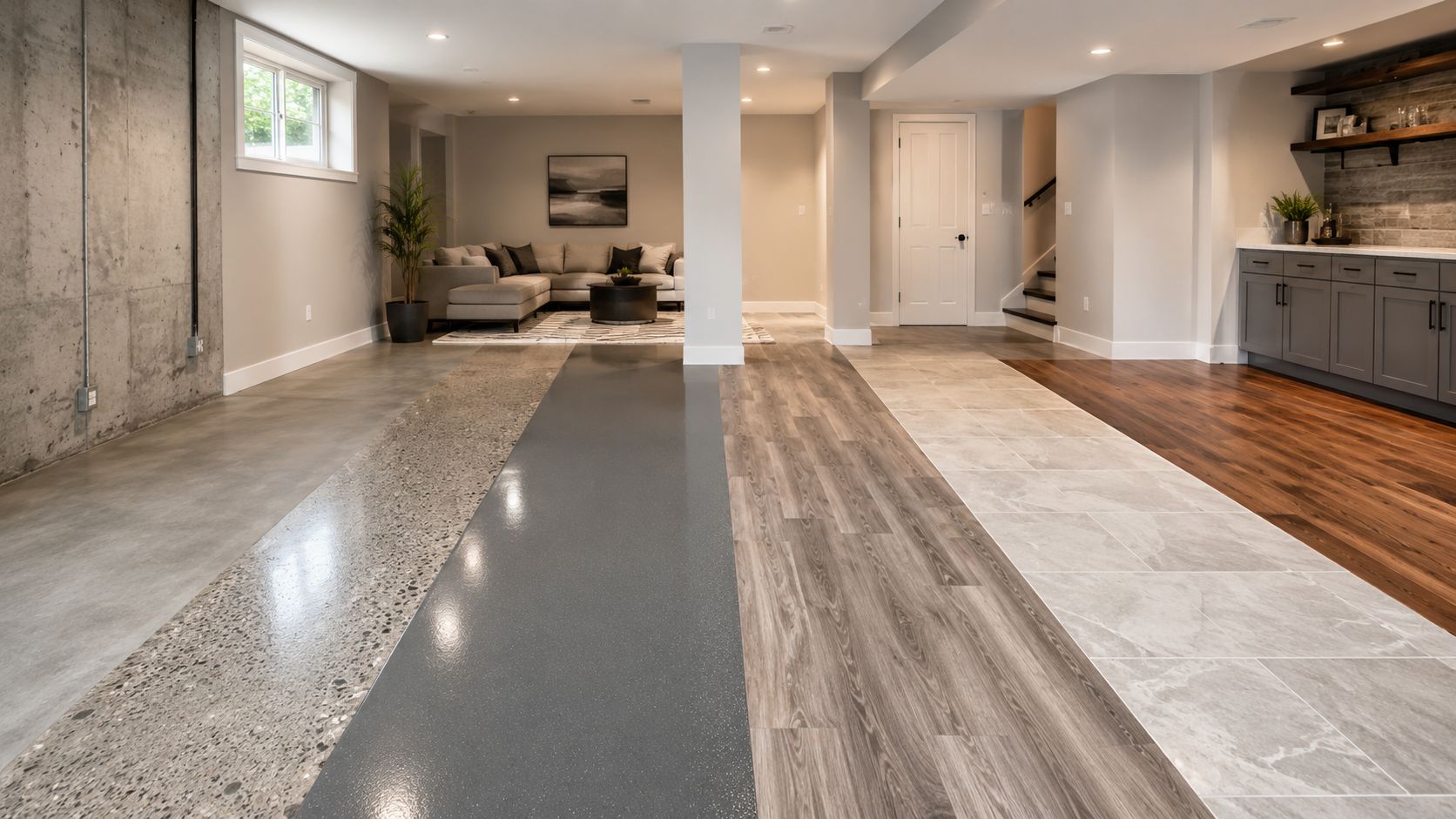
A lot of Massachusetts homeowners reach the same point. They look at an unfinished basement and see potential: a playroom, a quiet office, a gym, a media room, maybe even a guest space. Then they look down at the slab and realize the whole project comes down to one uncomfortable question.
What works on a basement floor in New England?
In this part of Massachusetts, basements are unforgiving. Humid summers, freeze-thaw cycles, older foundations, and decades-old slabs all put pressure on any floor you install below grade. The mistake I see most often isn't picking an ugly material. It's treating basement flooring like a finish choice instead of a moisture-control system.
If you want a basement floor that looks good and lasts, the order matters. First make the slab dry, flat, and stable. Then choose a flooring material that matches the room's use and your tolerance for risk.
Table of Contents
- Why the slab decides everything
- What proper prep usually includes
- Don't cover a water problem with a flooring product
- Concrete finishes
- Epoxy coatings
- Luxury vinyl plank and tile
- Ceramic and porcelain tile
- Engineered hardwood
- Rubber flooring
- What is the best basement flooring option for most finished Massachusetts homes
- Is tile too cold for a basement
- Can I put engineered wood in a basement
- What flooring should I avoid in a basement
- What if my basement slab is cracked or uneven
- Is sealed concrete a real finished-floor option
The Massachusetts Basement Challenge Why Flooring Is Different Here
A basement in Newton or Wellesley doesn't behave like a first-floor family room. Even when it looks dry, the slab can still carry moisture, the walls can hold seasonal humidity, and older homes often have small cracks, uneven patches, or signs of past water entry that never fully went away.
That's why basement flooring options need a different standard than upstairs flooring. The question isn't just what looks best. The key question is what can live over concrete, handle moisture swings, and still perform after a wet spring or muggy August.
What makes local basements tricky
Massachusetts homes bring a few common challenges together:
- Older construction: Many basements were never built with modern finishing systems in mind.
- Humidity: Even a basement without standing water can feel damp enough to stress sensitive flooring.
- Freeze-thaw movement: Exterior conditions can aggravate foundation cracks and minor slab movement.
- Mixed-use rooms: A basement might be part laundry area, part gym, part hangout space.
That mix changes the decision completely. A polished concrete floor may be smart in one part of the basement, while vinyl or tile makes more sense in another.
Practical rule: In a basement, the prettiest finish is the wrong choice if the slab underneath isn't ready for it.
Industry guidance consistently starts with the same principle: prioritize flooring materials that tolerate moisture. Common basement picks include vinyl, ceramic or porcelain tile, rubber, and some engineered wood, while solid hardwood is more vulnerable to moisture-related movement and damage, as noted by Wagner Meters' basement flooring guidance.
The floor is a system, not a surface
Homeowners often shop by sample board. That makes sense upstairs. In a basement, it's backwards.
A successful basement floor has layers of decision-making under the finish itself: slab condition, flatness, cracks, vapor exposure, underlayment, and whether the room is dry enough for the material you want. Get those right, and you can build a basement that feels finished instead of temporary. Skip them, and even a “waterproof” floor can disappoint.
Start with a Solid Foundation Subfloor Prep and Moisture Testing
Basement floor failures usually start below the visible surface. Not in the plank, not in the grout, not in the coating. They start in the slab.
Why the slab decides everything
Concrete looks solid and harmless, but below grade it can transmit moisture and vapor. That matters because many flooring systems fail from underneath. Adhesives let go, wood-based products swell, floating floors shift, and moldy smells show up where the room looked fine at the start.
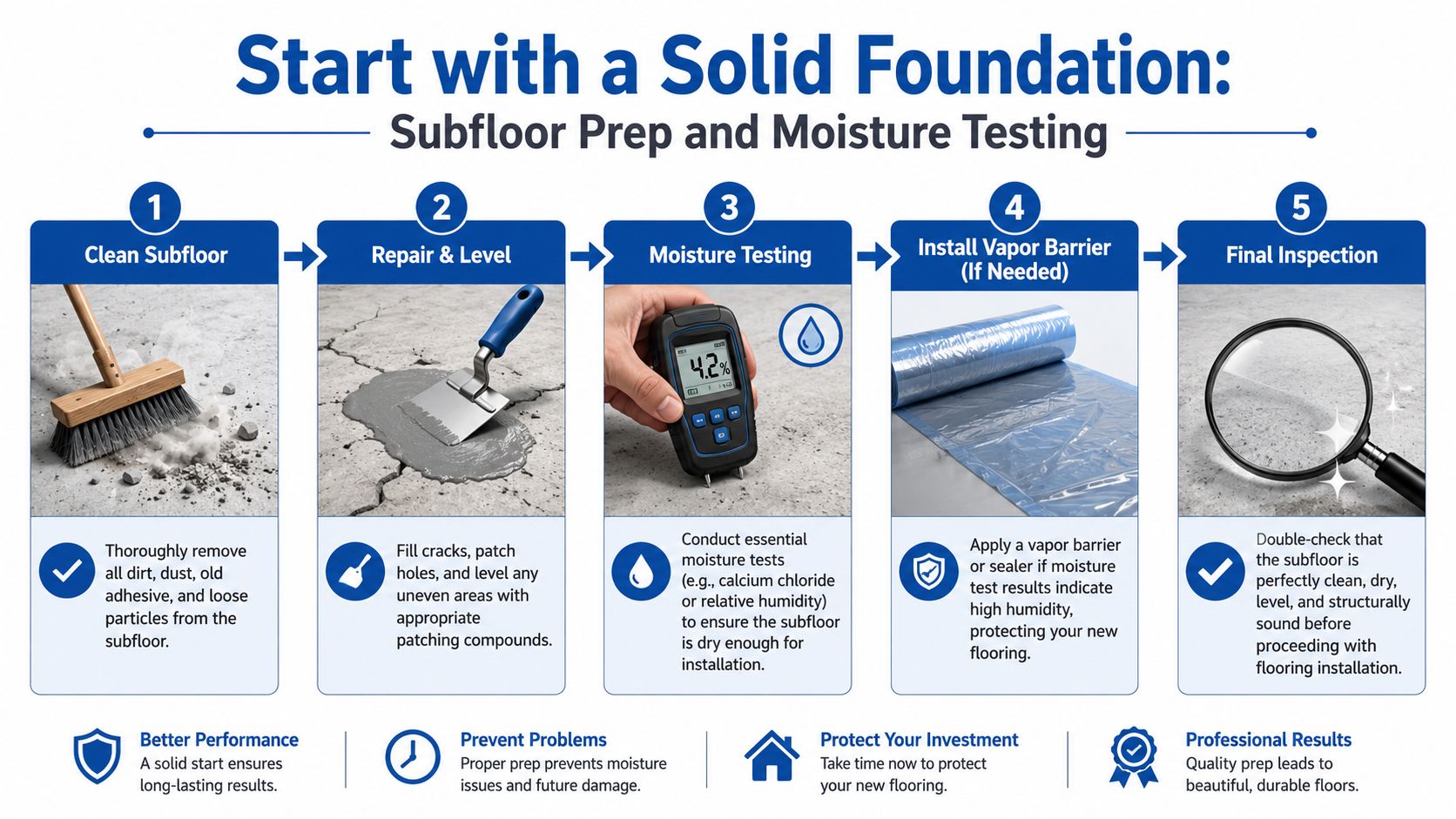
Published guidance for below-grade spaces treats moisture management as the technical gatekeeper. Fine Homebuilding notes that one common recommendation is one ASTM D4263 moisture test per 500 sq. ft. because hydrostatic moisture or vapor drive can cause flooring systems to fail if the slab isn't dry enough.
What proper prep usually includes
A basement slab almost always needs some amount of prep before finish flooring goes in. That work often includes:
Cleaning the slab
Dust, paint residue, old glue, and debris interfere with adhesion and make accurate inspection harder.Repairing cracks and damage
Hairline cracks may be cosmetic. Wider cracks, active movement, or edge breakdown need closer evaluation before you cover them.Flattening uneven areas
Click-lock flooring and large-format tile both punish uneven slabs. Minor dips can telegraph through floating floors or cause tile lippage.Moisture testing
This is the checkpoint that tells you whether the slab is ready for the planned system.Using vapor control where needed
Depending on conditions and floor type, that may mean a vapor barrier, membrane, or another approved assembly over concrete.
Some of the most expensive basement floor replacements begin with a floor that looked fine on installation day.
If you're considering tile, the prep matters just as much as the tile itself. Large-format porcelain, in particular, wants a flat substrate and disciplined layout. Homeowners comparing basement-friendly tile systems often get useful context from projects like this guide to porcelain tile installation, because basement tile success depends heavily on what happens before the first tile is set.
Don't cover a water problem with a flooring product
If the slab is staying damp, if water enters during storms, or if the basement smells musty year-round, flooring shouldn't be the first fix. The slab and drainage issue come first.
That's especially true in older Massachusetts basements, where the underlying problem may be outside grading, foundation seepage, or a history of moisture that no finish floor can solve by itself.
A Head-to-Head Comparison of Basement Flooring Options
Most homeowners narrow their basement flooring options to a handful of realistic contenders. The best choice depends on three things: how much moisture risk the basement has, how the room will be used, and how much floor prep you're willing to do before installation.
A foundational rule still applies here: moisture-tolerant materials are usually the safest bets below grade. Industry guidance commonly points to vinyl, ceramic or porcelain tile, rubber, and some engineered wood products as strong options, while warning that solid hardwood and traditional laminate are much more vulnerable in basement conditions.
| Material | Moisture Resistance | Durability | Comfort & Warmth | Avg. Cost (Material + Install) | Best For |
|---|---|---|---|---|---|
| Sealed or Polished Concrete | High | High | Low without rugs or added heat | Varies by slab condition and finish level | Low-maintenance basements, utility areas, modern designs |
| Epoxy Coating | High | High | Low | Varies by prep work and coating system | Laundry zones, workshops, utility spaces |
| LVP or LVT | High when correctly installed | High | Moderate | Varies by wear layer, prep, and layout complexity | Family rooms, playrooms, finished rec spaces |
| Ceramic or Porcelain Tile | High | High | Low unless paired with subflooring or heat | Varies by tile type and installation complexity | Premium finished basements, laundry areas, bath-adjacent spaces |
| Engineered Hardwood | Moderate, condition-dependent | Moderate to High | High | Varies by product grade and moisture-control requirements | Very dry, climate-controlled finished basements |
| Rubber Flooring | High | High | High | Varies by tile vs roll format and subfloor prep | Home gyms, play areas, workshop zones |
Concrete finishes
Sealed, stained, or polished concrete is often underrated. If the slab is in decent shape, it can be one of the lowest-risk basement flooring options because there's less layered material to trap moisture underneath.
It's not warm, and it won't give you the cozy look many families want for a TV room. But for utility-heavy basements, modern remodels, or homeowners who'd rather avoid hidden failure points, concrete deserves a serious look.
Epoxy coatings
Epoxy turns the slab into the finished surface, which removes a lot of the vulnerability that comes with organic or layered products. It works especially well in laundry areas, storage zones, and basement workspaces.
The catch is prep. Epoxy is only as good as the concrete under it. If the slab is dirty, damp, or poorly repaired, the finish can disappoint. It also feels harder and colder than living-space flooring.
Luxury vinyl plank and tile
LVP and LVT are popular for a reason. They offer the easiest path to a finished-room look without the sensitivity of real wood. In basements, they're often chosen because they can work directly over concrete when the slab is properly prepared and the full system is installed correctly.
For many households, this is the practical middle ground: softer than tile, better looking than a utility coating, and more forgiving for daily family use. It still needs a flat floor. If the slab has dips, ridges, or patchy repairs, vinyl tends to expose them over time.
Ceramic and porcelain tile
Tile remains one of the most established basement choices because it resists moisture, handles wear well, and performs over concrete. Guidance from Flooring Inc. on basement flooring describes ceramic and porcelain tile as excellent basement materials because they resist stains, tolerate moisture, and can be installed over concrete, though they're often more expensive and time-consuming to install than vinyl. The same guidance also notes the biggest comfort tradeoff: tile can feel cold underfoot.
That's why tile is such a strong choice for finished basements with a premium look, especially if homeowners are willing to improve comfort with underlayment, area rugs, or a warmer room design. For ideas on tile that holds up well in active households, this look at high-traffic tile flooring is useful because the same durability traits matter downstairs.
Engineered hardwood
Engineered wood sits in the caution category. It's more dimensionally stable than solid hardwood, which is why it sometimes appears on basement-approved lists. But it's still a wood product, and that means moisture control has to be excellent before it makes sense.
If a homeowner wants a true wood look in a well-controlled finished basement, engineered wood can work. If the basement has any history of dampness, seasonal odor, or slab uncertainty, it's usually not the first choice.
Rubber flooring
Rubber is highly practical and rarely chosen for looks alone. In a basement gym, kids' zone, or workshop, though, it can be exactly the right call.
It adds impact absorption, softens the feel of concrete, and handles moisture better than many decorative surfaces. Where it falls short is design flexibility. Rubber isn't typically desired across an entire basement living room, but in the right zone it performs better than more stylish materials.
Matching the Floor to Your Room's Purpose
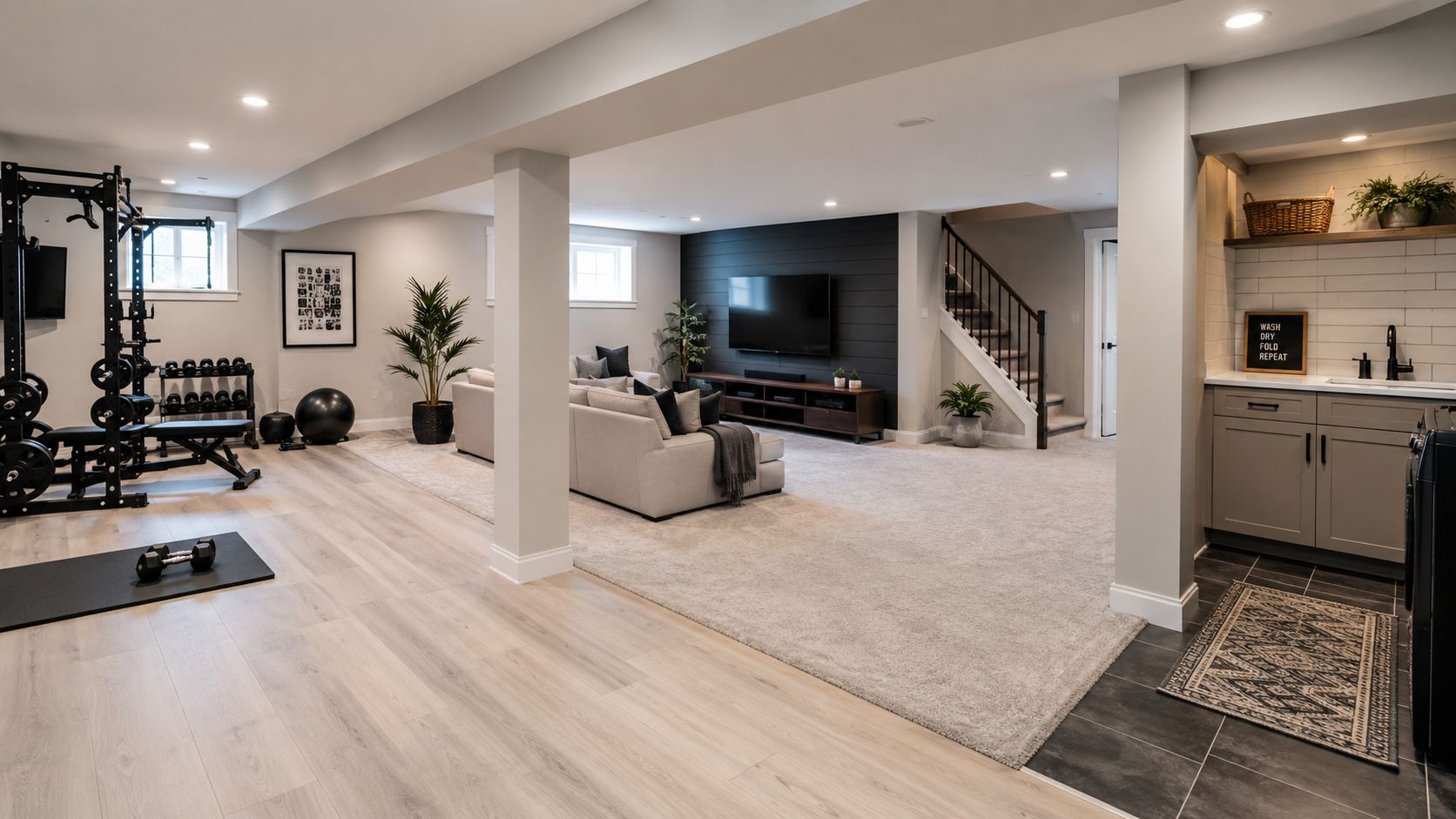
The smartest basement remodels don't force one flooring product to do every job. A basement in Needham or Weston might need a workout corner, a laundry wall, a TV area, and a storage zone. Those uses put very different demands on the floor.
Best fits by basement use
For a family room or playroom
LVP or LVT is often the easiest fit. It feels more comfortable than tile, cleans up easily, and gives you a finished look without pushing into higher-risk wood territory.
For a home gym
Rubber flooring stands out. It handles dropped weights, reduces noise, and takes the sting out of exercising on concrete.
For a laundry area or utility zone
Porcelain tile, sealed concrete, or epoxy all make sense. These spaces benefit from simple cleanup and stronger tolerance for moisture.
For a guest suite or polished living space
In these scenarios, homeowners often seek a warmer, more refined finish. Premium vinyl usually gets there with less risk. Engineered wood belongs here only if the basement is truly dry and stable.
The best-looking basement floor is the one that still looks good after a humid summer and a wet spring.
When one basement needs more than one floor
A split-use basement often benefits from zoning. That might mean tile at the exterior entry and laundry side, then vinyl in the seating area. Or rubber in the gym and a concrete finish in storage.
This approach solves a common problem: homeowners try to pick one material for the whole lower level, then end up compromising every zone. Matching the floor to the use of the room usually creates a better result than chasing uniformity.
It also keeps expectations realistic. A kid hangout space needs softness and cleanability. A workshop needs toughness. A basement bathroom-adjacent area needs stronger moisture performance than a movie room tucked into the driest part of the house.
Decoding the Costs of a New Basement Floor
Basement flooring costs aren't just about the visible material. Much of the budget resides in the system below it. In Massachusetts, especially in older homes, slab prep often decides whether a project stays straightforward or becomes a more involved repair-and-install job.
What drives the total price
Most basement flooring quotes include some mix of these line items:
- Material choice: Vinyl, tile, rubber, concrete finishes, and epoxy all carry different product costs.
- Labor intensity: Tile and detailed slab prep usually take more time than floating vinyl.
- Subfloor correction: Crack repair, patching, and leveling add cost before installation starts.
- Moisture-control measures: Vapor barriers or other approved systems can become necessary once the slab is tested.
- Room complexity: Stairs, tight corners, utility penetrations, and multiple transitions increase labor.
The cheapest-looking option on a sample board isn't always the cheapest completed project. A modest floor over a badly uneven slab can cost more than a higher-end finish over clean, sound concrete.
Where homeowners get surprised
The biggest surprise is usually prep. People price the visible floor and forget the hidden work that makes it last.
That can include old adhesive removal, slab grinding, crack treatment, flattening dips, or changing the plan entirely if moisture conditions aren't right for the original material. Tile also has a labor curve that many homeowners underestimate, which is why it helps to review how installation affects total pricing in a guide like how much tile costs.
A good budgeting mindset is simple: separate the finish material from the substrate work. One gives you the look. The other gives you the lifespan.
DIY vs Pro Installation When to Call Sunny Day Pro Services
Some basement flooring projects are reasonable for a careful DIYer. Others carry too much risk to treat as a weekend experiment. The difference usually comes down to slab condition, moisture sensitivity, and how exact the installation has to be.
Projects a skilled homeowner can handle
Click-lock vinyl in a dry, flat, already-prepared basement is the most realistic DIY candidate. Rubber tiles can also be manageable in a gym or workshop setting.
Even then, the prep still makes or breaks the outcome. If the slab has humps, hollow spots, moisture concerns, or visible cracking, the “easy” installation gets harder fast.

Projects that usually need a pro
Tile is at the top of this list. Basement tile work isn't just laying tile. It's evaluating the slab, correcting flatness, handling transitions, choosing the right setting materials, and building a floor that won't crack or telegraph substrate problems.
There's another issue many homeowners miss: some basements shouldn't get finish flooring yet. A Green Building Advisor discussion on an uneven basement playroom warns that “the only reliable solution is to prevent future water infiltration” through drainage and waterproofing first, and notes that any flooring other than concrete remains vulnerable if the water problem isn't fixed. That's the core reason pro evaluation matters in below-grade work.
If the basement still has an active water problem, flooring installation is not the first job.
When the plan involves tile, slab correction, moisture uncertainty, or multiple basement zones, professional installation protects the investment. That's where local experience matters. A contractor who works in Massachusetts basements understands that an old slab in Wayland or Newton often tells a different story than a new slab in a recently built home.
Protecting Your Investment Maintenance and Care
A good basement floor doesn't stay good by accident. Once the installation is done, the goal is simple: keep moisture under control, clean with the right products, and deal with small warning signs early.
Simple care habits that matter
For the most common basement finishes, these habits go a long way:
- For vinyl floors: Use a manufacturer-safe cleaner, keep grit off the surface, and wipe up spills quickly so moisture doesn't sit at seams or room edges.
- For tile floors: Clean regularly, keep grout in good shape, and pay attention to cracked grout lines near exterior walls or utility areas.
- For epoxy floors: Avoid dragging sharp metal across the coating, use soft pads under heavy items, and clean standing water instead of letting it evaporate in place.
- For rubber flooring: Vacuum or damp mop as needed, and check interlocking seams if the room sees heavy use or equipment movement.
- For concrete finishes: Recoat or reseal when wear becomes visible, especially in traffic paths or near exterior access points.
What to do if moisture shows up later
Musty odor, recurring damp spots, lifting edges, or white mineral residue on concrete all deserve attention. Don't assume the floor product failed first.
As noted earlier, uneven slabs and moisture issues usually point back to drainage, waterproofing, or ongoing water infiltration. The floor may be showing the symptom, not causing the problem.
Frequently Asked Questions About Basement Flooring
What is the best basement flooring option for most finished Massachusetts homes
For many finished basements, luxury vinyl plank or tile is the practical favorite because it balances moisture performance, comfort, and appearance. Porcelain tile is often the stronger long-term choice where moisture exposure is higher or the basement includes laundry and utility use.
Is tile too cold for a basement
Tile can feel cold underfoot in a basement. That's a real drawback, especially in Massachusetts. It still performs extremely well in moisture-prone spaces, which is why many homeowners use it selectively or pair it with rugs and comfort-focused room design.
Can I put engineered wood in a basement
Sometimes, but only with caution. Engineered wood is more stable than solid hardwood, yet it still needs a well-controlled basement environment. If the slab, humidity, or drainage history is questionable, vinyl or tile is usually the safer route.
What flooring should I avoid in a basement
Solid hardwood is a poor basement choice because it's more vulnerable to moisture-related movement and damage. Traditional laminate with a fiberboard core is also risky in damp conditions.
What if my basement slab is cracked or uneven
Deal with that first. Flooring products don't solve substrate problems. Some can hide minor cosmetic flaws, but they won't fix movement, moisture, or a badly uneven surface.
Is sealed concrete a real finished-floor option
Yes. In the right basement, sealed or polished concrete can be one of the most durable and low-maintenance choices. It won't feel as warm or soft as vinyl, but it avoids many of the hidden risks that come with layered floor systems.
If you're planning a basement remodel in Wayland, Newton, Needham, Wellesley, Weston, or a nearby Massachusetts community, Sunny Day Pro Services can help you make the right flooring decision before costly mistakes get buried under the finish. Reach out for a quote if you want expert help with tile installation, flooring prep, and a basement floor system built for real New England conditions.

