
10 Bathroom Tile Trends to Watch in 2026
Explore 10 bathroom tile trends for 2026, from tile drenching and large formats to terrazzo, natural stone, and practical care tips.
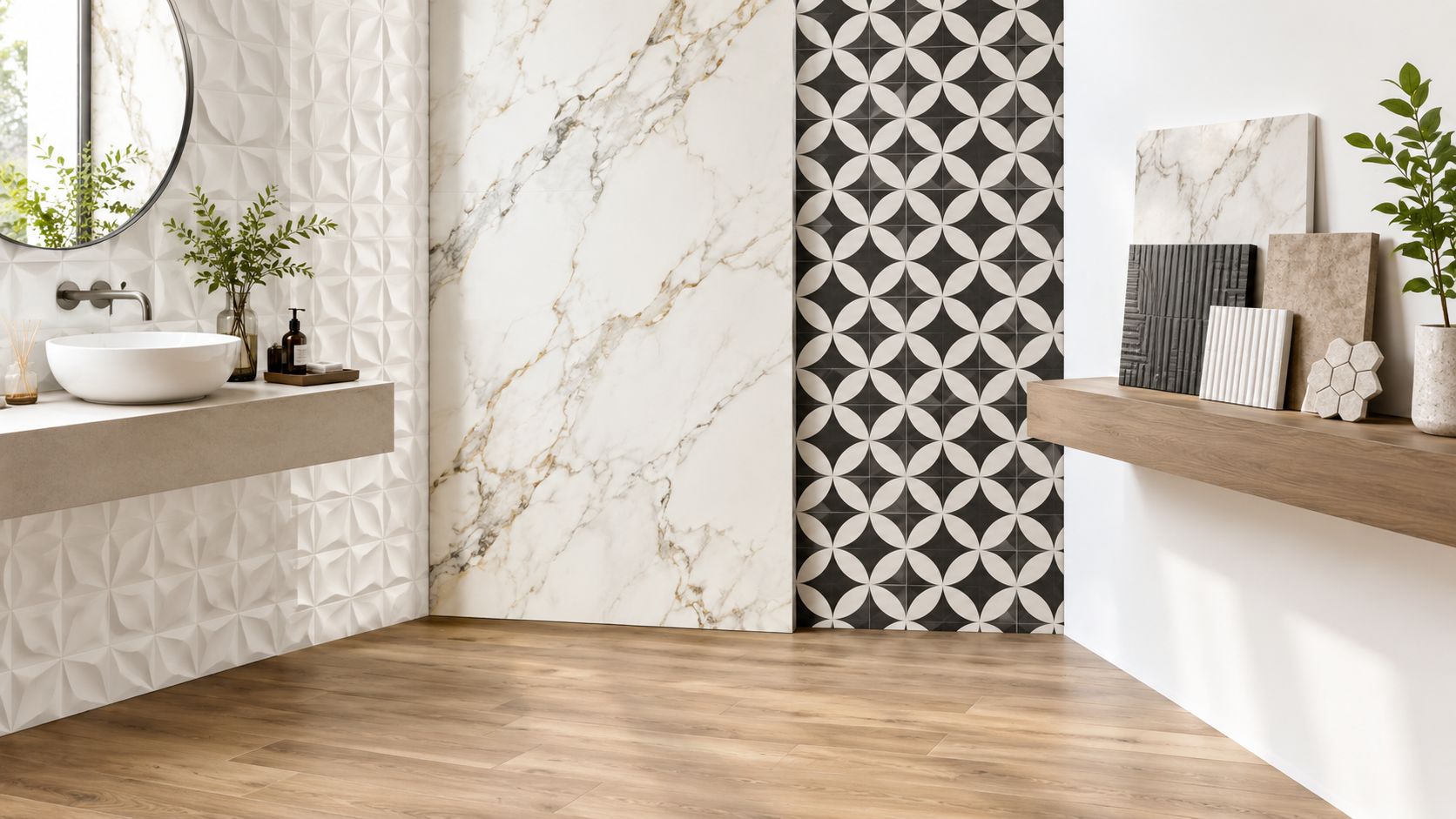
The strongest bathroom tile trends for 2026 aren't about choosing a dramatic color or an unusual shape. They combine visual continuity with the realities of wet-room performance, including slip resistance, waterproofing, installation precision, cleaning, and eventual repairs. That matters because tile remains the default bathroom surface in major renovation markets. The 2024 U.S. Houzz Bathroom Trends Study found that tile was selected for shower flooring in 87% of renovating homes and shower walls in 83%. Rectangular tiles were chosen for shower walls by 82% of homeowners.
This roundup evaluates ten looks through a homeowner's lens. Each trend gets tested against where it works best, what can go wrong during installation, how much maintenance it demands, and whether porcelain or ceramic offers a more dependable alternative. One of the most visible emerging directions is tile drenching, the use of a continuous tile treatment across floors, walls, and shower areas. It can make a compact Massachusetts bathroom feel cohesive, but it also magnifies every decision about grout, drainage, lighting, and replacement materials.
Table of Contents
- A simple selection checklist
- A 2026 perspective on tile drenching
- Frequently asked questions
- Schema recommendations
1. Large Format Tiles 24x48 and Larger
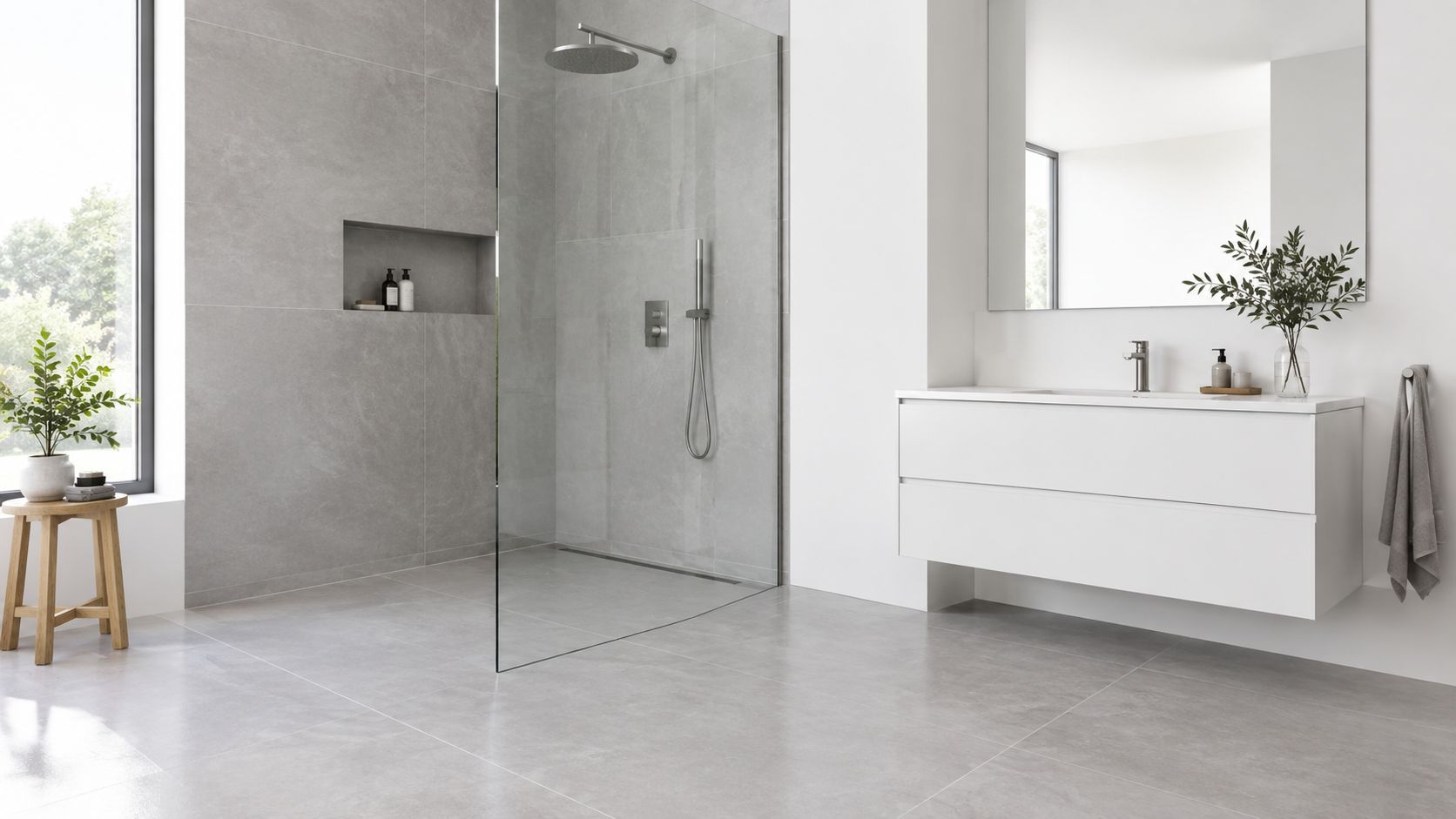
Large-format porcelain creates the clean, expansive appearance many homeowners want, especially in a small Newton or Needham bathroom where excessive grout can make the room feel busy. A 24x48 tile, or a larger slab-style format, can carry a marble, limestone, or concrete look across a shower wall with strong visual continuity. A soft gray porcelain floor paired with matching shower walls can feel calmer than several competing tile sizes.
The practical appeal is substantial. Large-format tiles typically have at least one edge measuring 60 cm or more, and they can reduce total grout length by 60% to 70% compared with standard layouts, according to this large-format tile installation guide. Fewer joints mean fewer lines to scrub, but they don't eliminate maintenance. Water still collects at corners, niches, benches, and changes in plane.
Where the format works and where it fails
A large tile works best on broad, flat walls and floors with a carefully planned layout. It becomes risky around curved walls, older houses with uneven framing, small shower floors, and rooms filled with plumbing penetrations. A Wellesley master bath with a broad shower surround can accommodate a 48x96 panel more gracefully than a compact powder room with multiple door and vanity offsets.
The substrate must be exceptionally flat. For tiles with an edge of 15 inches or longer, the allowable variation tightens to 1/8 inch over 10 feet and no more than 1/16 inch in any 24 inches, as summarized in this bathroom substrate preparation reference. Installers may need leveling work before setting tile, and the tile should be back-buttered to improve mortar coverage. Rectified tile can use joints as narrow as 1.5 to 2 mm, while non-rectified tile generally requires wider joints, according to the same installation guidance.
Practical rule: A large tile reduces grout, not installation responsibility. If the wall isn't flat, the finished surface will show it.
For a detailed look at the preparation and setting issues involved, review this guide to large-format tile installation.
2. Terrazzo Tile With Recycled Glass and Stone Aggregate
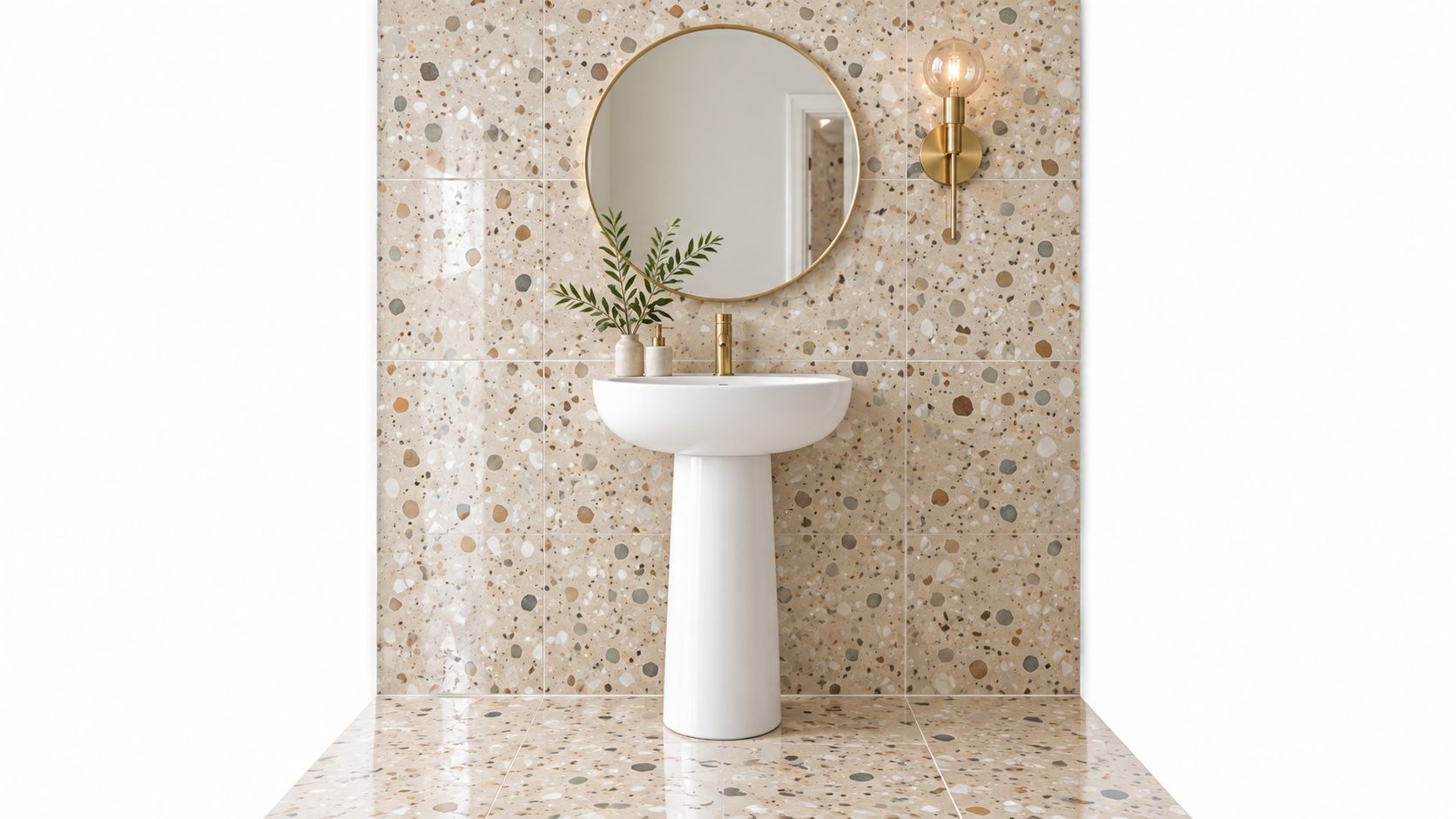
Terrazzo adds pattern and material variation without requiring a separate decorative mural. Factory-made tiles may combine stone aggregate, recycled glass, mirror fragments, or resin-bound chips in a repeatable product that is simpler to specify than site-cast terrazzo. In a Wayland bathroom, a neutral terrazzo floor can connect warm cabinetry with pale walls. In a Weston powder room, blue and green chips can reference the Massachusetts coast without covering every surface in pattern.
The material has movement, yet it does not depend on multiple tile shapes. It also introduces color while staying compatible with the warm-neutral direction common in current bath design. A terrazzo floor with beige, cream, or soft gray chips can keep a compact bathroom calm while adding enough variation to hide minor debris between cleanings.
Make the aggregate work for the room
Use terrazzo for a floor, vanity backsplash, shower stripe, or feature wall instead of automatically wrapping the entire bathroom. A plain porcelain wall tile gives the eye a resting point beside a lively floor. Honed or lightly textured finishes are safer underfoot than highly polished surfaces, particularly near an open shower, though texture can require more cleaning.
The product needs an installer familiar with its composition. Resin, cement, aggregate, and surface finish can change cutting methods, sealing requirements, adhesive selection, and cleaning procedures. Follow the manufacturer's sealing instructions, then use a pH-neutral cleaner. Porous or heavily textured terrazzo can hold soap and mineral residue more readily than smooth porcelain, a meaningful trade-off for a busy family bathroom.
Plan custom colors early. If the goal is to match beach-glass tones, cabinetry, or a particular stone palette, review samples under the bathroom's actual lighting before approving fabrication. Bright vanity lights can make a restrained showroom sample appear much busier.
For a 2026 tile-drenching approach, terrazzo can carry from the floor into a short backsplash or shower niche while durable porcelain handles high-splash walls. Repeating one aggregate palette creates continuity without forcing the same maintenance demands across every surface. In a Massachusetts home, that balance suits a renovated primary bath where visual warmth matters, but winter grit, hard-water residue, and regular family use still affect the finish choice.
3. Textured and 3D Tile for Dimensional Walls
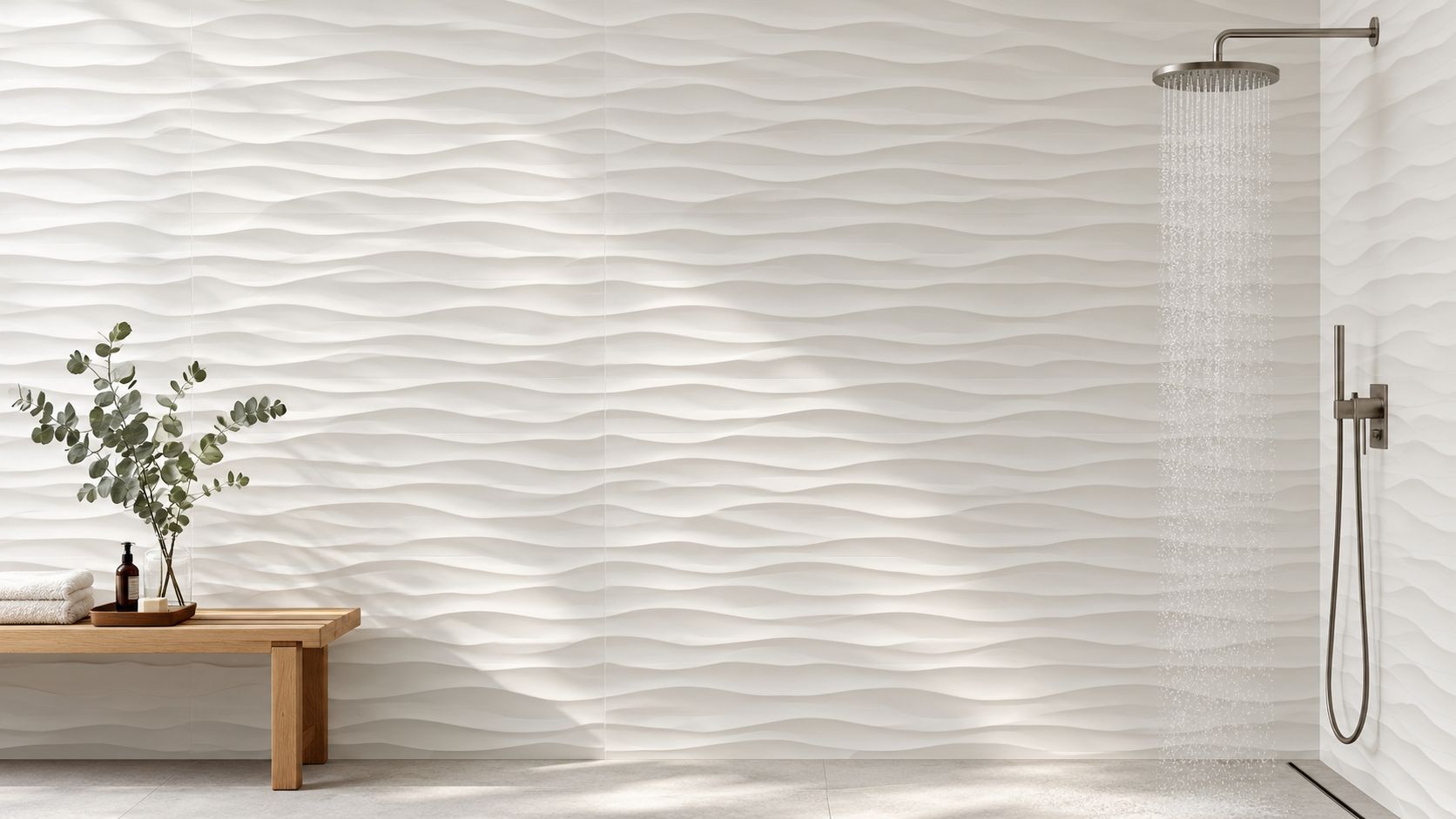
Texture is one of the most effective ways to make a neutral bathroom feel designed rather than bland. Fluted, ribbed, wave-patterned, hand-pressed, and sculptural tiles catch light differently throughout the day. A matte white wave tile behind a rainfall shower can create a spa-like effect in Weston, while a subtle linear relief behind a vanity can add depth without introducing another color.
The design payoff depends heavily on lighting. Grazing light from the side emphasizes every ridge and recess. Soft ambient lighting can make the same tile look quiet and architectural. Always place a sample in the bathroom or under a similar light source before ordering the full quantity.
Use texture selectively
A textured tile usually works best on one feature wall. In a Wayland master bath, alternating flat and relief tiles can establish a controlled rhythm. In a Newton powder room, a stronger sculptural pattern can carry the room because the space has less shower residue and lower daily cleaning pressure. Full-room coverage often creates two problems, visual fatigue and more difficult cleaning.
The relief depth matters. Subtle textures are easier to wipe than deep sculptural forms, particularly behind a tub or inside a shower. Ridges can collect soap film, dust, and mineral residue, so a highly dimensional tile isn't the right choice for every family bathroom.
Grout color changes the result. Light grout outlines the pattern and makes each tile read separately. A matching grout can soften the contrast and create a more continuous wall. Align grout joints with niches, shelves, and plumbing fixtures so the pattern looks intentional rather than interrupted.
Deep relief belongs where the design benefit outweighs the cleaning effort. In a frequently used shower, restraint usually ages better.
4. Hexagonal and Geometric Mosaic Tiles
Hexagons and geometric mosaics give homeowners pattern without the commitment of a large printed mural. Small white hexagons with subtle gray grout can make a Wellesley bathroom floor feel classic and refined. Elongated hexagons in spa gray can stretch across a spacious Weston shower, while jewel-toned geometric pieces can turn a Newton powder room into a compact statement.
The format is flexible, but it's also unforgiving. Small mosaics contain many grout joints, and poor alignment becomes visible quickly at walls, drains, thresholds, and corners. A professional installer should dry-lay the sheets, check the repeat, and plan the edges before setting adhesive. Factory-mounted sheets can still show gaps if they aren't blended carefully.
Match the pattern to the room
Monochromatic or neutral mosaics offer the safest long-term choice. A gray hexagon floor with a solid wall tile leaves room for brass, nickel, or matte black fixtures to change later. Strong multicolor geometry works better on a powder-room wall or a defined floor zone than across every surface.
Grout selection controls the pattern's intensity. White grout makes every hexagon prominent and can demand more visual and cleaning attention. Matching grout integrates the shapes into the floor. A mid-tone grout often hides everyday bathroom residue more effectively than bright white, though the product and maintenance requirements still matter.
The mosaic's surface matters more than its shape in a wet area. A glossy floor can become uncomfortable or slippery when wet, while a textured or honed finish may offer a better walking surface. A small-format floor can be useful where the installer needs more joints to follow a sloped shower base, but the finished slope and drainage still deserve priority over fashion.
5. Wood-Look Porcelain Tiles
Wood-look porcelain supplies warmth where stone-effect tile might feel too cold. Plank formats with printed oak, walnut, or reclaimed timber grain can carry a visual connection from a bedroom, hallway, or dressing area into the bathroom without exposing real wood to repeated moisture. That makes the look particularly useful in Needham and Wayland homes with open primary suites or transitional interiors.
Porcelain is the practical reason this trend continues. It provides a moisture-resistant manufactured surface while reproducing the color variation and grain direction associated with timber. The result isn't real wood, and an overly repetitive print can reveal that quickly. Choose a collection with varied faces, tonal movement, and a finish that doesn't look artificially glossy.
Installation details shape authenticity
Install planks in a layout that resembles flooring rather than a rigid grid. A staggered arrangement can feel more natural, but the installer must follow the manufacturer's recommendations and avoid creating undesirable alignment patterns. The room's dimensions should determine the starting line. Centering the layout and avoiding narrow edge cuts often matters more than forcing every plank into a particular pattern.
Use a grout color close to the tile's dominant tone. High-contrast grout interrupts the grain and makes the product read like individual strips instead of a wood surface. A textured or matte finish is generally a stronger bathroom-floor choice than polished tile, but the selected product still needs to meet the project's wet-floor safety requirements.
Wood-look porcelain pairs well with flat stone-look walls, warm white paint, brushed brass, and natural wood cabinetry. It doesn't need additional rustic elements everywhere. In a Wellesley bathroom, a restrained oak tone under a white vanity can add enough warmth without turning the room into a themed interior.
6. Marble and Limestone Natural Stone Tiles
Natural marble and limestone remain compelling because no two pieces carry exactly the same veining, fossil detail, or tonal variation. Carrara marble can give a Wellesley master bath a quiet, classic character. A boldly veined Calacatta-style stone can anchor a Newton vanity wall, while honed limestone can soften a Wayland bathroom that needs an organic, less formal finish.
The trade-off is maintenance. Natural stone demands more deliberate sealing, cleaning, and moisture management than a comparable porcelain lookalike. Marble can react to acidic cleaners, personal-care products, and some bathroom spills. Limestone's softer, more porous character makes finish selection and sealing especially important.
Keep luxury in the right zones
Honed or brushed stone is generally more forgiving than polished stone in wet areas. It can provide a less slippery feel and conceal small marks better, although no finish should be treated as automatically safe. For a busy family bathroom, use marble on a feature wall, vanity surround, or selected shower surface, then use porcelain on the floor or other high-use zones.
Ventilation is part of the material specification. A well-ventilated bathroom dries faster, which helps reduce the ongoing moisture burden on grout, stone, cabinetry, and painted surfaces. Stone should be sealed with a product designed for the specific material and bathroom application, following the manufacturer's timing and reapplication instructions.
Stone-care decision: Choose natural stone because you value its variation and accept its upkeep. Choose marble-look porcelain if you want the visual direction with a simpler maintenance routine.
Before approving a stone installation, review this practical guide to marble tile installation.
7. Subway Tile and Modern Interpretations
Subway tile remains one of the most adaptable bathroom choices because the format can shift personality through finish, scale, color, and layout. Glossy white subway tile with white grout keeps a Newton bathroom bright and familiar. Matte black subway tile can support a more graphic Wayland design, while a herringbone arrangement adds movement without requiring a complicated mosaic.
The format's longevity comes from its ability to support both traditional and contemporary fixtures. A white glazed tile paired with polished nickel reads differently from the same tile paired with warm brass or matte black hardware. That makes it a sensible foundation for homeowners who want a bathroom that can evolve without replacing the walls.
Change the layout before changing the material
A running-bond layout is dependable, but vertical stacking, herringbone, and offset arrangements create a more current effect. Oversized subway interpretations can simplify a larger bathroom while preserving the familiar rectangular language. In a Needham primary bath, a restrained herringbone shower niche or vanity wall can provide detail without competing with the floor.
Precision is essential. Long, straight grout lines expose uneven spacing, drifting courses, and inconsistent corners. Establish level reference lines before installation, especially when the tile meets a tub, niche, window, or ceiling. Grout color can either sharpen the pattern or reduce its contrast. Charcoal grout with a pale tile feels graphic, while a close tonal match creates a quieter surface.
Subway tile works best when the rest of the room has a clear role. Combine it with a stone-look floor, a simple mosaic shower base, or a narrow decorative band. Covering every surface in a high-contrast layout can make a small bathroom feel overly active.
8. Cement and Concrete-Look Tiles
Concrete-look porcelain creates an industrial finish without the maintenance and installation demands of poured cement. Soft gray, warm greige, and charcoal can carry from floor to shower wall in a Newton bathroom, while giving warm wood cabinetry, brushed brass, or textured tile a calm background.
The design risk is a room that feels cold and flat. Gray tile combined with gray cabinetry, cool lighting, and stainless fixtures can remove useful contrast. In Wellesley, pair the industrial surface with a warm vanity or wood-look porcelain inside a niche. In Weston, place a concrete-look floor beside relief wall tile so texture, rather than stronger color, creates separation.
Finish and precision matter
For bathroom floors, select a matte or lightly textured product only after verifying its wet-floor performance. ANSI A137.1 guidance cited in industry references sets a minimum DCOF of 0.42 for wet interior floors, as explained in this wet-area tile safety reference. Tile size does not determine safety by itself. Surface finish, profile, slope, and water management all affect traction.
A 2026 tile-drenching approach can extend the concrete look across floors, walls, and selected ceiling areas, but use it selectively. A continuous envelope suits a larger primary bath with strong natural light. In a compact Massachusetts bathroom, limit the same tile to the floor and main shower wall, then add warmer cabinetry or a contrasting niche to prevent a sealed-in feel.
Large pieces support the modern appearance, yet reveal substrate variation and layout errors. Set the starting point from the room's most visible sightline, and specify radiant heating carefully if warmer floors are part of the plan.
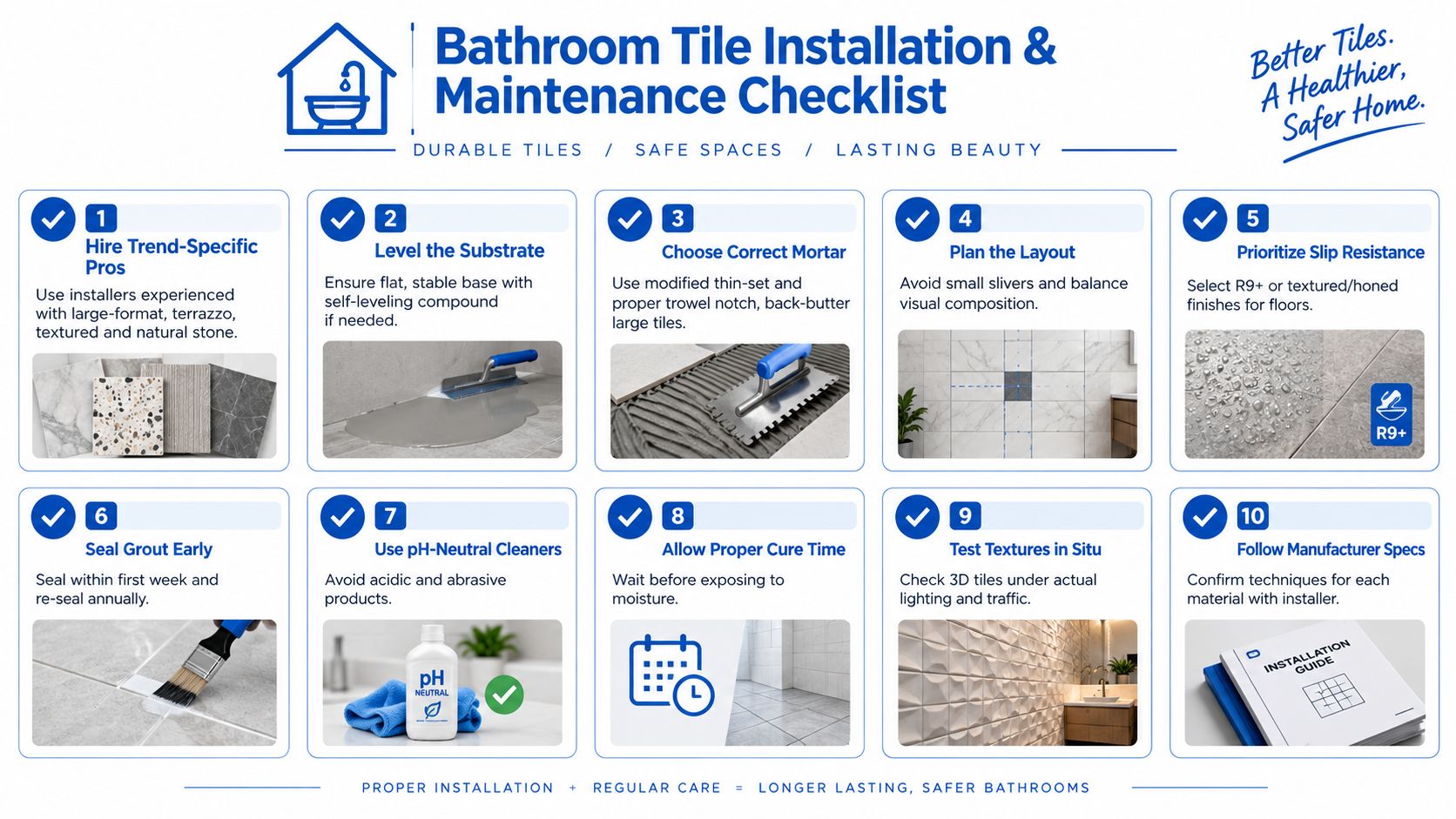
9. Installation and Maintenance Best Practices
A beautiful tile can fail as a bathroom surface if the assembly underneath it is poorly prepared. Waterproofing, substrate stability, mortar coverage, movement accommodation, grout selection, and cure time all influence the finished result. The decorative trend is only the visible layer of a system that must manage water every day.
Wet-area waterproofing isn't optional. A wet-area membrane code reference requires wet-area membrane tiling systems to follow the applicable installation standards, including AS 3958.1 and AS ISO 13007.1. The same reference explains that shower waterproofing must protect the floor and extend up the walls to the required height for the system and code jurisdiction. In Massachusetts, confirm the applicable local requirements with the contractor and building department before work begins.
A practical project checklist
- Confirm the substrate: Check that walls and floors are stable, appropriately flat, and ready for the selected tile size.
- Plan the layout: Avoid awkward slivers around doors, niches, benches, and plumbing fixtures.
- Choose the setting materials: Use the mortar and trowel configuration specified for the tile and substrate.
- Back-butter large tile: Improve coverage and reduce hollow spots beneath oversized pieces.
- Verify floor safety: Review the product's slip-resistance data for the intended wet location.
- Protect the waterproofing: Avoid careless fasteners or penetrations through the membrane.
- Respect cure times: Keep the bathroom out of service until mortar and grout have developed the required strength.
- Clean correctly: Use pH-neutral products and avoid acidic or abrasive cleaners on grout, stone, and resin surfaces.
- Maintain the joints: Seal grout when the product requires it and renew protection according to the manufacturer's guidance.
- Test the finished look: Check textured tile, grout color, and reflective surfaces under the room's actual lighting.
The bathroom tile installation guide can help homeowners understand the trade-offs before hiring a contractor.
10. Manufacturers, Designers, and Media That Popularize Trends
Bathroom tile trends don't spread only through showrooms. Manufacturers develop larger formats, realistic stone and wood graphics, relief surfaces, and coordinated collections. Designers combine those products into complete rooms, while renovation media translates the result into searchable ideas that homeowners in Massachusetts can adapt.
That creates both opportunity and risk. A photograph may show an uninterrupted slab wall, a glossy dark floor, or a fluted shower surround, but it rarely shows the substrate preparation, waterproofing details, cleaning routine, or replacement plan. Homeowners should treat media as a source of direction, not proof that a product will suit their room.
How to evaluate a trend before specifying it
Start with physical samples. Look at the tile under daylight, vanity lighting, and the dimmer evening conditions common in a bathroom. Run a hand across textured surfaces. Examine the edge, thickness, shade variation, and recommended grout joint. Ask how the manufacturer handles discontinued collections and whether matching trim, bullnose, or replacement pieces are available.
Designers often popularize combinations rather than individual products. A warm neutral palette may look current because of its pairing with ribbed texture, timber tones, or brushed metal. A large-format marble-look porcelain wall may feel luxurious because the layout avoids distracting cuts. The transferable lesson is the composition, not a requirement to duplicate every visible material.
For homeowners in Newton, Wellesley, Wayland, Weston, and Needham, local building character also matters. A historic home may benefit from a subway interpretation or restrained geometric floor, while a newer open-plan bathroom may support large-format porcelain and tile drenching. The best installation responds to the room's architecture, not just the image that inspired it.
Bathroom Tile Trends: 10-Item Comparison
| Item | Implementation Complexity | Resource Requirements | Expected Outcomes | Ideal Use Cases | Key Advantages |
|---|---|---|---|---|---|
| Large Format Tiles (24x48 and Larger) | High, requires perfectly level substrate and experienced installers | High material cost; heavy tiles, modified thin-set, reinforced substrate | Seamless, modern look with fewer grout lines and perceived spaciousness | Contemporary bathrooms, showers, radiant-heated floors, high-end remodels | Luxurious appearance, low grout maintenance, superior water resistance |
| Terrazzo Tile (Recycled Glass and Stone Aggregate) | Moderate–High, custom fabrication and terrazzo-specific installation | Premium materials, longer lead times, heavier substrate and epoxy resin binders | Customized, sustainable terrazzo aesthetic with depth and sparkle | Accent walls, statement floors, powder rooms, eco-conscious projects | Highly customizable, sustainable, non-porous, durable and luxurious look |
| Textured and 3D Tile (Dimensional Wall Features) | High, precise alignment, complex thin-set coverage, expert installer | Specialty tiles, higher labor, more careful grout application and cleaning tools | Sculptural wall depth and changing visual effects with light and shadow | Accent walls, powder rooms, shower focal points, low-traffic feature areas | Adds tactile interest, hides minor imperfections, strong visual focal point |
| Hexagonal and Geometric Mosaic Tiles | High, meticulous pattern alignment and grout control required | Skilled labor, increased grout, potential custom color palettes | Pattern-driven, high visual interest and distinctive geometric statements | Feature floors, accent walls, shower niches, decorative bands | Distinctive patterns, versatile styling, high customization, photogenic results |
| Wood-Look Porcelain Tiles (Realistic Wood Grain Aesthetic) | Moderate, standard porcelain techniques with careful layout for realism | Porcelain planks, textured finishes, matching grout; moderate cost | Warm, authentic wood appearance with porcelain durability and moisture resistance | Bathroom floors, transitions to adjacent rooms, rustic or contemporary designs | Realistic wood look, low maintenance, water-resistant, durable and cost-effective |
| Marble and Limestone Natural Stone Tiles | High, expert handling, sealing, and precise substrate work required | High material cost, regular sealing, specialized cleaners and maintenance | Timeless, one-of-a-kind veining and elevated luxury aesthetic | High-end bathrooms, accent walls, vanity surrounds, low-traffic areas | Unique natural beauty, high perceived value, sophisticated material depth |
| Subway Tile and Modern Interpretations (Timeless with Contemporary Twists) | Low–Moderate, straightforward but needs precision for grout and layout | Affordable materials, common installer skills, many finish and size options | Timeless, versatile aesthetic adaptable to many styles and trends | Whole bathrooms, backsplashes, shower surrounds, budget-conscious remodels | Classic versatility, affordable, easy repair, broad design flexibility |
| Cement and Concrete-Look Tiles (Industrial Aesthetic with Polished Appeal) | Moderate, standard porcelain installation with attention to seamless layout | Porcelain concrete-look tiles, textured finishes recommended, possible radiant heat | Industrial, minimalist look with durable, low-maintenance porcelain performance | Modern/industrial bathrooms, large-format floors, loft-style interiors | Durable, low-maintenance, contemporary industrial aesthetic, works with radiant heat |
| Installation & Maintenance Best Practices (Aggregated Guidance) | Varies, recommends trend-specific experienced installers and correct techniques | Leveling compounds, correct thin-set, sealers, pH-neutral cleaners, testing tools | Increased durability, safety, and long-term aesthetic performance | All tile projects, pre-install planning and ongoing maintenance routines | Prevents installation failures, standardizes care, prolongs material life and safety |
| Manufacturers, Designers & Media That Popularize Trends | N/A, informational resource rather than a material/system | Access to manufacturer samples, design resources, trade channels and marketing | Greater trend awareness, easier sourcing, curated product guidance | Material selection, sourcing, project inspiration, finding qualified vendors | Connects projects to reputable suppliers, trend insights, and design inspiration |
Choose a Trend That Will Last Beyond the Reveal
A bathroom renovation should still work after the reveal photos disappear. The safest decisions begin with three filters: the look you want, the room's moisture and safety demands, and the installation and maintenance commitment you can support. A deep-relief wall may be perfect for a lightly used Weston powder room but frustrating inside a busy family shower. A marble floor may suit a homeowner who enjoys natural variation and regular care, while porcelain may be the better choice for a household that wants a simpler routine.
Porcelain remains a strong technical standard for wet-area bathrooms because of its near-zero water absorption, which can help reduce concerns related to moisture entering the tile body. One industry forecast estimated bathroom-floor and wet-area applications at about 15% of porcelain demand, as reported in this porcelain market overview. The material also supports many of the major 2026 looks, including concrete, wood, marble, limestone, and terrazzo effects.
A simple selection checklist
- Define the visual anchor: Choose one primary statement, such as a large-format shower wall, terrazzo floor, or textured vanity wall.
- Support it with quiet surfaces: Use solid-color porcelain, restrained subway tile, or a low-contrast mosaic around the feature.
- Check wet-floor performance: Review the manufacturer's data instead of assuming that tile size or texture alone guarantees safety.
- Plan the cleaning routine: Deep relief, numerous grout joints, natural stone, and glossy dark surfaces each demand different care.
- Verify installation conditions: Confirm substrate flatness, waterproofing, drainage, movement joints, and access for large pieces.
- Keep replacement in mind: Save extra tile, record the product name, and confirm that trim and coordinating pieces are available.
- Review the whole room: Evaluate tile, grout, lighting, fixtures, vanity materials, and ventilation as one system.
A 2026 perspective on tile drenching
Tile drenching extends one tile, or a deliberately coordinated tile family, across the floor, walls, and shower area. The result can make a small bathroom feel visually larger because the eye encounters fewer material transitions. It can also simplify the design language in a large primary bath, particularly when the tile has quiet movement rather than a busy pattern.
The trade-off is commitment. If the same strong pattern covers every plane, replacement becomes more complicated and visual fatigue becomes more likely. A single damaged tile or discontinued product can affect several surfaces. Tile drenching also doesn't remove the need for careful waterproofing, floor slope, slip-resistance review, or properly sealed transitions.
For a durable Massachusetts interpretation, use dependable porcelain as the base and reserve stronger texture or color for a niche, vanity wall, or controlled band. A warm off-white stone-look tile across the room can feel continuous, while a small terrazzo or ribbed accent supplies personality. That combination delivers the emerging look without making every surface compete.
Frequently asked questions
What are the best bathroom tile trends for small spaces?
Large-format tile, restrained grout contrast, and a continuous wall treatment can make a small bathroom feel less fragmented. A small-scale mosaic may work especially well on a shower floor because it can follow the required slope, while a larger wall tile keeps the vertical surfaces calm. Avoid using several strong patterns in a compact room.
Is tile drenching a good idea for a bathroom?
It can be, especially when the homeowner wants a cohesive, low-contrast room. Use a durable porcelain or ceramic product, verify wet-floor safety, and plan access around drains, niches, valves, and corners. A quieter base tile with one accent zone is easier to live with than a highly dramatic pattern covering every surface.
Which bathroom tile materials are easiest to maintain?
Porcelain and ceramic are usually the most straightforward choices for routine bathroom care, provided the surface and grout are specified appropriately. Large formats can reduce grout cleaning, while matte finishes may hide marks better than high gloss. Textured tile and natural stone need more deliberate cleaning and maintenance.
How should homeowners care for natural stone tile?
Follow the stone and sealer manufacturer's instructions, use pH-neutral cleaners, and wipe away products that could stain or etch the surface. Honed finishes can be more forgiving than polished ones, but marble and limestone still require thoughtful sealing and ventilation. Don't use acidic cleaners unless the manufacturer specifically approves them.
What slip resistance should bathroom floor tile have?
For wet interior floors, ANSI A137.1 guidance cited by industry references sets a minimum DCOF of 0.42, according to this bathroom floor tile safety guidance. Some bathroom references also recommend at least R10 for bathroom floors and often R11 for wet rooms. Confirm the product's rating for the exact application.
Should a professional install large-format or textured tile?
Professional installation is a sensible choice for large-format, terrazzo, textured, geometric, and natural stone work. These materials demand careful substrate preparation, layout planning, mortar coverage, waterproofing, and finishing. Ask for examples of similar completed bathrooms, not only general remodeling photographs.
Schema recommendations
For the finished page, use Article schema with the article title, author, publisher, date, featured image, and URL. Add FAQPage schema only when the visible FAQ content meets Google's structured-data guidelines and accurately reflects the questions and answers on the page. Structured data should describe the page, not add claims that visitors can't see.
Homeowners in Wayland, Newton, Needham, Wellesley, Weston, and surrounding Massachusetts communities can request a quote from Sunny Day Pro Services for bathroom tile installation or a complete bathroom remodel. The right contractor should help you compare porcelain, ceramic, marble, terrazzo, and large-format options against your room's structure, moisture exposure, safety needs, and maintenance expectations.
Sunny Day Pro Services provides bathroom tile installation and remodeling for porcelain, ceramic, marble, granite, backsplashes, and full-room projects across Massachusetts. Visit Sunny Day Pro Services to request a quote and discuss a bathroom tile design that balances current style with dependable long-term performance.

