
Deep Cleaning Bathroom Service: What It Includes
See what a deep cleaning bathroom service covers, from grout and tile to fixtures, plus how often to book it and what results to expect.
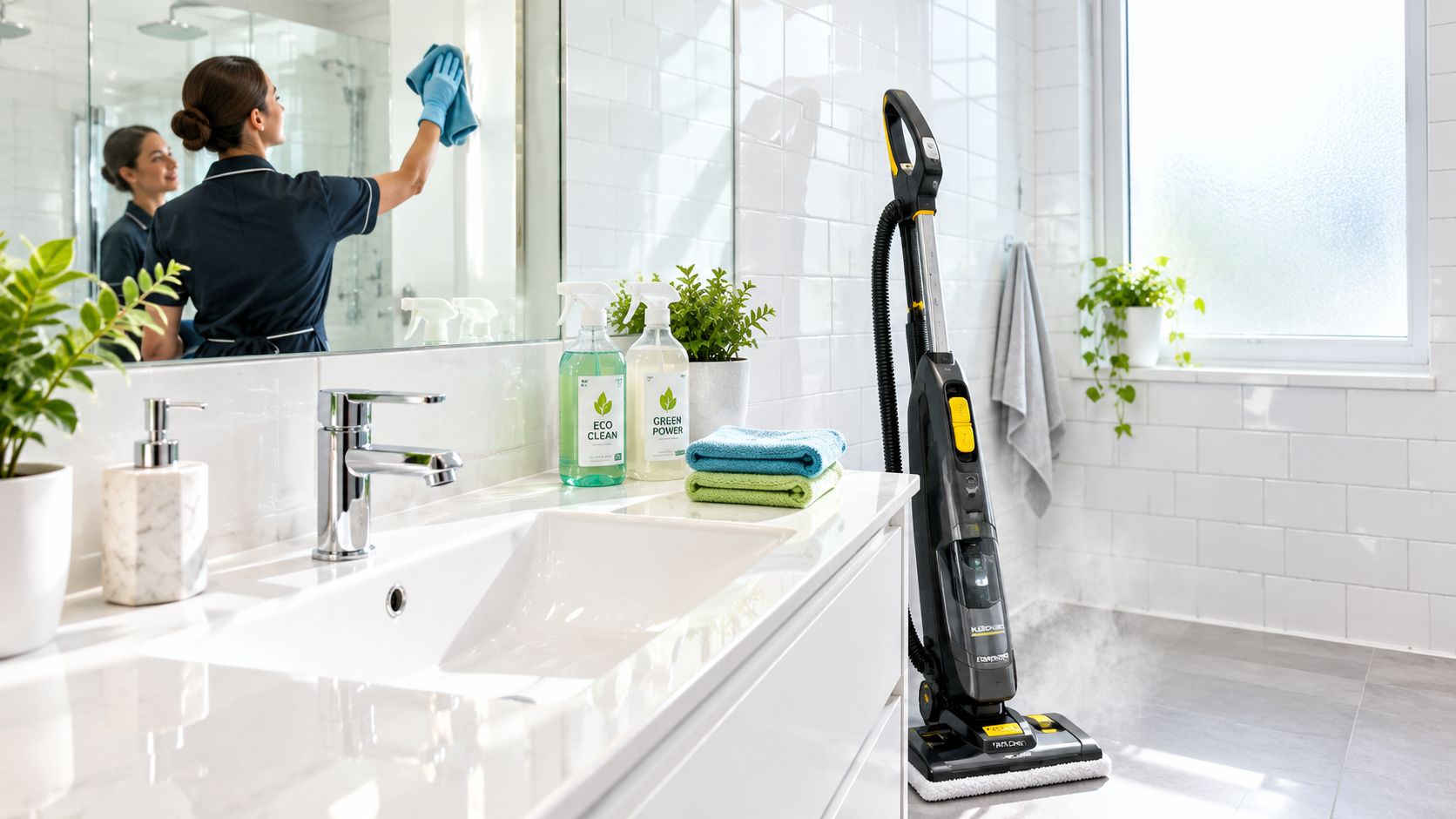
A professional deep cleaning bathroom service typically costs between $150 and $300, takes 1 to 3 hours, and involves a top-down workflow targeting grout, fixtures, and high-touch surfaces with EPA-registered disinfectants. If your bathroom looks tidy at first glance but still has dark grout, soap buildup, mineral stains, or a questionable toilet base, a routine wipe-down hasn't solved the underlying problem.
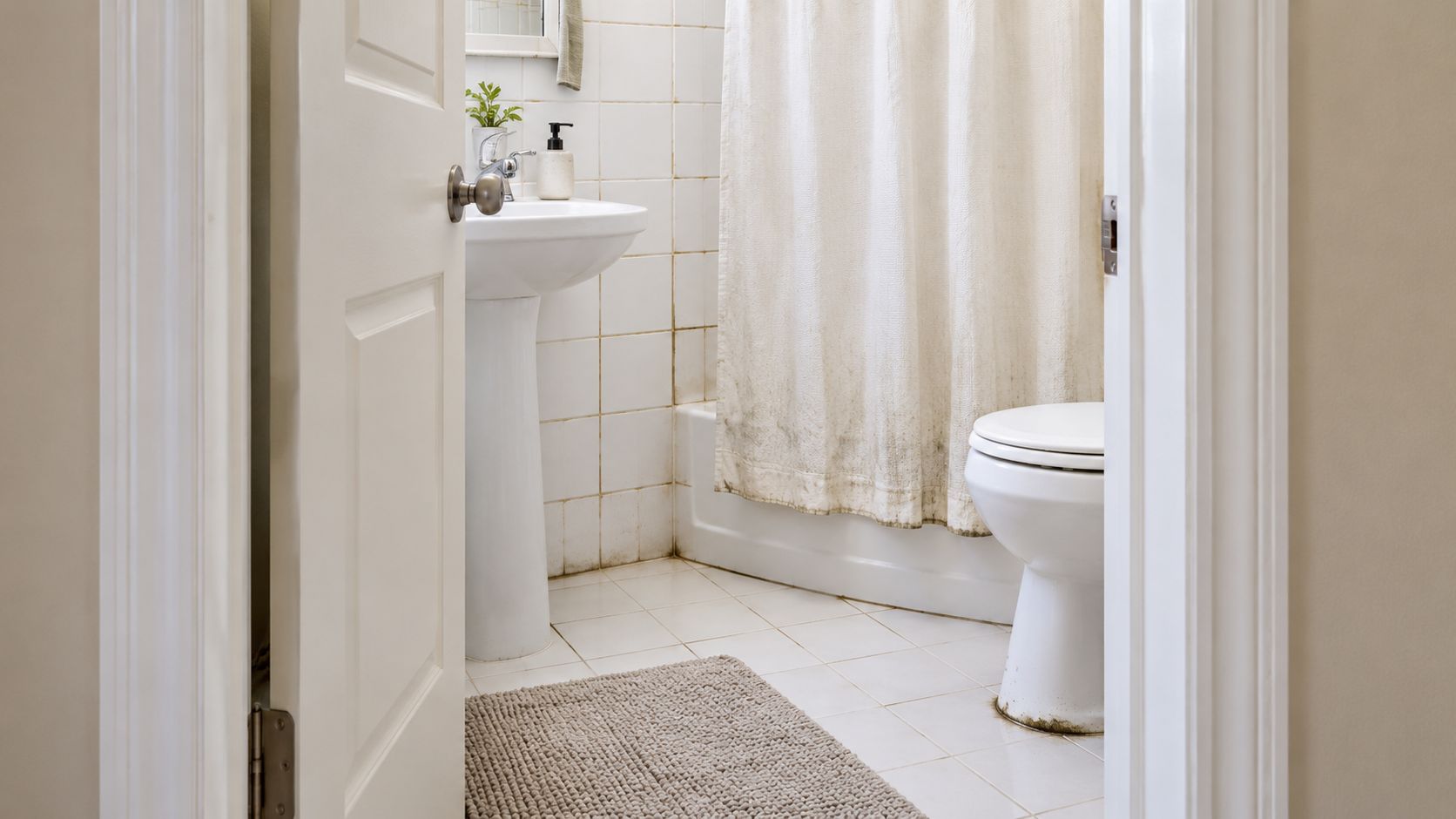
You open the door after a long week and see a familiar mix of unfinished chores. The sink is presentable, but the grout has changed color, the shower curtain has staining along the bottom, and dust has settled around the fan grille. The toilet may look clean from above while grime collects around the hinges, base, and floor edges.
That gap between visibly clean and properly deep cleaned is where professional service earns its place. A deep clean removes accumulated soil from overlooked surfaces, then applies disinfection correctly where the material and product allow it. It is not just a larger version of a weekly bathroom wipe-down.
Table of Contents
- Grout carries the heaviest burden
- Fixtures need detail, not just polish
- Mold and limescale require honest boundaries
The Hidden State of Your Bathroom
A bathroom can appear orderly while still carrying layers of residue. Soap scum bonds to tile and glass, hard-water minerals collect around faucets, and skin oils settle on handles, switches, and toilet surfaces. Moisture makes the room especially unforgiving, because damp grout, caulk, fabric, and dust can hold onto contamination long after the room looks acceptable.
A homeowner may spend several minutes cleaning the sink and mirror, then stop because the room looks better. The problem is that the most labor-intensive areas are often the least visible. The underside of the toilet rim, the seam where the tub meets the wall, the grout behind bottles, and the floor around the toilet all need separate attention.
Why bathrooms receive deeper attention
Bathrooms rank as the room homeowners most often choose for intensive cleaning. In a major U.S. cleaning survey, 46% of respondents identified the bathroom as the room they deep clean most often, ahead of kitchens at 36%, living rooms at 10%, and bedrooms at 7%. The survey included 1,000 nationally representative U.S. adults and was conducted in March 2018, providing a useful baseline for understanding why bathroom cleaning remains a distinct priority. The American Cleaning Institute survey results also found that the toilet was the area cleaned most often overall, cited by 88% of respondents, while the tub and toilet tied as the most dreaded tasks at 52% each.
Those findings match what cleaners see in homes. People keep returning to the toilet and sink because they're obvious, but they often postpone grout, caulk, fan covers, shower tracks, and the back of fixtures. Over time, those postponed tasks become the work that separates maintenance cleaning from a deep cleaning bathroom service.
Practical rule: A bathroom that looks clean from the doorway still needs an inspection at floor level, behind fixtures, and inside grout joints.
A professional visit can change the room's feel without pretending to repair every defect. Freshly cleaned grout may look brighter, fixtures can lose their cloudy film, and high-touch surfaces can be properly cleaned and disinfected. But cracked caulk, permanently etched stone, failed grout, and active moisture problems may need repair or remediation rather than more scrubbing.
What a Professional Deep Clean Actually Involves
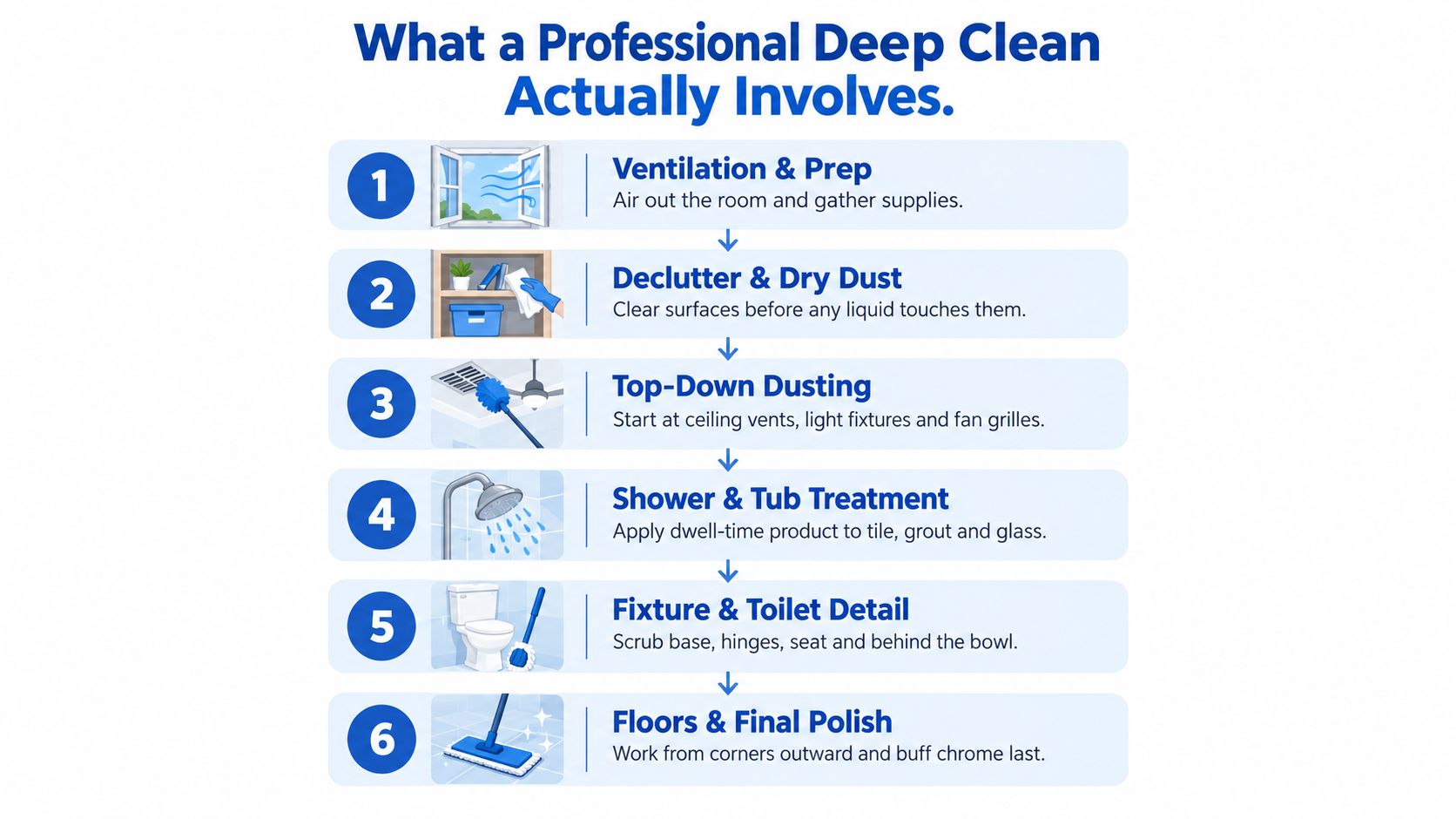
The order of work matters. Cleaning high surfaces after the floor has been washed sends dust and dirty water back onto finished areas, forcing the cleaner to repeat tasks. Professionals generally work from the ceiling downward, ending at the floor so loosened soil travels toward a surface that hasn't yet been finished.
The top-down sequence
Ventilation and preparation come first. The cleaner opens available ventilation, gathers surface-appropriate products, removes loose items, and checks whether stone, painted walls, sealed grout, or delicate finishes need special handling.
Ceilings and fan grilles receive attention before wet cleaning begins. Dry dusting or vacuuming removes loose particles from vents, light fixtures, corners, and high ledges without dropping them onto freshly cleaned counters.
Walls, mirrors, and upper surfaces follow. The cleaner removes marks from washable walls, cleans mirrors without flooding their edges, and wipes shelves or recessed niches where dust and product residue collect.
Countertops, sinks, faucets, and hardware are then cleaned according to their materials. A stainless fixture, chrome finish, porcelain sink, and natural-stone counter don't all tolerate the same chemistry or abrasive tool.
The toilet receives a detailed clean inside and outside. That includes the bowl, underside of the rim, seat hinges, flush handle, tank area, base, and the floor immediately around it. Restroom fixtures are recognized as high-touch surfaces in CDC cleaning and disinfection guidance, so wiping only the visible lid is inadequate.
The tub, shower, and floor finish the physical cleaning phase. Tile, grout, glass, tracks, drains, corners, and floor edges receive the attention their residue requires, and the floor is cleaned last to capture fallen soil.
Cleaning is not the same as disinfection
This distinction is the most commonly missed part of bathroom service. Disinfection doesn't work reliably on top of soil and biofilm, because residue can physically block the product from reaching microorganisms. A cleaner must pre-clean the surface, remove visible contamination, and then apply an EPA-registered disinfectant according to its label.
The surface must remain visibly wet for the full labeled contact time, which is often 1 to 10 minutes, depending on the formulation and target pathogen. The EPA's selected registered disinfectants guidance explains why a quick spray-and-wipe routine doesn't establish reliable disinfection. If the product dries early, the cleaner may need to reapply it.
Key Areas Targeted in a Deep Clean
Bathroom surfaces create different cleaning problems. Porcelain may tolerate stronger work than polished marble, while cementitious grout can absorb soil that sits untouched on the face of a glazed tile. A capable cleaner identifies the residue and material before choosing a chemical or tool.
Grout carries the heaviest burden
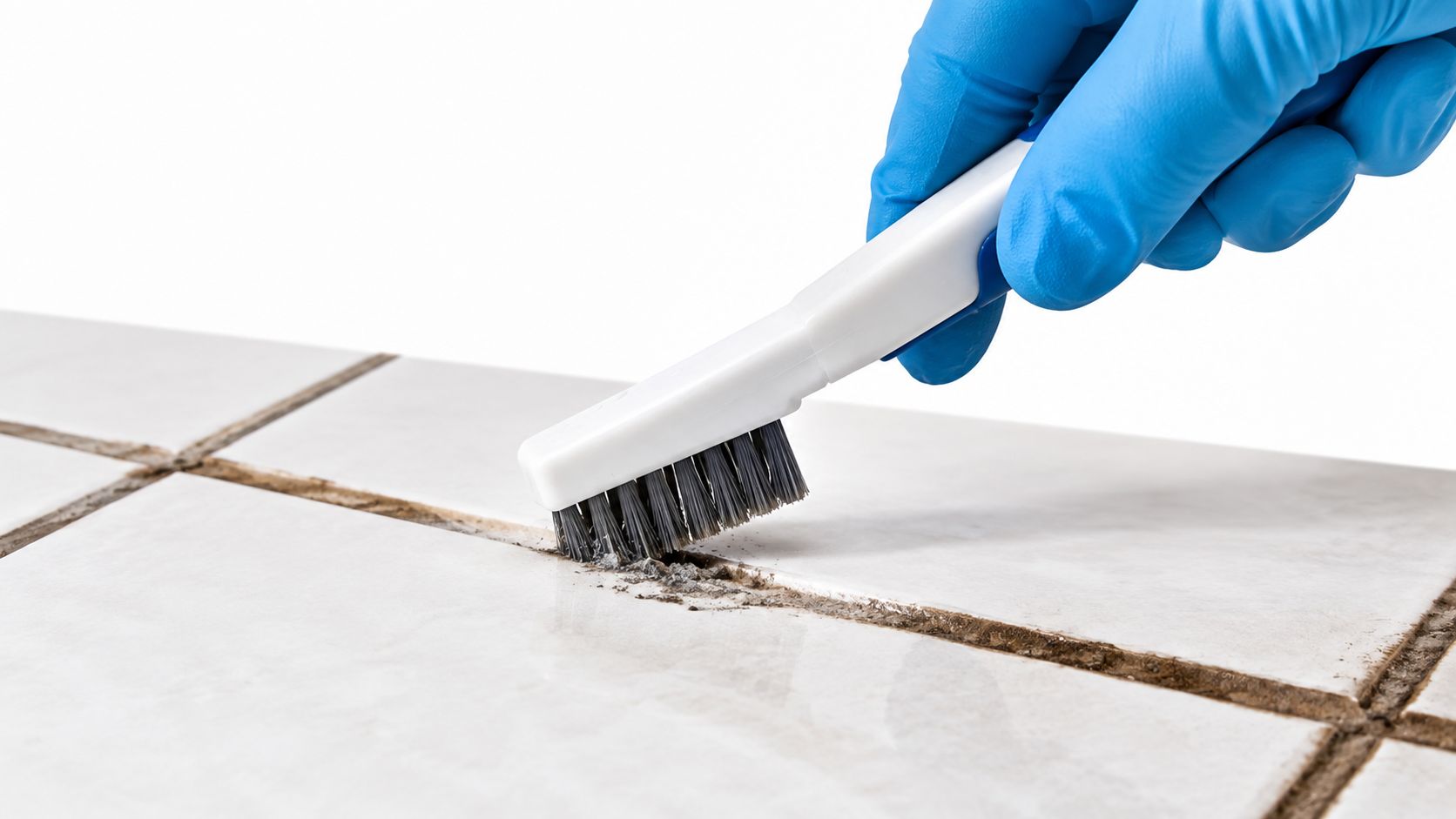
Grout and textured tile joints are usually the hardest-working part of the room. Porous cementitious grout can trap soil within its matrix, and neglected joints may develop stubborn biofilm. A spray alone won't extract embedded residue.
Effective grout work pairs chemical dwell time with mechanical agitation. For soap scum, hard-water scale, and mildew, expert guidance commonly uses a stiff nylon brush after 10 to 20 minutes of contact time, with the chemistry selected for the residue. A mild acid can help with mineral scale, while an alkaline or oxygen-bleach approach may suit mildew and biofilm, provided the product is safe for the surface. Homeowners can compare the principles in this guide to how to clean tile grout.
Fixtures need detail, not just polish
Faucet handles, shower controls, toilet handles, drawer pulls, and light switches are touched repeatedly. Cleaning removes oils and residue from those surfaces. Disinfection follows only after the surface has been cleaned and only when the product label permits use on that material.
Chrome can lose its finish from aggressive abrasives. Natural stone can etch from acidic products, and older caulk may be permanently discolored even after surface mold has been removed. A professional should explain the difference between removing contamination, improving appearance, and restoring damaged material.
Mold and limescale require honest boundaries
A deep clean can remove surface mold from suitable hard materials and reduce visible limescale, but it can't correct a plumbing leak or replace deteriorated caulk. Mold growth may recur if moisture remains trapped. The EPA mold guide advises scrubbing visible mold from hard surfaces with detergent and water, drying the area completely, and fixing leaks or other moisture sources.
That boundary protects the homeowner from paying for a cosmetic promise when the room needs repair. A service should identify whether the issue is removable soil, mineral scale, staining, damaged finish, failed sealant, or a moisture-related mold problem.
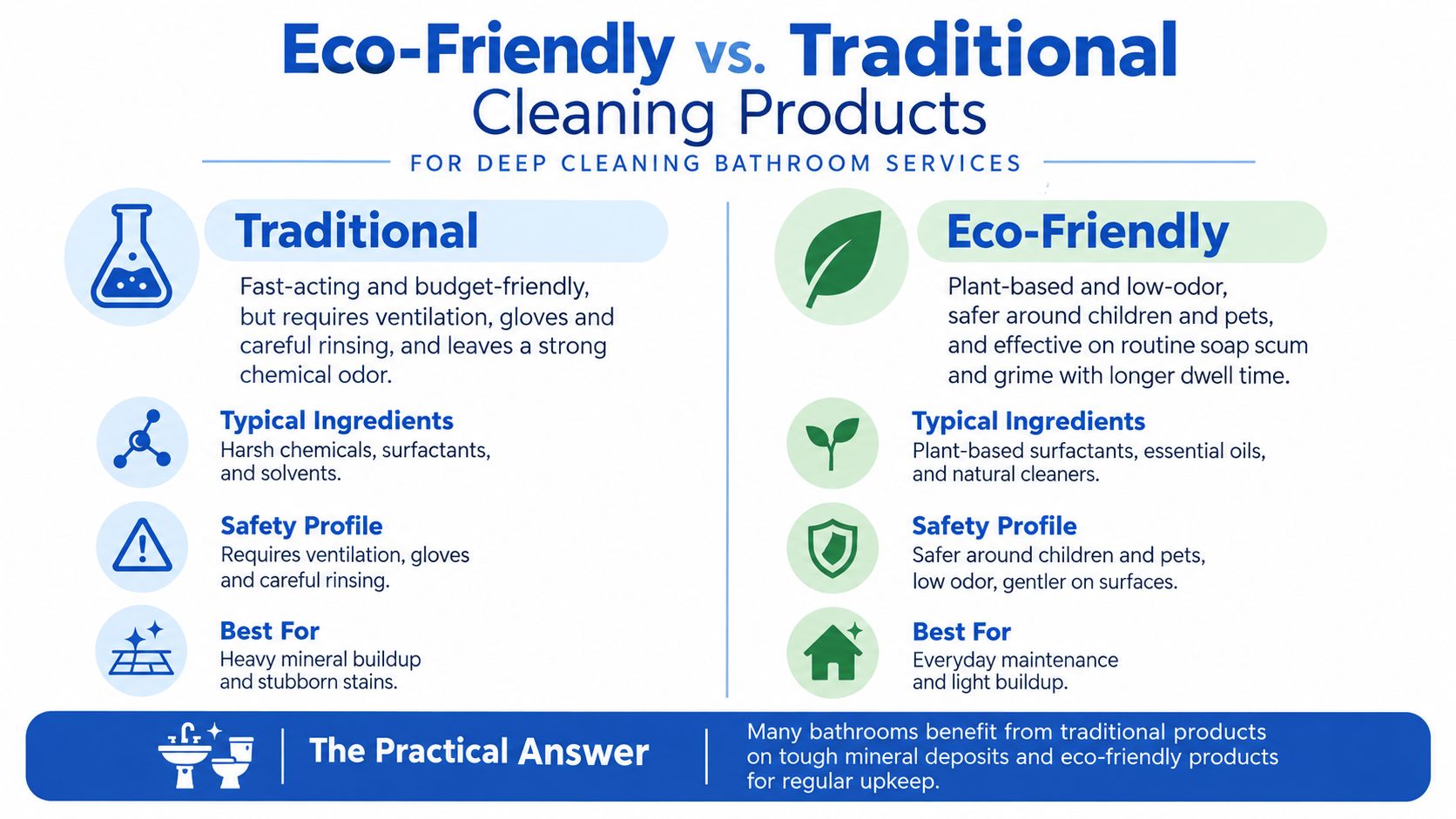
Eco-Friendly vs. Traditional Cleaning Products
The practical choice isn't just “green” versus “chemical.” Every effective cleaning product contains chemistry, and the right option depends on the residue, surface, ventilation, and household sensitivities. A low-odor product may be preferable for routine maintenance, while a difficult mineral deposit may require a stronger, surface-compatible formulation used with gloves and ventilation.
Cleaning product trends in 2026 are moving toward low-VOC and bio-based formulations, reflecting demand for safer, surface-specific maintenance rather than generic checklists, as described in this bathroom deep-cleaning scope guide.
Where traditional products can help
Traditional formulations can be fast-acting on heavy deposits, especially when the product is matched to the residue. A mild acid may loosen mineral scale, while an alkaline cleaner can help break down organic soil and some mildew-related residue. That doesn't make every strong bathroom product suitable for every surface.
The trade-off is exposure control. Cleaners may need gloves, ventilation, careful rinsing, and strict separation between incompatible products. Strong odor also matters to households with children, pets, asthma, or chemical sensitivities. More aggressive isn't automatically more effective if it damages grout, stone, metal finishes, or sealants.
Where lower-impact products fit
Bio-based and low-VOC options can work well for routine soap scum, light grime, and ongoing maintenance. They may have a lower odor and a more comfortable handling profile, but some require more dwell time and repeated mechanical action. A product that is gentle on a surface may be slower on baked-on scale.
| Cleaning need | Practical product direction | Main trade-off |
|---|---|---|
| Routine soap scum | Low-odor or bio-based cleaner with dwell time | May need more brushing |
| Mineral scale | Surface-safe mild acid where appropriate | Can damage stone or sensitive finishes |
| Mildew and biofilm | Compatible alkaline or oxygen-based product | Requires pre-cleaning and careful rinsing |
| Disinfection | EPA-registered product used after cleaning | Must remain wet for the label contact time |
Homeowners should tell the cleaner about product preferences before the appointment. Sunny Day Pro Services lists eco-friendly options alongside deep-cleaning work, allowing the product approach to be discussed with the condition of the bathroom rather than chosen as a slogan. More guidance is available in this resource on eco-friendly cleaning products.
How to Prepare Your Bathroom for Service
Preparation doesn't mean scrubbing before the cleaner arrives. It means removing obstacles so the professional can reach the surfaces that need the most work. A crowded counter turns a deep clean into a series of small item-moving tasks, while a clear room lets the cleaner concentrate on buildup, edges, fixtures, and floors.
A useful preparation checklist
- Clear countertops and shelves: Remove toiletries, cosmetics, medication, decorative objects, and loose accessories.
- Take out rugs and mats: Set them aside so the cleaner can reach the floor beneath and around them.
- Remove fragile belongings: Move glass containers, delicate organizers, and items that could be damaged by moisture.
- Empty the shower floor: Take out bottles, razors, stools, toys, and removable caddies.
- Secure pets: Keep animals away from wet floors, open products, and equipment during the appointment.
- Mention sensitive materials: Identify marble, granite, specialty tile, painted surfaces, old grout, or recently sealed areas.
- Share the problem areas: Point out a recurring odor, leak, mold-like growth, loose caulk, or fixture that shouldn't receive a particular product.
- Provide access and preferences: Confirm entry details, product sensitivities, and whether any cabinet or storage area is off-limits.
A clear bathroom helps the cleaner spend time on the surfaces you hired them to address, not on relocating personal belongings.
Ventilation is useful during and after service, especially when products need to remain wet for their labeled contact time. Moisture control also affects the result after the visit. One EPA-linked maintenance source recommends drying wet materials within 24 to 48 hours and keeping indoor humidity below 60%, ideally between 30% and 50%, to reduce mold risk in damp areas. Bathroom moisture-control guidance provides that context.
Before booking, ask exactly what the deep-clean package includes, whether grout restoration or mold remediation is separate, and how the provider handles delicate finishes. Requesting a cleaning service quote with the bathroom's materials and problem areas listed helps prevent a mismatch between the requested result and the actual scope.
Benefits of Regular Deep Cleaning Services
A deep clean has value beyond the immediate shine. It removes residue that makes routine maintenance harder, exposes damaged caulk or failing grout, and gives homeowners a clearer view of what needs repair. It can also make the bathroom easier to maintain because a clean surface has less accumulated buildup for the next weekly visit.
The maintenance rhythm should match the room's use and moisture conditions. Weekly attention to toilets, sinks, and shower surfaces helps prevent heavy accumulation, while a periodic professional visit addresses areas that ordinary wiping misses. A 2024 multinational YouGov survey found that 51% of respondents clean toilets weekly, 48% clean bathroom or toilet sinks weekly, and 40% clean shower units weekly. In the United States, another survey found that people clean their main bathroom an average of seven times per month, reinforcing the role of regular upkeep. YouGov's international bathroom-cleaning survey documents those habits.
What regular service protects
- Hygiene: High-touch fixtures receive structured cleaning instead of occasional surface wiping.
- Appearance: Grout, tile, glass, and chrome are less likely to develop layers of residue that make the room look permanently dull.
- Material life: Prompt removal of scale and soap buildup can reduce the need for aggressive scrubbing later, although damaged finishes still require repair.
- Moisture awareness: A cleaner may notice recurring dampness, failed caulk, or a leak that needs attention before cleaning alone can solve the problem.
- Convenience: Busy households in Wayland, Newton, Needham, Wellesley, Weston, and nearby Massachusetts communities can maintain a consistent standard without reserving every weekend for bathroom work.
Bathrooms also deserve a clear distinction between cleaning and remediation. A cited study reported mold in 49% of shower grouts and 50% of walls above showers, making the bathroom a particularly important place to investigate moisture and recurring growth. Coverage of that mold research also underscores why a broad promise to “sanitize everything” isn't enough. The provider should explain what can be cleaned, what may be permanently stained, and what requires moisture correction or specialized remediation.
A good service leaves you with more than a brighter room. It gives you a realistic condition report, a cleaner starting point for weekly maintenance, and practical instructions for keeping water, residue, and high-touch contamination under control.
Sunny Day Pro Services provides one-time deep cleaning, recurring home cleaning, move-in and move-out service, and restroom deep sanitizing options for homeowners across Massachusetts communities. Visit Sunny Day Pro Services to request a quote, discuss your bathroom's grout, fixtures, moisture, and material concerns, and schedule a service built around the specific work your space needs.

