
Deep Cleaning Services Kitchen: What to Expect
Deep cleaning services kitchen help you tackle grease, grime, and hidden buildup. Learn what’s included and how to prep your space for a thorough refresh.
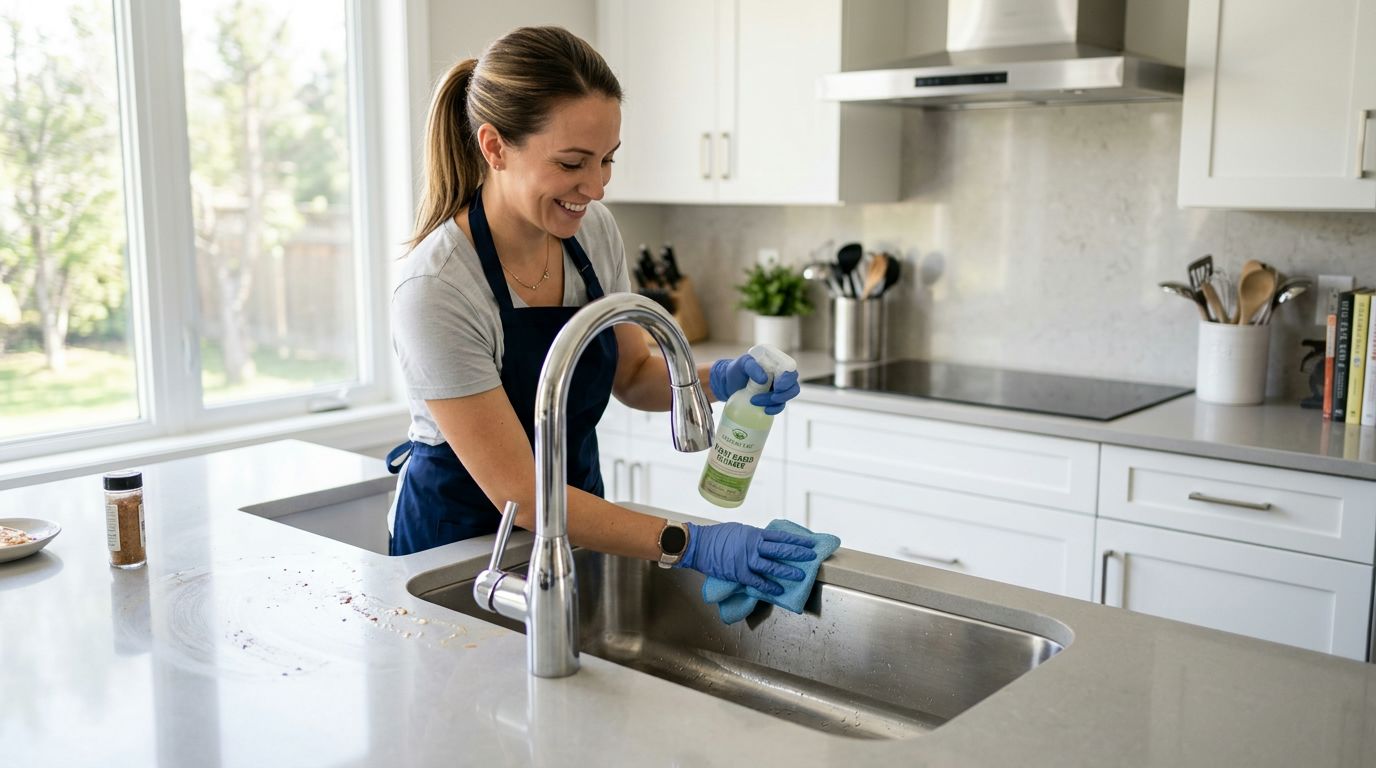
A kitchen can look spotless and still have a food-safety problem. A polished countertop doesn't tell you whether raw-meat residue reached the faucet handle, whether a sponge transferred soil back onto a cutting board, or whether the sink itself was cleaned after food preparation. The most useful deep cleaning services kitchen guide therefore starts with a less comfortable idea: shine is a visual result, not proof that cross-contamination has been controlled.
A professional deep clean should remove accumulated grease and food residue, address overlooked contact points, use products correctly, and improve ventilation around cooking equipment. It complements safe food handling, including handwashing, separating raw and ready-to-eat foods, and cooking food properly. It can't guarantee that a household will avoid foodborne illness, but it can give the room a more reliable preventive reset.
Table of Contents
- Start with preparation and dry soil
- Follow the kitchen's contact points
- Cleaning vs. Sanitizing vs. Disinfecting in the Kitchen
- Why two similar kitchens receive different quotes
- Typical Time and Cost Ranges for a Kitchen Deep Clean
Why a Spotless Kitchen Is Not the Same as a Safe Kitchen
Many homeowners judge a kitchen by its counters, floor, and overall smell. Those surfaces matter, but they don't tell the whole story. A kitchen's higher-risk points often include the sink basin, faucet lever, refrigerator handle, cabinet pulls, appliance controls, cutting-board area, backsplash seams, and trash-container lid.
The gap between intended hygiene and real behavior makes this important. In a 2023 USDA observational study, 87% of participants said they washed their hands before cooking, but researchers observed that only 44% did so. Handwashing wasn't attempted in 83% of situations where it was needed, including after contact with raw sausage, eggs, unwashed produce, contaminated equipment, or food-contact surfaces. The USDA study on consumer kitchen behavior also found that the sink was the most frequently contaminated tested area. 34% of participants contaminated the sink during meal preparation, while 26% contaminated cut cantaloupe.
Practical rule: If a surface touches hands, food, utensils, or raw-food packaging, include it in the cleaning plan even when it looks clean.
What a deep clean is really resetting
A kitchen deep clean is best understood as preventive maintenance. It removes grease that can hold food residue, clears buildup from edges and seams, and gives high-touch surfaces deliberate attention instead of receiving whatever quick wipe remains after dinner.
That matters beyond one household. The World Health Organization's food-safety overview estimates that contaminated food causes approximately 866 million illnesses and 1.52 million deaths worldwide each year, based on its latest global burden estimates for 2021. WHO also estimates an economic burden of about US$310 billion in 2021. Household dirt alone doesn't explain those figures, but safe food handling and kitchen hygiene remain practical preventive factors.
The service should leave you with more than a fresh smell. It should address grease, food residue, and high-touch contamination in the places routine wiping tends to miss, while keeping the distinction between cleaning and sanitizing clear.
What Deep Cleaning Actually Includes
Routine cleaning is like maintaining a car between trips. You remove obvious dirt, wipe the surfaces you use most, and keep the room functional. A kitchen deep clean is closer to scheduled maintenance. The crew reaches edges, handles, appliance zones, grease traps, and accumulated residue that daily upkeep usually skips.
A written scope matters because “deep cleaning” can mean different things to different companies. A useful explanation of what deep cleaning includes can help you compare the service description with the quote instead of relying on the label alone.
The core kitchen scope
A thorough visit commonly addresses:
- Appliance exteriors: Refrigerator, dishwasher, microwave, toaster, and other accessible surfaces.
- Accessible appliance interiors: Interior refrigerator shelves, microwave surfaces, or other areas when included in the quote.
- Cooking equipment: Cooktop, knobs, backsplash, range-hood exterior, and accessible grease filter.
- Cabinet surfaces: Doors, drawer fronts, pulls, edges, toe-kicks, and grease-heavy areas above or beside the cooktop.
- Food-preparation surfaces: Countertops, cutting-board zones, seams, and backsplash.
- Sink area: Basin, drain-adjacent surfaces, faucet, handles, splash guard, and surrounding counter.
- Waste areas: Trash and recycling container exteriors and, when included, their interiors and lids.
- Floors and trim: Debris removal, mopping, corners, baseboards, and edges under accessible furniture.
The order also matters. Crews generally remove loose debris first, work from higher surfaces toward lower ones, complete wet cleaning after dry soil removal, and leave floors until the end. That prevents dust and crumbs from landing on surfaces that have already been finished.
What may cost extra
Some work needs a separate line item or special preparation. Inside an oven may require specialty treatment, and a fully stocked refrigerator may need to be emptied by the homeowner before shelves can be cleaned. Exterior windows, walls, closed cabinet contents, and items that require disassembly are also commonly outside a standard kitchen scope.
Ask the provider to identify included areas, add-ons, access requirements, and material limitations in writing. Two companies can use the same phrase while offering very different levels of detail.
The Room-by-Room Deep Cleaning Checklist
A crew shouldn't move randomly around the room. A practical progression limits cross-contamination and keeps finished areas protected.
Start with preparation and dry soil
Remove trash, recycling, rugs, and loose objects from the work zone. Dust high surfaces first, then clear crumbs from cabinet tops, appliance tops, trim, and floor edges. Small appliances should be unplugged before their exterior is cleaned, and anything that could be damaged by moisture should be moved or identified.
Work around the kitchen in zones. Clean cabinet faces above the cooktop with a suitable degreaser, then continue across nearby doors and drawer pulls. Pull accessible small appliances forward so the counter behind and beneath them doesn't retain sticky residue.
Follow the kitchen's contact points
The range hood and filter need grease removal, not just a damp cloth. The sink basin, faucet base, drain rim, and disposal splash guard should be scrubbed and rinsed. The trash can interior and lid deserve attention because hands touch them during food preparation and disposal.
High-touch areas include refrigerator handles, cabinet pulls, microwave controls, stove knobs, dishwasher handles, light switches, and faucet levers. Cutting-board zones and backsplash seams need careful cleaning because food particles can collect in small gaps.
The table below separates three steps that are often treated as if they mean the same thing.
Cleaning vs. Sanitizing vs. Disinfecting in the Kitchen
| Step | What it does | When to use in the kitchen |
|---|---|---|
| Cleaning | Detergent and water remove grease, food residue, and organic soil. | Use first on countertops, sinks, cutting areas, cabinet surfaces, appliance exteriors, and other visibly or technically soiled surfaces. |
| Sanitizing | Reduces microorganisms on a cleaned food-contact surface to the level permitted by the product or applicable guidance. | Use after cleaning and rinsing on surfaces that contact food, utensils, raw ingredients, or hands during food preparation. |
| Disinfecting | Provides a higher-control antimicrobial treatment when an appropriate registered product is used correctly. | Use selectively on suitable high-touch or contaminated surfaces, following the product label and surface restrictions. |
The CDC guidance on cleaning and disinfecting at home recommends hot, soapy water for countertops, followed by sanitizing surfaces that contacted raw meat, poultry, or their juices, including the sink basin. The practical sequence is remove debris, wash, rinse where required, apply the correctly labeled product, maintain wet contact time, and air-dry or follow label rinsing instructions.
Time Estimates and What Drives the Price
A kitchen deep clean can take a short visit when the room is maintained, or a much longer service when grease has hardened around the cooktop, cabinets, hood, and appliance edges. The clock reflects the work, not just the room's floor area.
A standard residential kitchen may require a few hours of focused labor. A neglected kitchen that hasn't received detailed service in over a year can take substantially longer, especially when the hood filter, cabinet faces, appliance interiors, and sink area need degreasing. Inside-fridge and inside-oven work are often quoted as add-ons because they require extra handling, emptying, soaking, or specialty products.
Why two similar kitchens receive different quotes
Square footage is only one variable. Crews also consider:
- Layout and surface count: More cabinets, corners, handles, trim, and appliances create more handwork.
- Grease and residue: Baked-on cooking film takes longer than loose dust.
- Occupancy and pets: More daily activity can mean more food residue, hair, and touchpoints.
- Service frequency: A regularly maintained kitchen usually needs less reset work than a one-time clean.
- Add-ons: Refrigerator interiors, ovens, cabinet interiors, stainless-steel polishing, and grout work may be separate.
- Product requirements: Fragrance-free, low-emission, or surface-specific products can change preparation and labor.
- Local labor conditions: Rates vary among suburban Boston communities, including Wayland, Newton, Needham, Wellesley, Weston, and nearby areas.
Because no universal price fits every home, use ranges as planning categories rather than promises.
Typical Time and Cost Ranges for a Kitchen Deep Clean
| Kitchen profile | Typical duration | Typical price range | Key drivers |
|---|---|---|---|
| Maintained kitchen with standard scope | A few focused hours | Quote dependent | Cabinet count, appliance access, grease level, and included surfaces |
| Heavily used or neglected kitchen | Several focused hours or a split service | Quote dependent | Baked-on grease, hood filter, cabinet buildup, neglected edges, and residue |
| Kitchen with interior add-ons | Additional time beyond the standard visit | Quote dependent | Fridge emptying, oven condition, cabinet interiors, appliance access, and specialty treatment |
A written walkthrough or video estimate is more reliable than a quick ballpark because the provider can see the actual condition and confirm what “deep” includes. Use this guide to understanding a cleaning service quote when comparing labor, add-ons, access instructions, and cancellation terms.
Cleaning Products, Dilution, and Dwell Time
“Stronger” doesn't automatically mean safer or more effective. A concentrated product can damage stone, metal, sealants, or finishes, while an under-dosed sanitizer may not perform as tested.
The first step is detergent cleaning. Grease, protein, and food residue can shield microorganisms and consume the capacity of a product applied afterward. For food-contact surfaces, the sequence should be clean, rinse, sanitize, with disinfection used only when appropriate for the situation and surface.
Read the label like a technician
Check four things before applying a sanitizer or disinfectant:
- Dilution: Measure the product exactly. Don't estimate by adding a larger splash to a spray bottle.
- Surface compatibility: Confirm that the product is approved for the countertop, metal, plastic, stone, or other material.
- Contact time: Keep the surface visibly wet for the label-specified period. Wiping it dry immediately can prevent the intended microbial reduction.
- Rinsing instructions: Some food-contact products require a potable-water rinse, while others specify air-drying without rinsing.
The USDA Food Safety and Inspection Service guidance on chemical sanitization states that chemical sanitization of food-contact equipment should provide at least 10 seconds of exposure for chlorine solutions or at least 30 seconds for other chemical sanitizers, unless the EPA-registered label specifies otherwise. Chlorine performance also depends on concentration, temperature, and pH. At pH 8 or below, the guidance lists 25 mg/L at least 49°C, 50 mg/L at least 24°C, and 100 mg/L at least 13°C.
Never mix bleach with acids or ammonia. Keep chemicals away from food and children's access, ventilate the space, and document product dilution and dwell time so the result can be repeated rather than improvised.
Eco-Friendly Options That Actually Matter
A strong lemon or pine smell isn't evidence that a kitchen is cleaner. Fragrance can mask odors, and fragranced sprays, air fresheners, essential-oil diffusers, and disinfectants can contribute nanoscale particles indoors. A 2025 Purdue University report on indoor air and everyday chemical products also notes that cooking with a gas stove can emit large quantities of particles.
“Eco-friendly” isn't a complete technical specification. Ask what the crew uses, where it will be used, how long it must remain wet, and how the kitchen will be ventilated during and after service.
Questions that reveal meaningful product choices
- Fragrance policy: Can the provider use fragrance-free products or avoid scented sprays?
- Targeted disinfection: Will disinfectant be reserved for appropriate high-touch or contaminated areas instead of sprayed everywhere?
- Surface protection: Is the product compatible with your stone, sealed wood, tile, stainless steel, and appliance finishes?
- Ventilation plan: Will the range hood vent outdoors, and can windows be used when appropriate?
- Household sensitivities: Can the team accommodate asthma, allergies, children, older adults, pets, or chemical sensitivities?
The Sunny Day Pro Services guide to eco-friendly cleaning products can help homeowners frame that conversation. A practical request is fragrance-free or low-emission products, no chemical mixing, measured dilution, targeted antimicrobial use, and ventilation during and after the visit.
For range-hood ventilation, the EPA recommends turning on the hood whenever you cook and leaving it on for 10 to 20 minutes afterward. Its indoor-particulate guidance cites approximately 100 cubic feet per minute as a typical range-hood recommendation, while noting that larger fans may require make-up air to reduce depressurization and backdrafting concerns. EPA guidance on indoor particulate matter also recommends routinely cleaning cooking surfaces, appliances, and the hood's grease filter.
How to Get Your Kitchen Ready Before the Crew Arrives
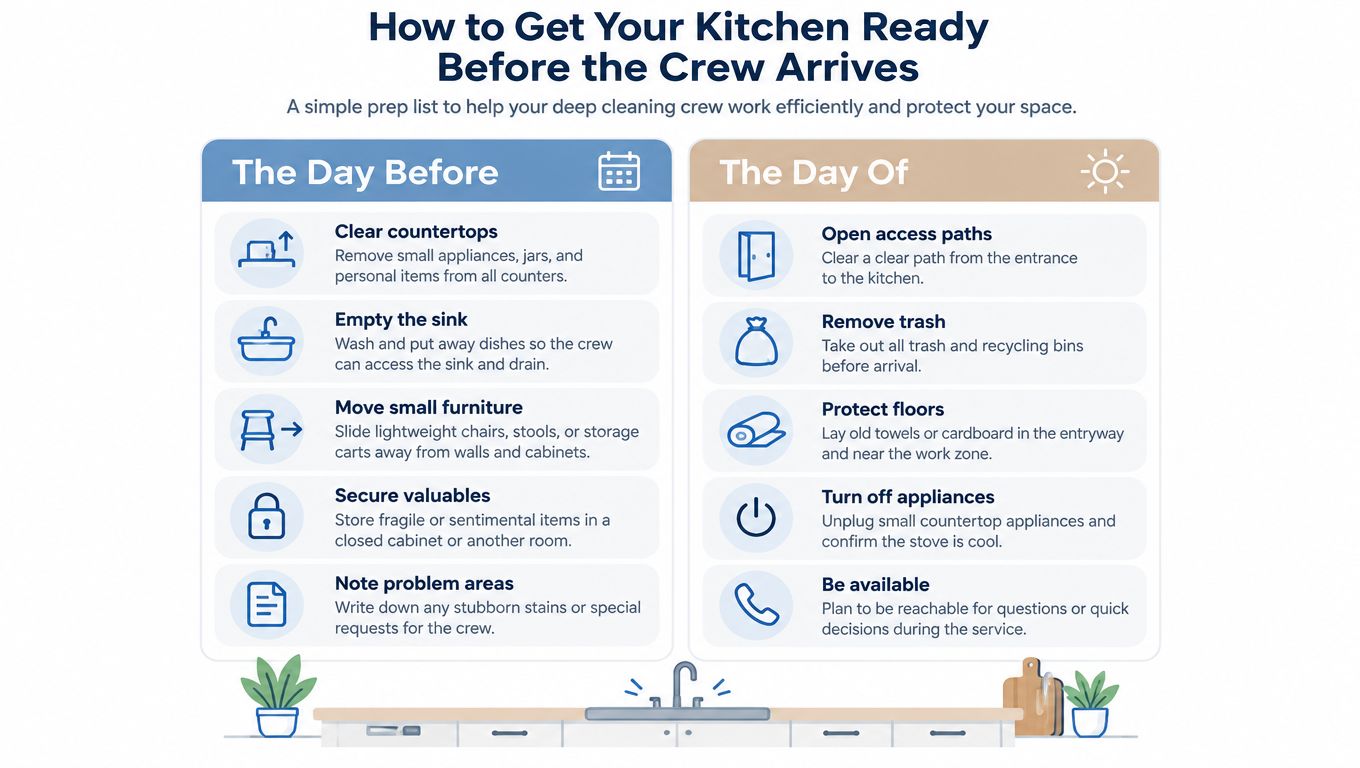
Preparation doesn't mean cleaning the kitchen first. It means removing obstacles, protecting fragile items, and giving the crew access to the surfaces that need the most work.
The day before
Clear small appliances, jars, mail, and personal items from countertops. Empty the sink and put away dishes so the basin, drain area, and faucet are accessible. Emptying the dishwasher also gives the crew somewhere to place cleaned removable parts.
Move lightweight stools, chairs, and storage carts away from walls and cabinets. Secure fragile or sentimental items in another room, and write down any stubborn stains, damaged finishes, or special requests. A stocked refrigerator usually stays in place, so tell the provider in advance if you want interior shelves cleaned and need instructions for emptying it.
The day of service
Open a clear path from the entrance to the kitchen. Remove trash and recycling before arrival, place old towels or cardboard near the entry and work zone if floor protection is needed, unplug small countertop appliances, and confirm the stove is cool.
Pets should be secured away from wet floors, open doors, and cleaning products. Decide whether you'll remain home, then stay reachable for questions about fragile materials, product preferences, or items the crew shouldn't move.
Good preparation protects the service: Clear access lets the crew clean under and behind accessible appliances instead of spending the visit relocating household items.
Don't leave a soaked sponge in the sink, grease-filled drip pans inside an oven, or a fully stocked refrigerator without warning. Those conditions don't make the service impossible, but they can slow the work and create avoidable handling risks.
Putting It All Together for Your Home
Before booking, answer three questions. First, is the goal a cosmetic refresh, a food-safety reset, a pre-event clean, or a move-in or move-out service? Second, what is the kitchen's real condition, including grease on cabinet faces, residue around the sink, and buildup under small appliances? Third, who uses the room, especially children, pets, older adults, or people with allergies and sensitivities?
Your decision framework can stay simple:
- Choose the scope by the problem: Visible dust needs maintenance. Sticky grease, neglected edges, and overlooked contact points call for a deep reset.
- Choose the process by the surface: Clean first, rinse where required, sanitize food-contact areas, and disinfect selectively according to the label.
- Choose products by exposure: Fragrance-free or low-emission options and proper ventilation matter more than a strong “clean” smell.
- Choose timing by workload: A one-time deep clean can reset the room, while recurring maintenance helps prevent residue from becoming difficult buildup.
- Choose the provider by documentation: Request the checklist, product approach, add-ons, access requirements, and quote in writing.
For homeowners in Wayland, Newton, Needham, Wellesley, Weston, and nearby Massachusetts communities, Sunny Day Pro Services offers one-time kitchen deep cleaning alongside recurring maintenance, move-in and move-out cleaning, and post-construction cleanup. The company also provides tile and flooring installation, which can be relevant when kitchen grout, backsplashes, or high-traffic flooring need more than surface cleaning.
A safer-feeling kitchen doesn't come from polishing one visible counter. It comes from matching the service scope to the room's actual risks, using the right sequence, protecting indoor air quality, and maintaining the reset afterward.
Sunny Day Pro Services provides kitchen deep cleaning for busy Massachusetts homeowners, with attention to counters, sinks, cooking areas, appliance surfaces, grease, and overlooked touchpoints. Visit Sunny Day Pro Services to request a quote and discuss the right scope for your kitchen.

