
Eco Friendly House Cleaning Plan
Master your eco friendly house cleaning plan with room-by-room steps, non-toxic recipes, and expert tips for a healthier home in Massachusetts.
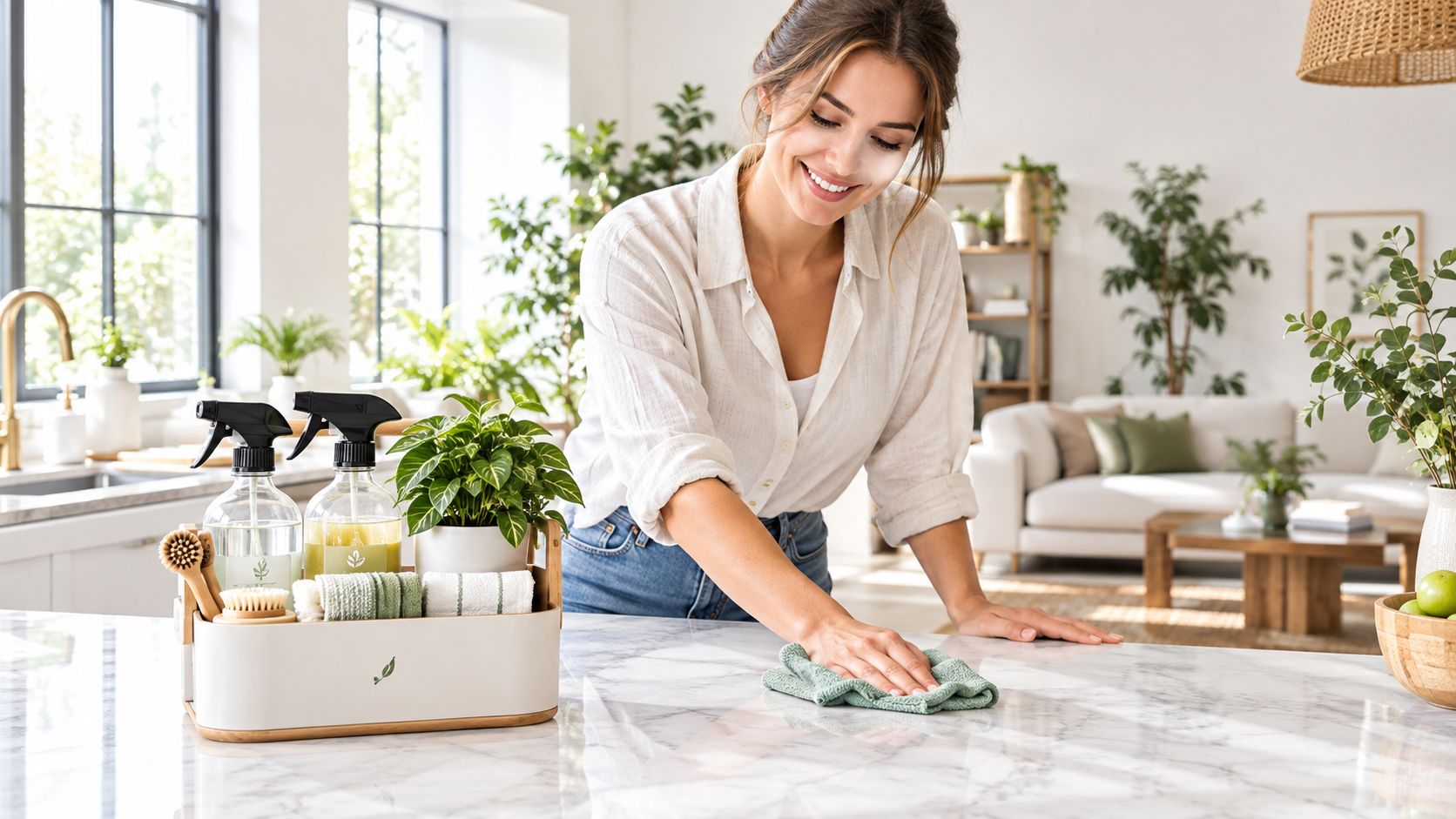
Most advice about eco friendly house cleaning starts with a shopping trip: replace every conventional spray with something plant-based, add a refill bottle, and assume the home is automatically healthier. That shortcut sounds appealing, but it confuses a product label with a cleaning system. A fragranced “natural” cleaner can still release volatile compounds, and an eco-labeled disinfectant can fail if you wipe it away before its required contact time.
A better plan focuses on lower emissions, sensible materials, correct surface care, and repeatable procedures. That matters in Massachusetts, where tightly sealed homes and closed windows during winter can make ventilation harder. The practical standard is simple: reduce unnecessary chemical exposure and waste, while still delivering the hygiene and finish your household expects.
Table of Contents
- Kitchen first for visible results
- Bathroom soil needs targeted treatment
- Living areas benefit from dry removal
- Floors and tile need restraint
- Does “natural” mean healthier for indoor air?
- Are concentrated products always more sustainable?
- Can eco-friendly cleaners handle pet stains?
- Are green methods safe for every floor and tile?
- Does green cleaning match traditional hygiene?
- Do I need to disinfect every surface?
Rethinking Green Cleaning and Indoor Air Quality
A green label is a screening clue, not an indoor-air guarantee. Plant-derived ingredients can still include fragrance compounds that enter the air during use. Evaluate three practical questions instead: what becomes airborne, what remains on the surface, and whether the formula cleans effectively without repeated applications.
A 2023 analysis of cleaning product emissions found that 30 cleaning products contained 530 unique volatile organic compounds. Green-labeled products emitted about half as many VOCs on average as conventional products, while fragrance-free green products emitted nearly eight times fewer VOCs. The result supports careful product selection, not the assumption that every green formula improves indoor air.
Indoor air can be 2 to 5 times more polluted than outdoor air, and some estimates place the difference at 10 times. In a closed Newton or Wellesley home during a cold spell, fragrance and cleaning vapors may linger after the work is finished. Ventilation and controlled application therefore matter as much as the label.
Fragrance matters more than the front label
Research found no strong evidence that green cleaners consistently outperform regular cleaners on indoor air quality. Some green products released more monoterpenes, compounds that can participate in indoor reactions and increase secondary pollutants such as formaldehyde by up to 7% and PAN species by up to 6%, according to the Royal Society of Chemistry assessment of green cleaning products and indoor air.
Use a protocol that limits exposure while preserving cleaning performance:
- Choose fragrance-free when possible. “Natural scent” still indicates aromatic compounds.
- Open windows or run exhaust ventilation. Air exchange lowers airborne concentrations during and after cleaning.
- Spray the cloth, not the room. This limits airborne droplets and gives you better control of dosage.
- Use only enough product to wet the soil. Extra foam or perfume does not improve sanitation.
- Never mix cleaners. Keep bleach away from ammonia and acidic products.
Practical rule: Treat “green” as a starting point for investigation, not proof of low exposure.
Certification provides a more useful filter than claims such as “pure,” “green,” or “chemical-free.” The EPA's Safer Choice program reviews ingredients, requires disclosure, and evaluates finished products for performance and environmentally preferable packaging, as explained in the Safer Choice FAQ. Follow the label directions even when a product carries certification.
For antimicrobial products such as disinfectants and sanitizers, the EPA's Design for the Environment label identifies products evaluated under the program's standards. The EPA guide to identifying greener cleaning products explains how to assess these labels and other environmental claims.
Homeowners comparing formulas can use this low-VOC cleaning products guide to examine air-quality considerations separately from broad natural-product marketing. The target is a clean, hygienic home with fewer unnecessary emissions, achieved through product choice, ventilation, and disciplined application.
Building Your Non-Toxic Cleaning Toolkit
A non-toxic toolkit succeeds through control, not shelf space. Choose a few products that handle ordinary soil, then apply them at the right strength and to the right surface. Most homes need a dependable general cleaner, a bathroom descaler, dish soap or a degreaser, a clearly labeled disinfectant for situations that require it, reusable cloths, and surface-appropriate tools.
Certification is the fastest initial screen. Look for EPA Safer Choice on general products and Design for the Environment on antimicrobials, then read the label for ingredients, dilution, surface limits, and contact time. Certification narrows the options, but it does not replace correct use.
Concentrates and refill systems can reduce material use when measured accurately. A 2021 assessment cited by Ethical Consumer found that concentrated household cleaning products used 75% less plastic packaging and 97% less water than non-concentrated alternatives, as reported in this assessment of eco-friendly cleaning products. The benefit comes from shipping less water and packaging. A concentrated formula used at the wrong ratio can waste product and leave residue.
Stock the caddy by task
| Item Type | Eco-Friendly Recommendation | Primary Use Case |
|---|---|---|
| General surface cleaner | Fragrance-free Safer Choice product or accurately diluted concentrate | Counters, sealed floors, doors, and washable surfaces |
| Mild scrub | Baking soda or a low-abrasion cream cleaner | Sink marks, soap residue, and light buildup |
| Acid cleaner | Vinegar or citric-acid formula used only on compatible surfaces | Mineral deposits and hard-water film |
| Degreaser | Concentrated, low-fragrance kitchen cleaner or dish soap | Cooking grease and food residue |
| Cloths | Reusable microfiber or washable cotton cloths | Dusting, wiping, and polishing |
| Disinfectant | EPA-registered product with clear contact-time directions | Situations requiring disinfection, not routine soil removal |
| Floor tool | Washable flat mop with a controlled-moisture head | Hardwood, tile, and other manufacturer-approved floors |
DIY formulas have a place in limited maintenance. A small amount of dish soap in warm water works on washable, sealed surfaces. Diluted vinegar can loosen mineral deposits on compatible glass or some bathroom fixtures, but it can damage marble, limestone, travertine, and other acid-sensitive stone. Baking soda provides mild abrasion. Scrubbing too hard can dull finishes and wear grout edges.
Avoid the common toolkit mistakes
Never pour products into an unmarked bottle. Keep original labels, write dilution instructions clearly, and store cleaners away from children and pets. A pleasant smell does not prove cleanliness, and a product labeled “disinfecting” does not work instantly. Disinfection requires the surface to stay visibly wet for the stated contact time.
Reusable cloths need their own process. Assign separate cloths to bathrooms, kitchens, and general living areas, then launder them according to fabric and soil level. A contaminated cloth can transfer residue from a toilet area to a vanity even when the cleaner is suitable.
For a closer product-selection framework, review this guide to eco-friendly cleaning products. Buy fewer formulas, check compatibility before use, measure concentrates precisely, and keep disinfectants for tasks that require them.
Room-by-Room Eco Friendly House Cleaning Flow
A busy Massachusetts household usually doesn't need a heroic weekend scrub. It needs a sequence that prevents clean areas from being re-soiled. Start with ventilation, remove clutter, and work from high surfaces toward the floor. The order matters more than moving quickly between random rooms.

Kitchen first for visible results
Clear counters before applying product. Dry-remove crumbs and dust, then clean from the backsplash and cabinet fronts down to the counters and floor. For ordinary grease, a measured low-fragrance degreaser or dish-soap solution usually works better than repeatedly spraying a mild all-purpose cleaner.
Stubborn cooking film needs dwell time and patience. Apply the product to a cloth or directly to the affected area, allow it to soften the soil according to the label, then wipe with a clean damp cloth. Don't use acidic cleaners on natural stone counters, and test any new formula on an inconspicuous section of finished cabinetry.
The refrigerator needs a food-safe approach. Remove shelves where possible, use a mild cleaner, rinse away residue, and dry thoroughly. A strong scent left near food isn't a sign of a better result.
Bathroom soil needs targeted treatment
In the bathroom, remove dry hair and dust first. Apply a compatible bathroom cleaner to soap film, wait as directed, and scrub with a non-scratch pad. For mineral deposits, an acidic product may help on porcelain or glass, but it can etch marble and weaken some cement-based grout finishes.
Toilets and high-touch fixtures deserve separate cloths. Clean visible soil before disinfecting. Disinfection cannot replace cleaning because organic residue can interfere with the product's performance.
Living areas benefit from dry removal
Dust shelves, ceiling-fan blades, trim, and furniture before vacuuming. A vacuum with effective filtration and a washable floor tool can reduce the need for sprays in bedrooms and living rooms. Use a lightly damp cloth on finished wood, and don't saturate hardwood, laminate seams, or unsealed flooring.
Pet stains require fast absorption, not perfume. Blot liquid, remove solids, use an enzyme-based product that is compatible with the textile, and allow the area to dry fully. Test first, particularly on wool, vintage rugs, and dyed upholstery.
Floors and tile need restraint
Porcelain and ceramic tile tolerate many routine cleaners, but grout can hold soil and excess moisture. Use a soft brush, controlled water, and a final rinse when the product leaves residue. Natural stone requires a pH-appropriate cleaner and no abrasive powder unless the manufacturer approves it.
For a repeatable weekly rhythm, use these house cleaning schedules and checklists. A realistic rotation assigns high-traffic areas regular attention and reserves detailed baseboard, grout, and appliance work for planned visits.
Mastering Dwell Times and Cleaning Protocols
Buying a product labeled “green” does not establish a cleaning protocol. Method controls results. A lower-impact formula can still fail when it is under-applied, wiped away too soon, or used without removing soil first. Indoor air quality improves when products are limited and controlled, not when surfaces receive repeated quick sprays.
For disinfection, follow the label's wet contact time. The surface must remain visibly wet for the full contact time. If bleach directions are unavailable, diluted bleach should stay wet for at least 1 minute before wiping, according to the CDC guidance on cleaning and disinfecting with bleach. EPA guidance defines contact time as the period the product must remain wet to work effectively.
A mist followed by an immediate wipe may remove some soil, but it is not verified disinfection. Independent guidance from the University of Utah on chemical disinfectants notes that many EPA-registered disinfectants carry a 10-minute label claim. Diluted bleach may have a limited effective life, and some applications require longer contact. The product label governs.
Use a professional-style sequence
A practical residential protocol is:
- Remove clutter and dry soil. Vacuum or wipe away dust, crumbs, hair, and loose grit.
- Clean the surface. Choose the least aggressive compatible product that removes the soil.
- Remove residue. Rinse or wipe as directed. Buildup attracts soil and can leave floors dull.
- Disinfect only when needed. Select an EPA-registered product suited to the task.
- Maintain wet contact time. Reapply if the surface dries early, then wipe or rinse according to the label.
A 2025 study of a CAM-compliant green cleaning protocol found comparable surface microbiology results between conventional and green protocols when procedures included standardized sampling and post-cleaning verification. The green protocol reduced carbon footprint by 20.0% overall and by 35 g CO2e per square meter of cleaned surface annually.
Hospital-setting research reported comparable microbiological performance from one green protocol, with a 43.7% reduction in greenhouse-gas impact, or about 273 g CO2e per square meter per year, while selected pathogenic indicator organisms were eliminated after cleaning. A separate study found acceptable sanitation across sampled spaces without a statistically significant loss in effectiveness, as reported in the hospital green-cleaning protocol research.
For Massachusetts homeowners, the working rule is straightforward: use lower-impact chemistry, apply enough product, respect wet contact time, and check the finished surface. Green cleaning delivers traditional hygiene outcomes through process design, not a one-for-one bottle swap.
When to Call Professional Eco Cleaning Services
DIY cleaning is sensible for routine dust, kitchen turnover, bathroom maintenance, and small spills. It becomes less efficient when the home has heavy soil, fine construction dust, neglected buildup, or a deadline. A move-out clean is a different job from wiping down a lived-in kitchen because the cleaner must reach empty-cabinet interiors, baseboards, doors, appliances, and floors without leaving residue for the next occupant.
Post-construction cleanup creates another limit. Fine dust settles on horizontal and vertical surfaces, enters tracks and hinges, and can circulate when handled carelessly. A household vacuum and a few reusable cloths may manage visible dust, but they're not always the right combination for a full renovation handoff. The cleaning process should protect finished flooring, newly installed tile, fixtures, and cabinetry while removing dust thoroughly.
Compare the job before choosing the method
| Situation | DIY eco cleaning | Professional service |
|---|---|---|
| Weekly maintenance | Efficient for organized households | Useful when schedules are tight |
| Move-in or move-out | Possible with time and an empty home | Better suited to deadline-driven, whole-home detail work |
| Post-construction dust | Limited by equipment and repeated resettling | Better suited to controlled dust removal and surface protection |
| Deep spring cleaning | Manageable room by room | Helpful when neglected buildup spans the entire property |
| Delicate tile or flooring | Requires manufacturer-specific knowledge | Can reduce the risk of unsuitable chemicals and excess water |
Professional work doesn't mean using harsher products. A strong service should be able to explain which products it uses, how it controls dilution, how it handles contact time, and how it protects surfaces. It should also distinguish routine cleaning from disinfection instead of treating every room as a place for aggressive antimicrobial spraying.
For homeowners in Wayland, Newton, Needham, Wellesley, Weston, and nearby communities, Sunny Day Pro Services offers recurring maintenance, deep cleaning, move-in/move-out cleaning, and post-construction cleanup with eco-friendly options. The company brings equipment and eco-friendly cleaning products for cleaning jobs, and homeowners can ask about a green cleaning service or an eco product upgrade for recurring visits.
Ask for a clear scope before booking. Confirm whether inside appliances, cabinets, trim, grout, and post-renovation dust are included. A written plan prevents the common disappointment of expecting a deep clean from a standard maintenance visit.
Common Eco Cleaning Questions Answered
Does “natural” mean healthier for indoor air?
A green label does not guarantee cleaner air. Fragranced products marketed as green may still release compounds that contribute to secondary pollutants. Choose fragrance-free formulas where practical, ventilate during use, and apply cleaner to a cloth instead of spraying broadly.
Are concentrated products always more sustainable?
Only when the dilution is accurate. The packaging and shipping savings documented in the toolkit section materialize when you mix the product to its labeled ratio. Measure with a marked cup rather than free-pouring. Wasted concentrate, incorrect dilution, and unnecessary refills can reduce the benefit.
Can eco-friendly cleaners handle pet stains?
They handle many fresh, everyday stains when used promptly. Blot rather than scrub, choose a compatible enzyme product for organic residue, and allow the area to dry fully. Fragrance only masks odor. Test the cleaner on an inconspicuous section of rugs, upholstery, or sealed wood before treating the visible area.
Are green methods safe for every floor and tile?
Each material has limits. Vinegar and other acidic formulas can damage natural stone, while excess water can affect wood, laminate seams, and unsealed grout. Follow the flooring or tile manufacturer's care instructions, then test an unfamiliar product in a hidden spot.
Does green cleaning match traditional hygiene?
A disciplined protocol can produce comparable cleaning outcomes. The facility and hospital protocol studies cited in the dwell-time section reported comparable microbiological performance when procedures used standardized application, validated dwell times, and post-cleaning verification. Product choice matters, but technique, coverage, and contact time determine whether the process works.
Do I need to disinfect every surface?
Routine cleaning removes visible soil. Disinfect after relevant contamination events or when the product's intended use calls for it, rather than applying antimicrobial chemicals throughout the home. Keep the surface visibly wet for the exact contact time on the label.
A reliable eco-friendly routine uses fewer products, limits fragrance, controls water and packaging, and follows the same procedure consistently. That process protects indoor air quality without sacrificing practical hygiene.
Sunny Day Pro Services provides recurring house cleaning, deep cleaning, move-in/move-out service, and post-construction cleanup with eco-friendly options for Massachusetts homeowners. Visit Sunny Day Pro Services to request a quote and discuss a cleaning plan that protects your surfaces, indoor environment, and schedule.

