
Flooring Installation Agreement Essentials
Protect your home with a solid flooring installation agreement. Learn MA contract rules, essential clauses, and red flags for your next tile or floor project.

You're looking at a stack of samples, a rough estimate, and a contractor who says the floor will “all get handled” once work starts. That's exactly how people end up arguing about subfloor prep, trim, transitions, cleanup, and surprise costs after the old flooring is already torn out. In Massachusetts, your flooring installation agreement has legal weight, and if you treat it like a casual quote, you're inviting problems you could've prevented on day one.
Table of Contents
- Why Your Flooring Estimate Needs to Be a Legal Contract
- What has to be written down
- What should be spelled out before work starts
- Do I need a separate warranty for materials and labor
- What if the project needs a permit
- What if I signed at home and changed my mind
- What if the job goes off-track
Why Your Flooring Estimate Needs to Be a Legal Contract
A vague estimate gives you a starting point, but no protection once demolition begins.
In Massachusetts, a flooring installation agreement becomes legally significant once residential home-improvement work exceeds $1,000, including labor and materials. That means the document you sign should spell out the job before anyone pulls up a board or orders tile [Massachusetts home-improvement contractor resources]. Flooring projects shift fast from a simple swap to subfloor repair, leveling, underlayment, moisture checks, and material changes that move the price and the schedule.
Practical rule: If the contractor cannot point to a written clause, do not assume it is included.
Homeowners in Wayland, Newton, Needham, Wellesley, or Weston should treat the contract as the project's control room. It should state what is included, what is excluded, who handles permits if they are needed, and when payment is due. Without that detail, the contractor can redefine the job after work starts, and that is how scope creep turns into a payment dispute.
A one-page quote may list the floor type and a rough price. A real contract names the rooms, the prep work, the installation method, and the cleanup boundaries. It should also match the work itself, especially on technical flooring jobs where moisture testing and subfloor conditions affect whether the installation holds up. See a flooring installation services overview
That written agreement is the document that stops “install new flooring” from becoming an argument over what the contractor owed you.
Mandatory Massachusetts Contract Requirements for Homeowners
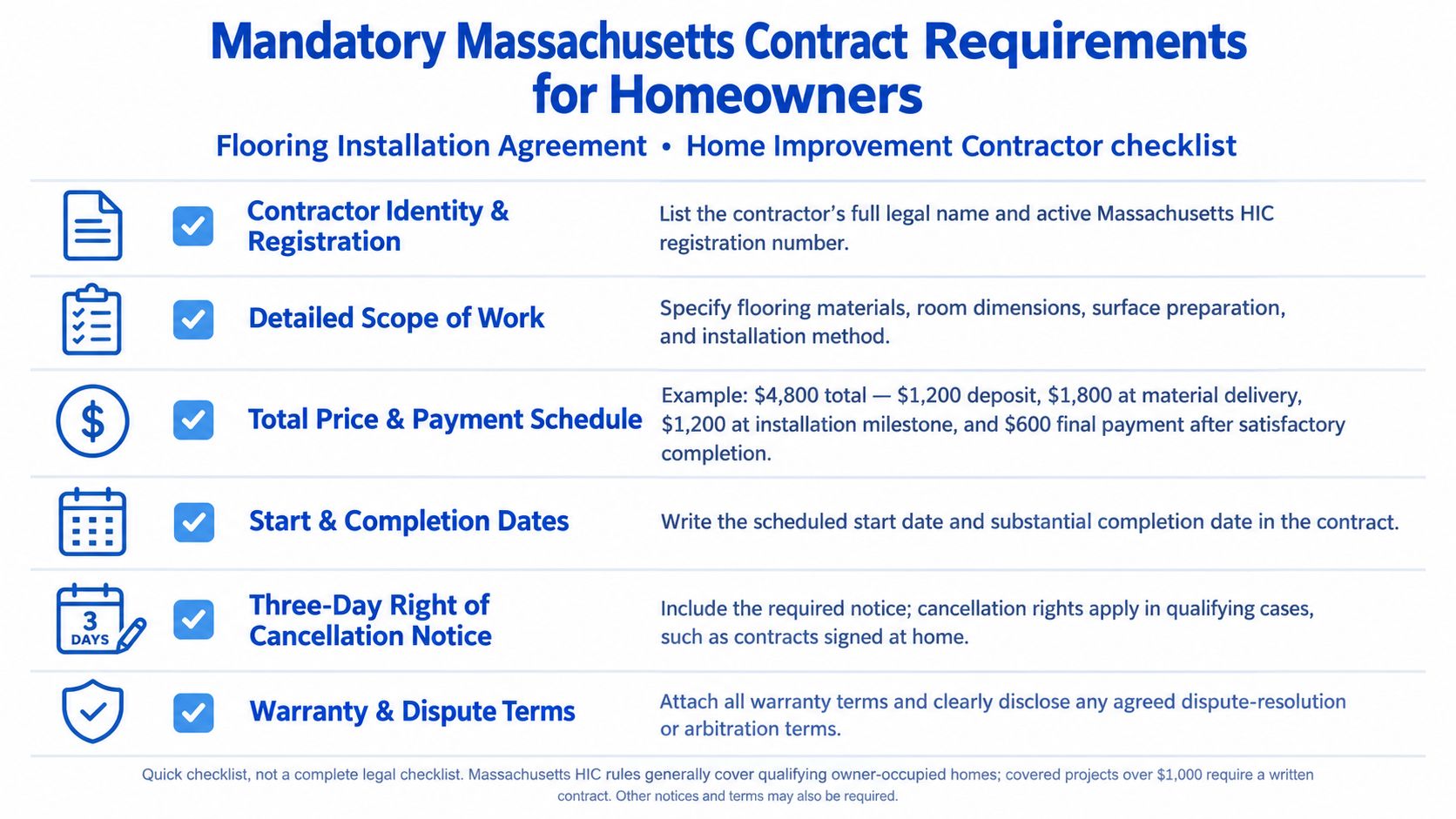
A Massachusetts home-improvement contract for a flooring project above the legal threshold needs more than a signature line. It needs the full identity of the homeowner and contractor, the contractor's registration number, the execution date, the complete scope of work, the total price, and the payment schedule [Massachusetts home-improvement contract sample language].
What has to be written down
The contract should identify the exact rooms, removal and disposal work, subfloor preparation, underlayment, flooring type, trim, transitions, and installation boundaries. “Install new tile” is too loose. “Primary bath floor, remove old ceramic tile, inspect and prepare substrate, install porcelain tile with matching trim and transitions” is the kind of language that protects you.
It also needs duplicate signed copies, one for you and one for the contractor. If the agreement gets signed in your home or anywhere outside the contractor's normal business location, Massachusetts consumer guidance gives you a three-day cancellation right [Massachusetts contractor resources]. Homeowners lose bargaining power fast when they sign under pressure, so the contract has to control the job, not the sales pitch.
What should be spelled out before work starts
Use this checklist mindset, not a handshake mindset:
- Who is responsible: The contractor's legal name, registration information, and any salesperson involved.
- What gets done: Substrate tolerance targets, adhesive or mortar type, and who supplies the transitions.
- When it happens: Start date and expected completion date.
- How much it costs: Total price and payment schedule in dollars, not casual verbal promises.
- What happens if you back out: The off-site cancellation notice when it applies.
- What happens if the scope changes: A written process for extras, substitutions, and revisions.
A permit may also be required depending on the building and scope, including work affecting fire-resistance ratings in three- and four-family buildings. For a flooring job, make the contract name permit responsibility clearly instead of leaving that question open until the inspector shows up. In Massachusetts, vague paperwork is how a simple floor job turns into an argument over who owed what.
Technical Flooring Clauses That Prevent Costly Failures
A flooring contract can look clean on paper and still fail on site if it ignores how the slab behaves. In Massachusetts, that means you need moisture controls, movement-joint language, and clear responsibility for the conditions under the floor, not just the finish above it.
Moisture testing belongs in writing
Name the moisture test in the agreement. For concrete slabs, that should include the test method, who performs it, where tests are taken, the acceptance limit, and what happens if results come back high. ASTM F2170 is the standard method for measuring internal relative humidity in concrete, and it belongs in the contract when the job goes over slab [ASTM F2170].
Do not leave the limit vague. The manufacturer's published requirement controls, and the contract should require the installer to follow it before setting tile, vinyl, or resinous flooring. A practical contract also says who pays for retesting if the slab fails.
For homeowners who want more background on slab work, installing flooring over concrete explains why the prep matters before finish materials go down.
Movement joints are not optional details
Tile work needs movement-joint language too. Structural, control, and expansion joints stay open, not bridged, and flexible joints belong at perimeters and changes of plane where the assembly has to move. TCNA EJ171 is the reference contractors should be following for that detail.
Leave that out and you set up a failure that shows up later as tenting, cracked grout, or fractured tile.
Moisture and movement that go uncontrolled always show up later as tenting, cracked grout, or fractured tile.
A good flooring installation agreement makes the job conditional. It should say the work starts only after acceptable moisture readings and should assign waterproofing responsibility in wet areas. It should also preserve existing joints and separate installation defects from slab movement, leaks, excessive moisture, and defects in owner-supplied materials. In a Massachusetts home, that is how you keep a floor job from turning into a dispute over whose problem it really was.
Managing Payments and Unexpected Change Orders
A flooring contract falls apart fast when the contractor gets paid too early. In Massachusetts, the payment terms should protect the homeowner first.
The state's home-improvement guidance says a contractor generally cannot collect more than one-third of the total contract price in advance, except for the cost of special-order materials, and cannot demand final payment until the contract has been fully performed [Massachusetts home-improvement guide]. Put the payment schedule in dollars, tie each payment to a defined stage, and do not accept a vague promise to “settle up later.”
Use the contract to control budget drift
Flooring jobs uncover problems the estimate missed. A rotten subfloor, excess moisture, uneven spots, or a homeowner-approved upgrade can change the price quickly. The contract should require a written change order before extra work starts, and that change order should state the requested change, the price increase or decrease, and any schedule adjustment [Massachusetts archival consumer guidance].
Do not let a contractor treat change orders as casual text messages or verbal approvals. If the work changes, the paper changes too.
A clean payment structure beats a big deposit and hopeful assumptions. The contractor gets paid as stages are completed, and you hold the final payment until the job is done.
| Payment Milestone | Risky Contractor Demand | MA Compliant Structure |
|---|---|---|
| Before materials are ordered | Large upfront payment with no written breakdown | Deposit limited by state payment rules, with special-order materials documented |
| Mid-project | Another large payment with no visible progress | Milestone payment tied to completed work already described in the contract |
| Final balance | Demand for full payment before punch list items are handled | Final payment held until the contract has been fully performed |
If you want to understand why contractors sometimes price jobs by area, flooring installation cost per square foot shows the usual way that estimate language is framed.
Red Flags and Missing Clauses to Negotiate Before Signing
A contractor can give you a bad agreement without meaning to. A sloppy form still leaves you holding the risk, and flooring jobs expose every gap fast.
What should make you pause
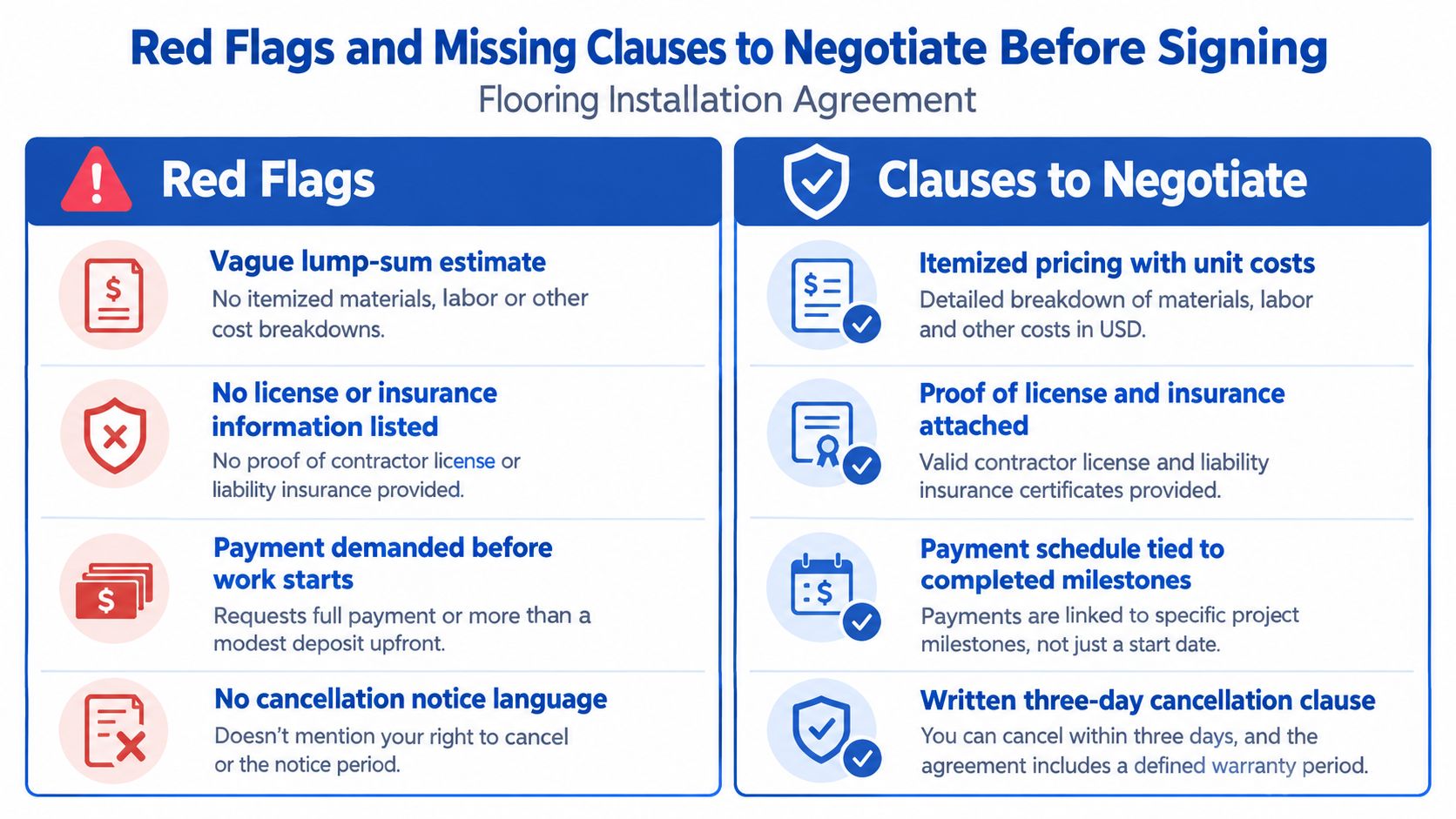
A lump-sum estimate with no itemized materials is a warning sign. So is a contract with no insurance information, no warranty terms, or pressure for you to pull your own permit. Massachusetts consumer guidance also warns homeowners to pay attention to permit responsibility, since using an unregistered contractor or getting a required permit yourself can put access to the state Home Improvement Contractor Guaranty Fund at risk [Massachusetts consumer guidance].
A serious flooring agreement reads like a job plan, not a guess. It should spell out the work and the risk in plain language.
- Itemized pricing: Materials and labor listed separately.
- Proof of registration and insurance: So accountability is clear.
- Payment tied to progress: Not to promises.
- Warranty language: What is covered, what is excluded, and for how long.
- Cancellation language: Especially for any off-site signing.
The permit question is a test
A contractor who pushes permit responsibility onto you without a clear explanation is showing you a gap, not confidence. If the project needs a permit, the contract should say who pulls it, what it covers, and how any permit-related delay affects the schedule. Permit responsibility is not red tape. It keeps one missing document from stalling the installation and turning the warranty into a dispute.
A contractor who will not put these points in writing is not ready for a clean job. Walk away.
The Homeowner Pre-Installation Verification Checklist
A flooring job goes wrong fast when the contract looks fine but the site is not ready. Before demolition starts, confirm the paperwork, then confirm the floor itself.
Verify the paperwork first
Keep a fully signed copy, and make sure the contractor has one too. No work should start until both sides have signed and each has received a completed agreement.
Then check the basics:
- Names and addresses match: Every party should be identified correctly.
- Registration information is present: Do not accept a blank, vague, or outdated entry.
- Rooms and materials are specific: The scope should match the actual floor plan, not a generic summary.
- Payment schedule is in dollars: Each installment should be written out clearly.
- Change-order language exists: Any out-of-scope work needs a written process.
- Cancellation terms are clear: That matters even more for off-site signing.
Verify the job conditions too
For tile over concrete, ask for slab moisture readings to be on file before installation. If the project calls for movement joints, confirm their locations before the first piece is set. Those details are not paperwork filler, they are what keep the floor from failing later.
Take a photograph of the pre-demo condition while the room is still intact. Save shots of existing transitions, thresholds, cracks, patches, and any damaged areas the crew may need to work around. If a dispute starts later, that record matters.
If the job is in a multi-family building or touches fire-resistance-rated assemblies, confirm whether a permit is needed before anyone starts tearing out material. The contract and the site conditions need to match before the first board comes up.
A homeowner in Needham or Weston who checks these items before installation day keeps the job cleaner and the arguments smaller. Clean paperwork and clear site conditions help the crew move and leave less room for a fight on the jobsite.
Common Questions About Flooring Contracts and Warranties
Homeowners usually ask the same questions once the estimate becomes a contract. The answers should protect the floor and protect you from a dispute later.
Do I need a separate warranty for materials and labor
Yes. Keep the two warranties separate in writing. Manufacturer warranties cover product defects and replacement terms for the material itself. Contractor warranty coverage should spell out workmanship, including what happens if a tile bed fails, a plank lifts, or an install defect shows up after the job is done.
Do not assume labor is covered just because the material is warranted. If the tile cracks because of a bad batch, that is a product issue. If it cracks because the substrate was not prepared correctly, that is an installation issue. The contract should say who pays for removal, replacement, and reset work in each case.
What if the project needs a permit
Ask before anyone starts demolition. Some flooring work does not need a permit, but work that affects fire-resistance ratings in three- and four-family buildings may require one. The contract should say who is responsible for the permit and who is paying the fees [Massachusetts home-improvement contractor resources].
If the contractor gives you a vague answer, press for a written one. Permits are not a side issue. They affect timing, inspection, and whether the job can move forward without a stop-work problem.
What if I signed at home and changed my mind
Massachusetts consumer guidance gives homeowners a three-day cancellation right for agreements signed in the home or at another off-site location [Massachusetts contractor resources]. Use it the right way. Send the cancellation notice in writing, keep a copy, and keep proof that it was delivered.
Do not rely on a phone call or a text message. If the contractor says they will “take care of it,” that is not enough. Written notice is what protects you if the job starts anyway or the deposit becomes a fight.
What if the job goes off-track
Put the change in writing before more work starts. A proper notice should say what changed, why it changed, the added or reduced price, and any shift in the completion date. If the contractor keeps working without documenting the change, you are inviting a billing dispute.
For flooring, the notice should also describe the technical issue. If moisture testing was skipped, if the subfloor needs leveling, or if the material has to be reset because the site conditions were wrong, the paper trail should say that directly. That record matters when the job stops matching the original scope.
If you are planning a flooring project in Massachusetts and want the tile or flooring details handled cleanly from the start, Sunny Day Pro Services can help with professional tile and flooring installation, including prep, finish details, and clear project quoting. Visit Sunny Day Pro Services to request a quote and get the paperwork, scope, and installation plan aligned before work begins.

