
How to Choose a House Cleaning Service Without Regret
Learn how to choose a house cleaning service with confidence. Practical vetting steps, key questions, and red flags for busy homeowners.

You booked the cleaner because the price looked good, the reviews looked fine, and you needed the house handled before guests arrived. Then you came home to a strong chemical smell, a chipped vase nobody mentioned, and a bill with charges you never approved. That's the moment people learn how to choose a house cleaning service the hard way. The fix isn't luck or a better guess. It's a short, documented process you run before anyone gets a key.
Table of Contents
- Stage One and Two, Written Estimates and Verified Coverage
- Stage Three and Four, References and a Written Agreement
The Moment You Realize Your Current Cleaner Isn't Working
It's a Tuesday in Wayland or Needham. You've got work calls stacked up, kids coming home hungry, and family arriving Friday. The cleaner you hired from a quick online search was supposed to take cleaning off your plate. Instead, you're opening windows to clear a scent you didn't choose, texting about a bathroom that was supposedly finished, and wondering why the oven and refrigerator cost extra after the fact.
I have watched this pattern for years, and it is rarely about one sloppy visit. The warning signs were there at hiring. There was no written scope, so "deep clean" meant something different to you than it did to the crew. Nobody confirmed who was insured, who would enter the home, or what happened if something broke. The price was compared, but the service behind the price was not.
Bad Luck Versus a Skipped Step
Some problems really are accidents. A frame gets bumped. A cleaner calls out sick. A good company tells you immediately, documents what happened, and makes it right under a policy you saw before the first visit. That's very different from preventable failures:
- Surprise charges: Add-ons appear because the quote never listed tasks room by room.
- Unexplained products: Strong odors linger because nobody asked what would be sprayed, diluted, or ventilated.
- No recourse: A missed area becomes an argument because there's no checklist or re-clean policy to point to.
- Unclear accountability: You don't know if the person in your home is an employee, a subcontractor, or someone assigned that morning.
Most bad hires aren't bad luck. They're what happens when price gets verified and everything else gets assumed.
That doesn't mean you need to become an investigator. You need a repeatable way to compare providers on scope, coverage, staffing, and follow-through, then test the winner on a first clean before you commit to recurring service. The four stages that follow give you that system. Use them whether you're in Newton, Wellesley, Weston, or any nearby Massachusetts town, and whether you need recurring maintenance, a move-out clean, or post-construction cleanup. Thirty minutes of verification up front protects a relationship that could last for years.
A Four-Stage Vetting Process That Beats Hourly Shopping
Hourly shopping feels efficient, but an hourly rate tells you almost nothing about total cost, who's liable, or what "done" looks like. Cleaning is also real, physical work at scale. U.S. Bureau of Labor Statistics data for May 2024 counted approximately 2,199,900 janitors and cleaners, excluding maids and housekeeping cleaners, with an annual mean wage of $37,460, according to BLS occupational employment data for May 2024. A workforce that large still doesn't guarantee any one provider runs a tight operation. You have to check.
Stage One and Two, Written Estimates and Verified Coverage
Start by obtaining written estimates from at least three providers for the exact same scope. Give each company the same rooms, the same priorities, and the same problem areas. If one quote is dramatically lower, ask what it leaves out before you celebrate.
Then verify the business itself. Check registration, bonding where applicable, general liability and property damage insurance, and workers' compensation. Don't stop at a screenshot of a certificate. Contact the insurer to confirm coverage is current. The Better Business Bureau guidance on hiring a house cleaning service recommends interviewing at least three companies, checking registration, bonding, and insurance, requesting background checks, and contacting references.
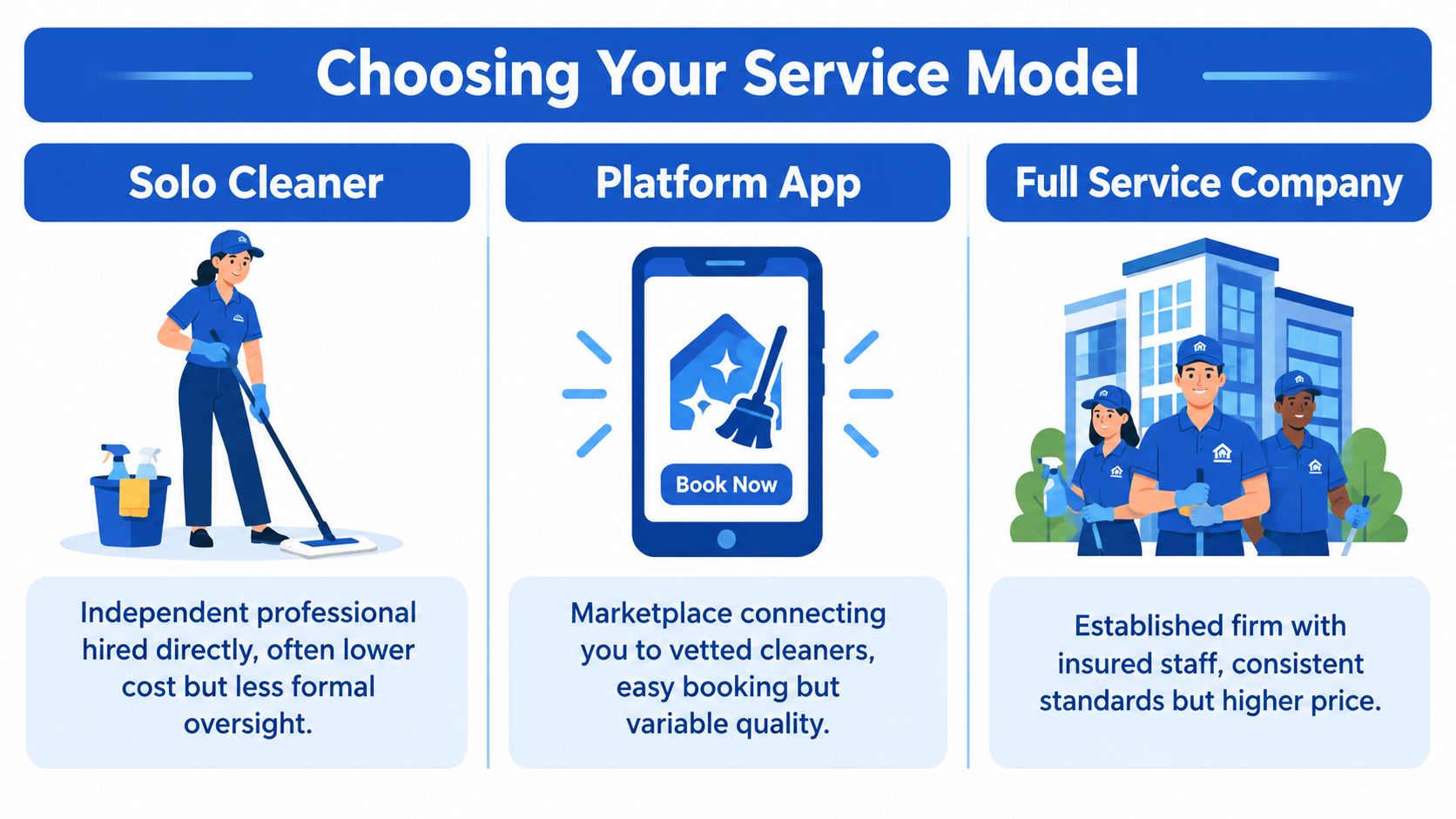
The comparison below shows why the business model behind a quote matters as much as the quote itself.
Stage Three and Four, References and a Written Agreement
Ask for at least three comparable references, then ask specific questions. Did the crew arrive inside the promised window? Did they complete the agreed scope? Were there unexpected charges? When something was missed or damaged, how did the company respond? Vague praise won't help you. Patterns will.
Finally, compare a written service agreement before you book recurring visits. It should name the rooms, task-level inclusions and exclusions, supplies, access arrangements, arrival window, cancellation terms, re-clean policy, payment schedule, and total price. That aligns with the FTC guidance on verifying insurance and putting scope, timing, and cost in writing, which also covers confirming subcontractor coverage.
Convert that agreement into a checklist and inspect the first paid clean against it. That makes "satisfaction guaranteed" something you can measure instead of a slogan you have to trust. A low quote with no verifiable coverage isn't a bargain. If a worker is hurt or property is damaged, that missing paperwork can become your financial problem.
Solo Cleaner, Platform App, or Full Service Company
There's no universally right model. There's only the model whose risks and paperwork you're willing to own. A solo cleaner can be excellent and consistent, but you're often the manager. A platform makes booking easy, but the person assigned may change. A full service company usually costs more because supervision, insurance, training, and backup staffing are built into the price.
The Employment Question Most Homeowners Miss
If you hire an individual directly and control not only what gets done but how it's done, the tax picture changes. The IRS guidance on household employees says housekeepers and maids are household employees when the homeowner controls what work is done and how it's done, with Social Security and Medicare taxes of 7.65% generally owed by each side. Calling someone an independent contractor doesn't settle it. The IRS looks at actual control.
That doesn't make a direct hire wrong. It means you should price in payroll, tax, and recordkeeping duties if that's the arrangement you're creating. With a company-managed service, ask directly whether the company hires, supervises, and pays its cleaners. With a platform, ask who employs the cleaner, who carries insurance, and who you call when the work falls short.
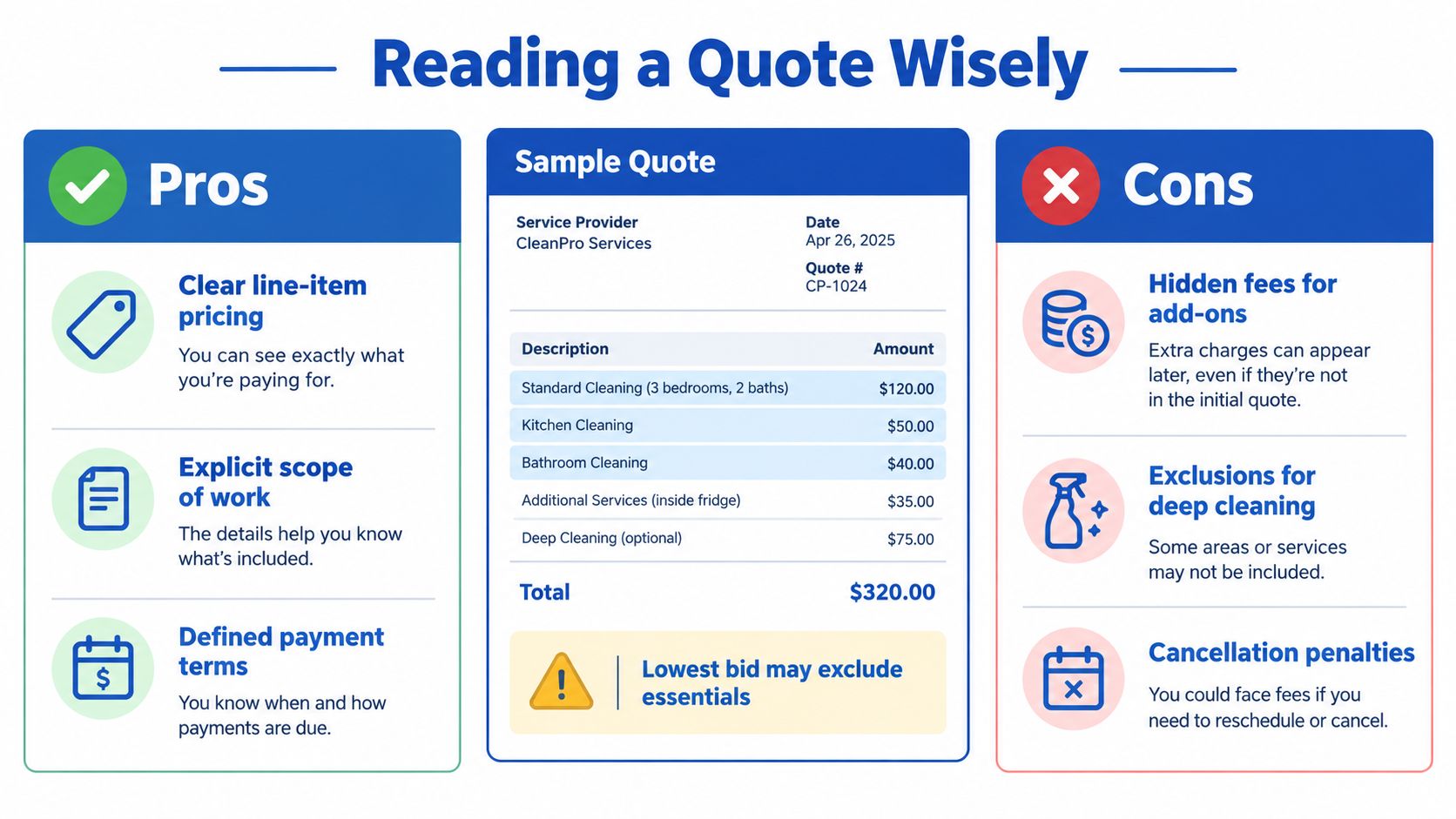
The quote-reading visual below is useful here because the cheapest model often looks cheapest only after exclusions are ignored.
| Model | Who Employs the Cleaner | Insurance | Quality Control | Recourse if Something Goes Wrong |
|---|---|---|---|---|
| Solo cleaner | You may, depending on control | Verify personally, often limited | You inspect and direct | Direct conversation, limited backup |
| Platform app | Varies by platform and cleaner | Confirm who carries each policy | Ratings and platform standards | Platform dispute process |
| Full service company | The company | Company liability and workers' compensation to verify | Training, supervision, checklists | Re-clean policy and company claim process |
My recommendation is simple. Choose a solo cleaner only if you're comfortable supervising, verifying coverage yourself, and going without service when that person is sick or on vacation. Choose a platform only if convenience matters more than crew consistency and you've confirmed coverage in writing. Choose a full service company when you want the administrative burden, scheduling backup, and quality checks handled for you, and you're willing to pay for that structure.
Reading a Quote Without Falling for the Low Number
Two quotes show up the same week. One reads "$180, standard cleaning." The other runs a full page and lists every room, every task, and every surcharge. The second one earns your trust faster, and homeowners agree: a 2025 consumer report on house cleaning selection found price or estimate clarity was the leading consideration at 47.0%, ahead of reliability and reviews at 22.7% and staff quality at 19.3%, while the same reporting documented complaints about a $19 introductory cleaning that rolled customers into a six-month subscription costing $49 to $59 per month.
That subscription trap never appears in the headline number. It hides in the terms nobody reads. Ask every provider what the regular rate is after the promotion, in writing, before you book. If the answer is vague, the offer was designed that way.
What a Comparable Quote Must Contain
Before you compare totals, force every provider onto the same page. The breakdown of what a cleaning service quote should include works well as a template, and it's the standard I'd hold any Massachusetts company to. At minimum, demand:
- Rooms and tasks: Named inclusions and exclusions. "Standard clean" means whatever the company wants it to mean.
- Labor and supplies: Estimated time, crew size, and whether products and equipment are included.
- Surcharges: Travel or access fees, pet hair, heavy soil, and move-out conditions.
- Add-on pricing: Inside oven, inside refrigerator, and interior windows priced in writing before the visit.
- Terms after day one: Cancellation rules, recurring commitments, tax, and the regular price once any introductory offer ends.

One question exposes weak offers fast. Does the same crew, checklist, and quality guarantee apply at the promotional price, or does the actual service start only at the regular rate? If a provider won't itemize, don't negotiate harder. Walk away. A quote built to resist comparison was built to cost you more later.
Practical rule: Never compare two quotes that aren't itemized the same way. The lower number usually just hides the missing work.
This scrutiny matters most for move-in and move-out cleans, real estate turnovers, and post-construction jobs, where labor-heavy tasks drive the true cost. Get the full scope in writing for the exact service you need. In Massachusetts, that document is also your best evidence if a billing dispute ever turns into a formal consumer complaint.
Products, Air Quality, and What Green Really Means
"Green" on a website doesn't tell you what's being sprayed in your nursery, kitchen, or primary bathroom. Neither does a pleasant scent after the crew leaves. If your household includes children, older adults, pets, asthma concerns, or chemical sensitivities, the product list is a hiring criterion, not a preference.
The U.S. EPA page on volatile organic compounds and indoor air quality reports that concentrations of many VOCs are consistently higher indoors than outdoors, sometimes up to 10 times higher, and that cleaning supplies, air fresheners, and waxes are among the potential sources. EPA's Total Exposure Assessment Methodology studies also found levels of roughly a dozen common organic pollutants averaged 2 to 5 times higher inside homes than outside. During and for several hours after certain activities, indoor concentrations can reach 1,000 times outdoor background levels, according to that same EPA resource.
Questions That Separate Policy From Marketing
Don't ask, "Are you eco-friendly?" You'll get a yes from everyone. Ask what will be used, where, and how air is cleared afterward. If you want product categories explained in plain language first, read about eco-friendly cleaning products and how to evaluate them before you interview providers.
- Exact product categories: What is used in kitchens, bathrooms, and on floors, and are labels or Safety Data Sheets available?
- Lower-VOC and fragrance-free options: Can the company customize products for your household and document that choice?
- Storage and dilution: How are chemicals stored, mixed, and kept away from children and pets during the visit?
- Ventilation routine: Do workers open windows or run fans during and after cleaning, and for which products?

EPA also cautions that "low VOC" or "no VOC" labels don't automatically guarantee a product is safer, because individual chemicals differ in toxicity. A professional company won't hide behind that nuance. It'll name its products, follow label directions, explain substitutions, and put your agreed product list in the service agreement. If a provider gets defensive when you ask, that's your answer. Transparency about chemistry is one of the clearest signs you're dealing with a mature operation.
What a Room-by-Room Cleaning Plan Should Actually Cover
A competent cleaner doesn't walk into every room with one bottle and one method. Kitchens, bathrooms, natural stone, sealed grout, finished wood, and painted surfaces all fail in different ways when the wrong product or tool touches them. Ask for a room-by-room method statement and you'll learn more in five minutes than a sales call will teach you in an hour. You can compare answers against a standard cleaning checklist organized by room.
Training matters because this work carries real risk. Federal labor data recorded 21,100 nonfatal injury-and-illness cases involving days away from work among private-industry janitors and cleaners in 2020, equivalent to 191.6 cases per 10,000 full-time-equivalent workers, according to BLS injury data for janitors and cleaners. A serious provider should explain PPE, ventilation, slip prevention, lifting practices, incident reporting, and who supervises quality on each visit.
| Room / Surface | Safe Products | Tools | Warnings |
|---|---|---|---|
| Natural stone and grout | pH-neutral cleaner | Soft microfiber, nonabrasive pad | No acidic products on marble or sealed stone |
| Bathrooms | Label-approved bathroom disinfectant | Dedicated microfiber kept separate from kitchen cloths | Never mix chlorine bleach with acids or ammonia |
| Kitchens | Degreaser matched to the finish | Separate microfiber, nonabrasive tools | Confirm products for counters, cabinets, and appliances |
| Finished wood and painted surfaces | Mild, finish-safe cleaner | Soft cloths, gentle pads | Escalate unknown stains instead of scrubbing through the finish |
Reject any provider that promises universal one-product cleaning, won't disclose exclusions, or can't explain how crews protect flooring, grout, wood, and painted finishes. Photograph pre-existing damage before the first visit and require immediate reporting of breakage or finish changes. That protects both sides and makes a re-clean or claim actionable.
One local option, Sunny Day Pro Services, serves as an example of the model to look for, a Massachusetts company that pairs house cleaning with tile and flooring installation for porcelain, ceramic, marble, and granite. Whoever you hire, insist on that same surface-specific thinking in writing. A documented method survives crew turnover. A verbal promise doesn't.
Massachusetts Checks, Red Flags, and Your Final Hiring Checklist
Massachusetts homeowners need one extra layer of care when a cleaning company also sells tile, flooring, remodeling, or renovation cleanup. Cleaning and regulated home-improvement work are not the same credential. Verify each scope separately.
The Commonwealth requires contractors, subcontractors, partnerships, and corporations performing contracting work on existing owner-occupied residential properties with one to four units to register as a Home Improvement Contractor, and the Guaranty Fund may compensate eligible homeowners up to $25,000 for unpaid judgments against registered contractors, as explained in Massachusetts consumer guidance from the Secretary of the Commonwealth. Ordinary housekeeping doesn't prove HIC status. For bundled work, check HIC registration and complaint history through the Massachusetts Contractor Hub, and still ask for proof of liability and workers' compensation insurance.
Copy-Ready Final Checklist
Use this on your next call, whether you're hiring in Wayland, Newton, Needham, Wellesley, or Weston:
- Three written estimates: Same rooms, same tasks, same exclusions for every provider.
- Insurance verified directly: Current liability, property damage, workers' compensation, and bonding where applicable.
- Employment model confirmed: Who hires, trains, supervises, pays, and background-checks the crew.
- References checked: Punctuality, scope completion, surprise charges, and how problems were resolved.
- Products documented: Categories, Safety Data Sheets on request, ventilation, and fragrance-free options if needed.
- Method statement reviewed: Stone, grout, wood, kitchens, and bathrooms handled with surface-safe products.
- Agreement signed: Arrival window, access, cancellation terms, re-clean policy, payment schedule, and total price.
- Massachusetts credential matched to scope: HIC registration verified for any tile, flooring, or remodeling work bundled with cleaning.
Walk away from cash-only demands, no written agreement, refusal to share insurance certificates, automatic subscription enrollment after a cheap first clean, and high-pressure upsells during the estimate. Those aren't quirks. They're the business model showing itself early.
Run the checklist, book a first clean, and inspect it against the agreement before you approve recurring service. That's how to choose a house cleaning service without regret.
If you want that checklist applied to your own home, request a fast, itemized quote for recurring cleaning, a deep clean, move-in or move-out service, or post-construction cleanup, then judge the first visit against the written scope. Visit Sunny Day Pro Services to choose your service and schedule, and make the company earn the second visit before you commit to the routine.

