
Kitchen Remodel Financing for Massachusetts Homes
Compare kitchen remodel financing options, monthly costs, contractor offers, qualifications, and planning steps for Massachusetts homeowners.

You're standing in a kitchen that still works, but barely. The cabinets are dated, the backsplash is tired, and the contractor's estimate is sitting on the counter while you try to protect savings, keep monthly bills manageable, and avoid getting halfway through the job with no cash left for cabinets, tile, or labor. That's a key challenge with kitchen remodel financing in Massachusetts; it's not just about getting approved, it's about making sure the money arrives when the project needs it and still leaves room for life.
Most homeowners in Wayland, Newton, Needham, Wellesley, Weston, and nearby communities are not trying to max out a loan. They're trying to avoid a bad decision. The smartest plan covers the full project, likely change orders, and the temporary disruption that comes with living through demolition and installation. If you're comparing scope, schedule, and funding, start with the remodel plan itself, then look at the money. For project planning and finish work, you can also review kitchen remodeling and tile installation pages after you've mapped out the budget.
Rates, fees, and lender terms change, so every offer needs current verification. By the end, you'll know how to estimate affordability, compare offers without getting lost in jargon, and coordinate money with the remodel schedule instead of hoping the timing works out.
Table of Contents
Planning Kitchen Remodel Financing With Confidence
A lot of homeowners start with the wrong question. They ask, “Which loan should I use?” when the better question is, “How much can this household safely support while the kitchen is under construction?” That shift matters in Massachusetts, where labor, materials, and scheduling can push a modest-looking project into a more serious cash-flow event fast.
A Newton homeowner with a solid savings account might still pause after seeing a contractor estimate. The estimate doesn't just signal cost, it signals timing. Cabinets may be ordered early, tile may need deposits, and installation can trigger payment milestones before the final kitchen is usable. If the household also wants to keep an emergency cushion intact, financing has to fit the whole picture, not just the headline number.
Practical rule: treat financing as part of the remodel plan, not a separate decision you make after signing the contract.
A good plan asks three things at once. How much cash is already available. What monthly payment still feels manageable if taxes, insurance, and everyday bills stay the same. And how much flexibility is needed if the project scope changes once walls are opened or product selections shift.
For homeowners comparing execution quality and finish work, the practical next step is to line up design choices with the construction schedule. If you're planning a backsplash, countertop finish, or tile-heavy update, it helps to review the budget in tandem with kitchen backsplash cost before committing to funding.
The safest answer to kitchen remodel financing is simple. Finance only what the household can carry without stress, keep enough liquidity for surprises, and make sure the money arrives in step with the remodel, not after it. The rest of the article gives you a clearer way to test that fit.
Deciding Whether to Borrow for the Remodel
Not every kitchen upgrade needs debt. That's the first thing homeowners should challenge before they start filling out applications. If savings can cover the work without draining the emergency fund, paying cash is usually the cleanest move because it avoids borrowing cost and keeps the project simpler to manage.
The harder call is what to do when savings cover part of the work but not all of it. In that case, the smartest option is often to reduce scope, delay a nonessential feature, or finance only the portion that moves the project forward. A smaller, well-executed remodel often protects more value than stretching to the limit just because a lender approved the amount.
Build the household test first
Before you borrow, write down the obligations that still have to get paid while the kitchen is offline. Mortgage. Utilities. Insurance. Car payments. Childcare. Groceries. Any repairs that can't wait. Then look at the cash you already have available after those basics are protected.
Keep a real reserve for life, not just for the remodel.
That reserve matters because remodels create friction outside the contractor estimate. Orders can shift. Install dates can move. A delivery may be delayed. If all available cash gets tied up in the kitchen, the household loses flexibility at exactly the wrong time.
Ask these questions out loud with a spouse, partner, or adviser:
- What amount can we pay without touching the emergency fund?
- Which upgrades can wait if the budget tightens?
- How much monthly payment still feels comfortable if something else breaks?
- Are we borrowing for the whole job, or only for the part we can't fund from savings?
The answer should be grounded in liquidity, not enthusiasm. If the remodel only works by draining every spare dollar and betting that nothing else comes up, the project is too big for the household as designed. Finance less, or pause and re-scope. That's not hesitation, it's discipline.
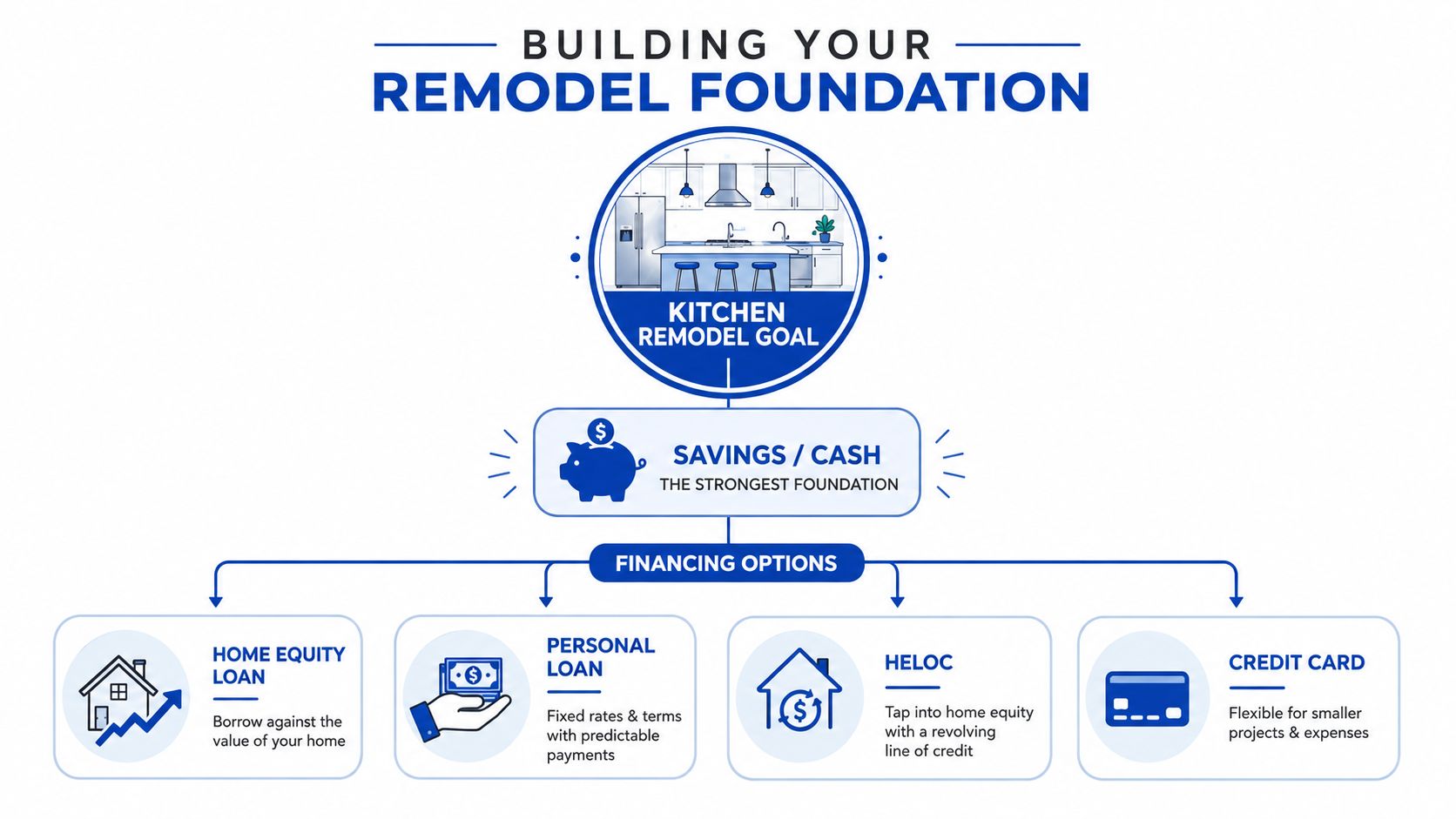
Comparing Kitchen Remodel Financing Options
The cleanest way to compare financing is by how it behaves during the project, not by how friendly the marketing sounds. Some options are fast but expensive. Others are cheaper but slower. The right choice depends on whether the remodel is a small refresh, a larger update, or a full kitchen rebuild.
| Financing Option | Home as Collateral | Payment Structure | Timing to Confirm | Best-Fit Use |
|---|---|---|---|---|
| Personal loan | No | Fixed monthly payments | Verify directly with lender | Mid-sized projects, speed matters, homeowner wants no home collateral |
| HELOC | Yes | Revolving line, usually variable | Verify directly with lender | Projects with staged draws or uncertain timing |
| Home equity loan | Yes | Fixed loan, set repayment schedule | Verify directly with lender | Larger defined projects with a known total cost |
| Cash-out refinancing | Yes | Replaces existing mortgage with new terms | Verify directly with lender | Homeowners already considering a mortgage reset |
| Credit card | No | Revolving balance, high carrying cost risk | Verify directly with issuer | Small purchases or short-term bridge amounts |
| Contractor-arranged financing | Depends on program | Program-specific structure | Verify directly with contractor and lender | Homeowners who want one coordinated process |
A fast approval is not the same thing as an affordable approval. Fees can change the true cost. So can repayment timing, insurance requirements, and a term that looks manageable only because it stretches the debt out for years. If the project has scheduled deposits or material orders, the funding method has to match those milestones. Otherwise, the remodel stalls even though the loan is technically in place.
For homeowners working through finish selections, granite installation cost is another good reminder that surface choices affect scope and cash flow. In practice, the best financing option is the one that fits both the construction schedule and the household budget, not the one with the flashiest headline rate.
Estimating Monthly Payments and Total Repayment
A remodel budget can look reasonable on paper and still be too aggressive once payments are added. That's why homeowners should separate the project cost from the financing cost. The loan quote is only part of the picture, because principal, interest, fees, and repayment timing all shape the burden.
Use the project size as a starting point
A modest refresh, a midrange remodel, and a major renovation can all require very different funding plans. A short payment term may keep total borrowing cost lower, but it can raise the monthly obligation enough to strain the household. A longer term may lower the monthly payment, but the total repayment can climb.
That trade-off is where many homeowners get trapped. They focus on the monthly number and forget to ask what the full repayment looks like. They also forget that borrowing capacity is not the same as construction budget. If the lender approves more than the contractor estimate, that extra room can disappear quickly once change orders show up.
Here's a simple worksheet method to use with every quote:
- Approved amount: record the exact limit or loan amount.
- Rate type: fixed or variable.
- Estimated term: note how long repayment lasts.
- Fees: ask for every lender or program fee in writing.
- Monthly payment: write down the expected payment, not just the advertised one.
Then compare the quotes side by side, not one at a time. The offer with the lowest payment is not automatically the best if it charges more in fees or stretches repayment too long. The offer with the fastest funding is not automatically the safest if it leaves no cushion for overruns.
If the project budget only works when every estimate is perfect, the budget is too tight.
That's especially important for homeowners who are selecting finishes as the project moves along. Tile, fixtures, and cabinetry choices can shift the total quickly, so the financing decision has to leave enough room for those realities. The right number is the one that still works after the contractor has priced the actual work.
Qualifying for Kitchen Remodel Financing
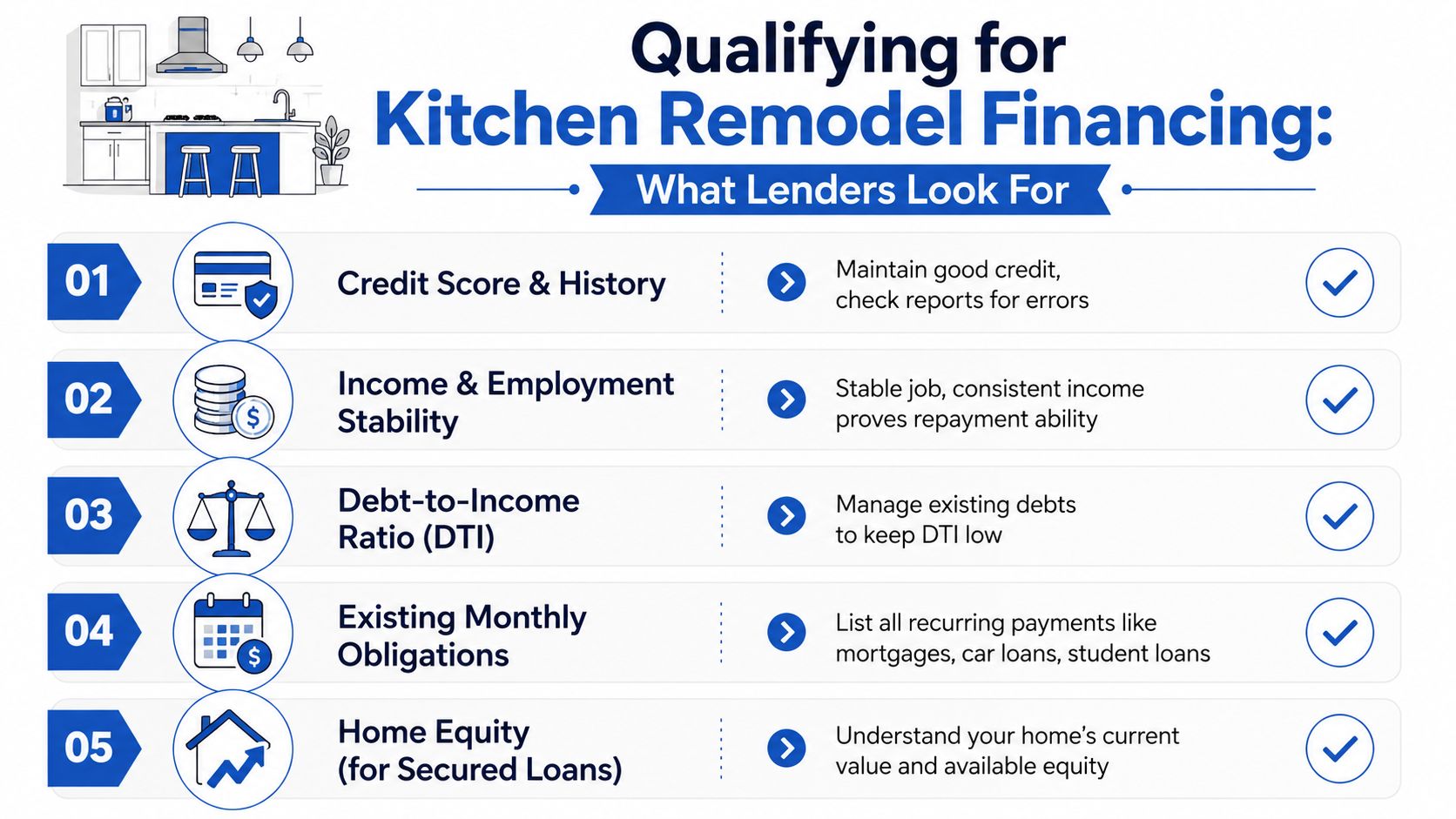
Lenders usually look at the same core information, but they weigh it differently. Credit history, income, existing obligations, property value, and home equity all matter, especially when the loan is secured by the house. What homeowners can control is preparation, and that part pays off before a single application is submitted.
Get the paperwork ready before you apply
Start with the contractor estimate. If the numbers are vague, incomplete, or missing phases of work, the financing request will be harder to structure. Then gather the basics lenders usually want, such as income records, employment details, monthly debt obligations, and property information if the loan is tied to equity.
You should also ask for the lender's document list in writing before submitting anything. Different products can require different forms, and homeowners shouldn't guess. Too many applications without a clear plan can create confusion and waste time.
Check readiness against the project schedule
The question is not just whether you can qualify. It's whether the lender can deliver the funds on the remodel timeline. A kitchen job often depends on deposits, material orders, and staged payments, so approval has to match that sequence.
Use this quick filter:
- Can the approved amount cover the contractor estimate and a realistic buffer?
- Does the payment still feel manageable after your other obligations are counted?
- Will the lender fund in time for the first major project milestone?
- Does the loan leave room for approved change orders without forcing a second scramble?
If the answer to any of those is no, the financing is not ready yet. That doesn't mean the remodel is impossible. It means the paperwork or scope needs another pass before you lock yourself into a fragile plan.
Choosing Contractor Financing or Homeowner Loans
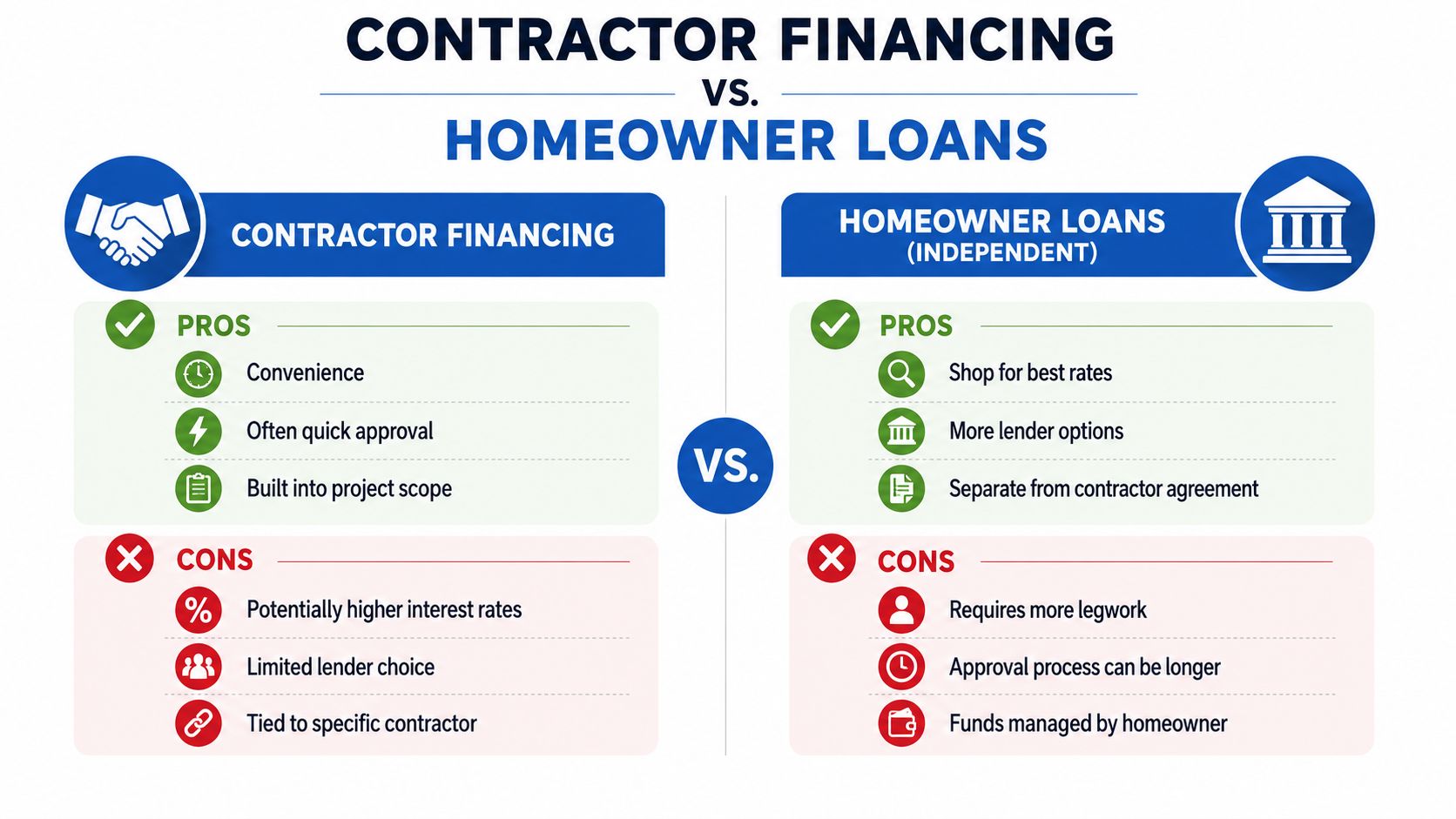
Contractor financing can simplify coordination because one team is helping line up the project and the funding. That convenience is real, but homeowners still need to inspect the loan terms with the same care they'd use for any other obligation. The monthly payment alone tells you almost nothing about the actual cost.
Ask who controls the money and the terms
With contractor-arranged financing, review the rate type, repayment term, fees, and cancellation terms separately from the construction contract. Also confirm who pays any program fee and whether the financing changes any of your rights if workmanship or completion becomes an issue. A clean financing offer should not pressure you to give up normal protections.
Independent homeowner loans, by contrast, give you more control over timing and disbursement. That can work well if you're comfortable managing deposits, product orders, installation dates, and the final payment yourself. It's more work, but it also keeps the borrowing decision separate from the construction agreement.
Match the path to the project style
Contractor financing may feel easier for homeowners who want one point of contact and less coordination. Independent borrowing may fit better for people who want to shop the financing first and then bring the contractor into a finalized plan. Neither path is automatically better.
A simple due-diligence sequence helps keep the decision clean:
- Get the full contractor proposal first.
- Review the financing disclosures on their own.
- Compare total repayment, not just monthly payment.
- Confirm the fee responsibility before signing.
- Make sure the loan doesn't weaken your protections.
That sequence keeps the financing tied to the work, not the sales pitch. If the contractor's financing is convenient but expensive, you'll see it. If a homeowner loan is cheaper but harder to coordinate, that becomes clear too. The right answer is the one that fits your schedule, your tolerance for admin, and your need for control.
Finding Massachusetts Financing and Contractor Support
Massachusetts homeowners should treat financing research and contractor selection as parallel workstreams. Don't wait for one to finish before starting the other. Local lenders, housing agencies, and municipal programs can all have different eligibility rules and application steps, so you need to verify what applies to your city, property, and income profile.
Build the local action list
Start by confirming which lenders serve your area. Ask directly whether they work in Wayland, Newton, Needham, Wellesley, Weston, and surrounding communities. Then compare their requirements against your contractor estimate, not against a generic home-improvement number.
Search with location-specific terms and verify everything through official Massachusetts or municipal sources before you act. That's the safest way to avoid relying on outdated program descriptions or assumptions that don't fit your property.
For planning around flooring and finish work, flooring installation cost per square foot is another useful budget checkpoint before you commit to materials or timing.
Keep the project ready before funds move
A lender wants clarity. So does a contractor. Have these ready:
- A defined scope of work
- Written estimates
- Property details
- Income documents
- A payment schedule
That preparation helps both sides move faster and reduces the odds of a funding gap once the kitchen is underway. It also makes it easier to compare local options without guessing which program is workable.
If you're also planning tile, backsplash, flooring, or post-construction cleanup, Sunny Day Pro Services is a practical Massachusetts resource to line up after the budget is set. Their work can help finish the room cleanly once financing and scope are settled, which is exactly how a kitchen project should be handled.
Kitchen Remodel Financing Questions Homeowners Ask
Can financing be arranged before demolition starts? Yes, and it should be. Confirm that the money will be available before the first major deposit or order, and ask the lender how funds are released relative to the contractor schedule.
What if the final cost is higher than the approved amount? Don't assume the gap will solve itself. Ask the contractor about change-order procedures, then ask the lender whether the borrowing limit can be adjusted before work continues.
Does it make sense to put a small deposit on a credit card? Sometimes, but only for a limited portion of the job and only if you've confirmed the repayment terms with the card issuer. It can be useful for a small bridge payment, but it's a poor plan for carrying a large balance over time.
What records should you keep after closing? Save the loan documents, payment receipts, change orders, contractor invoices, and any insurance-related paperwork tied to the project. If the financing and construction terms ever need to be reviewed, those records will save you time and stress.
Request a Sunny Day Pro Services quote when your scope and funding plan are set, especially if your kitchen needs tile installation, a new backsplash, flooring, or post-construction cleanup. A clean finish matters just as much as a smart budget, and the best time to schedule it is before the project starts moving.
Sunny Day Pro Services helps Massachusetts homeowners turn a funded kitchen plan into a finished space with professional tile installation, custom backsplashes, flooring, and post-construction cleanup. If you're ready to align your remodel scope with a practical budget, visit Sunny Day Pro Services to request a quote and move your kitchen project forward with less stress.

