
Move in Cleaning Service Cost: What You'll Actually Pay
Learn what a move in cleaning service cost looks like in 2026, from national averages to Massachusetts pricing, key cost factors, smart ways

Most U.S. move-in cleaning jobs run $200–$500 nationally, and Massachusetts homeowners typically pay toward the upper end because regional labor and operating costs are higher. The right quote depends less on the label “move-in clean” than on the home's size, condition, and the exact work included.
You might be standing in an empty house the night before the movers arrive, looking at dusty floors, sticky cabinets, and an oven you'd rather not inspect. A written, itemized estimate helps you decide what needs attention before the boxes take over, and prevents an advertised base price from hiding the work that matters.
Table of Contents
What a Move In Cleaning Service Cost Covers
Before movers bring in boxes, an empty home gives you a clear view of what needs cleaning: dust in drawers, residue on shelves, and dirt along baseboards. A move-in clean is a detailed reset, and the scope matters more than the label. For a standard empty-home scope, the national planning range is $200–$500. Interior appliances and windows are often quoted separately, so ask about them before comparing estimates. The move-in cleaning checklist can help you decide which tasks to request.
A routine visit covers accessible, frequently used surfaces. An empty home gives cleaners access to cabinet interiors, corners, and floor edges that furniture usually blocks. That access makes the job more detailed, not faster.
What a standard checklist should address
Ask the provider to confirm each task in writing:
- Kitchen surfaces: Counters, sink, and cabinet fronts. Confirm whether inside cabinets and drawers are included.
- Bathrooms: Toilets, sinks, tubs, and showers, including soap residue and grime.
- Floors and baseboards: Vacuuming or mopping, plus visible dust along edges and trim.
- Appliance interiors: Ask whether oven and refrigerator cleaning are included or priced separately.
- Windows and fixtures: Confirm whether interior glass, vents, and ceiling fixtures are covered.
“Deep” doesn't tell you what the crew will clean. One company may include appliance interiors; another may charge extra. Request a room-by-room scope, especially if the home has construction dust, heavy residue, or cabinets that need interior cleaning.
Practical rule: Compare written task lists and estimated labor, not just starting prices.
Use the checklist to flag priorities before you request estimates, then have each provider price the same scope. That makes differences in coverage easier to spot.
National Averages and Why Massachusetts Runs Higher
National averages are a starting point, not a local promise. Care.com's 2025 cost analysis reports an average posted move-out cleaning rate of $23.21 per hour. Listed city rates range from $19.64 in San Antonio to $28.57 in Seattle, a spread of about 45% that shows how strongly local labor markets can affect a quote (Care.com's cost analysis).
Other listed city rates make the point even clearer: $28.29 in San Francisco, $23.91 in Brooklyn, $23.48 in Chicago, and $21.80 in Atlanta. A Massachusetts estimate shouldn't be built by taking the national hourly figure and applying it to every home. Local wages, insurance, travel, scheduling, and business overhead all matter, and a detailed empty-home clean calls for more work than a recurring tidy.
What that means around Greater Boston
Homeowners in Wayland, Newton, Needham, Wellesley, Weston, and nearby communities should expect a quote to reflect local operating costs. The same square footage can take different amounts of labor depending on bathrooms, appliance interiors, floor condition, and whether the home has renovation dust or heavy soil.
That's why I'd treat a national midpoint as a rough orientation, not a budget ceiling. Ask providers to state the scope, the pricing method, and what changes the price if they find a condition that wasn't visible during the estimate.
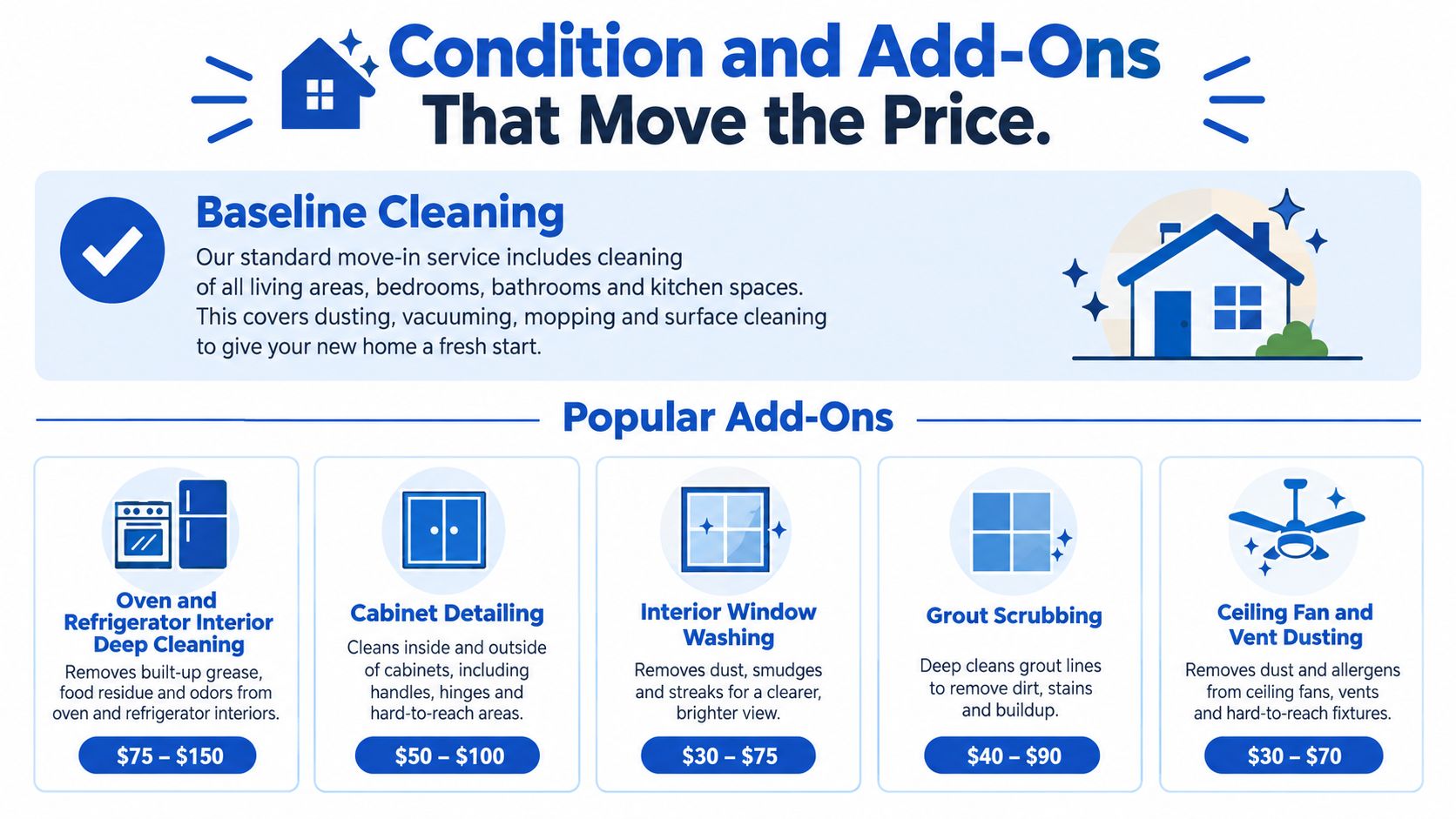
The infographic below highlights common cleaning tasks and optional additions that can affect what a home needs before move-in.
How Home Size Drives the Final Quote
A larger home usually needs more cleaning time, but square footage doesn't tell the whole story. A compact place with multiple bathrooms or substantial grime may take longer than a larger home in good condition. HomeAdvisor's published move-out cleaning ranges provide a useful comparison by property size, though they're benchmarks rather than guaranteed Massachusetts quotes (HomeAdvisor's property-size estimates).
| Property Size | Typical Cost Range |
|---|---|
| Studio | $90–$130 |
| One-bedroom apartment | $100–$190 |
| Two-bedroom apartment | $140–$210 |
| Three-bedroom townhome | $180–$300 |
| 1,000–1,500 sq. ft. home | $120–$260 |
| 1,500–2,000 sq. ft. home | $180–$300 |
| 2,000–2,500 sq. ft. home | $240–$340 |
| 2,500–3,000 sq. ft. home | $300–$380 |
| 3,000–3,500 sq. ft. home | $360–$420 |
Read the estimate, not just the square footage
The listed upper-end benchmark rises from $260 for a 1,000–1,500-square-foot home to $420 for a 3,000–3,500-square-foot home. The increase reflects more surface area and labor, but the range also leaves room for differences in layout, condition, and requested tasks. A quote based only on floor area may miss a bathroom-heavy layout or an unusually dirty kitchen.
Ask how a provider calculates its price. A square-foot estimate, a flat rate, and an hourly quote don't measure the same thing. If the price is hourly, clarify whether it means time on site or total crew-hours. If the quote is flat, ask what work is included and what conditions could trigger a change.
The most useful estimate identifies the home's size, room count, appliance interiors, floor types, visible soil, and add-ons. If two bids cover different tasks, they aren't comparable, even if one looks much cheaper.
Condition and Add Ons That Move the Price
A clean, empty home and a recently renovated home can have the same square footage but need very different work. The cost driver is the scope: what's stuck to the surfaces, what needs detailed cleaning, and whether the job calls for specialized equipment or products.
Start by sorting requested work into the base clean and specific add-ons. That gives you control over priorities instead of paying for a vague “deep clean” package that may not include the areas you care about.
Decide what the home actually needs
- Appliance interiors: Ovens and refrigerators often need degreasing or residue removal. Confirm whether each is included.
- Cabinets and drawers: Empty interiors can collect crumbs, dust, or adhesive residue. Specify whether the crew should clean inside.
- Interior windows: Ask which windows and glass doors are included, and whether tracks or frames are part of the task.
- Grout and tile: Grout detailing can take additional time, especially after installation or when buildup is embedded.
- Carpet and pet hair: Vacuuming isn't the same as extraction or odor treatment. Name the problem and request a clear scope.
- Construction dust and debris: Renovation can leave fine dust, adhesive, or grout residue. Tell the estimator what work was completed and what remains.
- Junk hauling: Removing unwanted items is a separate task from cleaning. Don't assume a cleaning crew will carry away debris.
You can reduce unnecessary work by telling the estimator which surfaces are already clean and which need attention. But don't leave out renovation dust or heavy soil to get a lower initial number. The surprise usually arrives when the crew sees the home.
Household cleaning-product prices were reported 1.75% higher in 2026 than in 2025 in the price index for household cleaning products. That's one input among many; your estimate still needs to be based on the actual labor and supplies required for your property.
Use this checklist to identify the condition and add-on questions worth settling before you book.

The Massachusetts Security Deposit Question Renters Actually Ask
Paying for a professional clean does not guarantee that a landlord will return a security deposit. Cleaning the home and deciding whether a deposit deduction is lawful are separate questions. Massachusetts renters and property owners should keep them separate when discussing move-out costs.
In its Peebles ruling, the Massachusetts Supreme Judicial Court held that lease clauses requiring tenants to pay for professional cleaning are generally unenforceable. Landlords may retain funds for unpaid rent, certain tax obligations, or repair of tenant-caused damage beyond ordinary wear and tear, as explained in the Massachusetts security-deposit ruling summary.
Keep a record of the property's condition
A cleaner's invoice documents work performed. It doesn't automatically establish that a tenant owes for ordinary cleaning, or that a landlord can charge that cost against a deposit. The Massachusetts Attorney General's guidance also says a landlord may retain money for unpaid rent or qualifying tenant-caused damage, and that the deposit generally must be returned with interest within 30 days after the tenancy ends (Attorney General's landlord and tenant rights guide).
For renters, practical records can help show the home's condition:
- Take dated photos: Photograph rooms and visible problem areas before handing over the keys.
- Save itemized paperwork: Keep the invoice and any written description of the cleaning performed.
- Compare condition reports: Refer to the move-in record when discussing existing damage or ordinary wear.
Landlords should document actual damage rather than treating routine end-of-tenancy cleaning as an automatic deduction. Renters deciding whether to hire a cleaner should base that decision on the home's condition and their own move-out needs, not on a promise that a cleaning bill will protect the deposit.
For a room-by-room handoff list, use this move-out cleaning checklist. It can help you record what was cleaned without confusing that record with a legal guarantee.
Smart Ways to Save Without Cutting Quality
Cutting the checklist to chase the lowest bid can leave you with a home that still needs work before you unpack. A better approach is to reduce wasted labor and compare quotes that cover the same tasks.
Make the estimate easier to price accurately
- Declutter first. Clear loose items from counters and floors so the crew can clean surfaces rather than sort belongings.
- Share the details upfront. Provide square footage, bathroom count, floor types, appliance needs, and any known renovation dust or heavy soil.
- Ask for the scope in writing. Compare base tasks and add-ons line by line, including supplies, equipment, and any conditions that could change the estimate.
- Check scheduling options. If your move date has flexibility, ask whether the provider has a less-busy appointment slot that fits your schedule.
- Coordinate related work. If flooring or tile work is planned, ask whether cleaning can be scheduled around the installation so the home is cleaned at the useful stage.
- Ask about available options. If you prefer particular products, ask about eco-friendly choices. If you've used the company before, ask whether any returning-customer pricing applies.
The lowest headline number isn't automatically the best value. A bid that excludes the oven, inside cabinets, or construction dust may leave you paying for separate work later. Ask each provider to list what's included, what costs extra, how the price is calculated, and what happens if the crew finds conditions that differ from the estimate.
This savings guide offers a reminder to check the scope before focusing on the total.

What to Expect on Cleaning Day and How to Book
A good appointment starts with a clear agreement, not a crew guessing which rooms or appliances you meant. Before service, confirm the scope, access arrangements, and what the team needs from you. For a move-in clean, the home is easiest to assess and clean when it's empty and the requested work is settled in advance.
Confirm the details before the crew arrives
Ask the provider to confirm:
- The checklist: Which rooms, surfaces, and appliance interiors are included?
- The estimate basis: Is the price flat-rate, square-foot based, or hourly, and how are changes handled?
- The crew and supplies: Who is arriving, and are cleaning products and equipment provided?
- The finish standard: Is there a satisfaction or re-clean policy, and how do you request a correction?
- The final review: Who will walk through the home with you or review any concerns after service?
A walkthrough gives you a chance to point out fragile finishes, problem areas, or tasks that matter most before work begins. After the clean, check the agreed scope rather than judging the service against tasks nobody discussed.
If you're comparing bids, Sunny Day Pro Services' guide to requesting a cleaning service quote can help you prepare the details providers need. The company offers move-in and move-out cleaning, deep cleaning, recurring maintenance, and post-construction cleanup in Wayland, Newton, Needham, Wellesley, Weston, and surrounding Massachusetts communities. Its trained, background-checked team offers flexible scheduling, eco-friendly options, and a satisfaction guarantee.

For a useful budget, focus on four things: home size, condition, cleaning scope, and location. Give the estimator accurate details, compare written checklists, and choose the quote covering the work needed before you move in.
If you're moving into a home in Wayland, Newton, Needham, Wellesley, Weston, or a nearby Massachusetts community, request a scope-based move-in cleaning estimate from Sunny Day Pro Services. Share the home's size, condition, and the tasks you want included so the team can help you plan a clean, ready-to-unpack space.

