
Pet Safe Cleaning Products That Actually Protect Your Pets
Find pet safe cleaning products that work. Learn which ingredients matter, which certifications to trust, and how to clean without putting pets at risk.
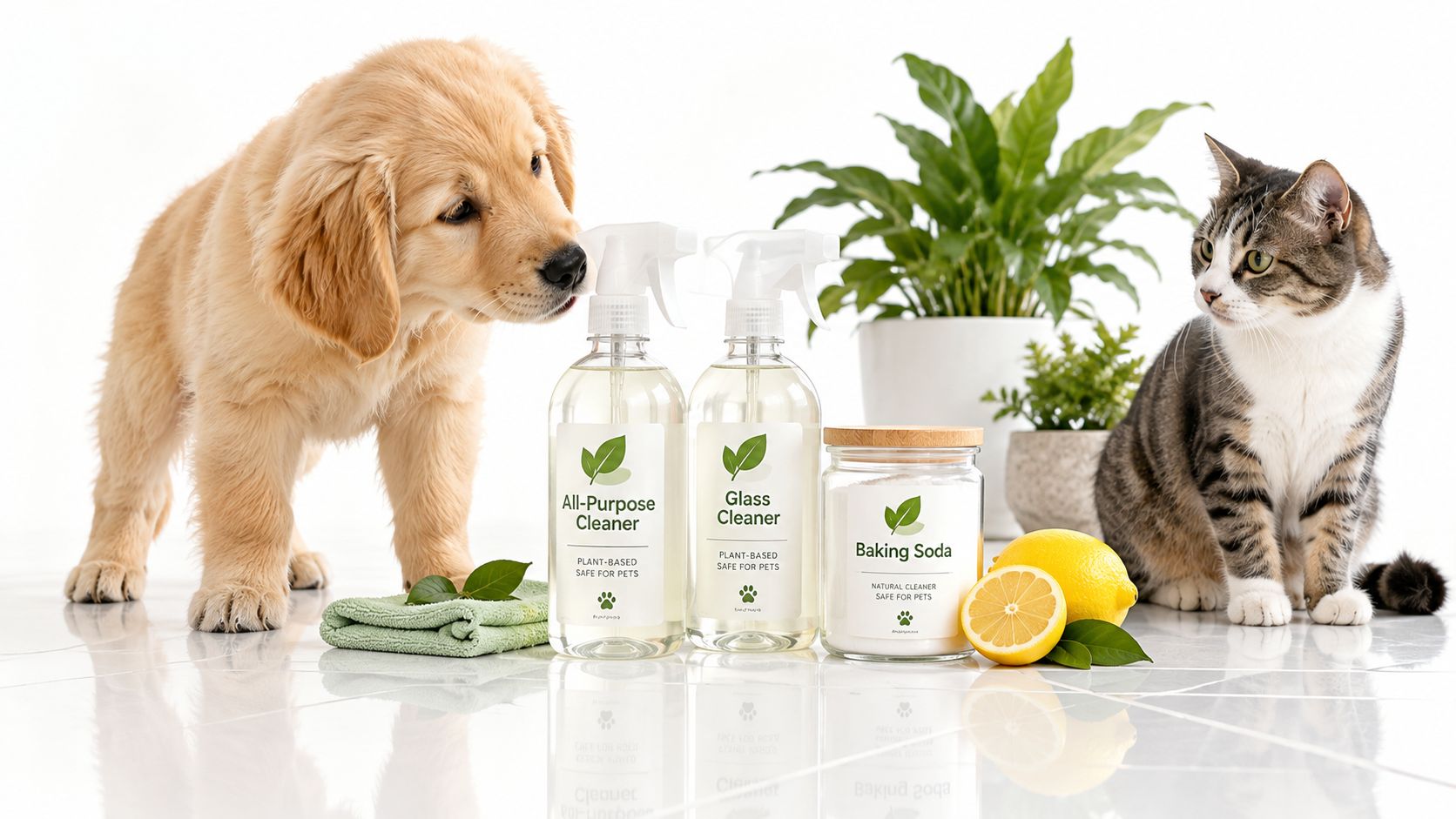
“Natural” doesn't automatically mean safe for pets. I've seen homeowners use a homemade vinegar spray with a strong smell, leave a floor wet, and assume the label makes the room harmless while a dog licks the residue from its paws. Pet safety depends on dose and exposure route, including concentration, wet contact, drying time, ventilation, rinsing, and storage.
A better standard for pet safe cleaning products is simple: choose transparent ingredients, verify meaningful certification, use the correct dilution, and keep animals away until surfaces are dry. Veterinary toxicology supports that approach. A study of 241,253 household-substance exposure consultations recorded by the ASPCA Animal Poison Control Center found that cleaning and maintenance products were part of a substantial share of classified dog and cat exposures, with serious outcomes documented among cases with known final outcomes (Journal of the American Veterinary Medical Association).
This guide cuts through product marketing and focuses on what works in real homes, from harmful ingredients and label literacy to room-by-room routines, DIY recipes, exposure response, and professional cleaning. If you're in Massachusetts, the same rules apply whether you're cleaning a small apartment in Newton or a larger home in Weston. The safest cleaner is the one you can identify, dilute, apply, ventilate, rinse when required, and store correctly. For broader principles around lower-impact cleaning, see this guide to eco-friendly house cleaning.
Table of Contents
Why Pet Safe Cleaning Is About How You Clean, Not Just What You Buy
A “green” bottle can still create a problem if you spray too much, leave a residue, or let a cat walk across a wet floor and groom its paws. A conventional cleaner used exactly as labeled may create less exposure than a homemade mixture with an unknown concentration. The product matters, but the method often decides the actual risk.
Veterinary toxicology sources describe many common anionic and nonionic surfactants, found in dish soaps, laundry detergents, and all-purpose cleaners, as generally mild irritants. That doesn't make wet residue harmless. Licking can lead to drooling, vomiting, diarrhea, or irritation of the eyes and mucous membranes, while concentrated formulas and prolonged wet contact increase concern (Merck Veterinary Manual).
Practical rule: If your pet can lick it, walk through it, breathe it, or rub against it before it dries, treat the cleaning step as an exposure event.
The exposure controls that matter most
Use this sequence every time you clean:
- Remove pets first. Close the door or place animals in a separate, ventilated room.
- Clear contact items. Move food bowls, toys, bedding, and chew objects away from the work area.
- Follow the label. Use the stated dilution and contact time, not an extra splash for “more cleaning power.”
- Ventilate the space. Open windows when practical, use exhaust fans, and avoid spraying into the air.
- Wait for complete drying. Re-entry happens after the floor, fabric, or surface is fully dry, not merely after wiping.
- Store concentrates securely. Keep original labels intact and use a closed cabinet pets can't access.
This approach also explains why “pet-friendly” is too vague to guide a purchase. A marketing phrase doesn't tell you whether the formula contains a problematic active ingredient, whether it needs rinsing, or how long a surface remains unsafe while wet.
What this guide changes about shopping
Don't chase a miracle product. Build a repeatable routine around transparent ingredients, independent screening, correct dilution, dry time, and sensible storage. The next step is learning which chemical families deserve the closest attention and which alternatives handle everyday dirt without leaving unnecessary exposure behind.
Ingredients That Harm Pets and Safer Swaps That Actually Work
The most useful ingredient check starts with function, not scent. Ask whether the product is a mild cleaner, a disinfectant, a descaler, a degreaser, or a concentrated specialty formula. Stronger chemistry isn't automatically wrong, but it demands tighter controls and a more specific reason for use.
Common surfactants in dish soaps and general cleaners are usually irritants rather than corrosives, yet a pet can still react after licking wet residue. Strong acids and alkaline products require more caution. ASPCA guidance identifies very low-pH acids and bases above approximately pH 10 as capable of corrosive gastrointestinal injury, including burns after ingestion (ASPCA Animal Poison Control).
Quaternary ammonium compounds, often called quats, deserve a separate warning. They appear in some disinfecting wipes and sprays, and Pet Poison Helpline reports that they can cause corrosive injury to tissue on contact. Cats are especially sensitive, even at low concentrations (Pet Poison Helpline).
| Ingredient or Class | Common Products | Risk to Pets | Safer Swap |
|---|---|---|---|
| Strong acids | Toilet bowl cleaners, descalers | Can burn the mouth, esophagus, skin, and eyes if concentrated or misused | Use a mild, labeled citric-acid product only where appropriate, with ventilation and full drying |
| Strong alkalis above approximately pH 10 | Heavy-duty degreasers, some oven and drain products | Can cause corrosive gastrointestinal injury after ingestion | Use a mild plant-based surfactant cleaner for ordinary soil, reserving stronger products for controlled tasks |
| Anionic and nonionic surfactants | Dish soaps, laundry detergents, all-purpose cleaners | Usually irritants, but wet residue may cause drooling, vomiting, diarrhea, or paw and eye irritation | Choose a fragrance-free, clearly labeled formula and rinse food-contact surfaces |
| Quaternary ammonium compounds | Disinfecting wipes and sprays | Can injure tissue on contact, with particular concern for cats | Use a verified alternative only when disinfection is necessary, and follow the registered contact and rinse directions |
| Bleach, ammonia, and phenol-based products | Disinfectants, glass cleaners, pine-scented cleaners | Can irritate or injure the mouth, skin, eyes, or respiratory tract, especially when concentrated or mixed | Use a purpose-built mild cleaner for routine soil and never mix products |
| Enzyme cleaners | Pet stain and odor removers | May cause mild stomach upset before drying if licked | Apply only to the target area, block access, and let the treated surface dry fully |
The swaps I actually trust
Citric acid and lactic acid can handle mineral deposits and some bathroom soil when the product is designed for that surface. Avoid natural stone unless the manufacturer explicitly approves the formula, because acidic chemistry can etch stone even when it presents limited toxicity risk.
Plant-based surfactants work well for routine dust, food film, and tracked-in dirt. Their advantage isn't a magical “natural” status. It's that a properly formulated, diluted cleaner can remove soil without relying on unnecessarily aggressive chemistry.
Enzyme cleaners are useful for organic pet messes, but they still need controlled application. Keep the animal away until the area dries, and don't assume “bio” means safe to lick while wet. For acid-related risks on toilets and other surfaces, understand the limitations explained in this guide to acid toilet bowl cleaner.
How to Read Labels and Trust the Right Certifications
Words such as natural, green, non-toxic, and pet-friendly don't give you a consistent technical standard. A bottle can use those terms while providing little detail about concentration, active ingredients, fragrance compounds, or required rinsing. Treat them as marketing language unless the product also provides verifiable ingredient and use information.
The EPA Safer Choice label is a stronger screening signal. EPA reviews every intentionally added chemical ingredient against human-health and environmental criteria, including carcinogenicity, reproductive and developmental toxicity, aquatic toxicity, and environmental persistence. Certified products also have to meet performance, packaging, ingredient-disclosure, and volatile-organic-compound requirements, and EPA explicitly describes Safer Choice products as safer for people, families, and pets (EPA Safer Choice label).
The standard was strengthened in August 2024, including stricter criteria for pet-care products (EPA Safer Choice FAQs). That matters because certification is not frozen in time. It establishes a review framework that can become more demanding as the program develops.
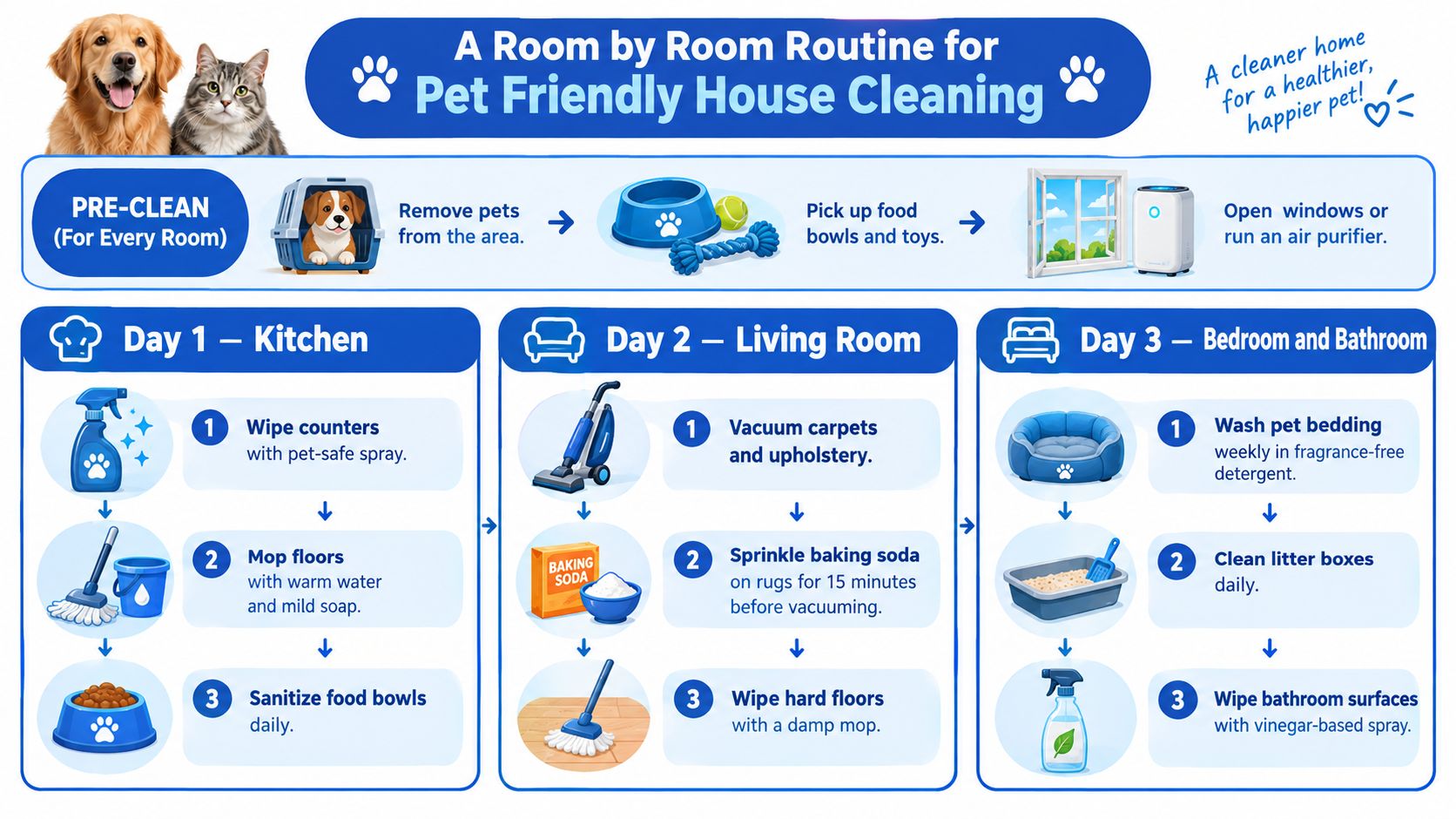
A label-reading routine for shopping
- Find the ingredient information. Look for an ingredient disclosure, active-ingredient panel, or manufacturer page that identifies what the product contains.
- Check the certification itself. Don't rely on a front-label phrase. Confirm that the actual product carries the EPA Safer Choice mark and appears in the program's information.
- Inspect fragrance and VOC language. For cats, birds, respiratory-sensitive animals, and homes with frequent floor licking, fragrance-free or low-VOC options are the sensible starting point.
- Read dilution and contact directions. A disinfectant may need to remain wet for its stated contact time before wiping or rinsing. More product isn't better.
- Confirm the re-entry rule. Keep pets away until treated surfaces are dry and the space is ventilated.
EPA's program evaluates each ingredient, including minor components such as dyes and fragrances, rather than ignoring ingredients because they appear in small amounts (EPA Safer Choice standard document). Before buying, use this compact test: ingredients checked, certification verified, dilution followed, surface rinsed when required, and treated area dried before re-entry. For a broader purchasing framework, compare that process with these eco-friendly cleaning products.
A Room by Room Routine for Pet Friendly House Cleaning
Start every job the same way. Remove pets, pick up food bowls and toys, open windows or run an air purifier, and decide where the animals will stay while floors and surfaces dry. This prevents the most common mistake, letting a curious pet return before the cleaner has stopped being a wet exposure.
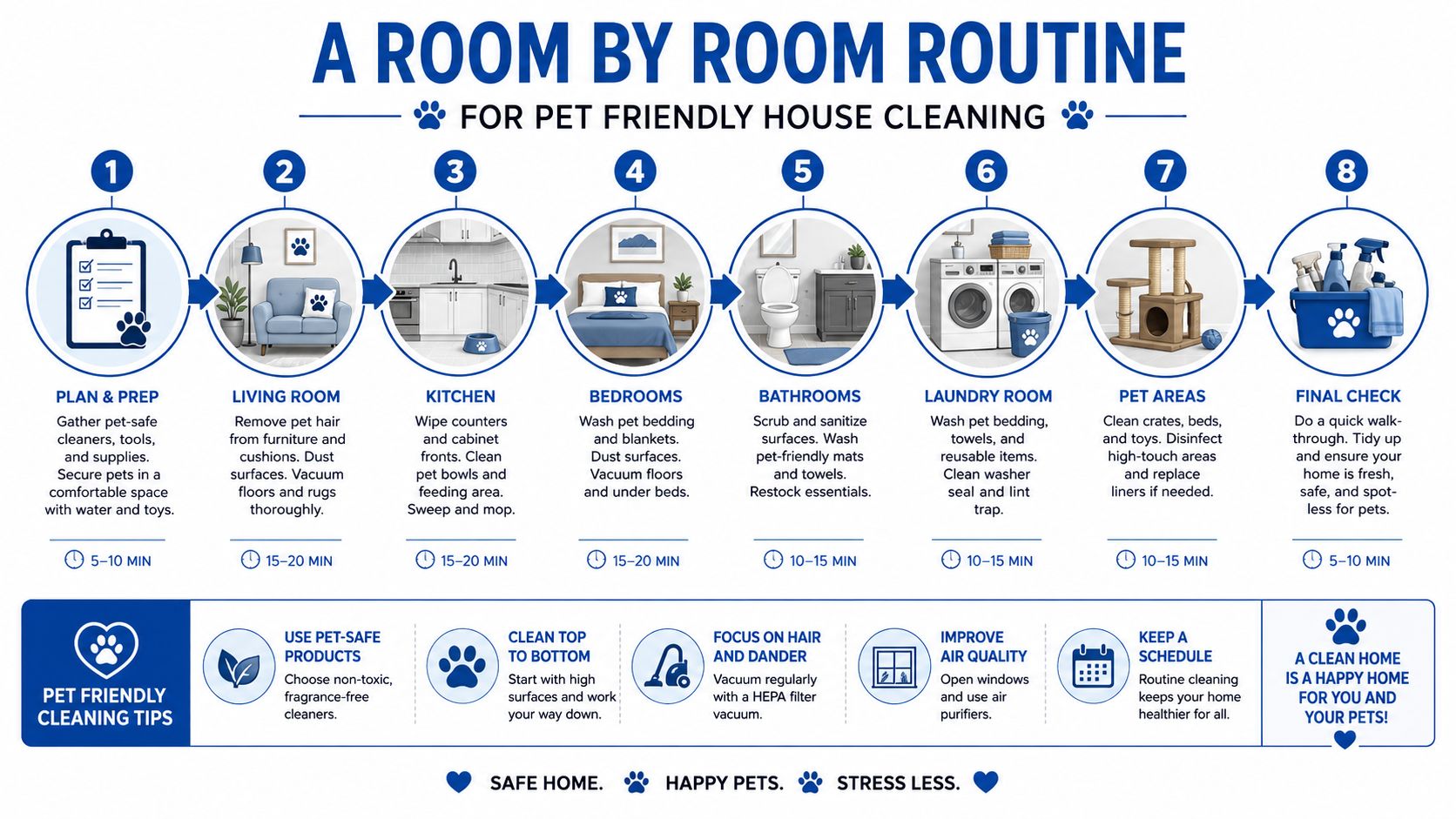
Kitchen
Kitchen surfaces combine paw traffic, food residue, and frequent contact. Use a mild, verified cleaner on counters, then rinse food-preparation surfaces if the label requires it. Mop sealed floors with the correct dilution, keep pets out until dry, and don't leave a bucket where an animal can drink from it.
Food bowls deserve plain-water rinsing after cleaning. If you use a disinfectant, follow its contact time and rinse direction exactly. Never wipe a bowl with a quat-containing product and return it to service while residue remains.
Bathroom
Bathrooms sometimes justify stronger chemistry, especially around mineral buildup or mildew. That doesn't justify using concentrated toilet cleaner as a general floor product. Apply specialty products only to their intended surfaces, close the door, ventilate, and keep animals away until all treated areas are dry.
Avoid acidic products on marble and other acid-sensitive stone. A pH-neutral cleaner is usually the safer choice for tile, grout, and finished surfaces when heavy descaling isn't required.
Living room and bedrooms
Vacuum carpets, rugs, upholstery, and pet hair before applying anything wet. Residue can remain in fabric longer than on a hard floor, so use the smallest effective amount and keep pets away until the material is fully dry.
Wash pet bedding with a fragrance-free detergent, use the label's recommended amount, and dry it completely before returning it. Skip essential-oil diffusers around birds and avoid adding scented oils to cleaning water because the scent seems mild to people.
Feeding and litter areas
Clean feeding stations separately from bathroom tools. For litter boxes, remove waste regularly, ventilate the area, and use a cleaner that doesn't leave a strong residue where cats may walk and groom. Never combine bleach, acids, ammonia-containing products, or disinfectants. Mixing can generate irritating gases or change a product's toxicity and cleaning performance.
Keep a written note of the product, dilution, contact time, ventilation method, and dry-time rule for each recurring cleaning task. That turns guesswork into a household protocol.
Safe DIY Cleaning Recipes and the Ones to Skip
DIY cleaning can work, but only when the recipe has a clear concentration and a limited purpose. Homemade doesn't mean harmless. It means you are responsible for the ratio, container, label, storage, ventilation, and dry time.
Three practical recipes
Glass cleaner for non-stone surfaces: Mix one part white vinegar with three parts water in a labeled spray bottle. Use it on glass and other acid-tolerant, non-stone surfaces. Don't use it on marble, granite, limestone, unsealed wood, waxed floors, electronics, or surfaces where the manufacturer prohibits acidic cleaners. Apply lightly, ventilate, and wipe dry.
Carpet odor treatment: Sprinkle baking soda lightly over a dry rug or carpet, leave it for a short period, then vacuum thoroughly. If the material needs further cleaning, use a clear-water rinse appropriate for the fabric and extract the moisture. Keep pets away while powder is present and while the carpet dries. Avoid saturating carpet or using the method on delicate textiles without testing a hidden area.
Sealed-floor mopping solution: Mix approximately one tablespoon of castile soap per quart of water for general mopping on sealed floors. Use a damp mop rather than flooding the floor, then allow it to dry fully. Avoid unsealed wood, waxed floors, natural stone unless approved, electronics, and any surface whose finish reacts to soap.
These recipes work because dilution limits residue and each ingredient has a narrow job. The vinegar solution cuts light mineral film and fingerprints. Baking soda helps capture odor on dry textile surfaces. Diluted castile soap lifts ordinary soil from sealed flooring.
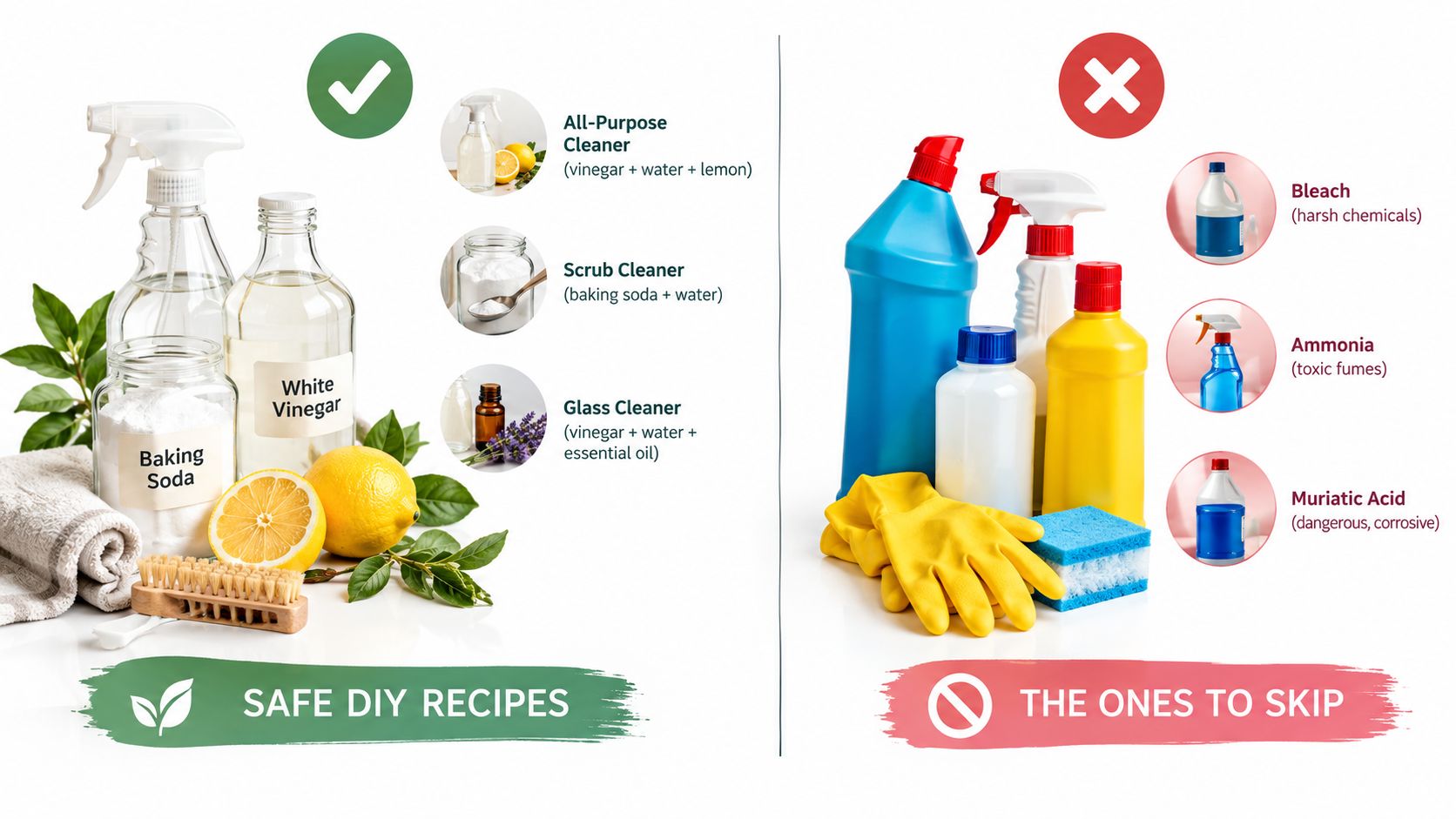
DIY shortcuts I would skip
- Undiluted vinegar: Stronger isn't automatically more effective, and acidic exposure can irritate pets or damage stone and finishes.
- Essential-oil blends: Concentrated oils can harm cats and other animals through ingestion, inhalation, or skin contact. “Natural” is not a safety clearance.
- Wound-strength hydrogen peroxide: A product suitable for a specific first-aid use isn't automatically appropriate for floors, fabrics, or pet-accessible surfaces.
- Acid and base mixtures: Combining ingredients can create heat, splashing, fumes, or a useless solution. Never mix cleaners to make a stronger formula.
- Unlabeled spray bottles: A mystery bottle is a storage and emergency-response problem. Label every mixture with its contents and date.
When a recipe has no reliable dilution, surface limit, or dry-time plan, choose a properly labeled and independently screened cleaner instead.
What to Do If Your Pet Is Exposed to a Cleaner
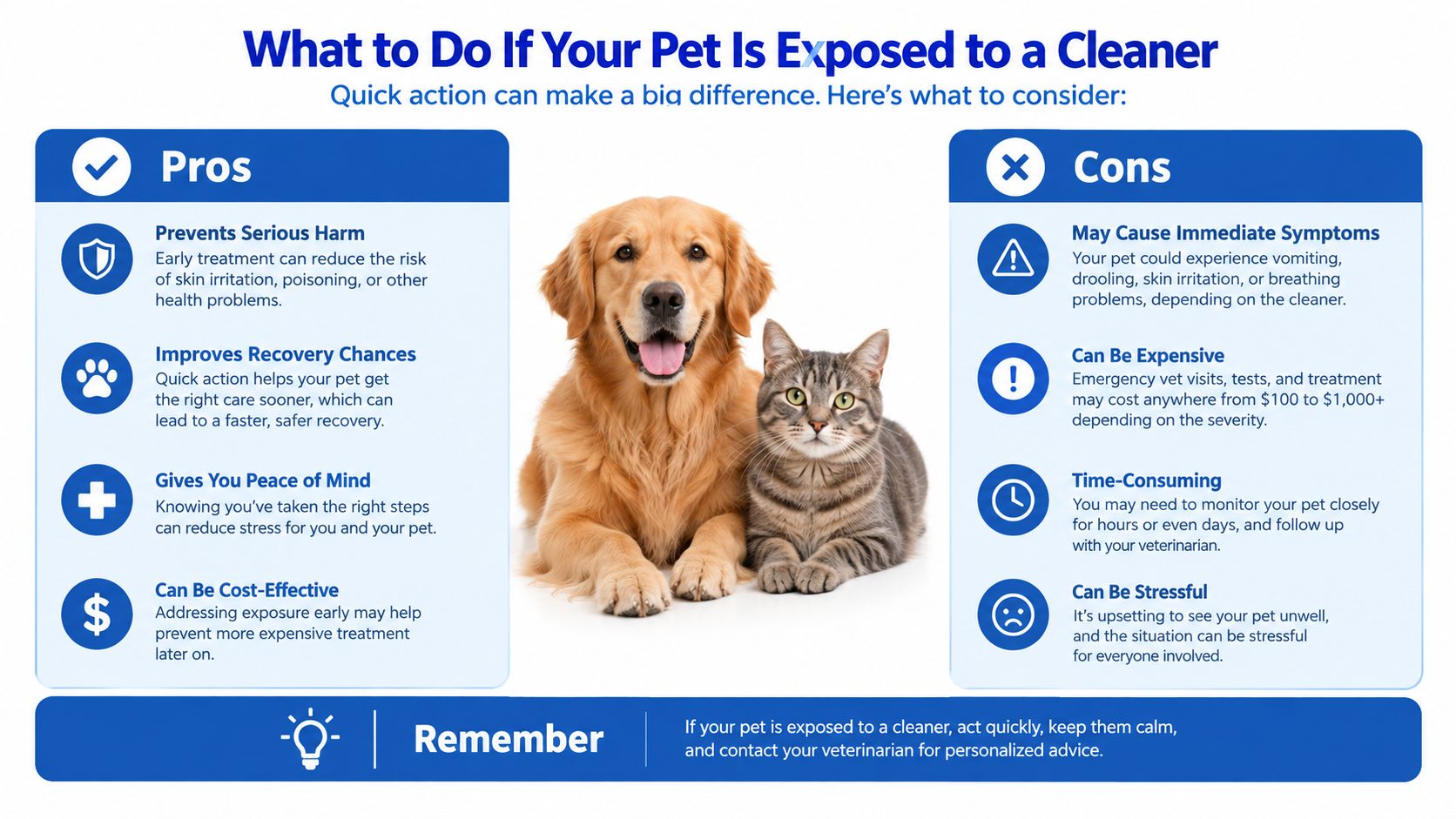
Don't wait for symptoms to become dramatic. A pet may encounter cleaner by drinking from a bucket, licking a paw, walking across a wet floor, rubbing an eye, or inhaling fumes. Dogs and cats may drool, vomit, develop diarrhea, paw at the mouth, or show eye and skin irritation. Birds and rabbits can be particularly vulnerable to airborne irritants because of their sensitive respiratory systems.
The first minutes matter
- Remove the pet from the area. Move the animal to fresh air if fumes are involved, without exposing yourself to the same hazard.
- Check the route. Identify whether the exposure involved ingestion, skin or paw contact, eyes, or inhalation.
- Rinse carefully. Flush skin, paws, or eyes with lukewarm water for 10 to 15 minutes. Prevent the pet from grooming during the rinse.
- Don't induce vomiting. Only do so if a veterinary professional specifically directs you.
- Photograph the label. Capture the product name, ingredients, active ingredient, dilution, and directions.
- Call for guidance. Contact the ASPCA Animal Poison Control Center at 888-426-4435 or Pet Poison Helpline at 855-764-7661.
ASPCA guidance notes that many household cleaners are generally safe for dogs and cats when used according to label directions (ASPCA poisonous household products). That should prevent panic, not delay a call when the product is concentrated, the pet ingested it, or symptoms appear. Undiluted bleach, concentrated acids, and quats deserve urgent professional advice.
| Do | Don't |
|---|---|
| Move the pet away and bring the label or a clear photograph | Don't wait for severe symptoms before seeking advice |
| Flush eyes, paws, or skin with lukewarm water | Don't scrub chemical residue deeper into the coat or skin |
| Call a poison-control service or veterinarian | Don't induce vomiting unless specifically directed |
| Describe the product, amount, route, and time of exposure | Don't guess about the ingredient or mix another product to “neutralize” it |
When to Hire a Professional Eco Friendly Cleaner
Professional help makes sense when exposure control is difficult to manage alone. Recurring maintenance helps working households keep floors, bathrooms, and pet areas under control without rushing through dilution or dry time. Post-construction cleanup deserves extra care because dust and chemical residue can coexist. Move-in and move-out cleaning also matters when pets enter an unfamiliar space with unknown residues.
Homes with senior animals, allergy-prone pets, birds, or cats that lick floors benefit from a documented low-VOC workflow. The cleaner should record the product, dilution, dwell time, ventilation, and re-entry dry time instead of merely announcing that the products are “green.”
Sunny Day Pro Services serves Wayland, Newton, Needham, Wellesley, Weston, and nearby Massachusetts communities with recurring, deep, move-in/move-out, and post-construction cleaning, including eco-friendly options. The company also installs porcelain, ceramic, marble, and granite, so tile-safe product selection matters. A pH-neutral, Safer Choice-certified cleaner can help protect grout, stone, and the manufacturer's finish, while the wrong acid or abrasive may damage a surface before the homeowner notices.
A Pet Safe Cleaning Checklist You Can Pin to the Fridge
- Verify certification: Trust documented ingredient review more than “natural,” “green,” or “pet-friendly” wording.
- Follow directions: Match the label's dilution and contact time exactly.
- Control access: Keep pets away until surfaces are fully dry and the room is ventilated.
- Rinse wisely: Rinse bowls, toys, and food-contact surfaces when the label requires it.
- Store securely: Keep concentrates in original containers inside closed cabinets, and dispose of products according to the label.
- Get local help: Homeowners in Wayland, Newton, Needham, Wellesley, and Weston can request a fast quote for eco-friendly recurring cleaning or tile-safe deep work.
Sunny Day Pro Services offers recurring, deep, move-in/move-out, and post-construction cleaning with eco-friendly options for Massachusetts homes where pets need controlled exposure. Visit Sunny Day Pro Services to request a fast quote and discuss a cleaning workflow built around verified products, proper dilution, ventilation, and safe dry time.

